Can Multi-Asset Support Across Multi-Markets Boost Broker Stability?

Most FX brokers ride the same cycle. Volatility spikes and volumes surge until the market quiets and earnings drop with it. When your entire book sits in one asset class, your revenue lives and dies with that market's volatility regime.
Multi-asset support across multi-markets changes that equation. Offering FX, crypto, commodities, indices, and other instruments through a single platform builds structural resilience into the business model. Clients whose investment strategies span multiple financial markets stay engaged regardless of which market is moving.
The diversification benefit is real, but it only materializes when the underlying infrastructure supports it. This guide examines why multi-asset coverage improves broker stability, what the liquidity and technology requirements look like, and how to approach implementation cleanly, without rebuilding the fragmentation problem you set out to solve.
Key Takeaways
- Multi-asset coverage offsets low volatility in one market with active trading volumes in another to stabilize quarterly revenue.
- Bolting new asset classes onto siloed systems creates dangerous risk blind spots instead of actual diversification.
- Real-time cross-asset margining treats net risk holistically to free up trapped collateral and improve capital efficiency.
- Consolidating multiple financial markets into a single client account directly reduces trader churn and lowers acquisition costs.
Why Multi-Asset, Multi-Market Coverage Matters for Broker Stability
When FX spreads compress during low-volatility periods, an FX-only brokerage has nothing else generating flow. Crypto-only platforms depend entirely on sentiment, and a quiet cycle can flatten volumes for a full quarter.
So, different instruments respond to different triggers:
- Commodities activate on supply disruptions and geopolitical tension, which rarely coincide with suppressed FX volatility.
- Crypto volumes spike during equity sell-offs, following a cycle uncorrelated with FX.
- Indices surge around earnings seasons, when corporate reporting drives institutional activity.
When all of these sit on one platform, quiet periods in one segment overlap with active periods in another. The result is a more predictable revenue line from quarter to quarter.
Retention follows the same logic. Traders go where the instruments are, so when a client's interest moves from FX to crypto, and your platform doesn't cover it, they open an account elsewhere. Most never come back. A single account covering multiple markets removes that trigger entirely.
What happens when the infrastructure doesn't match? Running five asset classes on five separate systems produces five independent risk blind spots, five separate liquidity relationships to maintain, and five sets of reporting to reconcile. The stability benefit disappears when operational complexity absorbs the margin gained from diversification.
Stabilize Your Brokerage Revenue With Multi-Asset Liquidity
Access FX, crypto, and commodities through one institutional-grade liquidity connection — competitive spreads, consistent execution, zero fragmentation.
How Unified Liquidity Aggregation Enables Cross-Asset Execution
Adding an asset class to your platform only works if you can back it with real liquidity. An FX brokerage with deep institutional liquidity that adds a thin crypto book and a shallow commodities feed will see wider spreads and worse fills on those instruments. Clients notice the difference, and churn follows.
Deep Aggregated Liquidity Across FX, Crypto, Commodities, and Indices
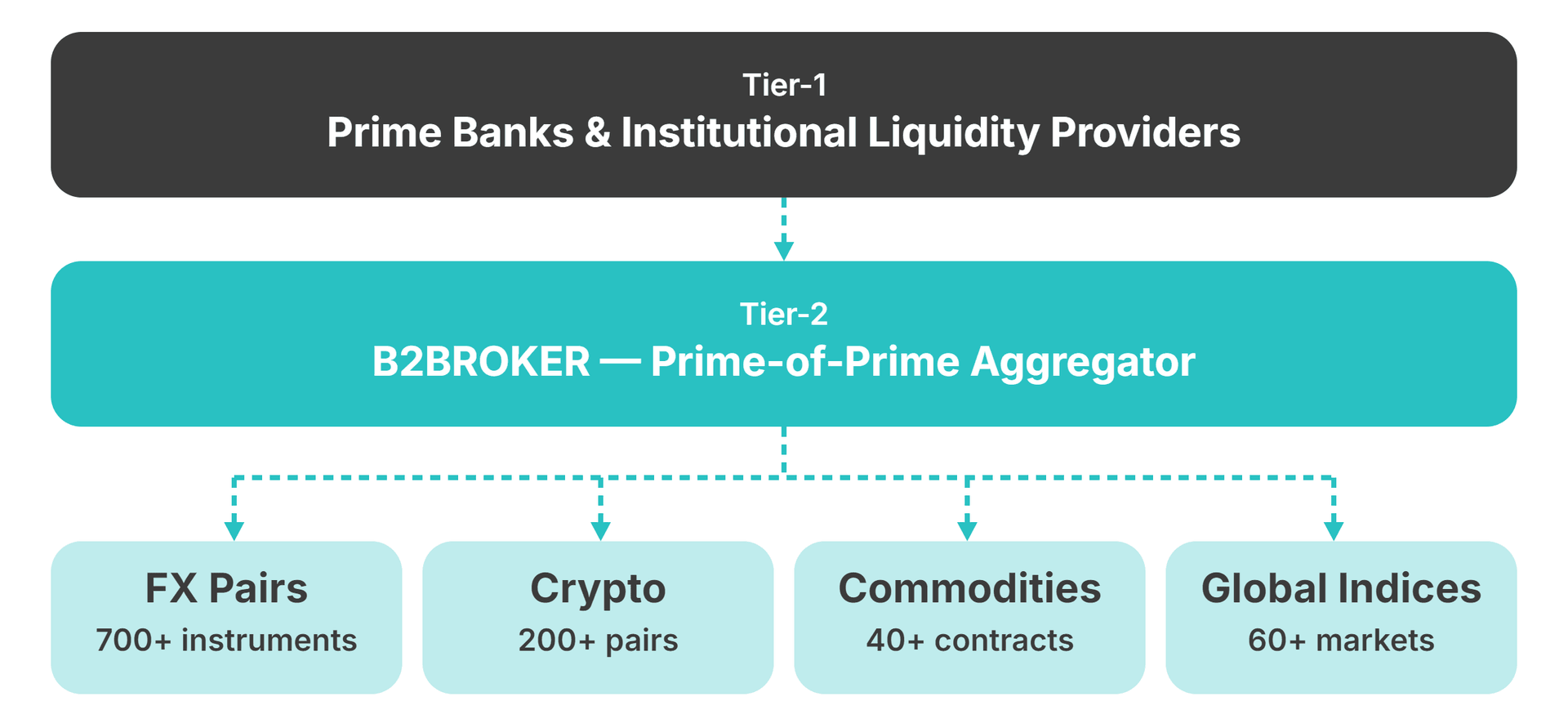
Prime-of-prime liquidity aggregation consolidates streams from multiple Tier 1 providers into a single feed that delivers competitive spreads and reliable fills at depth. For a multi-asset brokerage, this aggregation needs to span every instrument class: FX pairs, spot and derivative crypto, metals, energy, and major indices.
A wide instrument menu with thin order books underneath creates execution inconsistency. The depth per price level is what matters, because that's what determines whether a large order fills cleanly or moves the market.
B2BROKER delivers this through a single liquidity connection covering FX, crypto, indices, commodities, and metals, all aggregated from multiple Tier 1 counterparties. One institutional relationship replaces what would otherwise require separate liquidity arrangements per asset class.
Unified Order Routing and Smart Order Management
Routing logic on a multi-asset book becomes unmanageable when each asset class runs on a separate order management system. Smart order routing within a unified infrastructure evaluates available venues for every instrument, then routes orders to minimize slippage, improve fill rates, and cut market impact.
The operational efficiency case is clear. One system means one set of routing rules, one configuration layer, and one audit trail. Separate systems multiply the maintenance burden and create synchronization risks during high-volume periods when routing accuracy matters most.
For clients who want coordinated exposure in FX and crypto simultaneously, unified routing is the only viable option. Siloed systems cannot coordinate execution between asset classes in real time.
Real-Time Cross-Asset Margin and Funding Engine
Cross-asset margining calculates requirements on the total portfolio rather than on each asset class separately. A client holding offsetting positions in FX and commodities gets margin based on combined exposure, which frees capital that isolated rules would lock up in a single book.
Isolated margin pools create a specific problem: collateral gets trapped in one asset class while the client has unused capacity in another. Cross-asset engines release that trapped capital and reallocate it dynamically as exposure shifts.
Real-time margin monitoring completes the risk management picture. One engine tracks margin events on every open position simultaneously. Over-leverage is caught before it compounds, and risk teams no longer need to reconcile reports from multiple systems. B2TRADER's dynamic leverage and partial liquidation logic handles this cross-asset margin management in practice.
One Platform for Every Market You Offer
B2TRADER manages order routing, cross-asset margin, and dynamic leverage across all instrument classes from a single execution layer.
Core Technology Requirements for a Cross-Asset Solution
The operational upside from multi-asset coverage depends entirely on system integration. Brokers who expand into new asset classes by adding disconnected modules gain instrument breadth but lose visibility, a tradeoff that makes the business harder to manage.
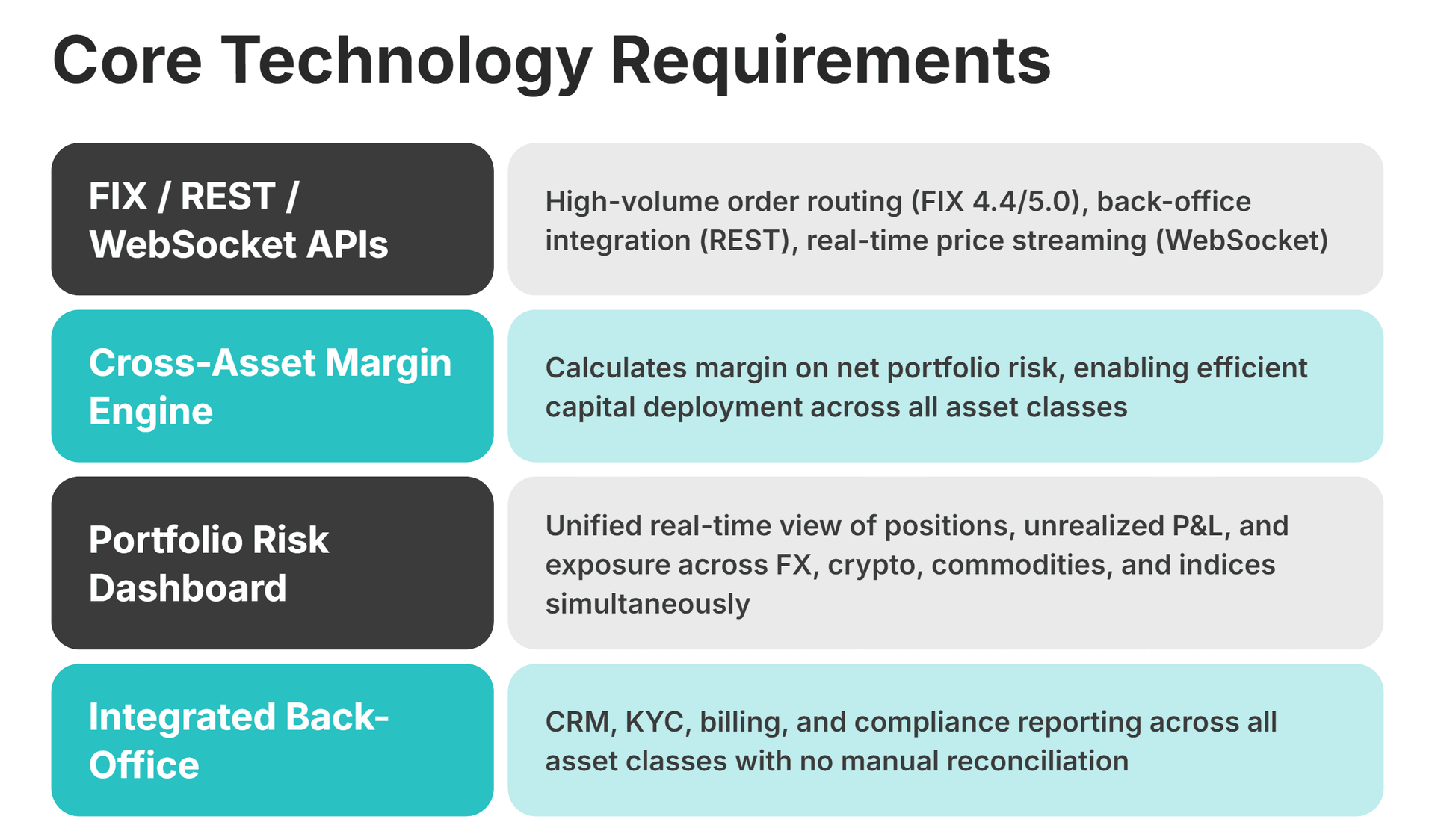
Three infrastructure capabilities determine whether multi-asset operations scale cleanly.
FIX, REST, and WebSocket API Connectivity
Each protocol in a multi-asset stack serves a specific function. FIX protocol (4.4/5.0) handles high-volume order routing and execution reporting with the low-latency consistency that institutional flows require. REST APIs handle back-office integration (account management, position queries, reporting) in a format compatible with most CRM and billing systems. WebSocket streams price feeds, order book updates, and trade confirmations on all instruments simultaneously.
Protocol flexibility reduces integration bottlenecks. Counterparties and internal systems vary in what they support. Infrastructure that handles all three protocols connects to any external system directly, with no custom bridges adding latency or maintenance overhead.
Cross-Asset Portfolio Aggregation Solutions for Risk Teams
Risk teams managing a multi-asset book need a single dashboard that shows positions, unrealized P&L, and instrument-level exposure with no delay. When FX and crypto positions live in separate systems, there is no consolidated view of how those positions correlate. A drawdown in one asset class can amplify losses in another, and the combined exposure may exceed margin thresholds even when each position looked manageable on its own.
A practical example: a correlated sell-off in FX and crypto pushes a client past margin thresholds faster than any single-asset move would. Understanding these correlations is critical because portfolio risk compounds across different asset classes in ways that single-instrument dashboards cannot capture. Cross-asset portfolio aggregation that consolidates all data in one view is the baseline requirement.
Back-Office Integration for Multi-Asset Brokerage Operations
Every new asset class adds back-office work. KYC requirements change because different instruments may carry distinct regulatory treatment. Billing logic needs updating to accommodate new fee structures. Compliance reporting expands to cover additional jurisdictions and instrument types. A back office originally built for FX cannot absorb this volume without significant rework.
B2CORE provides an integrated back-office layer that covers CRM, billing, client onboarding, and reporting in one system. It is purpose-built for multi-asset brokerages that need consistent client management for every instrument they carry.
Operational Upsides: Revenue Diversification and Client Retention
Multi-asset infrastructure delivers two measurable business outcomes: more stable revenue and longer client relationships.
Diversified Revenue Streams From Multi-Asset Trading
Global FX daily turnover reached $9.6 trillion in April 2025, according to the Bank for International Settlements. That volume makes FX the largest financial market in the world, but it doesn't move in isolation from other asset classes.
Crypto volumes spike during equity volatility events and sentiment-driven cycles that have no correlation with FX. Commodities (energy, metals, agriculturals) activate on supply shocks and geopolitical events that run counter to FX trends. Indices surge around central bank decisions, interest rate announcements, and earnings seasons. Even fixed income instruments and derivatives like swaps respond to macroeconomic shifts that leave FX relatively flat.
Because these triggers rarely overlap, a brokerage covering multiple asset classes doesn't need all of them active at once. When one segment is quiet, another is generating the flow that supports the quarter.
The global FX market is projected to grow from $792 billion in 2024 to over $1.1 trillion by 2029, and brokers who already offer a wide range of asset classes are positioned to capture those expanding flows. Multi-asset investing is no longer reserved for institutional investors and fund managers at large investment management firms. Retail brokerages that cover global markets alongside traditional FX are seeing the same diversification benefit.
Brokers limited to one market cycle lose revenue every time the fundamentals shift against their segment. A brokerage that offers ETFs, mutual funds, and direct market access alongside FX and crypto can absorb short-term valuation swings across the stock market without depending on any single instrument for quarterly earnings.
Longer Client Lifecycles Through Single-Account Access
Multi-instrument users trade more frequently and maintain larger account balances than single-instrument traders. When their market interest shifts, they stay on the platform because the new market is already there.
What makes these clients sticky? Consolidated portfolio history, linked accounts, and established funding relationships all create friction. A client who has calibrated an asset allocation strategy to instruments on your platform faces a real cost to replicate that setup elsewhere. Asset managers and institutional investors using your infrastructure for portfolio construction and portfolio management are especially unlikely to leave. Migrating a full multi-asset class book to a new provider disrupts every position.
That friction directly extends retention and reduces acquisition spending. For brokerages where client acquisition costs are substantial, improving retention by even a few percentage points materially changes unit economics.
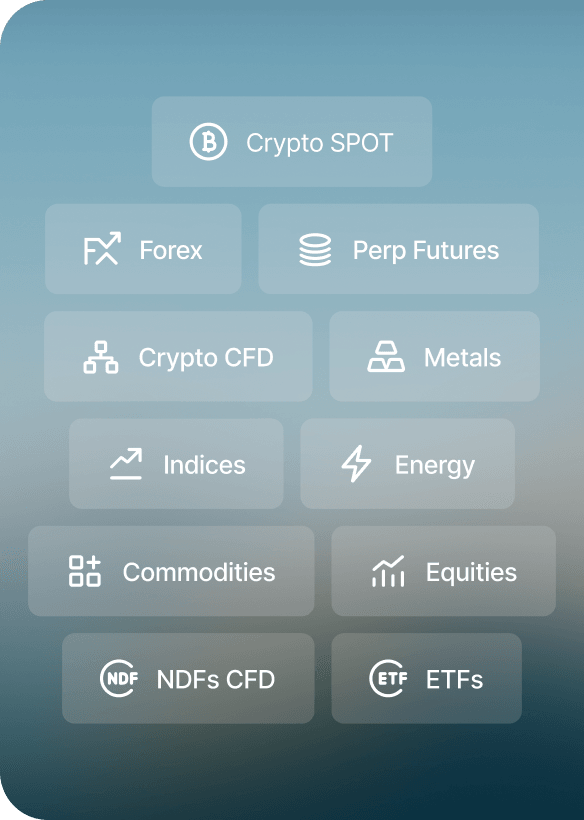
Deep, Reliable Liquidity Across 10 Major Asset Classes
FX, Crypto, Commodities, Indices & More from One Single Margin Account
Tight Spreads and Ultra-Low Latency Execution
Seamless API Integration with Your Trading Platform
Implementation Roadmap for Transitioning to a Multi-Asset Platform
Expanding to multi-asset operations is an infrastructure decision before it is a product decision. The brokerages that struggle with this transition usually treat it as the latter: adding instruments without upgrading the systems underneath.
1. Assess Market Demand and Regulatory Scope
Start with three questions. Which instruments are your clients requesting? What market trends are shaping competitor offerings in your target geographies? Where does your current regulatory authorization extend?
Licensing requirements vary by asset class and jurisdiction. Crypto often requires separate registration even in markets where FX is already authorized. Commodity derivatives may fall under entirely different regulatory frameworks. Brokers entering emerging markets face additional licensing layers on top of existing authorizations. Market conditions in each region determine which multi-asset solutions make commercial sense and which carry regulatory risk that outweighs the revenue opportunity.
Define a phased scope: begin with asset classes covered under current licensing, then expand as compliance capacity allows. Rushing into unlicensed instruments creates regulatory exposure that outweighs any near-term revenue upside, regardless of current market conditions.
2. Select a Prime-Of-Prime Liquidity and Technology Partner
Five criteria matter when evaluating partners:
- Liquidity depth in your target asset classes
- Integration maturity with your existing stack
- Regulatory credibility in your operating jurisdictions
- Operational support capacity during onboarding and ongoing
- Execution transparency with clear reporting on fills and slippage
A partner who covers liquidity but requires separate vendors for trading technology and back office recreates the fragmentation problem. Institutional traders require consistent execution on every instrument, and they move on quickly if the infrastructure underneath falls short. An end-to-end partnership from one provider cuts vendor complexity and integration risk at every level.
3. Integrate Trading, Risk, and Back-Office Stacks
The technical workstream runs on several parallel tracks:
- Connect liquidity feeds per asset class
- Configure cross-asset margin and risk parameters
- Integrate CRM and billing for new instrument types
- Align compliance reporting with updated regulatory obligations
Run the single-stack principle through every decision. Each integration point that doesn't connect cleanly to the core trading and risk layer is a future liability. Parallel systems for different asset classes reduce visibility and create inconsistent client experiences that erode trust over time.
4. Pilot, Monitor, and Scale Multi-Asset Offerings
Launch new asset classes to a limited client segment first. Monitor execution quality, margin event frequency, platform stability, and client adoption rates before full release. Multi-asset platforms require continuous optimization: liquidity conditions, volatility regimes, and client behaviors all change across market cycles, and system parameters need to evolve with them.
Accelerate Your Multi-Asset Strategy With B2BROKER
Multi-asset support in multi markets strengthens broker stability when it's built on an integrated infrastructure. Stability requires a single stack that manages liquidity, execution, risk, and back office for every instrument simultaneously.
B2BROKER provides multi-asset solutions built for broker scale: institutional-grade liquidity aggregation across FX, crypto, indices, commodities, and metals; B2TRADER for matching engine and cross-asset margin management; B2CORE for CRM and back-office operations; and B2BINPAY for crypto payments infrastructure. One partner relationship replaces the complexity of assembling and integrating multiple point solutions from separate vendors.
International licensing footprint and long-term experience supporting forex brokers, crypto exchanges, and institutional clients, whether retail-focused brokerages or platforms serving investment professionals, mean the infrastructure is already operational at the scale your business requires.
Build the Multi-Asset Infrastructure That Actually Scales
From liquidity aggregation to back office, B2BROKER delivers the integrated stack that turns multi-market coverage into a competitive advantage.
Frequently Asked Questions about Multi-Asset Broker Infrastructure
- Does adding more asset classes always improve broker stability, or can it backfire?
It improves stability only if you use a unified infrastructure. Adding asset classes through disconnected systems creates risk blind spots and fragmented liquidity that can actually amplify market volatility.
- What are the biggest risk blind spots brokers face when running separate systems per asset class?
Siloed systems hide total portfolio exposure, allowing correlated drawdowns across different markets to trigger margin calls before your team even notices. They also cause dangerous reconciliation delays and reporting gaps during high-volatility periods.
- How does single-account multi-asset access reduce churn compared to offering separate accounts per asset class?
Forcing traders to open separate accounts for different markets frustrates them and drives them straight to competitors. A unified account keeps all their positions, history, and funding in one place, creating natural friction that prevents them from leaving.
- What are the most common integration mistakes brokers make when expanding to new asset classes?
Brokers often treat expansion as a simple product launch rather than a core infrastructure upgrade, resulting in a patchwork of disconnected systems. They also underestimate the massive back-office burden, as new assets require entirely different KYC, billing, and compliance workflows.
- How do compliance obligations change when a broker adds crypto or commodities to an FX platform?
Each new asset class usually carries entirely distinct licensing and regulatory requirements depending on your operating jurisdiction. For example, crypto often demands separate registrations even if you already hold an active FX license in that exact same market.