Why Start a Forex Brokerage With White Label Software

Building a forex brokerage from scratch means running half a dozen infrastructure projects at once, from platform licensing and liquidity to compliance tooling, months before the first client deposits. Direct platform ownership is expensive, and regulatory approval can take months depending on the jurisdiction.
White label software changes the shape of that problem. The provider runs the platform and the infrastructure around it, while the broker launches under its own brand within weeks and spends the licensing window on compliance and client acquisition.
This guide answers a practical question: why start a forex brokerage with white label software? The sections below compare three creation models, define what the software does and does not solve, and explain how to judge a provider.
Key Takeaways
- White label software removes most of the technical build, while licensing, compliance, execution risk, and client acquisition stay with the operator.
- The strongest reason to choose the model is an integrated platform that runs the whole client lifecycle, from KYC and funding through trading, retention, and IB attribution.
- Generic CRMs cannot natively manage trading accounts, KYC/AML workflows, or IB hierarchies, so a brokerage needs a CRM designed for those workflows.
- Execution quality depends on liquidity access, and Prime of Prime providers are the realistic entry route for a new broker.
- Judge providers on ecosystem depth: platform coverage, CRM and back office, liquidity, native integrations, IB tooling, risk controls, and 24/7 support.
Three Ways to Build a Forex Brokerage
Who maintains the technology is the first question to settle, because the answer determines your cost curve and your launch date. The three brokerage creation models split that responsibility in three different ways.
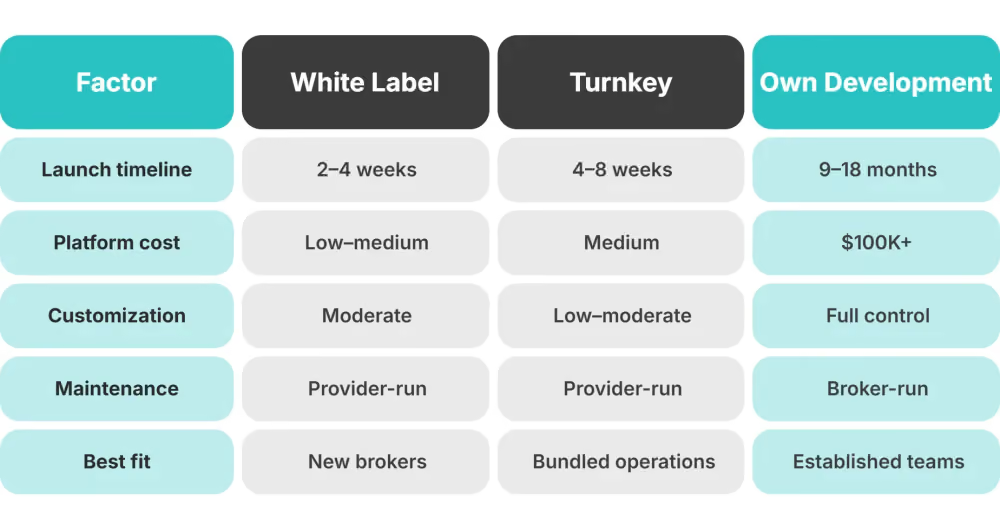
White label gives the broker branded access to an established platform and stack. The provider maintains the technology, while the broker configures spreads and leverage settings and owns the client relationship. For a new broker, this model shrinks the technical build to configuration work.
Turnkey packages go further and bundle liquidity connectivity, back-office systems, and payment integrations alongside the platform. The practical difference for a CTO is how much remains to source independently: a narrow white label deal can leave several of those components for the broker to arrange separately, while a turnkey solution includes them from the start.
Own development offers full control over architecture and roadmap. It carries the highest upfront cost: six figures for platform licensing, a permanent engineering team, and months of build time before anything client-facing exists.
The last model fits established operators with deep capital and in-house engineering. For a first launch, it usually means paying enterprise prices to rebuild commodity infrastructure.
What a Complete White Label Brokerage Stack Includes
A white label offer combines several systems. Its scope doubles as your evaluation checklist. A complete stack covers:
- Forex trading platform access and client trading tools: MT4, MT5, cTrader, or the provider's own platform
- A forex CRM and back-office system
- A Trader's Room, the client-facing portal for accounts, deposits, and withdrawals
- Liquidity connectivity and bridge infrastructure
- Payment gateways for fiat and crypto
- KYC/AML workflows with identity verification
- IB and affiliate tools with commission tracking
- Risk management tools and audit-ready reporting
Packages differ, and the gaps cluster in three places: KYC/AML tooling, IB management, and liquidity connectivity. Each missing component becomes a separate vendor the broker must integrate and maintain, which multiplies integration points and support dependencies.
The Trader's Room deserves particular attention, because it shapes the user experience inside the trading environment clients actually see: every deposit and every platform login runs through it. It has to carry the broker's brand and stay wired into the back office. A disconnected portal forces staff to reconcile deposits by hand.
The Financial Case for White Label Over Proprietary Development
The cost argument starts with the platform license. Beyond the $100,000-plus that a full MetaTrader server license historically required, MetaQuotes moved direct ownership to subscription pricing. After the January 2025 price increase, Finance Magnates reported a roughly $50,000 monthly bill for a comprehensive MetaTrader package , before the staff and integration work needed to run it.
Direct licensing is also harder to get than it used to be. MetaQuotes stopped issuing new white label licenses in late 2022 , pushing branded MT4/MT5 access toward technology service providers that hold full server licenses.
Platform access is one line in the budget. A realistic launch plan also prices in:
- Liquidity deposits, which vary by provider and execution model
- Payment gateway integration and reserve requirements
- KYC/AML tooling subscriptions
- Hosting and infrastructure
- Compliance and legal preparation
- Staffing across operations, support, compliance, and risk
- Marketing and client acquisition
Exact figures shift with jurisdiction and scope. Typical ranges for each budget line are documented separately.
As a planning guideline, hold six to twelve months of operating costs in reserve before launch. Revenue ramps slowly while the license is pending and the first clients onboard, so the budget has to carry payroll and compliance work through that gap.
What White Label Software Solves, and What It Does Not
White label trading software removes most of the technical build and shortens deployment from months to weeks, with the platform, CRM, and payments arriving already integrated.
It does not obtain a license, design an execution risk model, or bring in clients. All three stay with the broker, along with the internal expertise to run them. Operators who plan as if the software were the whole business discover the missing pieces at scale, when they are most expensive to fix.
Vendor dependency is the other side of the deal. The broker rides on the provider's pricing decisions, platform roadmap, and uptime, so contract terms covering data portability and migration support belong in the negotiation before signature.
The broker can configure the provider's framework but cannot rebuild core platform behavior.
Licensing, Jurisdiction, and the Time-to-Market Equation
Jurisdiction choice shapes banking access, capital requirements, and which clients you can serve, so it comes before any infrastructure decision. This article uses a practical commercial grouping rather than a legal classification:
- Tier A (the UK's FCA, Australia's ASIC, Singapore's MAS): the highest capital and reporting requirements and the longest timelines; the FCA alone takes up to six months on a complete application and twelve on an incomplete one . In exchange, the license opens institutional counterparties and major retail markets.
- Tier B (CySEC in Cyprus, South Africa's FSCA, Malaysia's Labuan): a middle path, with meaningful oversight, faster approval, and lower capital thresholds.
- Tier C to E (Seychelles, Vanuatu, and similar offshore centers): fast and inexpensive relative to the upper tiers, with real limits on banking relationships and the clients you can serve.
Across the tiers, the timeline spread runs three to eighteen months. That window is what white label deployment converts into an advantage. A provider can configure and test the infrastructure in weeks, so compliance preparation and liquidity negotiations run in parallel with the regulator's review instead of after it.
Which obligations each jurisdiction places on a white label forex broker and how the license application process runs are both covered in detail separately.
A broker should not onboard clients until its license is granted and compliance workflows are live. This article is not legal advice — requirements depend on jurisdiction and business model, so engage qualified counsel before committing to a licensing path.
Execution Models and Risk Architecture
The execution model determines the broker's capital requirements, dealing operations, and liquidity needs.
A-Book (STP/ECN). Client orders route to external liquidity. The broker earns spread markup or commission. Because the brokerage firm does not hold the other side of a client position, external routing can reduce its market exposure. The capital and regulatory effects still depend on the jurisdiction.
B-Book. The broker internalizes client flow and retains the resulting market exposure. Net client losses can become broker revenue, which creates a conflict of interest. Tier-one regulators already restrict how CFDs are marketed and sold to retail clients , and managing the retained exposure requires enough scale to diversify the book.
Hybrid. A broker can route selected orders to external liquidity and internalize others within defined risk parameters. Its dealing desk adjusts that routing as the book grows and monitors exposure in real time.
Liquidity access decides whether the A-Book works in practice. Direct prime brokerage relationships demand a track record and capital that new firms lack. Prime of Prime providers fill that gap. They aggregate institutional liquidity and pass it through at thresholds a startup broker can meet.
Managing the Full Client Lifecycle From Day One
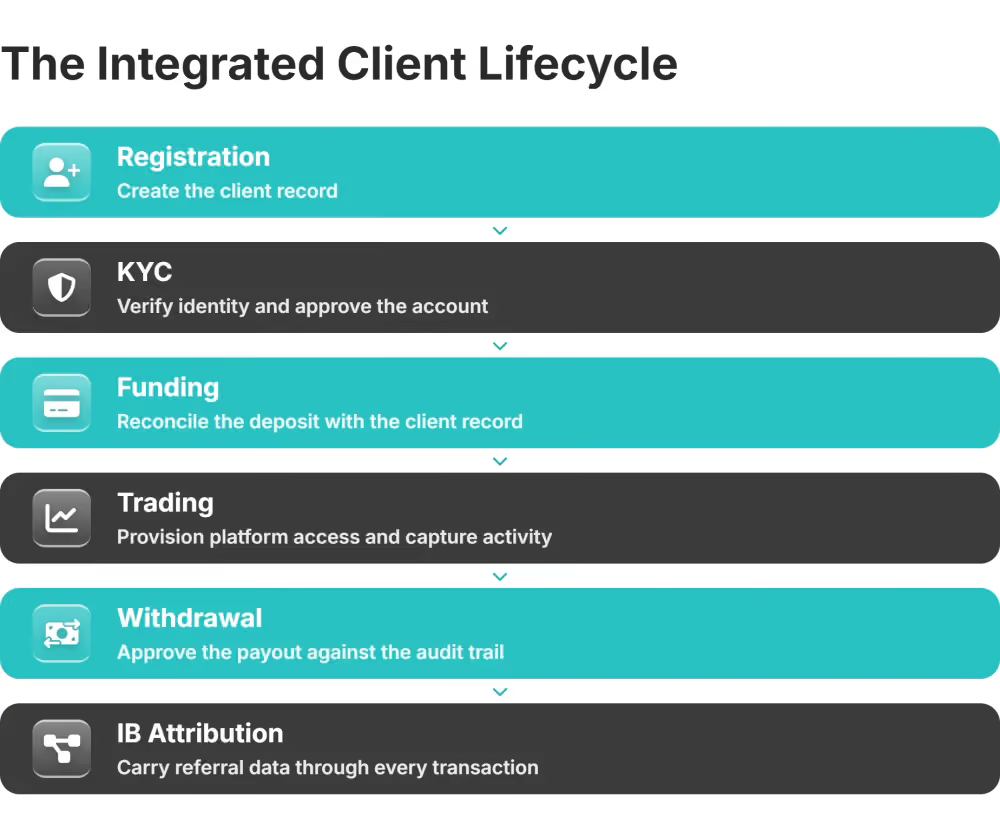
The strongest answer to why start a forex brokerage with white label software lives in what happens after launch day. A client passes through registration, KYC, account opening, funding, trading, support, withdrawal, and IB attribution, and each transition needs its own operational capability.
The handoffs are where operations break. Take IB attribution: the referral is recorded at registration and then has to follow the client through every trade, deposit, and withdrawal for the life of the account. One broken link in that chain means a wrong commission. KYC approvals and deposit records cross system boundaries the same way.
When those systems come from separate vendors without native integration, every handoff turns into manual reconciliation. Each manual step opens a compliance or an audit-trail gap, and the workload compounds with every hundred new clients. An integrated white label platform runs the same transitions inside one system.
Why a Purpose-Built Forex CRM Outperforms Generic Alternatives
Salesforce and HubSpot are excellent at what they were built for, which is contact management and sales pipelines. Brokerage operations need a different machine. A purpose-built CRM system must handle these functions natively:
- Trading account creation and management, with status tracked in real time
- KYC/AML document workflow, with account activation gated on verification
- Deposit and withdrawal handling reconciled against multi-currency payment gateways
- IB hierarchies with multi-level commission calculation and automated payouts
- Market data and platform events flowing back into the client record
Rebuilding this on a generic CRM means custom code, third-party connectors, and permanent maintenance by developers who understand both systems. The adaptation project adds technical overhead and leaves a system that is fragile and hard to audit. Why generic CRMs break on brokerage workflows runs deeper than a feature comparison.
The layer boundary matters too. The CRM and back office manage the relationship and the money movement, while the platform executes client orders. The two layers exchange data constantly — a native connection between them is what keeps client records complete.
IB and Affiliate Management as Revenue Operations Infrastructure
For most retail-focused forex brokers, introducing broker networks are the main client acquisition channel. The tooling behind them is revenue infrastructure and deserves day-one attention. A reliable IB layer needs:
- Multi-level hierarchy management, since IBs recruit sub-IBs who recruit clients
- Referral tracking that starts at the registration event
- Commission structures per instrument: spread share, volume rebates, or fixed fee
- Automated payout calculation and processing
- Partner portals where IBs verify their own earnings without contacting support
The failure mode is gradual. An IB who cannot verify their earnings starts questioning every commission figure. Those disputes land on the operations team. If a payout then arrives late on top of the doubt, the partner moves new clients to a competing broker. Attribution accuracy is what keeps the channel producing.
How to Evaluate a White Label Provider
Provider evaluation works best as a fixed checklist applied to every vendor, because marketing pages blur the differences that matter. Eight dimensions cover the decision:
- Platform coverage. MT4, MT5, cTrader, and proprietary platforms shape the trading experience for different client segments; a provider offering several leaves room to add trading instruments later.
- CRM and back-office depth. Check whether brokerage workflows run natively or through custom integration, because the answer sets your maintenance burden.
- Liquidity quality. Ask to see the aggregation model, order book depth, and counterparty coverage before committing.
- Native integrations. Every KYC provider or payment gateway connected through custom API work is a maintenance surface you own.
- IB tooling. Commission structures and hierarchy depth must match the partner model of your target market.
- Risk controls. Leverage limits, margin monitoring, and exposure tracking should be configurable per account and per group, with an audit trail.
- Scalability. Confirm that the stack can add accounts and regions without replacing its core systems.
- Technical support. Global sessions keep multi-asset operations active across time zones, so 24/7 help from brokerage specialists is a functional requirement.
B2BROKER Supports Brokerage Launch and Scaling
Apply that checklist and full-ecosystem providers stand out quickly. B2BROKER is built as one: a global Prime of Prime liquidity and fintech provider covering aggregation, trading platforms, back-office software, copy trading, and crypto payment processing. The company employs more than 500 professionals and holds multiple international licenses, with over a decade in the market.
B2CORE is the ecosystem's CRM and back office, available as a white label solution. It runs the lifecycle described above, from onboarding and KYC through trading account management to IB payouts, behind a fully branded Trader's Room.
Native connections to MT4, MT5, cTrader, B2TRADER , and third-party KYC and payment providers keep client records inside one system. Security ships as standard: 2FA, SSL encryption, DDoS protection, and built-in AML controls.
The same stack serves brokers past launch. A firm can add a region or an asset class without replacing its core CRM and back office. Established brokers can also use the ecosystem to consolidate fragmented legacy systems.
Why start a forex brokerage with white label software? For a new broker, the model keeps the team focused on licensing and client acquisition while the provider maintains the technology stack.
Frequently Asked Questions About White Label Forex Software
Does white label software mean I don't need a forex broker license?
No. The licensing obligation stays with the broker; the software supports compliance workflows such as KYC processing and reporting, and regulatory planning has to run in parallel with deployment since approval takes three to eighteen months.
What's the difference between a white label and a turnkey brokerage solution?
White label provides branded access to an established trading platform, while turnkey bundles more of the surrounding infrastructure: liquidity connectivity, back office, payments, and CRM. The practical difference is how much the broker must source and integrate independently.
Why can't I use Salesforce or HubSpot as my brokerage CRM?
Generic CRMs have no native support for trading account management, KYC-gated activation, IB hierarchies, or trading platform connectivity, so adapting them means custom development and permanent maintenance. A CRM designed for brokerage workflows, such as B2CORE, ships with those functions and integrations in place.
How much capital do I need to launch a forex brokerage with white label software?
Plan well beyond the software fee: liquidity deposits, payment integrations, compliance and legal work, staffing, and marketing all land before meaningful revenue arrives. As a planning guideline, reserve six to twelve months of operating costs, with the exact figure set by jurisdiction and scope.
Can white label brokerage software support a multi-asset operation, not just forex?
Yes, provided the infrastructure is evaluated for multi-asset readiness at the CRM, back-office, liquidity, and platform layers. Running crypto or equities alongside forex adds cross-asset account structures, separate liquidity connectivity, and product-specific compliance workflows.
Recommended articles


Subscribe to our newsletter