How to Choose the Best Forex CRM Software for Your Brokerage

Slow client intake now costs financial firms accounts they had already won: 70% of institutions lost business to it over the past year , the highest share Fenergo has recorded, and roughly 10% of applications are abandoned before completion. For forex brokers, nearly every step of that funnel runs through the CRM.
That is what makes the search for the best forex CRM software harder than vendor pages suggest. The market places generic SaaS tools dressed in trading vocabulary next to systems built for brokerage operations, and the two categories fail in different places: a sales CRM was never designed to open trading accounts or calculate IB commissions.
This guide gives you a decision framework: the three layers every firm has to cover, the criteria that expose weak platforms during evaluation, and a comparison of the main forex CRM providers against those criteria.
Key Takeaways
- A purpose-built CRM must open trading accounts, run identity and AML checks, and pay out IB commissions natively; generic platforms cover none of this out of the box.
- Evaluate every candidate across three layers: the client-facing Trader's Room, the CRM layer, and the back office.
- MT4/MT5 connectivity is the entry ticket. Judge platforms on how they connect to verification vendors, payment processors, and funding rails.
- IB management is a financial operations function: commission logic, payout validation, and audit trails matter more than a referral dashboard.
- Treat the decision as infrastructure economics and compare total cost of ownership across build, buy, and branded-deployment paths.
Why Generic CRM Platforms Fall Short for Forex Brokerages
Salesforce, HubSpot, and Zoho are excellent at what they were built for: contacts and sales pipelines. None of them can open an account on a trading server or hold a cash-out for approval, so closing that gap means building operational machinery inside a platform that has no concept of it.
The gap exists because requirements sit at the intersection of customer relationship management and trading infrastructure. When a client passes compliance review, an account has to appear on the trading server. When funds leave, someone with the right permissions has to approve the request against a real balance. Each of those touchpoints becomes a custom integration on a generic tool, and the count grows with every new provider you add.
The compliance cost is quieter but larger. Client records and verification history end up spread across systems that were connected after the fact, and reconstructing a clean audit trail from that sprawl takes weeks a regulator will not give you.
Purpose-built platforms such as B2CORE exist as a distinct product category in the forex industry because these processes have to be designed in from the start. The rest of this guide covers how to tell a genuinely purpose-built forex CRM solution from a repackaged one.
The Three Operational Layers of a Forex CRM System
The best forex CRM software is defined by how well three layers work together across the client lifecycle, and that lens gives a clearer evaluation than a feature count.
Each layer serves a different user. The Trader's Room faces your clients, the CRM layer serves your revenue and sales team, and the back office belongs to operations and compliance. Weak platforms usually handle one or two layers well and leave the third to manual work, so the handoffs between layers are where evaluation should focus.

1. Trader's Room
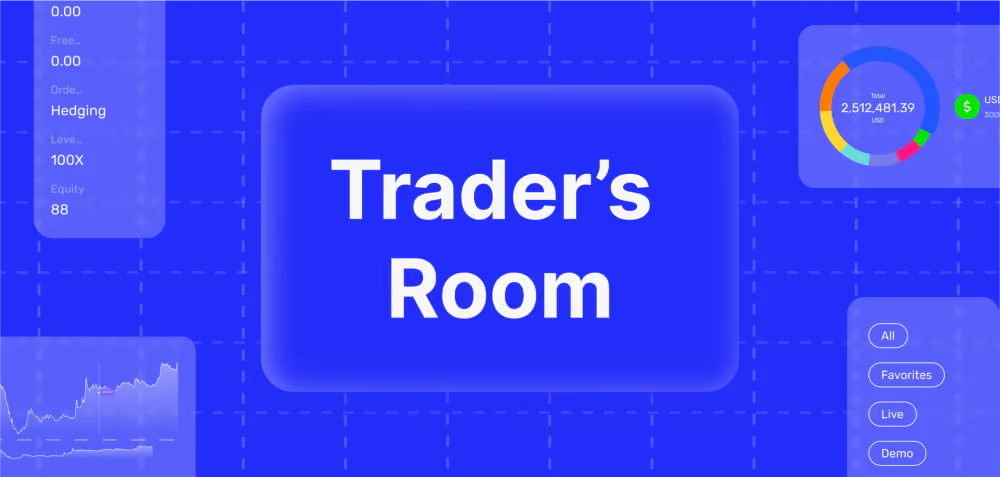
The Trader's Room is the layer forex traders see: the portal where they manage accounts and funds, check balances, and open the web trading terminal, with analytics and market calendars built in. What a client portal covers, and how it shortens the path from registration to first deposit , is worth understanding in detail before any vendor call.
When this layer is thin, the cost lands on customer support. Clients who cannot change an account setting or track withdrawals themselves write tickets instead, and every ticket that replaces a self-service action erodes both margins and retention.
A capable portal removes manual intervention from funding and trading platform access, and that self-service functionality is why deposit conversion and support volume are the two numbers to ask vendors about.
2. CRM System
The CRM layer manages the relationship itself: lead management, client segmentation, onboarding steps, identity and AML coordination, and communication history. It is the bridge between front-end acquisition and ops activation, and its job is to make compliance review a step inside the funnel rather than a separate queue in another team's inbox.
You can see the absence of this layer in the symptoms: new clients stall while the sales team and compliance email each other, and verification status ends up tracked in spreadsheets. A working CRM layer answers "where is this client in the funnel and what is blocking them" in one screen.
3. Back Office
The back office is the internal control layer: client profiles, IB and lead administration, compliance tooling, real-time account monitoring, and trade management. Its depth decides whether the platform is scalable, because a book of thousands of accounts cannot be monitored by hand; margin alerts and payout runs have to fire with automation and leave an auditable record.
Evaluate this layer as a risk function. The components of an internal control stack for forex brokers map almost one-to-one to what a regulator or auditor will ask about, and gaps here surface as governance findings.
Key Criteria for Evaluating a Forex CRM
The criteria below cut across all three layers. Score every candidate against the full set, because vendors demo their strongest features and stay quiet about the rest.
Trading Platform and Infrastructure Integrations
MT4/MT5 connectivity is the baseline every serious vendor meets, so it tells you nothing about platform quality. The meaningful question is what the CRM connects to after that: cTrader and B2TRADER for multi-platform offerings, plus FIX, REST, or WebSocket APIs for liquidity providers and custom reporting. Third-party verification vendors, payment gateways, and wallets belong on the same map as endpoints.
For a CTO, this criterion is a maintenance forecast. Choosing brokerage software with the full technology stack in view is cheaper than discovering after go-live that every new provider requires custom development.
KYC/AML Workflow Support
Regulators fined financial institutions $3.8 billion for AML, KYC, sanctions, and due diligence failures in 2025 , and digital asset firms appeared in almost a quarter of the ten largest fines. A CRM reduces that exposure only when compliance work stays inside auditable processes.
Helping means the CRM runs compliance as continuous workflows, from document collection through review to an auditable record. The practical test: when a client uploads documents during onboarding, does the platform route the review and clear the account for activation automatically?
If compliance status lives in a separate system, every case becomes a manual sync between tools, and the audit trail fractures exactly where regulators look first. The choice of identity-verification vendor matters less than whether the CRM treats that vendor as a step in the process or as an external silo.
Payment Gateway and Wallet Operations
Payment handling inside the CRM determines your support load and reconciliation accuracy. The core requirement is one place where deposit and cash-out status, multi-currency provider routing, balance views, and approval controls on outbound funds all live.
The test is whether your operations team can run reconciliations and clear approval queues without leaving the platform. Every task that requires switching to a provider dashboard multiplies both handling time and error rates.
IB Management and Payout Operations
IB tooling is where forex CRMs diverge most sharply, because partner networks are financial operations, and referral-tracking add-ons collapse under them. Multi-tier commission structures need configurable rules, lead attribution, partner portals where IBs track their own earnings, and payout validation before money leaves the house.
Ask each vendor one question: can the platform run a full payout cycle across a multi-level partner tree without a spreadsheet? If the answer involves exports, your finance team becomes the reconciliation engine every payment cycle, and payout disputes get settled by argument instead of by audit trail.

Operational Governance and Permission Architecture
Role-based access, approval steps, deposit and cash-out controls, and audit trails decide whether growth produces manageable process or uncontrolled internal risk. The stakes are documented: more than half of occupational fraud cases happen because internal controls were missing or overridden , at a median loss of $145,000 per case. A junior support agent should not hold cash-out approval rights, and a departing employee's access should end everywhere at once.
Platforms that treat permissions as an enterprise add-on push this risk onto you, and it compounds with every hire. At scale, governance architecture determines whether the broker can document its control history for an auditor.
Multi-Asset and Crypto Brokerage Readiness
Digital assets are now common among surveyed retail FX operators: 91% of retail FX firms already offer crypto trading , and 53% plan to expand that offering within a year. Most forex CRM platforms have not caught up, because they grew up around single-market FX processes, and multi-asset client segmentation often behaves like a bolted-on extra.
Firms running forex trading, digital assets, and CFDs side by side need those structures in the core architecture, with account types, payment methods, and compliance flows that differ by instrument. Prop firms, multi-asset desks, and forex brokers with cross-asset books hit the same constraint when they outgrow a single-market core.
The question for vendors is architectural, so ask it directly: was the platform designed for multi-asset operations, or is multi-asset support a layer over an FX core? The second answer predicts custom development later.
Implementation, Migration, and Launch Readiness
Implementation capability belongs in the vendor scorecard, because a platform you cannot migrate onto has no value. The question to settle before signing is how much of the go-live work the vendor carries versus your own developers: data migration, permission configuration, provider setup, and staff training all land on someone.
For teams replacing fragmented legacy tools, a branded CRM deployment compresses this phase substantially, since the vendor delivers a pre-integrated stack instead of a box of parts.
Total Cost of Ownership and Build-vs-Buy Considerations
Fragmentation is the hidden line item: separate tools for intake, payments, compliance checks, and IB operations each carry their own license and their own maintenance bill, and together they routinely exceed the deployment cost of one purpose-built platform. The real cost of building a brokerage CRM makes the same point from the build side.
Compare total cost of ownership across three paths: build in-house, buy a platform, or take a white label deployment. Licensing and pricing fees are the visible number; integration work and vendor dependency decide the actual total.
Comparing Leading Forex CRM Platforms
B2CORE covers all three operational layers natively and extends past MT4/MT5 into cTrader, B2TRADER, and open connectivity, which makes it the reference point for multi-asset desks evaluating against the criteria above.
UpTrader positions well for FX-focused, mid-market operators, with configurable compliance checks and multi-tier IB tools, though multi-asset coverage stays limited.
Leverate serves traditional FX desks inside its own ecosystem built around MT4/MT5 and its SiRiX trading platform, with identity checks handled through integrated providers.
Cloud Forex CRM targets startups and small-to-mid FX desks that accept basic compliance coverage in exchange for SaaS pricing.
FXBO is a dedicated CRM and operations layer with broad platform connectivity but no turnkey path of its own. Prop firms evaluating the same stack should apply the same ops checklist.
Syntellicore's compliance-first architecture with automated MiFIR and EMIR reporting makes it a natural shortlist entry for CySEC- and FCA-regulated entities specifically. Brokerage firms comparing forex CRM providers should score each row against the same operational checklist, not against marketing feature counts.

How B2BROKER Supports Brokerage Operations with B2CORE
B2BROKER is a global prime-of-prime liquidity and technology provider, and B2CORE is its flagship forex CRM system for forex, digital-asset, and multi-asset operators launching or scaling operations.
Its coverage maps directly onto the criteria in this guide:
- client onboarding with native identity and AML coordination;
- account management across MT4/MT5, cTrader, and B2TRADER;
- payment processing and balance operations inside the same platform;
- a full self-service client portal with user-friendly functionality for deposits and account views;
- multi-tier IB management with automated payout logic.
Branded deployment is available for brokers who want the stack delivered pre-integrated, and security includes 2FA, SSL encryption, DDoS protection, and AML controls as standard. How the operations side of that stack should be evaluated is covered in the guide to choosing forex back-office software .
Support runs 24/7 with teams that work on this infrastructure specifically, so integration troubleshooting and incident response come from people who know what a stuck payout run costs on a Friday night. Trading history, partner ledgers, and approval logs stay in one place rather than split across tools.
Assess Your CRM Infrastructure and Take the Next Step
The framework above gives you the criteria; the remaining work is mapping them to your own operation. Start with two questions: which of the three layers is underserved today, and where fragmented tools are creating compliance exposure or support overhead. Those answers narrow the field faster than any demo.
The complexity covered here, from IB payout trees to multi-asset compliance flows, is also why a direct conversation beats a product page once your shortlist is real. Choosing the best forex CRM software ends with a concrete deployment plan, and B2BROKER's team works with operators at exactly that stage: assessing fit against your requirements and walking through integration planning with specialists who run these systems daily.
Frequently Asked Questions about Forex CRM
What's the difference between a Forex CRM and a regular CRM like Salesforce or HubSpot?
A generic CRM manages contacts and sales pipelines, while a forex CRM natively runs trading account provisioning, identity and AML checks, payment operations, and IB payouts as one system. Adapting a generic tool to those requirements means heavy integration work and compliance gaps between systems.
What integrations should a Forex CRM support beyond MetaTrader?
Look for cTrader and B2TRADER connectivity, third-party verification vendors, payment gateways, funding rails, and FIX, REST, or WebSocket APIs for liquidity providers and reporting. The more of your stack the CRM connects to natively, the less integration maintenance your team carries.
How does IB management work in a Forex CRM?
The CRM configures multi-tier commission rules, calculates payouts automatically, and validates them before funds are released, while partners track their referrals and earnings in a dedicated portal. Audit trails make payout disputes resolvable without manual reconciliation.
Can a forex CRM support crypto and multi-asset brokerages, or is it only for FX?
It depends on the architecture: platforms built around single-market FX processes often lack native multi-asset account structures. Desks spanning forex, digital assets, and CFDs should confirm the platform was designed for multi-asset operations rather than extended toward them.
What should brokers consider when switching from a legacy CRM or fragmented back-office tools?
The heaviest work sits in data migration, permission configuration, and provider setup, so the quality of vendor onboarding support decides how rough the transition is. The economics usually favor the switch, since maintaining fragmented systems tends to cost more over time than one purpose-built platform.
Recommended articles

Subscribe to our newsletter