How to Register a Forex Broker: Jurisdiction to Launch

A new brokerage picks the cheapest offshore license to reach the market fast. Then the banking partners decline to open accounts, the prime brokers refuse credit, and the launch stalls with capital already committed and no way to take a single client deposit.
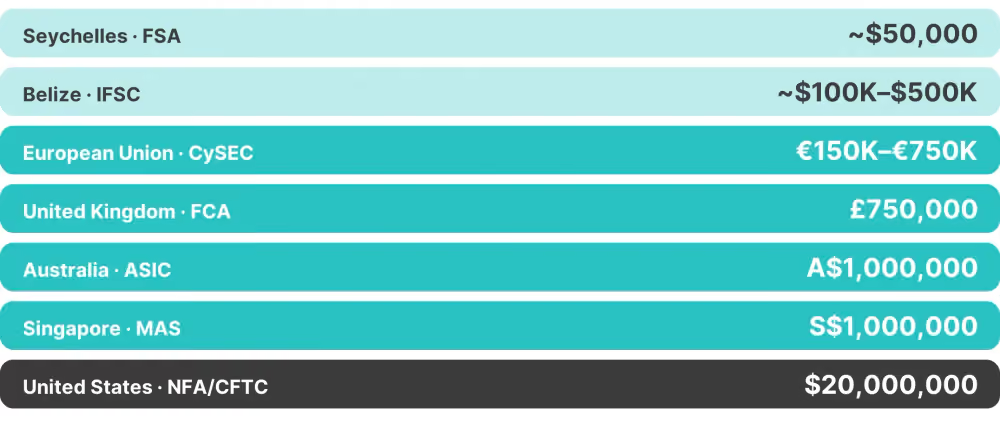
Registering a forex broker is a strategic infrastructure decision. The jurisdiction you choose sets the capital floor, which runs from roughly $50,000 offshore to $20 million for a US Forex Dealer Member, and that number reshapes everything the firm can afford to build after licensing.
This guide is written for senior operators focused on how to register a forex broker well: which jurisdiction to choose and why. It maps how jurisdiction shapes capital requirements and licensing timelines, then follows the market access and infrastructure commitments that each regulatory path locks in.
Key Takeaways
- Jurisdiction sets a firm's capital allocation and banking access long before the first client is onboarded, so the choice belongs at the start of planning.
- Tier-1 licenses open institutional client access and prime brokerage relationships that offshore registrations usually cannot support.
- Compliance keeps costing money after approval, because AML monitoring and capital adequacy reviews scale with client volume.
- The build-versus-buy technology decision after registration is a capital efficiency question rather than a platform preference.
- Matching the intended asset class scope to the right license type early prevents expensive regulatory retrofits as the firm scales.
Broker Registration as a Strategic Decision
Licensing is easy to treat as a box to clear before launch. For a firm that intends to actually operate, registration is the first architecture decision it makes. The jurisdiction on the license decides which banking partners will open accounts, and that single fact cascades into which counterparties extend credit and which client geographies the firm can legally market to. It is the first and most constraining move in starting a forex brokerage , setting the boundaries the rest of the build inherits.
Getting the jurisdiction right at the start costs far less than retrofitting it later. Once a firm has live operations and contracts built around one regulatory structure, changing course means renegotiating most of them, so the cheap decision early becomes the expensive one to reverse.
Why Jurisdiction Choice Shapes Everything Downstream
The regulator you choose dictates the entire compliance and technology stack you build, well beyond the rulebook you follow. A Cyprus Securities and Exchange Commission (CySEC)-authorized firm builds a different compliance stack than a National Futures Association (NFA)-regulated Forex Dealer Member. The anti-money laundering (AML) documentation and transaction reporting a MiFID II firm produces look nothing like what the Bank Secrecy Act or Commodity Futures Trading Commission (CFTC) rules demand, and the same divergence runs through data residency and payment processing.
That first setup is expensive to unwind, because path dependency takes hold fast. The compliance infrastructure a firm configures for its launch jurisdiction becomes the base its technology integrations and reporting workflows sit on, and its client onboarding inherits the same constraints. Moving jurisdictions later rebuilds that foundation instead of just filing new paperwork.
Disambiguating Broker Registration from Trader Onboarding
Two very different activities share the same search query: registering a brokerage firm with a financial regulatory authority, and opening a foreign exchange trading account as a retail client. The confusion carries real consequences, so it is worth separating them cleanly.
Broker registration is a firm-level authorization. It means proving to a regulator that the company can operate as a regulated financial services provider in the forex market, from the fitness of its directors to the size of its capital base and the strength of its governance. Retail account opening is what forex traders do after the firm is authorized and running, once they can fund a trading account and begin forex trading. An operator reading this is doing the former.
Jurisdiction Comparison: A Decision Framework
Choosing a jurisdiction comes down to four variables: capital requirements, licensing timeline, market access rights, and ongoing compliance overhead. Each combination sets a different launch cost and addressable market, along with a different operating burden to carry afterward, which is why the same firm can look well-suited to one regulator and badly matched to another.
Capital Requirements Across Major Jurisdictions
Capital thresholds set the floor on registration cost and decide how much working capital is left for technology and staffing once the regulator is satisfied.
Time-to-License by Regulatory Environment
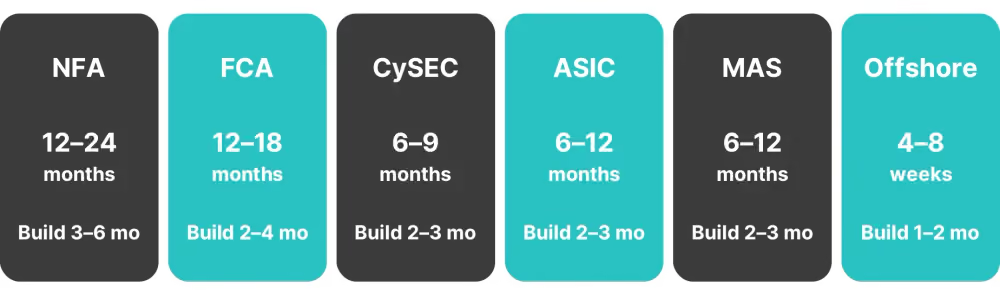
Timeline decides when a firm can onboard clients and start recovering the capital locked up in licensing and build-out.
Operators routinely underestimate the post-license build-out. Platform deployment, KYC configuration, back-office integration, and payment onboarding all land after approval arrives, and together they add real months to the timeline. A turnkey infrastructure stack compresses that phase, a difference measured in months rather than weeks.
Market Access and Client Acquisition Implications
Jurisdiction decides more than where a firm is regulated. It decides which client geographies the firm can legally serve and which counterparties will work with it.
Tier-1 licenses reach markets that offshore registrations structurally cannot. Institutional allocators in the financial markets, like asset managers and hedge funds, require Tier-1-authorized counterparties in most mandates, and prime brokers will not extend credit lines to offshore-only entities. EU rules also restrict marketing to retail clients when a firm lacks MiFID II passporting rights.
For EU access, CySEC authorization with MiFID II passporting is the most efficient route, since one license covers all 27 member states without separate local approvals. In APAC, ASIC and MAS carry the credibility that institutional relationships depend on. Offshore licenses fit specific retail segments and work better as a phase than a permanent home.
Tier-1 Regulators: Trade-Offs at a Glance
Tier-1 regulators deliver the strongest market access and the most institutional credibility, and they charge for it in capital and in supervisory attention. The three that matter most for a new brokerage each impose a distinct constraint, so the right one depends on the firm's target clients and its capacity to carry the compliance load.
United States: NFA and CFTC
The defining constraint is capital. A Forex Dealer Member must hold $20 million in net capital at all times under NFA financial requirements , which prices most international brokers out of direct registration. Registration also reaches every principal and associated person individually, each of whom files Form 8-R and submits fingerprints, so the work extends well past company incorporation. The FIFO rule adds a product constraint by prohibiting hedging within the same currency pair.
The payoff is direct access to the US retail market and to US-based institutional counterparties. Most international brokers reach that market through alternative structures rather than taking on NFA registration head-on.
United Kingdom: FCA
FCA authorization works as a forward-looking choice. The regulator is actively building frameworks for tokenization and digital asset market structure through its 2025 and 2026 consultations, so an FCA-authorized firm can expand into those products as the rules settle.
The cost sits in ongoing compliance, which weighs heavily on small teams. CASS client asset segregation, MiFID II best execution documentation, and ICARA capital adequacy assessments all demand continuous attention, backed by active supervisory engagement. The £750,000 minimum capital for dealing on own account, set by the FCA's MIFIDPRU capital rules , is manageable; for a team under 20 people, the compliance overhead is the harder variable.
European Union: CySEC and MiFID II
CySEC is widely treated as the most accessible Tier-1 entry point in Europe, helped by a faster authorization timeline and lower operating costs than the UK or US routes. CIF capital scales with the model: €150,000 for a firm that executes and transmits client orders, rising to €750,000 for a firm that deals on its own book. The bigger strategic advantage is MiFID II passporting, since a CIF authorization from CySEC lets the firm offer investment services across every EU member state by notification, rather than a fresh authorization in each one.
ESMA product intervention rules then apply across the whole EU. For CFDs, retail leverage is capped at 1:30 for major FX pairs such as EUR/USD, 1:20 for minor pairs and gold, 1:10 for non-gold commodities and minor equity indices, and 1:2 for crypto assets. These caps bind any MiFID-authorized firm serving EU retail clients, so they are not specific to Cyprus.
Offshore Jurisdictions: Cost Versus Credibility
Offshore registration buys faster timelines and lower capital thresholds. The trade-off has sharpened since 2022 and 2023. Banking access has tightened and EU payment processors increasingly turn away offshore-licensed brokers, while institutional counterparties either price the relationship at a premium or decline it outright.
Belize and Seychelles: When Offshore Makes Sense
Offshore registration is defensible in a few specific situations. A firm serving retail clients in regional markets, where Tier-1 credentials do not drive acquisition, can launch offshore and reach those clients well. The same holds for an early-stage operation preserving capital ahead of a Tier-1 application, or a firm that runs an offshore entity in parallel while its Tier-1 license works through approval.
The Seychelles FSA and the Belize IFSC still issue licenses quickly and at low capital thresholds. The consequence to plan for is downstream: payment processing has to come from providers willing to work with offshore brokers, and the cost model should assume higher processing fees and reserve requirements. Banking takes more effort too, and specialist institutions may be the only realistic option.
The Registration Process: Where Complexity Concentrates
The registration sequence itself is well documented. The value for an experienced operator is in knowing where applications stall: which governance elements draw the most scrutiny, and what has to be operationally ready before submission.
Entity Formation and Legal Structure Decisions
Entity structure decided at formation shapes how the firm scales and how transparent its beneficial ownership looks to a regulator, and it sets up the substance requirements that follow. Most jurisdictions accept a Limited Company structure, though some regulators layer on requirements beyond basic incorporation.
Regulators now scrutinize beneficial ownership at every level. Nominee shareholder structures that were routine a decade ago trigger enhanced due diligence today and can delay an application significantly. Director fitness-and-propriety checks require demonstrable financial services experience, and the FCA and NFA vet the background and finances of every principal.
Substance requirements have tightened since the OECD's BEPS reforms. CySEC and the FCA expect genuine operational presence, meaning local staff, real decision-making authority, and offices. A shell entity whose only local footprint is a corporate services address will not clear modern substance standards. Entity structure and substance requirements sit at the front of the process to become a forex broker , where a misstep is cheapest to correct.
Compliance Documentation and Governance Requirements
The AML and KYC policy, the business plan, the governance framework, and qualified-personnel documentation are where applications most often stall. Regulators have grown more rigorous on each of them.
The AML and KYC policy has to fit the specific jurisdiction's law, because a generic template invites scrutiny. Regulators read the business plan against the firm's acquisition strategy, business model, revenue model, and technology setup, and vague or templated submissions tend to trigger information requests that push timelines out by months. Most Tier-1 regulators also require a locally based, regulator-approved compliance officer, so sourcing that person before submission rather than after approval is the right order.
Capital evidence takes a specific form: certified bank statements confirming funds on deposit in a qualifying bank account at the time of submission. Firms launching on a white label platform carry an added documentation layer, since MT5 white label compliance requirements fold platform-level obligations into the same submission.
Jurisdiction-to-Infrastructure Mapping
License approval starts the infrastructure buildout rather than closing the regulatory process. What that buildout has to include varies materially by jurisdiction, so mapping it before choosing a regulator is what prevents an expensive retrofit afterward. The requirements split along regulatory lines:
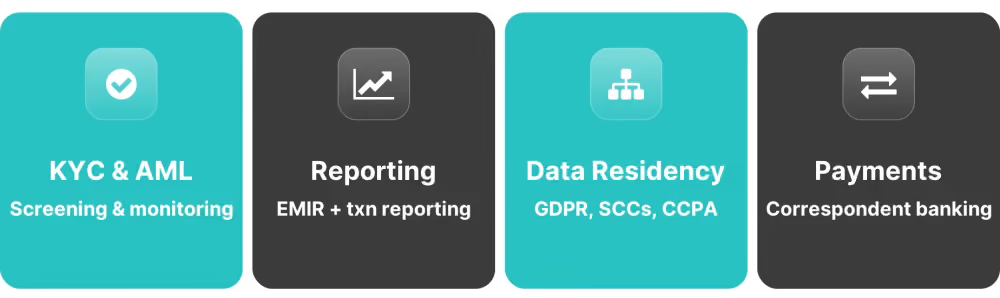
KYC and AML systems. EU-regulated firms configure AMLD5/6 workflows: enhanced due diligence, PEP and UBO screening, transaction monitoring, and suspicious-transaction reporting on defined timelines. UK firms file a suspicious activity report with the National Crime Agency as soon as suspicion arises, while NFA-regulated entities run FinCEN AML programs under the Bank Secrecy Act.
Reporting infrastructure. MiFID II firms carry EMIR trade reporting and transaction reporting to national competent authorities, plus the standing best-execution duty. (The periodic RTS 27 and RTS 28 best-execution reports were withdrawn in the MiFID II review.) UK firms follow the equivalent post-Brexit regimes, and NFA firms comply with NFA Compliance Rule 2-36 and, where relevant, CFTC swap data reporting.
Data residency. EU operations fall under GDPR, and transfers outside the EU need Standard Contractual Clauses or an adequacy decision. For firms serving US clients, state privacy laws such as the CCPA and Virginia's VCDPA add another layer.
Payment processing. Tier-1 licensed brokers qualify for standard correspondent banking with normal reserve requirements around 5–10%. Offshore-licensed brokers increasingly face reserves of 15–25% and a narrower set of willing processors.
Compliance as a Continuous Operational Cost
License approval does not close the compliance file. It opens the chapter of ongoing obligations. AML and KYC monitoring and transaction reporting run continuously, and capital adequacy reviews recur on the regulator's schedule, with every cost scaling as client volume grows.
The cadence is regulator-specific. CySEC-regulated firms run an internal capital adequacy assessment and file periodic prudential returns. The FCA mandates an annual ICARA (Internal Capital Adequacy and Risk Assessment) process. NFA-regulated Forex Dealer Members file monthly financial reports on CFTC Form 1-FR. Each of these needs data infrastructure and internal staff capacity, and often external legal or advisory support on top.
Transaction monitoring has to flag suspicious activity in real time or close to it, since manual review at the volume of a working retail brokerage does not hold up under examination. Compliance technology alone adds roughly $2,000–$8,000 a month depending on client volume and sophistication, before staff and advisory costs. For a mid-tier CySEC-authorized broker, total ongoing compliance overhead runs $150,000–$450,000 a year. An integrated CRM and back-office platform that automates reporting and monitoring lowers the per-unit cost as volume climbs, instead of forcing headcount to grow in step with obligations.
Capital Allocation and Build-Versus-Buy Trade-Offs
Jurisdiction capital minimums set the floor on the technology budget. Once the firm clears the regulator's minimum, whatever capital remains still has to fund the trading platform, the compliance stack, staffing, liquidity access, and payment processing, all before the business earns its first revenue.
A point-solution approach stitches together separate vendors, one each for the trading platform, the CRM, KYC tooling, the liquidity bridge, payments, and reporting. Across the stack that typically runs $75,000–$340,000 a year before integration labor, and the seams between vendors create ongoing API maintenance, multiple support relationships, and data reconciliation gaps that turn into compliance risk.
An integrated stack removes most of that coordination cost. The B2BROKER ecosystem covers the full brokerage infrastructure in a single engagement: B2TRADER for the trading platform, B2CORE for CRM, KYC workflows, and back-office reporting, B2BINPAY for payments including crypto, and B2CONNECT for liquidity aggregation over FIX 4.4 and 5.0 and REST API connectivity. The capital-efficiency case is simple, because integration complexity is itself a cost, and removing it frees resources for client acquisition and market development.
B2BROKER has supported brokerage launches across more than 50 jurisdictions, with 24/7 technical support and licensing experience spanning multiple international frameworks. The post-license build-out that usually takes three to six months with independently selected vendors can compress substantially when the stack already fits the firm's regulatory environment.
Frequently Asked Questions about Registering a Forex Broker
Which country is best to register a forex broker?
It depends on your target clients, available capital, and operational capacity. CySEC is the most accessible Tier-1 route, with CIF capital of €150,000–€750,000 and MiFID II passporting across the EU-27, while offshore options like Belize or Seychelles trade credibility and banking access for speed and lower cost.
How much capital do you need to start a forex brokerage?
Figures range from roughly $50,000 offshore to €150,000–€750,000 for a CySEC CIF and $20 million for a US Forex Dealer Member. Technology, liquidity, and compliance are budgeted separately and often add two to five times the regulatory minimum in the first year.
How long does it take to get a forex broker license?
Approval runs from 4–8 weeks offshore to 12–18 months for Tier-1 regulators like the FCA or NFA. Post-approval build-out adds one to six months, which a turnkey infrastructure stack can compress significantly.
What documents are required to apply for a forex broker license?
Regulators expect a detailed business plan, jurisdiction-specific AML and KYC policies, governance documentation, and evidence of qualified compliance and risk management personnel. NFA applicants also file individual registration forms and fingerprints for each principal, and governance and AML frameworks draw the heaviest scrutiny.
What systems need to be in place before a forex broker launches?
A compliant trading platform, KYC and AML workflows, back-office reporting, and jurisdiction-appropriate payment processing all have to be live before onboarding. Because monitoring and capital adequacy reviews continue after approval, an integrated stack lowers per-unit compliance cost as the brokerage grows.
Recommended articles


Subscribe to our newsletter