What Is Institutional-Grade Liquidity for Exchanges?


An order book can look deep right up to the moment a large ticket trades against it. On October 10, 2025, Bitcoin's 1% market depth on major venues fell from roughly $8 million to $3 million within hours , while forced liquidations wiped out about $19 billion in leveraged positions in a single day.
A venue that had sized its book to the quiet weeks before would have spent that evening rejecting orders and fielding complaints from its largest clients.
This guide defines institutional grade liquidity in operational terms, then shows how your provider model and your own infrastructure together decide whether that quality survives a stressed session.
Key Takeaways
- Institutional-grade liquidity means executable depth: the book absorbs large orders while spreads stay inside a predictable band.
- Infrastructure co-determines quality, because a slow matching layer erodes even the best external pricing.
- Digital assets price through aggregation across fragmented venues, while FX runs on established prime and bank relationships.
- Shallow books raise slippage, rejections, and churn, with the damage concentrated in volatile windows when single-source pricing fails first.
- Evaluate providers on fill rate, rejection rate, latency, and counterparty diversity, all measured at realistic order sizes.
Defining Institutional-Grade Liquidity
Institutional-grade liquidity is depth you can actually execute against. Enough resting volume sits across price levels to keep the book highly liquid, so a large order fills near its expected price in calm conditions and stressed ones alike.
Retail-grade pricing targets small tickets in quiet markets. It can quote a tight spread on the first lot while the book behind it holds almost nothing. Professional flow finds that out on its first sizeable order.
The measure that separates the two is depth away from the mid-price. Check resting volume at 1, 5, and 10 basis points from mid before you look at the bid-ask spread, because a venue can show two tight ticks at the top and still fail every institutional client it has.
Depth, Speed, and Price Stability at Scale
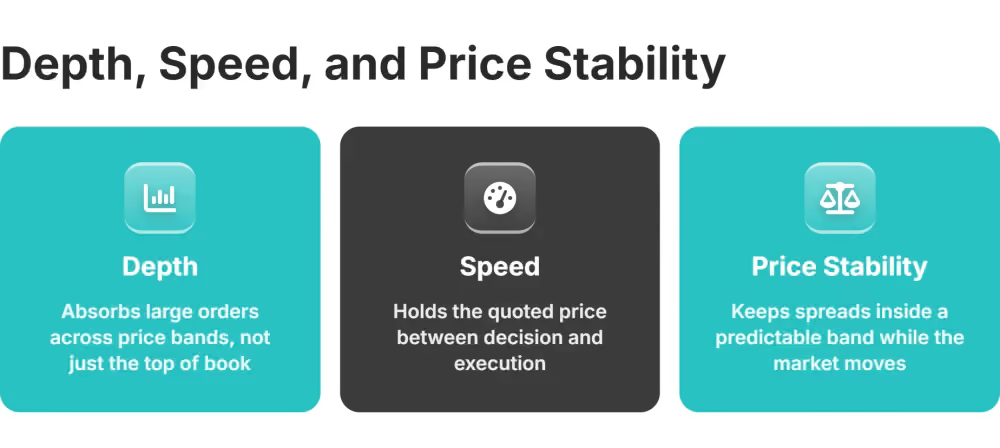
Depth, speed, and price stability work as one mechanism. Depth absorbs order size, speed preserves the quoted price between decision and trade execution, and stability holds the spread while the market moves. Reach that deep book a moment too late and it has already repriced, which is why the three only count together.
Measure all three on one scale across providers:
- Depth by basis-point band, for a book shape you can compare across venues.
- Median fill time under production message rates, because a quote you cannot reach in time was never available.
- Slippage bucketed by notional size, since a provider that looks strong on small orders can degrade sharply at ten times the ticket.
The Liquidity Provider Hierarchy: Tier-1, Tier-2, and Prime-of-Prime
For most exchanges, prime-of-prime is where institutional grade liquidity comes from. Direct Tier-1 bank relationships demand capital and credit quality thresholds a startup or mid-market venue cannot clear. Even a venue that clears that bar can still concentrate counterparty risk in one or two banks, where a broader panel would spread it.
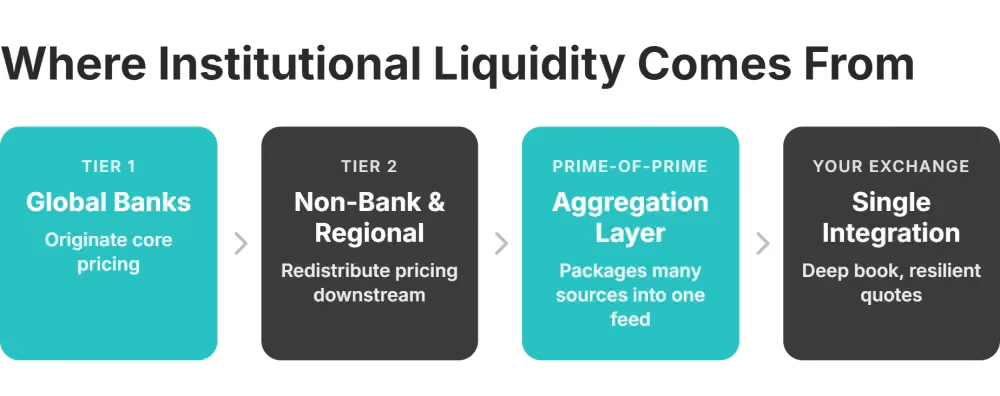
Above prime-of-prime, the chain runs in tiers. Tier-1 banks originate core pricing for capital markets and trade mainly with each other; Tier-2 firms redistribute that pricing downstream. A prime-of-prime layer sits below them and packages the aggregate into one institutional feed, connecting dozens of sources through a single integration that deepens the book and keeps quotes flowing when any one source pulls back.
When you compare providers at this tier, weigh counterparty diversification and onboarding speed as heavily as the headline spread.
What Institutional-Grade Liquidity Actually Requires From Your Infrastructure
External pricing is only half of execution quality. Your stack has to ingest quotes, rank them, and route orders fast enough to hit the prices your providers stream. When the stack lags, even the tightest external pricing reaches the client as a worse fill.
Treat sourcing and infrastructure as one procurement decision. The due-diligence questions worth asking are throughput under sustained load, failover design, and behavior during peak message bursts. Those bursts are where institutional flow finds the limits of your stack.
Matching Engine Latency and Order Book Depth
A latency figure means little on its own. Microsecond numbers come from controlled conditions, while institutional flow arrives during market volatility, so the real specification is the throughput an engine sustains when message rates spike.
Aggregation design is the second half of that test. In the October crash, market makers pulled quotes almost simultaneously. Venues that aggregated more independent sources kept more of their book standing through it. That advantage only materializes when the engine can rank and route across all of those sources in real time.
Crypto vs. FX: Why Institutional Liquidity Is Not One-Size-Fits-All
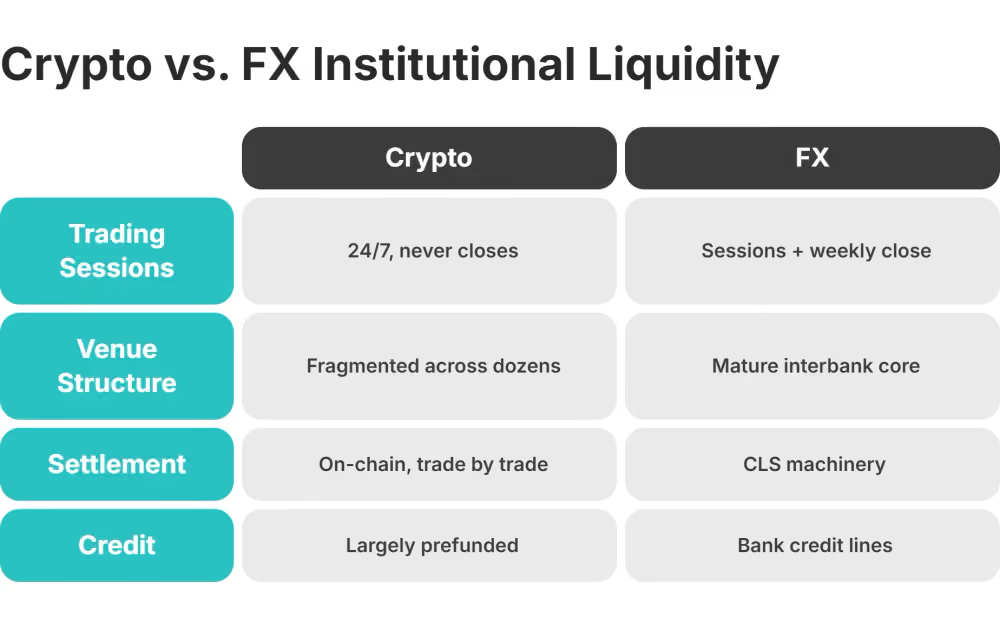
FX assumptions do not transfer to crypto. The two markets differ on four axes, and each one changes what institutional-grade execution looks like in practice:
- Session structure: FX trades around the clock on weekdays and closes for the weekend; crypto never stops.
- Venue concentration: FX pricing concentrates around a mature interbank core; crypto splits across dozens of venues.
- Settlement mechanics: FX settles through established machinery such as CLS; crypto settles on the blockchain, trade by trade.
- Credit intermediation: banks extend credit lines in FX; crypto still runs largely on prefunding.
An exchange that imports an FX operating model into crypto inherits controls designed for a market that closes on Friday.
Venue Fragmentation and Aggregation Architecture in Crypto
Crypto markets have no consolidated tape. Prices form independently on every venue, so the aggregation layer that merges those feeds becomes the source of price quality itself.
Stablecoin-denominated liquidity pools add a further layer. Depth in a USDT pair can differ sharply from the same instrument quoted against fiat, which forces a crypto exchange to source and monitor both books.
Settlement Risk and 24/7 Operational Exposure
Crypto settles around the clock with no session close and no central bank behind the market. Weekend gaps land on the venue's own treasury, and prefunding discipline decides whether quoted prices remain executable on a stressed Sunday.
FX shows what settlement machinery is worth. Even with CLS operating for two decades, more than $1.4 trillion of daily FX obligations still settles fully exposed to settlement risk , by the BIS's 2025 count. Crypto has no CLS equivalent, so on-chain finality, prefunding, and counterparty limits carry the entire burden.

The Operational Cost of Inadequate Liquidity
Thin liquidity costs more than a few bad fills. The larger loss is clients who leave. When a client watches one sizeable fill walk the book, they reprice the venue immediately, and the professional volume that follows them out is exactly the institutional investors the exchange set out to win.
The revenue side compounds quietly. Take a venue clearing $500 million of institutional notional a day: a two-basis-point deterioration on that flow works out to about $100,000 a day in higher transaction costs, before a single client leaves.
Stress concentrates the damage. During the October 10 crash, top-of-book Bitcoin depth on key venues shrank by more than 90% , and spreads went from single-digit basis points to double-digit percentages at the extremes.
Regulatory Obligations That Make Institutional Liquidity a Compliance Requirement
Under MiFID II and FCA rules, best execution is an evidence obligation. A firm has to show that clients received competitive execution across market conditions, and deep, multi-sourced liquidity is what makes that proof producible.
Compliance teams need auditable records of which pricing sources were reachable, why an order routed where it did, and how the fill compared to the alternatives. Single-source pricing makes that record hard to defend, because there is nothing to benchmark the fill against.
How to Evaluate an Institutional Liquidity Provider
A provider evaluation is a measurement exercise. Run the same tests on every candidate and score them against your own flow profile, from hedge funds to retail-facing brokers, whether in a demo or a full RFP.
Five dimensions cover the ground:
- Depth across basis-point bands, measured at the sizes you actually clear.
- Execution quality at your largest tickets, checked through stress testing while the market is moving, when the book is under real pressure.
- Connectivity: which of FIX, REST, and WebSocket the provider supports, and at what message limits.
- Counterparty mix behind the feed, since diversification there is your redundancy.
- Support coverage that matches your trading hours, including weekends for crypto.
The same framework extends to broker-specific pricing models and integration steps for a brokerage rather than an exchange.
Execution Quality Metrics: Fill Rate, Rejection Rate, and Slippage
Define the metrics before comparing them. Fill rate is the share of submitted trading volume that completes; rejection rate is the share of orders the provider turns away; and slippage is the drift between expected and executed price.
Averages hide the failures that matter. A 99% blended fill rate can mask a collapse on large tickets at the market open. Compare every metric inside notional bands, time-of-day windows, and volatility buckets.
Institutional Liquidity in the Current Macro Environment
Liquidity procurement now happens inside a tighter monetary regime. As quantitative tightening drains reserves, central banks have been recalibrating their lending facilities to keep short-term markets functioning. With the system holding a thinner buffer, reliable access to private liquidity and institutional capital counts for more than it did in the years of abundant reserves.
Market liquidity and funding liquidity feed each other. When funding tightens, market makers carry less inventory, books thin, and thinner books raise liquidity risk and the cost of funding further; research has documented these liquidity spirals across asset classes.
Diversification blunts that risk. Spreading exposure across providers and asset classes costs some integration effort, but it removes the concentration a tighter regime punishes hardest.
Build on Infrastructure That Delivers Institutional-Grade Liquidity from Day One
Institutional grade liquidity holds up only when you engineer sourcing and infrastructure together. A partner that runs both sides closes most of the integration gaps where execution quality leaks.
B2BROKER supplies that stack as one vendor:
- Multi-asset liquidity with deep spot and CFD pricing across 10 asset classes.
- B2TRADER , a multi-asset trading platform built for sustained order throughput.
- B2CORE , the back office and CRM behind accounts, reporting, and client operations.
- B2CONNECT , a crypto-native liquidity hub for aggregation across venues, including tokenized assets.
One vendor behind the whole chain means fewer integration seams and one accountable party when volatility hits.
That reliability comes with a track record. B2BROKER has operated in this market since 2014, serves 1,000+ corporate clients, and has helped launch 500+ brokers — more than a decade of live operation across more than one market cycle.
If your books thin out at the moments clients trade most, the gap is fixable before the next volatile session costs you a client.
Frequently Asked Questions about Institutional-Grade Liquidity
What is institutional-grade liquidity?
It is liquidity that lets a large order fill near its expected price whether the market is calm or stressed. The book holds enough resting volume across price levels to absorb size without the spread blowing out or the order getting rejected.
How is institutional-grade liquidity different from retail liquidity?
Retail pricing serves small orders in quiet conditions and thins out behind the top of the book. The institutional standard holds its depth when order size climbs and volatility spikes, which is exactly when retail-grade books start rejecting flow.
Why do exchanges need institutional-grade liquidity?
Deep, stable books control slippage and rejections and keep markets orderly through volatility. That execution record also underpins the best-execution evidence regulators expect.
What makes a liquidity provider institutional-grade?
The markers are aggregated multi-source pricing, consistently high fill rates, low rejection rates, and resilient connectivity over FIX, REST, or WebSocket. Expect transparent execution metrics and documented credit arrangements as well.
How do exchanges access institutional-grade liquidity?
Most connect through prime-of-prime relationships and aggregation layers that normalize quotes across sources. The execution stack matters as much as the counterparties, since matching latency and routing logic shape the liquidity clients actually receive.
Recommended articles

Subscribe to our newsletter