What to Know About Exit Liquidity for Brokers

People on social media treat exit liquidity like a meme, especially in crypto. But if you run a brokerage, it is a very real, measurable threat. Exit liquidity is the actual market depth you rely on when your clients need to sell assets immediately, typically because of forced liquidations or a sudden market panic.
When severe volatility hits, normal two-way trading can turn into a violent, one-way sell-off in minutes. If your backend isn't set up correctly, your brokerage essentially becomes the exit liquidity for the rest of the market. You get stuck absorbing toxic flow or warehousing risk right as your external counterparties disappear.
This guide skips the retail caution tales and focuses on your operational reality. We will break down how exit liquidity impacts your dealing desk and why leverage makes it worse, then walk through the controls that mitigate the damage.
Key Takeaways
- Exit liquidity is the market depth available during forced or large-scale asset sales. Brokers who fail to anticipate these scenarios face amplified slippage and wider spreads, which in turn drive a surge in client complaints.
- Leverage magnifies exit liquidity risk. Margin calls trigger simultaneous liquidations across correlated positions, consuming available liquidity far faster than normal market conditions allow.
- Aggregating liquidity from multiple providers eliminates single-point-of-failure exposure and keeps client orders executable even when primary sources dry up.
- Pre-trade risk limits combined with real-time monitoring and smart order routing prevent brokers from becoming unwitting exit liquidity for larger market participants.
- Due diligence on prime-of-prime partners should focus on pool depth and crisis-tested execution quality, backed by transparent fill-rate reporting during volatility events.
What Is Important About Exit Liquidity for Brokers?
In the context of day-to-day brokerage operations, exit liquidity represents the available market depth that can successfully absorb sell orders when clients or external counterparties must liquidate their positions rapidly.
A broker effectively becomes exit liquidity when it absorbs aggressive sell trades from participants who need immediate execution, often at highly unfavorable prices. Consider a scenario: a leveraged fund facing massive client redemptions is forced to liquidate large foreign exchange positions through your brokerage. To facilitate this, your dealing desk must quickly find external counterparties. If the broader market is also selling, those counterparties vanish. You are then forced to either execute at terrible prices or temporarily warehouse the risk on your own balance sheet.
Smaller brokerages often lack the sophisticated routing infrastructure and deep capital reserves to manage these toxic flows efficiently, thereby increasing their execution risk during periods of stress.
- Liquidation is the forced closure of positions when a client's account falls below the required margin.
- Deleveraging is the broader process of reducing borrowed capital exposure, which leads to mass selling.
- Redemptions occur when investors demand their money back from a fund, forcing asset sales to generate cash.
Order-Driven vs. Liquidity-Driven Exits
Order-driven exits are strategic sales based on a trader's fundamental view, with the seller willing to wait for favorable price levels.
Liquidity-driven exits, on the other hand, are forced sales triggered by margin calls, sudden fund outflows, or a hard risk-limit breach. The seller prioritizes speed over price and must execute regardless of the asset's price, creating asymmetric price impacts and making the order flow highly predictable to informed counterparties, and pump-and-dump operators.
Brokers facilitating liquidity-driven exits face significantly higher slippage (the gap between expected price and actual fill). In less liquid instruments, that gap compounds quickly.
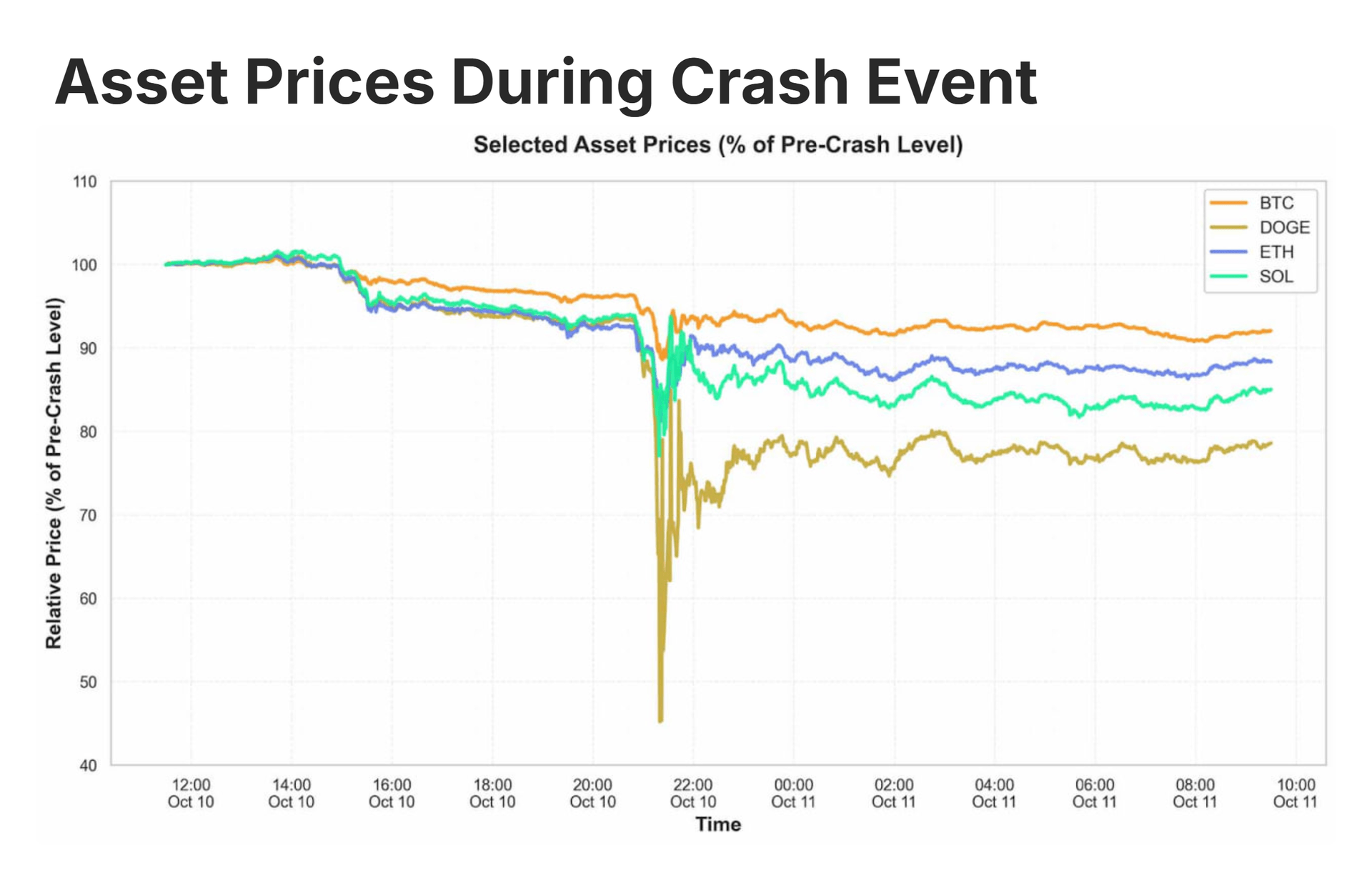
Why Brokers Become Exit Liquidity in Volatile Markets
Market volatility can transform routine, manageable order flow into severe exit-liquidity conditions with very little warning.
Common Triggers in FX, CFDs, and Crypto
Several primary triggers force widespread liquidation behavior across the financial markets.
The most common trigger is a margin call: when sharp price movements go against a leveraged position, automated systems close the trade to protect capital. That forced selling itself moves the price further, which triggers more margin calls across correlated positions.
Fund redemptions create a similar dynamic: institutional clients must generate cash regardless of market conditions, so they sell even when it is the worst time to do so. Regulatory actions freezing specific assets or a sudden market panic layer on top, pulling out whatever liquidity remains.
In the foreign exchange and CFD markets, brokers often face highly correlated triggers. When a central bank makes an unexpected interest rate decision, or a geopolitical shock hits the news, multiple correlated instruments will move simultaneously, straining the liquidity pool across the board.
The cryptocurrency market operates on a 24/7 basis, so triggers spread faster than in traditional markets. An exchange delisting or a blockchain-level smart contract failure can cascade across global venues within seconds. When a major stablecoin loses its peg, traders rush to swap holdings on decentralized exchanges (DEX), draining liquidity pools for tokens, NFTs, and stablecoin pairs almost instantly.
Stress-Test Your Execution Before the Market Does
Access aggregated multi-asset liquidity from Tier 1 sources through a single margin account, with depth that holds during volatility spikes.
How Leverage Amplifies Forced Selling
Leverage is the primary accelerant of exit liquidity crises. Leveraged positions require far less upfront capital, allowing traders to control large notional amounts. However, brokers or exchanges forcibly liquidate these positions the moment losses approach predetermined margin thresholds.
Margin-eligible assets show significantly higher liquidity comovement during market downturns. Under stress, liquidity becomes highly correlated: when one asset loses depth, the rest follow.
The cascade effect is brutal. One large liquidation consumes top-of-book liquidity, widening the bid-ask spread. That price drop triggers margin calls for traders sitting just below the current level. Exchanges close those positions, driving prices lower and triggering still more margin calls.
This dynamic is common in markets driven by social media hype. When a new memecoin or hyped token with a tiny market cap launches, early investors accumulate at low prices while retail investors, driven by FOMO, buy in as the price rises. Once early holders cash out at high prices, sell pressure drops the price rapidly, and late-arriving traders using leverage absorb the loss, becoming exit liquidity for those who exited first.
In worst-case scenarios, such as outright scams or organized pump-and-dump schemes, the hype fades, the memecoin issuer vanishes, leaving the remaining participants holding worthless assets.
During severe deleveraging events, effective spreads can widen by 40 percent or more, directly degrading your execution quality. Setting strict leverage caps and conservative margin policies helps brokers reduce the likelihood of these liquidation cascades.
Important Business Consequences of Being “Exit Liquidity”
Exit liquidity risk extends far beyond the trading desk and impacts the entire operating resilience of your brokerage. When your firm is caught on the wrong side of a liquidity vacuum, the business consequences hit execution quality and P&L stability first, then ripple into client retention and compliance.
Slippage and Spread Widening
Slippage is the difference between the price a client expects when they click a button and the actual fill price. When market liquidity thins out during a panic, slippage increases sharply.
When this happens, brokers face a difficult trade-off. Passing slippage through to clients erodes their trust in your platform, while absorbing it internally eats into your profit margins.
During forced liquidations, execution costs can rise by 50 percent or more because sophisticated counterparties anticipate the forced selling and reprice their bids accordingly. You can quantify this exposure by comparing average slippage and the rate of rejected or partial fills during stress events versus normal conditions. Spread widening also hits your entire client base during a stress event, including accounts with no open liquidation risk.
For a deeper understanding of how to manage this specific operational challenge, check our guide on how brokers deal with slippage.
Client Trust and Legal Exposure
When clients experience terrible fills during a market crash, they rarely blame market structure or a lack of liquidity. Instead, they attribute the poor execution to broker misconduct or technical incompetence.
Best-execution expectations come to the forefront. Regulators require brokers, as the issuer of execution, to provide evidence that they achieved the best available result given prevailing liquidity. If you are operating in the stock market or regulated crypto products like a spot Bitcoin ETF or an Ethereum ETF, the scrutiny is intense.
Repeated execution issues during volatile eras lead to client complaints and regulatory scrutiny that depress your firm's growth. Publishing a clear disclaimer about execution risks during extreme volatility, and providing transparent incident updates, can significantly reduce dispute frequency. Maintaining institutional-grade execution records is also essential for defending your fills when clients or regulators challenge them.
Protect Your Reputation With Ironclad Compliance
Deploy B2CORE to automate complex KYC and AML workflows and maintain transparent records that easily satisfy strict regulators.
Key Controls That Prevent Exit Liquidity Exposure
Preventing exit liquidity exposure requires layered and complementary controls. No single system will entirely eliminate the risk, but combined, they materially reduce your brokerage's exposure. Focus on practical controls you can build directly into your trading infrastructure and liquidity partnerships.
Aggregated Multi-Asset Liquidity Streams
The most fundamental defense is aggregating your liquidity streams across multiple top-tier providers. Relying on a single counterparty during moments of extreme stress is a risk most brokerages cannot afford.
Deeper, diversified liquidity pools help your brokerage maintain tighter spreads and better fill rates when your primary sources thin out. Multi-asset coverage is especially important if you offer foreign exchange and crypto assets alongside CFDs, because fragmented markets lead to inconsistent execution quality.
Connecting to a prime-of-prime aggregator allows you to access a depth and diversity of liquidity that most independent brokers simply cannot source directly. Ultimately, aggregated setups consistently demonstrate lower execution shortfalls during volatility compared to single-provider routing models.
Pre-Trade Risk Limits
Pre-trade risk limits are automated system checks that evaluate every single order before it is allowed to hit the open market. If an order violates configured parameters, the system instantly blocks or throttles the trade.
In today's fast-paced electronic markets, these controls are no longer optional; they are baseline expectations for professional-grade risk management. Without pre-trade limits, a single massive, erroneous order from a client could instantly consume your available liquidity and leave your brokerage exposed to the resulting price gap.
Real-Time Monitoring
Real-time monitoring surfaces concentration risks long before they force a chaotic liquidation, giving your risk team time to intervene before conditions become unmanageable.
Specific controls to include in your monitoring stack are: Position size limits calculated relative to the currently available market liquidity. Margin utilization thresholds equipped with early-warning alerts before forced liquidation is necessary. Correlation monitoring across client portfolios to ensure a single macroeconomic event doesn't wipe out multiple distinct accounts. Strict counterparty exposure limits for all B-book positions.
Automated monitoring drastically outperforms manual oversight in fast markets where price levels and liquidity conditions shift in seconds.
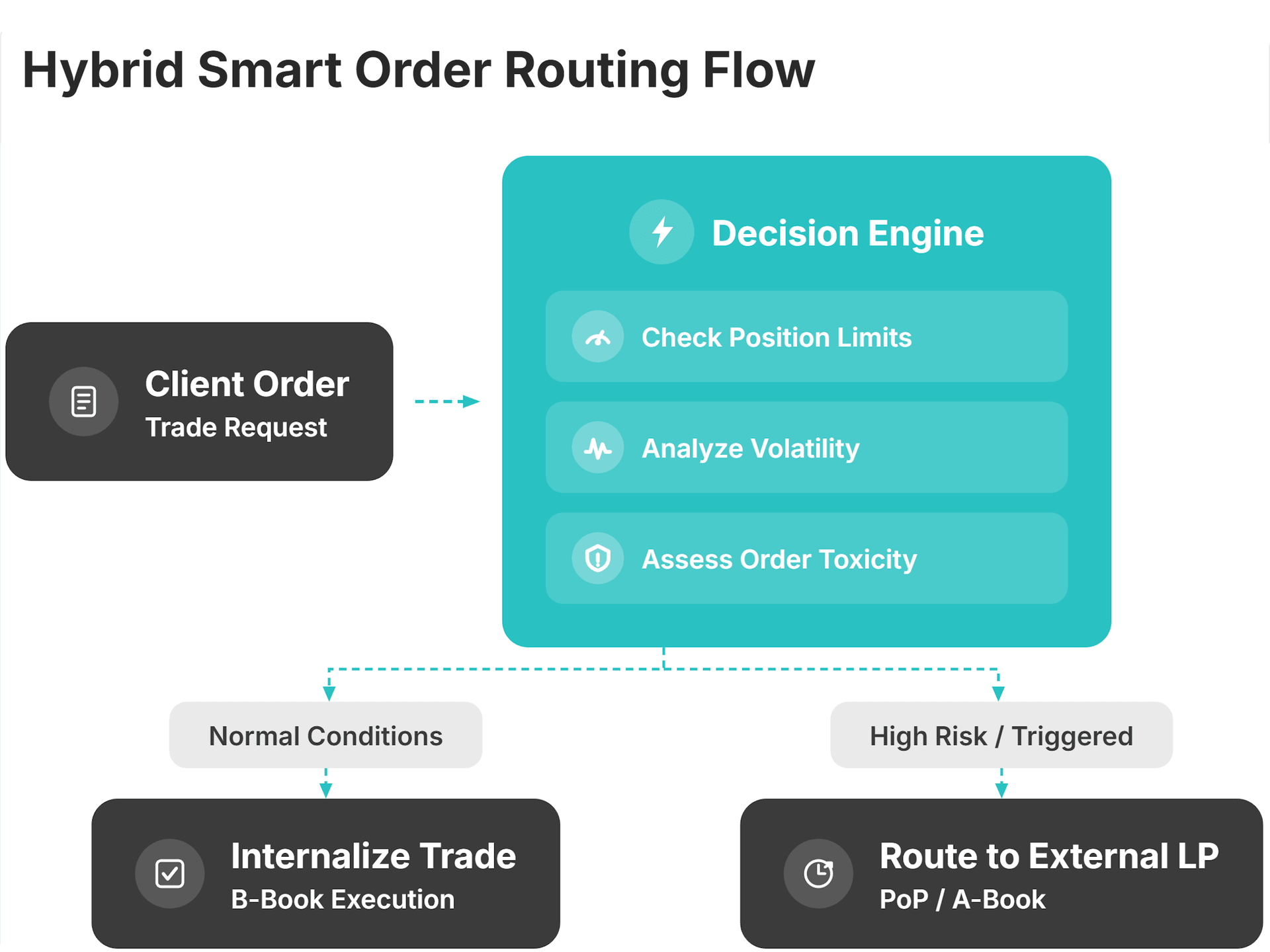
Smart Order Routing and Internalization
Smart order routing, often referred to as SOR, is the technology that automatically routes client orders to the specific venue or liquidity path most likely to deliver best execution at that exact millisecond.
SOR reduces your exit liquidity exposure by intelligently distributing trading volume across multiple venues, rather than exhausting a single liquidity pool and causing severe price impact.
Internalization complements SOR by matching opposing client flow on your own books before routing the remaining imbalance externally, preserving your external liquidity and reducing your market footprint. However, internalization only works safely with sufficient two-sided flow and robust risk controls. Combining intelligent SOR with automated risk tooling reduces execution variance without requiring a custom matching engine.
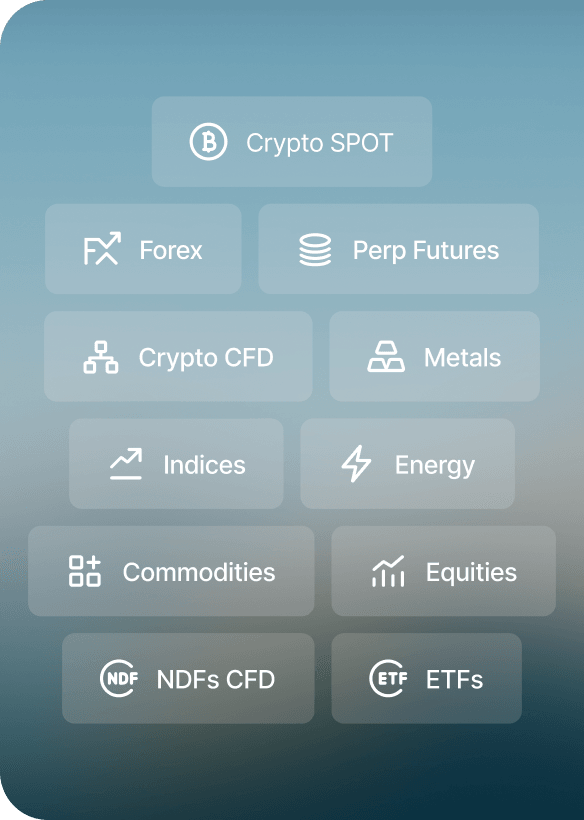
Deep, Reliable Liquidity Across 10 Major Asset Classes
FX, Crypto, Commodities, Indices & More from One Single Margin Account
Tight Spreads and Ultra-Low Latency Execution
Seamless API Integration with Your Trading Platform
Tips for Evaluating Liquidity Providers for Exit-Risk Mitigation
Your liquidity providers largely determine your execution quality during stress, so deep due diligence when selecting or reviewing prime-of-prime relationships is mandatory. Evaluate how providers perform in a volatile environment specifically, because calm-market metrics tell you very little.
Marketing metrics, such as average tight spreads during calm trading hours, are completely insufficient without understanding a provider's crisis behavior and transparency.
When evaluating a partner, you must specify the exact data you want to see. Request historical fill rates segmented by volatility regime. Ask for data on spread widening during specific named events, such as the flash crashes in Bitcoin or major central bank surprises. Request their counterparty concentration metrics. Providers that are confident and transparent will welcome this scrutiny. Reluctance or refusal to share stress-period performance data almost always signals underlying weakness.
The ultimate goal is to partner with firms that can prove their operational resilience precisely when market liquidity becomes scarce.
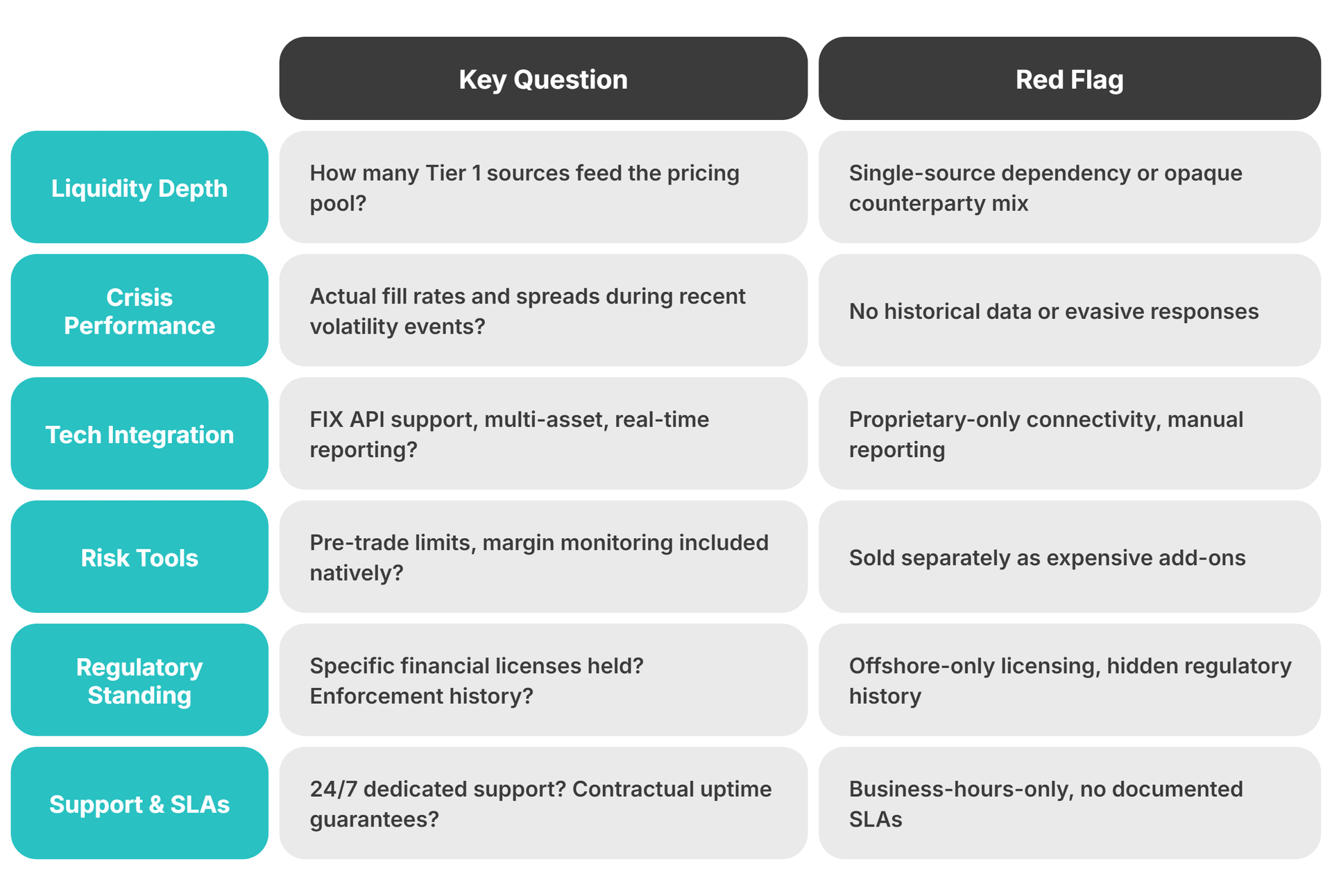
Due-Diligence Checklist for Prime-of-Prime Partners
When evaluating a potential partner, use this structured framework to ensure you are protected.
For a deeper look into what makes a provider truly institutional, review our guide on the institutional liquidity provider for brokers.
Strengthen Your Liquidity Framework Today with B2BROKER
Exit liquidity risk is a structural reality of operating a brokerage. It emerges predictably during sudden volatility spikes and correlated deleveraging cycles. However, while it cannot be entirely avoided, it is highly manageable with the right infrastructure and the right institutional partnerships.
Brokerage leadership should start by auditing liquidity-provider relationships for single-point-of-failure risks, then review pre-trade limits and real-time monitoring dashboards. Request crisis-performance data from your current providers and validate that integration and reporting capabilities meet modern best-execution standards.
B2BROKER provides a comprehensive ecosystem designed specifically to mitigate these risks. From deep multi-asset liquidity aggregation to advanced CRM systems and secure wallet infrastructure, our suite is engineered to work seamlessly together.
Brokers that invest in a resilient liquidity framework today are far better protected when the next volatility shock hits. Do not wait to become the market's exit liquidity.
How Resilient Is Your Liquidity Stack?
Book a one-on-one session with our institutional team to audit your current LP setup against the due-diligence checklist in this guide.
Frequently Asked Questions about Exit Liquidity
- What does exit liquidity mean in a brokerage context?
It means your brokerage is forced to absorb aggressive sell orders during market panics when external counterparties vanish. This dynamic severely increases slippage, widens spreads, and can create significant financial losses.
- How can small white-label brokers manage exit liquidity risk?
Partner with reputable prime-of-prime providers that aggregate liquidity from multiple Tier 1 sources to guarantee execution depth. You should also enable built-in pre-trade limits and automated margin thresholds to protect your capital.
- Does exit liquidity risk affect copy-trading flows differently?
Yes, copy-trading amplifies this risk because follower accounts execute identical orders simultaneously, creating massive, concentrated market impact. You can mitigate this by enforcing strict per-strategy position limits and using specialized execution algorithms.
- How do I avoid becoming exit liquidity for larger market participants?
Diversify your external liquidity sources and continuously monitor real-time exposures for concentration and correlation risks. Additionally, use smart order routing to intelligently distribute your trading flow across multiple venues during forced-selling events.