Crypto CFD vs Spot: Which Model Fits Your Brokerage?

A brokerage adding digital assets faces one structural decision before anything else: offer a derivative that tracks the price, or deliver the asset itself. Client demand is not the question. The top 12 cryptocurrency exchanges alone recorded nearly $21 trillion in spot volume in 2025, so the operator's real problem is which side of that flow to build on.
Most comparisons of crypto CFD vs crypto spot speak to traders deciding what to buy. An operator needs a different comparison, because the model determines how the whole operation gets built, from liquidity sourcing down to the license on the wall.
The sections below compare the two models the way a CTO would scope a build, from liquidity mechanics and failure modes under stress to the licensing path each product carries.
Key Takeaways
- The CFD-or-spot choice is a product architecture decision: liquidity sourcing, technology stack, and licensing path all follow from it.
- CFD execution quality depends on an external liquidity provider's feed, while spot execution depends on real order book depth. Both degrade visibly when markets turn volatile.
- A spot venue must build custody before launch, including wallet architecture, key management, and settlement monitoring on every supported chain.
- Regulators treat the two products under separate frameworks, so client eligibility and licensing requirements differ from day one.
- Running CFD and spot on separate vendor stacks multiplies reconciliation work and slows every new instrument launch.
CFD vs. Spot: Business-Level Distinction
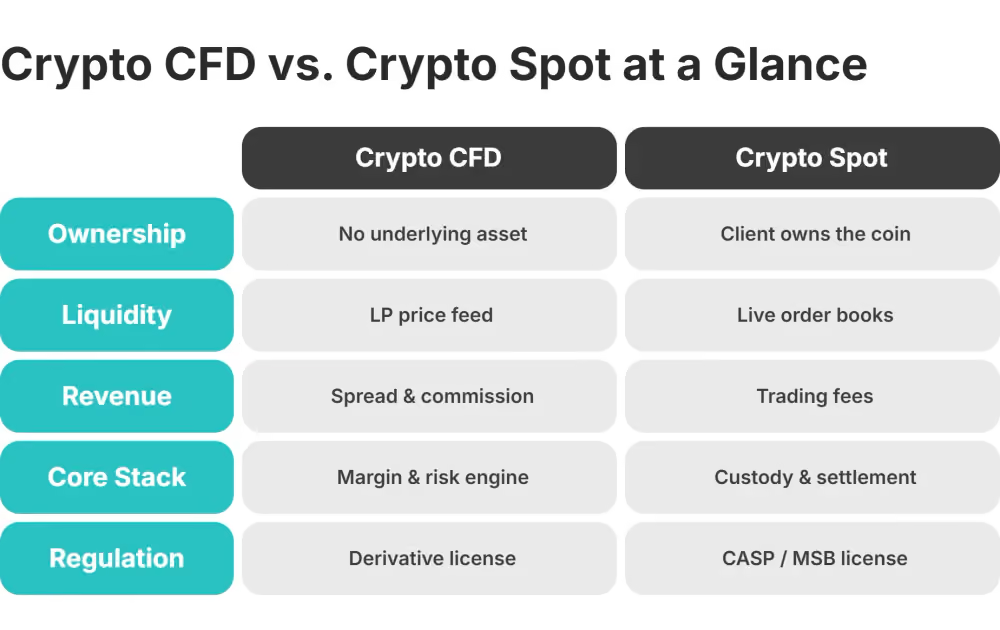
Crypto CFDs (contracts for difference) are derivative deals between clients and brokers. The broker holds no underlying asset; it manages client exposure, hedges the net position with a liquidity provider, and earns from spread markup or volume commission.
Crypto spot is the opposite arrangement, where the venue delivers the digital currency to the client. Revenue comes from trading fees, sometimes with withdrawal or custody charges on top. The client base runs from long-term holders to market makers who need real coins to quote elsewhere.
Ownership is the dividing line. A CFD client buys price exposure and never touches the coin, while a spot client owns the asset once the trade settles. Every operational difference between the two models traces back to that split, and the same question decides how spot and margin exchanges are built at the venue level.
What Crypto CFDs Mean for Your Product Offering
Offering CFDs makes you a derivatives business. Clients use leverage for position sizing and to go long or short, while the heaviest volume comes from algorithmic and arbitrage desks.
These accounts trade a lot and forgive very little. Systematic strategies run on thin margins, so the venue whose spreads widen first loses that flow to whichever competitor holds tighter.
Because the broker owns no asset, everything these clients experience arrives through the liquidity provider's feed, which makes that one relationship the deciding factor in whether the flow stays.
What Crypto Spot Trading Requires Operationally
Spot trading in crypto means your venue handles real cryptocurrency, and custody arrives before the first trade. Standard practice keeps most reserves in cold storage with a small operational float in hot wallets, backed by documented procedures for handling private keys.
On-chain money brings on-chain compliance. The venue screens incoming deposits against sanctions lists before crediting them to client accounts, a control layer that has no CFD equivalent.
A spot venue also needs real market depth behind its book, so fill quality under stress reflects the order books it can actually reach. Asset coverage expands the build too: a stablecoin on an existing chain can reuse some infrastructure, while altcoins such as Litecoin or XRP require separate network support.
How Liquidity Is Sourced Differently
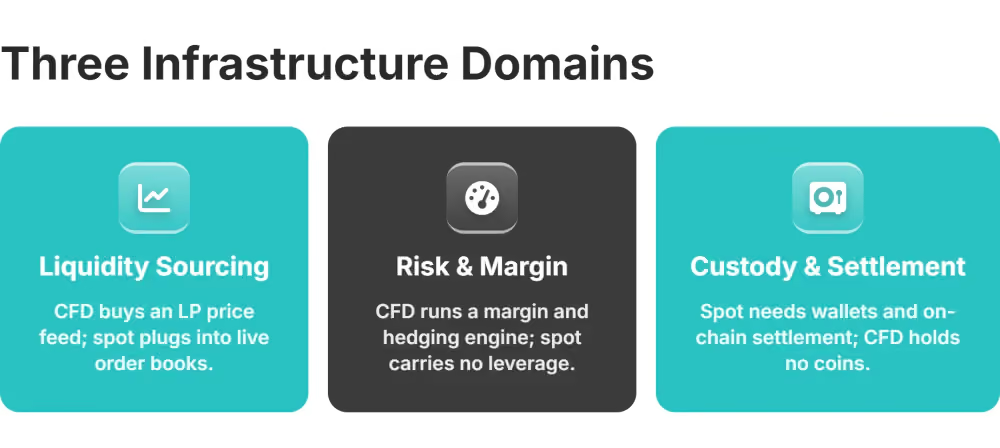
Liquidity sourcing is where the two models diverge the most. A CFD broker buys a pricing feed, while a spot venue plugs into live order books across fragmented spot markets. Those rails make the two behave differently in execution , and each fails in a way that shows up in client fills.
The CFD chain starts at the liquidity provider. The broker aggregates LP quotes, adds a markup, streams the result to clients, and hedges net exposure back out. The LP builds that feed from a spot price reference, so the broker never touches a real order book: clients trade a representation of the market, one step removed from actual depth.
That chain concentrates risk in one relationship. When an LP widens its quotes or starts rejecting hedge orders during a volatile hour, clients feel it within seconds, and there is rarely an alternative feed to switch to mid-event.
Spot venues carry the opposite exposure. When a liquidation cascade or a macro release empties the order books, price impact is immediate and visible, with no synthetic layer to smooth it over.
Liquidity Gaps and Their Business Consequences
A liquidity gap costs money directly. When depth runs out, spreads blow wide and orders start bouncing. Where the gap originates splits along the crypto CFD vs crypto spot line: for a CFD broker it sits with the liquidity provider, for a spot venue with its own market access.
Slippage, Rejected Orders, and Fill Rate Degradation
Slippage is the distance between the price a client expected and the price the fill came at. It grows whenever depth thins or price volatility spikes. In a CFD book it mirrors the LP's feed, while in a spot book it tracks the real depth on the venues you reach.
A rejection hurts more than a bad fill, because the trade simply did not happen. CFD rejections appear when the LP declines the requested size at any price it will quote. On a spot venue, they show up when the book is exhausted or the connection to it drops.
The time to test either path is a calm week. An LP agreement and a venue connection can both be stress-audited before the market does it for you, and operators with the best fill statistics run those audits on a schedule.
Client Churn and P&L Impact from Poor Execution
Execution quality decides who stays. Institutional and high-volume accounts run transaction cost analysis on every venue they use. A consistent slide of a few basis points in average fill quality shows up in their reports as a cost.
The arithmetic is unforgiving. A broker clearing $100 million a month in CFD volume that develops five basis points of extra slippage passes roughly $50,000 a month of new cost to its clients. TCA surfaces that within a quarter, and the accounts generating the most volume act on it first.
Multi-provider aggregation through a hub such as B2CONNECT reduces the concentration risk that sits behind that math.
Infrastructure Requirements by Instrument Type
The two models do not share a technology stack. Planning them as one build is how projects overrun, because the load-bearing systems barely overlap. One side runs on a margin engine, the other on a custody and settlement stack.
Margin Engine and Liquidation Logic for CFDs
The margin engine is the core of CFD risk management. It recalculates every client's exposure in real time, raises margin calls as equity approaches the threshold, and closes positions automatically when equity falls through it.
Calibration is the hard part. Poor calibration either closes viable positions too early or leaves the broker exposed to negative client equity. Dynamic leverage adds another dimension, since limits can vary by client group, instrument, or market regime.
B2TRADER ships margin trading, per-group dynamic leverage, and partial liquidation logic as built-in capabilities, which takes that engine off the custom-build list.
Custody, Wallets, and Settlement Stack for Spot
Custody is the one decision a spot venue makes at launch and lives with for good. Self-custody means full control and full operational burden; a third-party custodian like Fireblocks or BitGo takes on that burden but adds counterparty risk.
MPC infrastructure sits between the two. It removes single-key control and is now common in institutional-grade deployments.
The settlement stack sits underneath the custody choice. At minimum it has to:
- broadcast transactions and track confirmations against each chain's finality rules;
- estimate network fees in real time so payouts neither stall nor overpay;
- issue and monitor deposit addresses at scale on every supported network.
Each additional blockchain multiplies that surface. Bitcoin and Ethereum need different confirmation policies. Solana adds another smart contract network with its own finality behavior and upgrade schedule.
Running Both Models from a Single Platform
When a brokerage scales into both models, the pain arrives if each one runs on a separate vendor stack. Two stacks mean duplicate reconciliation and a second support queue. Every new instrument becomes a coordination project across both.
An integrated setup pays the integration cost once. When the whole stack comes from one ecosystem, expanding from CFDs into spot reuses the plumbing already in place.

Regulatory Considerations by Product Type
Regulators classify the two products under separate frameworks. Nearly every major jurisdiction treats a crypto CFD as a derivative and a spot trade as a crypto asset service, which changes who you can onboard and which license you need.
CFD Licensing and Client Eligibility Rules
A crypto CFD business needs a derivatives or investment firm license, and the rules tighten by jurisdiction. The US CFTC prohibits off-exchange leveraged crypto trading for retail customers. In the EU, MiFID II governs the product, and ESMA set retail crypto CFD leverage at 2:1 , a cap national regulators still enforce. The UK's FCA banned crypto derivatives for retail consumers in January 2021, leaving UK-facing desks to serve professional clients only.
Regulators also expect appropriateness tests, so a CFD broker has to confirm that a retail client understands leveraged products before granting access. That check lives in onboarding, and it shapes how the funnel gets built.
Spot Crypto Compliance Under Evolving Frameworks
Spot venues answer to crypto asset service provider regimes instead. In the EU, MiCA has governed CASPs since December 2024 , with authorization, custody, and disclosure requirements attached. US spot operators register with FinCEN as money services businesses and add state money transmitter licenses one state at a time. Capital or surety requirements typically come with the applicable EU or state licensing regime.
KYC and AML apply to both models, but spot carries the heavier load because real assets move. Screening incoming transfers and tracing funds that touched a mixer are obligations a CFD desk never faces.
An EU operator running both models often needs coverage under both MiFID II (as an investment firm) and MiCA (as a CASP), each with its own supervisor. Compliance tooling that covers both regimes cuts that overhead, and the time to secure it is when the infrastructure gets chosen.
This section is general orientation, not legal advice. Crypto regulation moves quickly and varies by jurisdiction, so confirm your specific licensing and compliance obligations with qualified counsel before committing to a model.
Choosing the Right Model for Business
The right model depends on your client base, revenue plan, and engineering capacity. Most scaling brokerages eventually run both.
Revenue Model and Client Demand Alignment
CFD revenue scales with volume, so the model holds up best when the book is full of active, high-frequency accounts. Those clients arrive with leveraged strategies , including momentum systems and hedging overlays, and they pay for tight spreads and stable financing costs.
Spot revenue leans on trading fees, and clients also see blockchain transaction fees when assets leave the venue. Durable spot economics usually need an institutional segment or adjacent services such as staking, custody, or DeFi (decentralized finance) access to carry margin.
Operational Capacity and Time-to-Market Tradeoffs
A CFD brokerage reaches market faster because there is no custody stack to build. With a white-label platform, a CFD desk can launch in weeks; a spot exchange usually spends months on custody and settlement before it can accept an order.
The launch sequence matters less than the platform decision behind it. An integrated vendor keeps the second model's build inside infrastructure you already operate.
Build Either Model Without Vendor Sprawl
Strip the comparison down and crypto CFD vs crypto spot is an infrastructure decision first: the model dictates what you build and whom you answer to. Reversing course after launch means paying for both stacks anyway.
B2BROKER's ecosystem covers both paths with one integration. B2TRADER executes CFD and spot trades with a built-in margin engine, B2CORE runs the back office, CRM, and reporting, and B2BINPAY handles crypto and fiat currency payments. An operator that starts with one model expands to the other on the same foundation.
B2BROKER has operated since 2014, holds 10 regulatory licenses, and supports more than 1,000 corporate clients, so the operational and regulatory experience above comes from systems running in production.
If a crypto launch is on your roadmap this year, the fastest way to scope it is to walk your requirements against a working stack.
Frequently Asked Questions about Crypto CFD vs Spot
What is the main operational difference between crypto CFDs and crypto spot for a brokerage?
A CFD gives the client price exposure while the broker holds no crypto; spot delivers the asset and obliges the venue to run custody and settlement. Everything else, from liquidity sourcing to licensing, follows from that split.
How do liquidity gaps affect a crypto CFD or spot brokerage differently?
In a CFD business a gap traces back to the liquidity provider's feed; in a spot business it reflects real order book depth and market access quality. Clients experience both the same way, as wider spreads, rejections, and slippage during volatile periods.
Should a broker launch crypto CFDs, spot trading, or both?
CFDs reach market faster because no custody build is required, while spot serves clients who want to own the asset. Most growing operations end up running both, and doing so on one integrated platform keeps reconciliation and vendor overhead manageable.
What infrastructure does a crypto spot exchange require that a CFD broker doesn't?
A spot exchange must run custody end to end, from wallets and key management to settlement tracking on every chain it supports. A CFD broker skips all of that and instead needs a real-time margin engine with automated liquidation logic.
How does the regulatory treatment of crypto CFDs differ from crypto spot products?
Most jurisdictions regulate crypto CFDs as derivatives, with investment firm licensing and retail restrictions such as the UK's ban. Spot products fall under crypto asset service provider regimes like MiCA, which center on custody and AML obligations.
Recommended articles

Subscribe to our newsletter