How Long Can Crypto Exchange Infrastructure Take to Deploy?

Crypto exchange launches usually slow down when separate systems have to work together for the first time. An exchange may pass every internal demo and still lose months once execution, custody, and compliance workflows need to operate as one production environment.
That makes crypto exchange infrastructure a systems question more than a timeline one. The cryptocurrency market is large: the top twelve centralized exchanges processed close to $21 trillion in spot trading volumes during 2025, per CoinGecko's spot exchange report.
This guide walks through what an institutional-grade stack requires and how long each component realistically takes to stand up. You will see where custom builds, white-label stacks, and MetaTrader-dependent setups diverge on time-to-market, and where that gap turns into commercial risk.
Key Takeaways
- Deployment speed matters less than how tightly execution, custody, compliance, and back-office systems act as one control layer.
- A credible stack rests on four linked systems: matching, liquidity connectivity, custody, and embedded KYC, AML, and Travel Rule workflows.
- Building internally stretches timelines, because every component has to be integrated, tested, and maintained by your own team.
- White-label deployment shortens time to market, and it lowers integration risk across liquidity, CRM, margin, and reporting.
- MetaTrader dependency narrows your options, adding licensing exposure and reducing control over margin design, front end, and roadmap.
Why Deployment Timeline Is the Wrong Starting Question
How long deployment takes is the wrong first question. The answer depends on which layers you own, which you outsource, and which you integrate and then maintain, and each choice moves the timeline more than any vendor estimate. A firm that builds its own matching engine but rents liquidity faces a different critical path than one buying an integrated stack and configuring it.
Map that critical path before you ask for dates. Every layer carries its own dependencies, from liquidity onboarding to regulatory sign-off, and the slowest of them sets your real launch date. Operational readiness tells you whether you will reach production, and that rarely matches a vendor's promised go-live.
The Core Infrastructure Stack Every Crypto Exchange Requires
Crypto exchange infrastructure behaves as an interdependent stack, so a cryptocurrency exchange stalls when weak architecture in one layer bottlenecks the rest, whether that surfaces as capped throughput from a slow engine or delayed withdrawals from fragile custody.
The order below follows how trades actually move, from matching through to compliance, because integration quality between these layers shapes both time-to-market and long-term ownership cost.
Matching Engine and Order Book Architecture
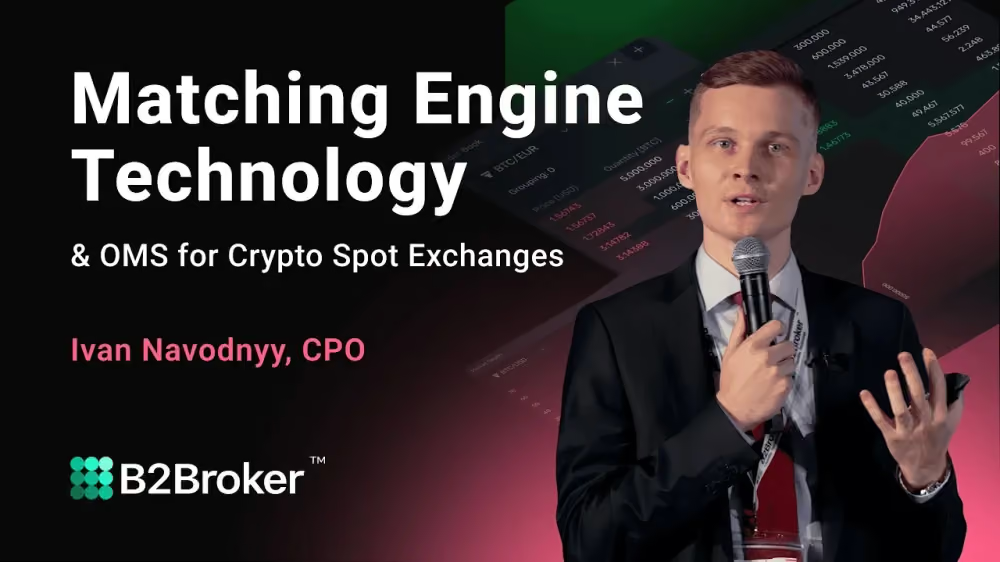
The matching engine sets your performance ceiling. Off-chain, low-latency designs already reach sub-millisecond latency and more than 200,000 trades per second in real time, and tier-one venues such as Binance run past a million orders per second . The matching algorithm functions under the same tail latency that high-frequency trading desks watch, the slowest one percent of orders, which they expect under 100 microseconds.
A central limit order book ranks resting buy and sell orders by price, then by the time each one arrived, so the earliest best-priced order fills first. Many centralized venues match trades off-chain and settle them on-chain through smart contracts. That split keeps matching fast, and it adds a blockchain settlement step your risk controls have to account for.
This is what separates a centralized exchange, or CEX, from a decentralized exchange. A CEX runs its own trading systems and order book off-chain, while a DEX settles peer-to-peer on-chain and leans on decentralized finance (DeFi) protocols instead of a central operator. Most institutional-grade venues still choose the CEX model, because it delivers the throughput and control that a stock exchange-style order book needs.
Liquidity Sourcing and Prime Brokerage Connectivity
Exchange infrastructure fails commercially without executable liquidity, however fast the engine runs. You have three sourcing routes, and each is a separate launch decision. Aggregation pulls quotes from several venues, market makers, and OTC desks into one book. Internalization fills client orders against your own inventory across major pairs such as Bitcoin and Ethereum. Prime brokerage connectivity opens access to institutional counterparties and deeper books for spot, derivatives, and fiat currencies.
Judge any route on spread quality, fill consistency, and how depth holds up when volatility spikes, since demo conditions rarely show where quotes thin out. A scalable market-making setup keeps a second counterparty ready, because a single provider that stops streaming during a spike leaves your book empty at the worst possible moment.
Custody Architecture and Wallet Tiering
Custody design decides how fast clients withdraw and how much treasury risk you carry across every digital asset you list. Institutional setups tier funds by exposure: cold storage holds more than 90 percent of assets offline under multi-signature control, warm wallets keep 5 to 10 percent for signed operational flows, and hot wallets hold under 1 percent for instant payouts.
Multi-signature schemes such as 2-of-3 or 3-of-5 require several private keys before funds move, so one compromised key cannot drain a wallet. Multi-party computation changes the control model further by splitting a single key into shares that sign together without ever reconstructing the whole key. Treat both as core security measures, and reach for either where it changes who can authorize a transfer rather than adding it as a reflex.
Custody also has to track how each supported chain behaves. Blockchain networks each expose their own vulnerabilities, so your cybersecurity model, key rotation, and incident response have to match the underlying blockchain technology and its distributed ledger rather than a generic template. If you plan to offer staking or tokenization, or list assets that a venue like Coinbase already supports, factor those flows into the same custody design from the start.
Compliance Layer: KYC, AML, and Travel Rule Integration
Compliance belongs inside the infrastructure from the first design review, since bolting it on after launch forces manual reviews that throttle growth. Know your customer (KYC) checks, anti-money laundering (AML) transaction monitoring, and Travel Rule messaging all touch the trading and wallet layers directly, so the sequencing you choose early decides how much rework you face later.
The FATF Travel Rule applies its Recommendation 16 to virtual asset transfers, asking providers to pass originator and beneficiary data on transactions at or above 1,000 US dollars (USD). The European Union goes further, enforcing a zero threshold under its Transfer of Funds Regulation, which also covers movements between crypto and fiat currencies, per FATF guidance.
In the EU, MiCA has governed crypto-asset service providers since December 30, 2024, with a transitional authorization window running to July 1, 2026, and other financial services hubs such as Hong Kong run their own regimes. A crypto venue rarely has the central authority or traditional intermediaries a bank relies on, so design the data handoffs between trading, wallets, and screening vendors early, because reworking them later resets your compliance testing.
Build Timelines by Infrastructure Component
Build timelines for a cryptocurrency exchange vary far more by component than by exchange size. Some layers need core engineering, others wait on external counterparties and regulator sign-off, and that second group is where schedules quietly slip.
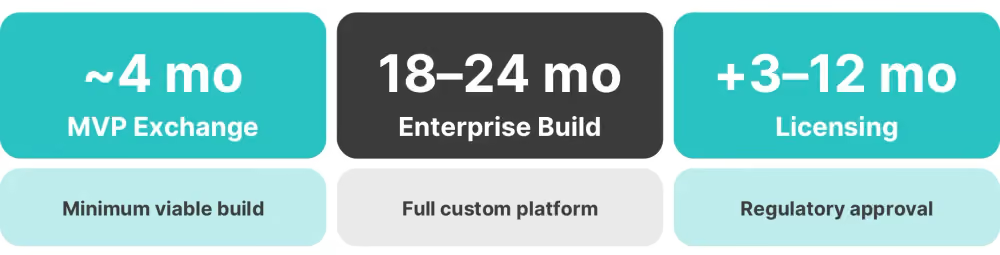
A ballpark helps set expectations. A minimum viable exchange can take around four months, while an enterprise-grade platform runs 18 to 24 months or more, plus another 3 to 12 months for licensing.
Timelines rarely slip on the code you planned for. They slip on scope creep, compliance rework, and the production hardening teams underestimate.
Custom Matching Engine Development
A custom engine reaches well beyond matching logic. You also own order types and liquidation rules, plus the monitoring, replay, and recovery tooling that keeps the engine safe when volume surges. Each of those functions adds its own test surface, and testing is where custom timelines stretch.
Greenfield work buys you full control over how the trading systems behave, and it hands you performance tuning, QA, and every future release. For a team shipping its first venue, that ownership burden is the part most schedules underestimate, because a matching engine you never stop maintaining is not the same as one you buy and configure.
Liquidity Integration and Market Depth Configuration
Liquidity integration takes longer than wiring an API. Counterparty onboarding, symbol mapping, and failover routing each need configuration and testing before real flow arrives, and markup and market-depth rules have to match how you actually price.
Ask any provider for production metrics from volatile windows rather than calm demos. Demo spreads look tight when nothing is moving, and they hide depth exhaustion and quote instability at exactly the moments your clients trade hardest.
Compliance and Regulatory Module Buildout
Regulatory buildout runs wider than KYC screens. Onboarding flows, sanctions screening, and jurisdiction-specific retention controls all need building and formal sign-off, and case management and reporting sit on top of them.
The delays here rarely come from engineering. Policy approvals, vendor contracts, and regulator feedback set the pace, and every deposit and withdrawal journey has to be tested against them before you open the doors.
White-Label Deployment vs. Custom Build: What the Timeline Gap Actually Means
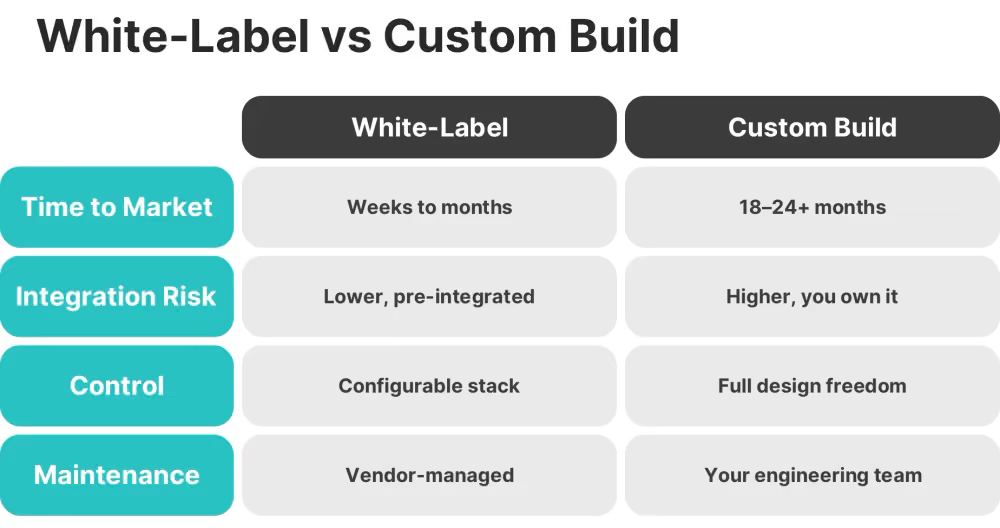
The real difference goes beyond months on a chart. White-label deployment compresses integration and operational setup, while a custom build preserves design freedom at the cost of higher execution risk. One path hands you a configured, user-friendly trading platform; the other hands you a construction project.
A delayed launch carries real commercial cost. Every month before go-live postpones client acquisition, revenue feedback, and the regulatory learning that only live operations produce. Custom development still fits some cases, usually a workflow specific enough that no packaged stack can express it. For most scaling brokerages, an integrated stack removes the compounding dependencies that turn a six-month plan into an eighteen-month one.
The Hidden Cost of MetaTrader Dependency in Infrastructure Planning
MetaTrader dependency is an infrastructure risk before it is a brand preference. Licensing sits with a third party, so your roadmap, unit economics, and room to differentiate all move at someone else's pace. That exposure rarely shows up in a launch estimate, and it shapes every year after launch.
The feature ceiling matters more than most planning admits. Native multi-asset workflows, modern CRM connectivity, and broker-controlled margin logic stay hard to reach when the core trading platform fits a different trading environment.
How B2TRADER Compresses Deployment Without Compressing Capability
An integrated platform removes most of the coordination that stretches a build. When trading, liquidity, CRM, and extension points already sit in one maintained ecosystem, you configure rather than assemble. B2TRADER works that way.
Its cross-margin management and TradingView integration ship as native functions inside the platform, alongside mobile access and dynamic commissions, so you tune parameters instead of writing them. Native links to B2CORE for back office and B2CONNECT for crypto liquidity mean the pieces that usually demand separate vendor projects arrive already connected.
For a scaling brokerage, proprietary ownership cuts third-party coordination and the release lag that follows it, which is where much of the timeline gap actually lives.
Infrastructure Selection Is a Competitive Positioning Decision
Infrastructure choices set more than a launch date. They decide product control, compliance posture, and how credibly you can serve institutional flow across crypto markets and wider financial markets once you are live. A brokerage that owns a tightly integrated stack can move on pricing, margin, and new digital asset classes while competitors wait on vendor tickets.
B2BROKER has built liquidity and trading technology for the brokerage and exchange industry since 2014, working with hundreds of institutional clients across the regulated financial system.
Before committing engineering years to a custom path, map your requirements against an integrated platform and see where the timeline and control tradeoffs actually land.
Frequently Asked Questions about Crypto Exchange Infrastructure
What are the core components of crypto exchange infrastructure?
A matching engine, order book, liquidity connectivity, custody, and a compliance layer, all operating as one system. How tightly they integrate with risk controls and post-trade operations matters more than any single part, since fragmented vendors add latency and reconciliation load.
How do matching engines work in crypto trading?
The engine receives orders, ranks them by price-time rules, and updates the central limit order book in real time, which sets throughput, latency, and fill quality. At launch, it should connect natively to liquidity, margin, and surveillance rather than run as a standalone module.
What compliance requirements apply to crypto exchange infrastructure?
Embedded KYC, AML screening, transaction monitoring, sanctions controls, and Travel Rule data handling, native to onboarding, payments, and withdrawals rather than added later. A tightly integrated back office such as B2CORE cuts manual reviews and inconsistent case management.
How long does it take to build a crypto exchange from scratch?
Usually many months, because execution, liquidity, custody, and compliance each carry separate engineering dependencies, and risk engines, wallet tiering, and reporting stretch it further. A white-label platform such as B2TRADER can compress that by delivering the core stack, integrations, and maintenance in one model.
How does white-label crypto exchange infrastructure compare with a custom build?
The tradeoff reaches past speed into control over roadmap, integration depth, and total cost of ownership. A custom build fits highly specific workflows but concentrates maintenance and regulatory change management on your team, while B2TRADER offers a proprietary alternative with native B2CONNECT liquidity and B2CORE CRM.
Recommended articles

Subscribe to our newsletter