Liquid vs. Illiquid Assets: What Brokers Need to Know

Liquidity is an operational reality for brokers, which determines how quickly positions can be converted into cash, how reliably assets can be priced, and how stable execution remains during volatility.
At its core, liquid assets trade rapidly with minimal price disruption, while illiquid assets require more time, wider spreads, or price concessions.
For example, a major FX pair in normal conditions can absorb large orders with limited slippage, whereas a thin altcoin pair during market stress may experience sharp spread widening and shallow depth.
Liquidity directly affects execution quality, margin efficiency, capital planning, venue selection, and settlement processes. For multi-asset brokers expanding their offering, understanding liquidity is strategic. This guide explores how liquidity functions in dealing environments and how brokers can leverage liquidity management to gain a competitive edge.
Key Takeaways
- Liquid assets convert to cash at predictable prices, while illiquid assets may require price discovery and time to sell.
- Brokers and trading desks must balance liquid holdings for operational flexibility against illiquid positions that may offer higher returns but constrain capital access.
- Understanding the difference enables platforms to structure client portfolios, manage margin requirements, and optimize funding.
- Infrastructures that aggregate multi-asset liquidity offer competitive execution across liquid markets and less-traded instruments.
What Does Liquid Mean in Finance?
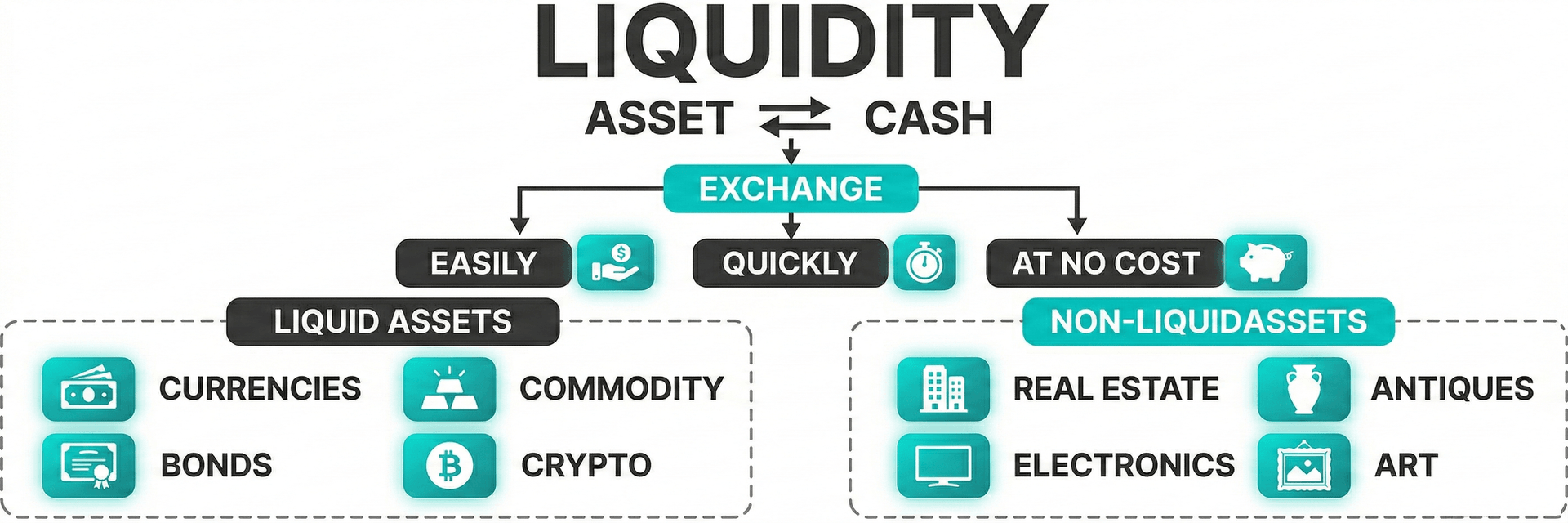
In finance, liquidity refers to the ease and speed with which an asset can be converted into cash without materially affecting the market price. Liquid assets typically have three practical characteristics:
- They trade in active markets with many buyers and sellers.
- They are associated with tight bid-ask spreads.
- They can be settled within predictable timeframes.
Cash is commonly known as the most liquid asset. It requires no conversion and carries no price uncertainty. Other assets are measured on a spectrum of conversion ease, including major currency pairs with deep order books and tight spreads, large-cap equities with high demand and efficiency, and smaller instruments that trade occasionally in noticeably thinner markets.
An important thing to note is that liquidity is not static. Instruments considered highly liquid under normal market conditions may experience spread widening, diminishing demand, or systemic stress, resulting in reduced liquidity.
For example, Apple (AAPL) experienced sharp liquidity downturns during the March 2020 sell-off, with widened bid-ask spreads and heightened volatility despite being among the most actively traded stocks globally. This demonstrated that even traditionally liquid instruments, such as large-cap equities, can temporarily exhibit liquidity constraints.
Therefore, liquidity management must be embedded in margin systems and risk models, reflecting current market conditions and developing patterns that can impact market prices and earnings.
Illiquid Assets Definition and Key Characteristics
Illiquid assets are holdings that cannot be quickly sold or exchanged for cash without accepting a considerable discount to fair value.
They are characterized by limited buyer pools, wide bid-ask spreads, longer time-to-sale, and valuation uncertainty. Some assets are less liquid due to structural constraints (such as contractual lock-ups) or market-based factors (such as infrequent trading activity).
Illiquidity creates holding-period risk, where investors may be unable to exit positions during unfavorable conditions. This can amplify exposure risk or price deterioration, even when the underlying asset fundamentals remain intact.
One thing to consider is that illiquidity is not only about market depth, or the lack of it. For example, a private equity stake with a 10-year lock-up period creates illiquidity by design, where the holder cannot efficiently sell their holdings.
Liquid vs. Illiquid Assets: Core Differences
Let’s compare liquid and illiquid assets across the dimensions that directly affect trading operations and investment decisions. Liquidity is not merely about convenience or speed of execution; it directly influences valuation.
For instance, two assets with identical cash flows can trade at different prices solely because of differences in liquidity, as market participants demand compensation for reduced flexibility and higher exit risk.
This dynamic gives rise to the liquidity premium — the additional expected return investors require for holding assets that cannot be easily sold without price concessions. As such, illiquid instruments often target higher returns to compensate for the illiquidity risk.
For brokers, these differences carry clear business implications. Liquidity affects execution quality, spread stability, balance sheet flexibility, client suitability assessments, and the design of internal risk controls.
Liquidity Exists on a Spectrum
Liquidity is not a static status. One cannot describe an asset as ultimately liquid or illiquid. There is a spectrum from structurally illiquid to highly liquid, depending on the trading venue, market demand, instrument availability, and other factors.
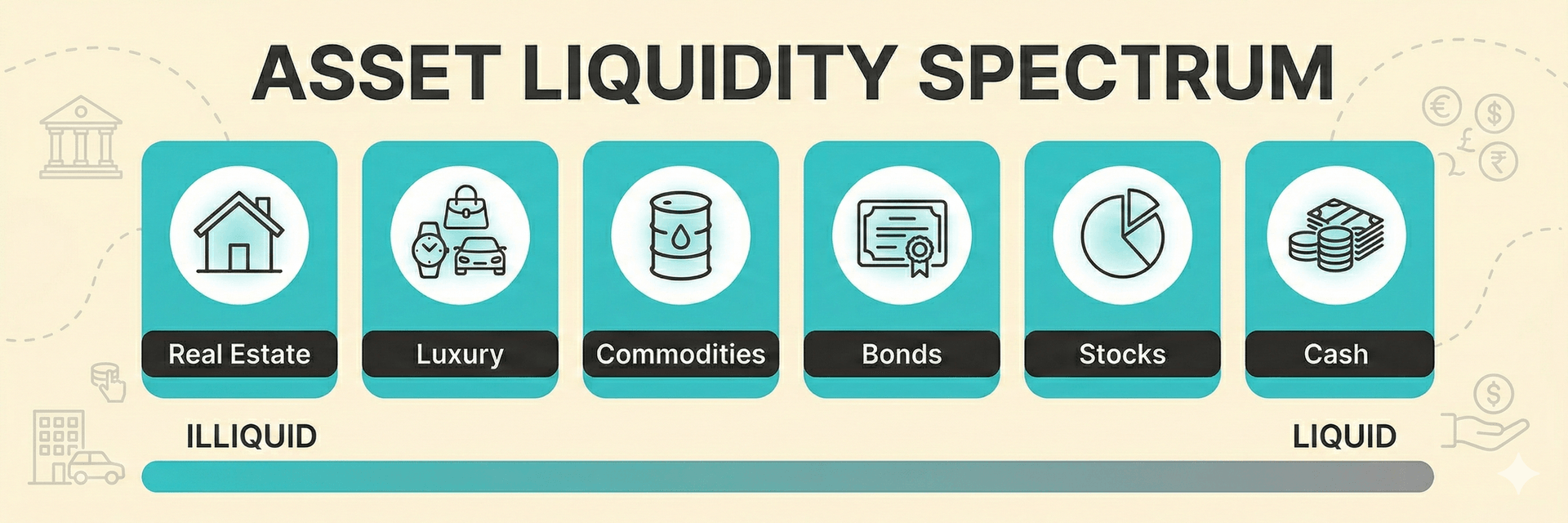
- Highly liquid: at the high-end of the spectrum sit instruments like EUR/USD in the global FX market and short-term US Treasury Bills. These markets feature deep order books and continuous quoting.
- Moderately liquid: these include mid-cap equities and certain exchange-traded funds that trade actively, but many experience wider spreads during market volatility.
- Episodically liquid: small-cap stocks and emerging crypto pairs may appear liquid during active sessions but thin out significantly outside peak hours or when stable virtual assets become more preferred.
- Structurally illiquid: these assets include private equity funds and infrastructure investments, where contractual lock-ups or complex transaction processes limit liquidity by design.
Understanding this spectrum enables brokers to calibrate execution routing, margin policies, and risk limits with greater precision.
Examples of Liquid Assets
Liquid investments are simpler to manage, observe, and understand. They have transparent pricing, reliable settlement, and deep order books.
Cash and demand deposits are the benchmark for perfect liquidity. Money market funds and overnight assets function as cash equivalents. In FX markets, the level of liquidity ranges from major pairs (most liquid) to exotic currencies (most illiquid).
Listed equities and ETFs on major exchanges generally benefit from continuous trading and competitive spreads. That said, large-cap stocks typically trade with depth, while thinly traded small-cap listings may exhibit liquidity constraints.
Short-term government bills maintain active secondary markets and are widely used as repo collateral. Shorter maturities tend to trade more actively than longer-dated bonds, enhancing their liquidity profile.
These instruments provide operational flexibility for brokers. They support margin calculations and rapid rebalancing, and serve as reliable collateral.
Examples of Illiquid Investments
Illiquid investments often embed structural constraints that limit exit speed.
Real estate and infrastructure assets typically feature extended sale cycles that involve inspections, financing contingencies, and title transfers. Commercial property transactions often require months to complete. While publicly traded REITs are more accessible, they carry different risk-return characteristics.
Private equity stakes commonly include multi-year lock-ups, often 7–10 years, which support long-term operational improvements but limit liquidity access. Secondary markets exist for these assets but may involve discounts and limited transaction volume.
Collectibles and specialty assets face narrow buyer pools and subjective valuation processes. They entail authentication, provenance verification, and condition assessments, which can significantly extend sale timelines.
These categories showcase how illiquidity is often embedded in asset structure rather than merely market activity.
How Liquidity Impacts Asset Valuation and Risk
While liquidity dictates the end-user’s trading convenience, it is more than that. It is a key input for investment strategies and risk management decisions.
Brokers must manage valuation processes, reporting differences, execution constraints, and funding resilience.
Pricing Flexibility
Liquid assets benefit from continuous price discovery. There are active buyers and sellers, visible bid-ask spreads, and real transactions throughout the trading day. This transparency gives brokers confidence in market-to-market valuation.
On the other hand, illiquid assets work differently. Pricing may rely on periodic appraisals, broker quotes, or limited comparable transactions. These inputs are not continuously tested by market participants. Therefore, valuations may shift unexpectedly during periods of high volatility.
Liquid assets may command a price premium over otherwise equivalent illiquid counterparts, purely because they can be sold more easily and quickly.
When it comes to reporting, the difference is clear: observable market prices provide stronger valuation confidence than Level-2 or Level-3 style estimates based on less direct inputs.
Execution Speed
In liquid markets, positions can be adjusted quickly and with minimal price disruption. As such, brokers can hedge exposures, rebalance portfolios, or reduce risk in response to new information without significantly moving the market.
In contrast, illiquid holdings do not offer the same flexibility. Exiting may take time, require staged selling, or involve negotiated transactions. Such a delay can amplify risk in fast-moving markets. If exposure cannot be reduced promptly, losses may accumulate before reconciliation.
Illiquidity also introduces path dependency, where portfolio decisions become constrained by time-to-sale, meaning outcomes depend not only on asset performance but on how quickly positions can realistically be adjusted.
Funding Strategy
Liquidity plays a central role in funding resilience. Brokers need liquid assets to meet margin calls, process client withdrawals, and satisfy collateral requirements. These obligations often arise suddenly and require immediate access to cash or cash equivalents.
When exposure is concentrated in illiquid holdings, funding stress can emerge during market dislocations. Even if long-term asset values remain intact, the inability to convert positions into cash quickly can create short-term pressure.
For brokers and trading desks, liquidity management is therefore not optional. It is a core competency, especially during volatile conditions when access to funding can determine operational stability.
Evaluate Your Infrastructure with Experts
Get a platform assessment to plan liquidity, execution, back-office, and other key components.
Liquidity Considerations for Brokers and Trading Desks
Liquidity management is a strategic function that directly influences execution quality, client outcomes, and balance sheet strength. It requires deliberate systems, source diversification, and clearly defined controls.
Here’s what you need to consider when planning your infrastructure.
Aggregated Multi-Asset Liquidity
Access to aggregated liquidity across asset classes improves execution depth and pricing consistency. By sourcing quotes from multiple counterparties, brokers can reduce spreads, improve fill rates, and maintain routing flexibility when conditions shift.
Diversified liquidity pools also reduce reliance on a single venue or provider, strengthening resilience during localized disruptions. For platforms expanding into multi-asset offerings, aggregated liquidity becomes a competitive necessity rather than a convenience.
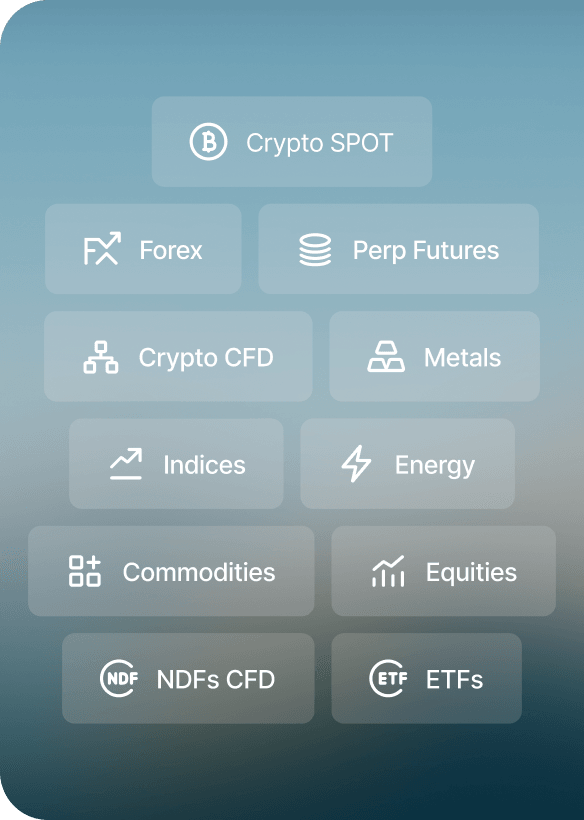
This is where institutional-grade liquidity access from B2BROKER comes into play, enabling firms to serve diverse client demand while maintaining execution standards across FX, crypto, commodities, and other instruments.
Deep, Reliable Liquidity Across 10 Major Asset Classes
FX, Crypto, Commodities, Indices & More from One Single Margin Account
Tight Spreads and Ultra-Low Latency Execution
Seamless API Integration with Your Trading Platform
Technology Stack Integration
Liquidity access is only as effective as the infrastructure supporting it. API connectivity and FIX protocol integration allow brokers to connect efficiently to liquidity providers and trading venues, and scale as they grow.
Integrated systems reduce manual processes, streamline onboarding of new assets, and support higher throughput without operational bottlenecks.
Most importantly, systems must handle a mix of highly liquid instruments and less-traded assets, each with distinct execution behavior and risk characteristics. Having a flexible technology stack ensures pricing and asset management remain consistent across markets and classes.
Risk Management Controls
Liquidity-specific risk control is also one part of the equation. Brokers should apply position limits to thinner markets, conduct stress tests for withdrawal scenarios, and maintain real-time exposure monitoring. This system ensures they operate efficiently even during platform stress.
Another consideration is compliance. Regulators increasingly expect firms to demonstrate structured liquidity management processes, including documenting reasoning, applying appropriate cuts, and evidencing the ability to withstand stressed market conditions.
A robust risk infrastructure ensures that asset and profile classifications are actionable inputs into margin systems and exposure controls.
Balancing Liquid and Illiquid Holdings in Client Portfolios
Liquidity allocation is an intentional design choice that affects return potential and operational flexibility, whether for clients or for the broker.
From a broker’s perspective, it is not only about maximizing returns. You must align liquidity exposure with client needs while preserving capital resilience. Here are three factors that you must balance.
Client Objectives
The first thing is the trader’s preferences and objectives. Clients prioritizing flexibility, short-term access to funds, or active trading strategies typically favor more liquid allocations. For them, the ability to enter and exit positions efficiently is central.
Long-term-focused investors may accept illiquidity in pursuit of higher expected returns. In particular, institutional clients often operate under defined liquidity requirements driven by liability schedules, payout policies, or operational commitments.
Objective-setting is essential to determine appropriate liquidity exposure.
Expected Holding Period
The second consideration is investment horizon. This factor directly shapes illiquidity tolerance, as longer-dated positions can be suitable when the expected holding period comfortably exceeds the asset's realistic exit timeline.
Risk arises when that alignment breaks down. For example, when the holding period is shorter than the asset’s realistic liquidity window, forced-sale risk increases, particularly during volatile markets.
Therefore, brokers should document holding period assumptions and revisit them as market conditions and client preferences evolve.
Regulatory Capital Constraints
Finally, governance. Regulatory capital frameworks and internal risk models often apply differentiated charges or “haircuts” based on liquidity characteristics, ultimately affecting balance sheet planning.
Illiquid holdings may require higher reserves, reducing a broker’s effective capacity and limiting flexibility. As a result, liquidity allocation decisions influence not only client portfolios but also the firm’s capital efficiency.
Liquidity management, therefore, is intertwined with strategic balance sheet planning — not separate from it.
Turn Liquidity Insight Into Infrastructure Advantage
Understanding the difference between liquid and illiquid assets is foundational for building competitive multi-asset offerings. Liquidity shapes pricing confidence, execution capability, funding resilience, and regulatory positioning.
B2BROKER supports firms operating across different liquidity regimes through aggregated multi-asset liquidity, trading platforms, CRM solutions, wallet systems, and back-office infrastructure.
This integrated ecosystem enables brokers, fintech startups, and hedge funds to serve highly liquid markets while maintaining the flexibility to expand into diverse instruments.
Infrastructure that adapts to varying liquidity conditions allows brokers to serve clients more effectively across market conditions.
Improve Your Liquidity Infrastructure
Boost product coverage across 10+ markets and 1,000+ instruments across highly liquid pools and exotic assets.
Frequently Asked Questions about Illiquid and Liquid Assets
- Is a brokerage's own float considered a liquid asset?
Generally, yes. Operating cash and demand deposits qualify as liquid because they can be accessed immediately. However, funds tied to client segregation or regulatory reserves are not freely deployable, even if they sit in the same banking relationship.
- Which assets are not considered liquid for margin purposes?
Direct real estate, private equity stakes, thinly traded securities, and restricted shares. These instruments can't be sold quickly at transparent prices, so brokers apply higher haircuts or exclude them from margin eligibility entirely.
- What does illiquid mean for mark-to-market reporting?
It means the asset lacks reliable, observable market prices. Instead of using active bid-ask quotes, brokers must rely on Level 2 inputs (observable but indirect market data) or Level 3 valuation models based on assumptions and comparable transactions, which increases uncertainty and can introduce earnings volatility when estimates are updated.