B2BROKER vs. Leverate: Key Differences Every Broker Should Know

Your infrastructure partner is the software that ties together all your trading platforms, liquidity connections, payment gateways, and other fintech solutions. B2BROKER and Leverate are among the biggest names that you will encounter when planning your brokerage business.
Choosing between them shapes your operational model, execution quality, time-to-market, and long-term scalability. Both providers serve Forex, crypto, and CFD brokers with white label trading software.
At a glance, they may look similar: platform integration, CRM systems, liquidity access, and risk tools. But there are core differences. B2BROKER prioritizes turnkey liquidity, multi-platform deployment, and integrated compliance infrastructure, while Leverate focuses on customized ecosystems, proprietary risk analytics, and client engagement optimization.
Let’s compare the two providers and explore how you can determine which partner aligns with your brokerage strategy.
Key Takeaways
- B2BROKER delivers turnkey white label solutions with integrated Prime of Prime liquidity, making it ideal for brokers who need rapid deployment without building custom infrastructure.
- Leverate’s LXSuite emphasizes customization and client retention tools, appealing to brokers focused on differentiation and advanced analytics for conversion optimization.
- B2BROKER’s B2CORE CRM includes built-in KYC/AML compliance and back-office automation, whereas Leverate offers mobile CRM with marketing-focused acquisition and retention features.
- Brokers prioritizing speed-to-market and multi-asset coverage often prefer B2BROKER as a wholly integrated fintech ecosystem.
How B2BROKER and Leverate Position Their Brokerage Solutions
B2BROKER positions itself as a prime-of-prime liquidity and technology provider delivering complete turnkey brokerage solutions. Its model combines liquidity aggregation, trading platforms, CRM, risk controls, and compliance tools into one integrated ecosystem.
This way, brokers reduce vendor fragmentation and accelerate launch timelines.
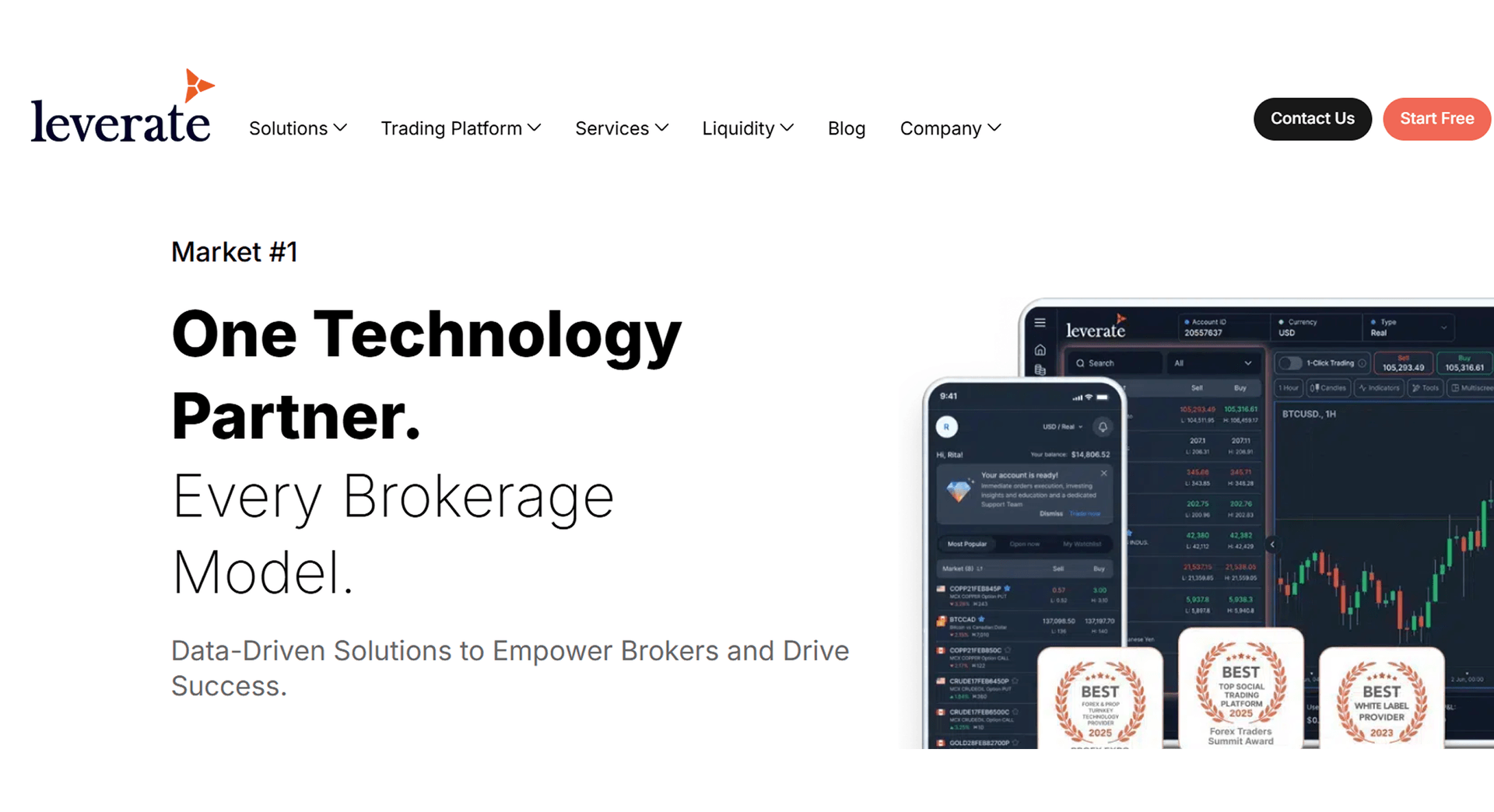
On the other hand, Leverate positions itself as a premium brokerage ecosystem partner, offering reliable technology solutions for various brokerage business models. Its LXSuite is structured around proprietary risk analysis, business intelligence dashboards, client engagement tools, and pre-integrated liquidity solutions.
In a nutshell:
- B2BROKER often targets startup and mid-sized brokers who want scalable infrastructure without heavy internal development.
- Leverate typically appeals to brokers focused on customization, market differentiation, and client lifecycle analytics.
Core Components of Each White Label Trading Software Stack
A brokerage technology stack determines operational efficiency, execution stability, and client experience—three main pillars for successful brokerage activities. While B2BROKER and Leverate support MetaTrader trading platforms, their ecosystems differ in deployment models.
Both providers extend their services to additional platform options, backend integrations, and other fintech ecosystem components. Let's break down each below.
B2BROKER Multi-Platform Stack
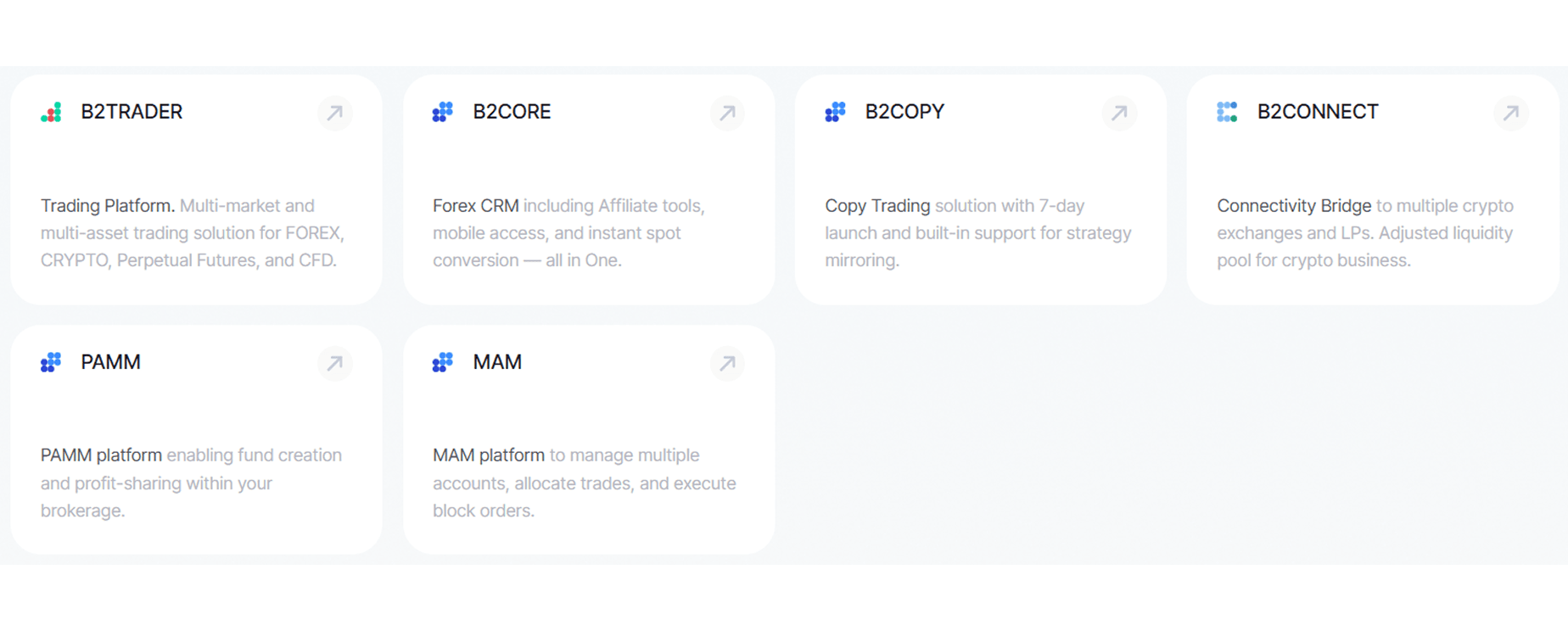
B2BROKER supports a wide range of popular trading platforms, such as MetaTrader 4, MetaTrader 5, cTrader, Match-Trader, and the proprietary B2TRADER. Its execution infrastructure includes low-latency hosting environments, such as Equinix NY4 and LD4, ensuring institutional-grade routing and optimal fill rates.
What sets B2BROKER apart is its pre-integrated solutions, offering clients a comprehensive ecosystem of back-office CRM (B2CORE), PAMM/MAM and copy trading modules (B2COPY), crypto payment solutions (B2BINPAY), and advanced IB, risk, and margin management.
B2BROKER’s solutions are turnkey, meaning clients get a unified infrastructure rather than stitching together CRM, liquidity, hosting, compliance, and payment layers.
Leverate LXSuite Ecosystem
Leverate’s LXSuite integrates numerous supporting and trading systems, including MT4 and MT5, proprietary risk management tools, business intelligence dashboards, and CRM software. This gives clients diversity over platform planning and configuration.
The provider focuses on flexibility and customization, with white label modules to adjust workflows, dashboards, and client funnels. What distinguishes Leverate is its proprietary analytical tools, including real-time exposure monitoring, advanced reporting, and data-driven insights.
In short, B2BROKER emphasizes ecosystem completeness, while Leverate focuses on infrastructure customization.
Liquidity Depth and Asset Range: 50+ Instruments and Beyond
Liquidity is the operational backbone of any brokerage because without deep, reliable liquidity, execution quality suffers and client trust erodes. Therefore, brokers serving high-volume trading environments must treat liquidity architecture as the foundation of long-term operations.
Let’s break down how both providers differ.
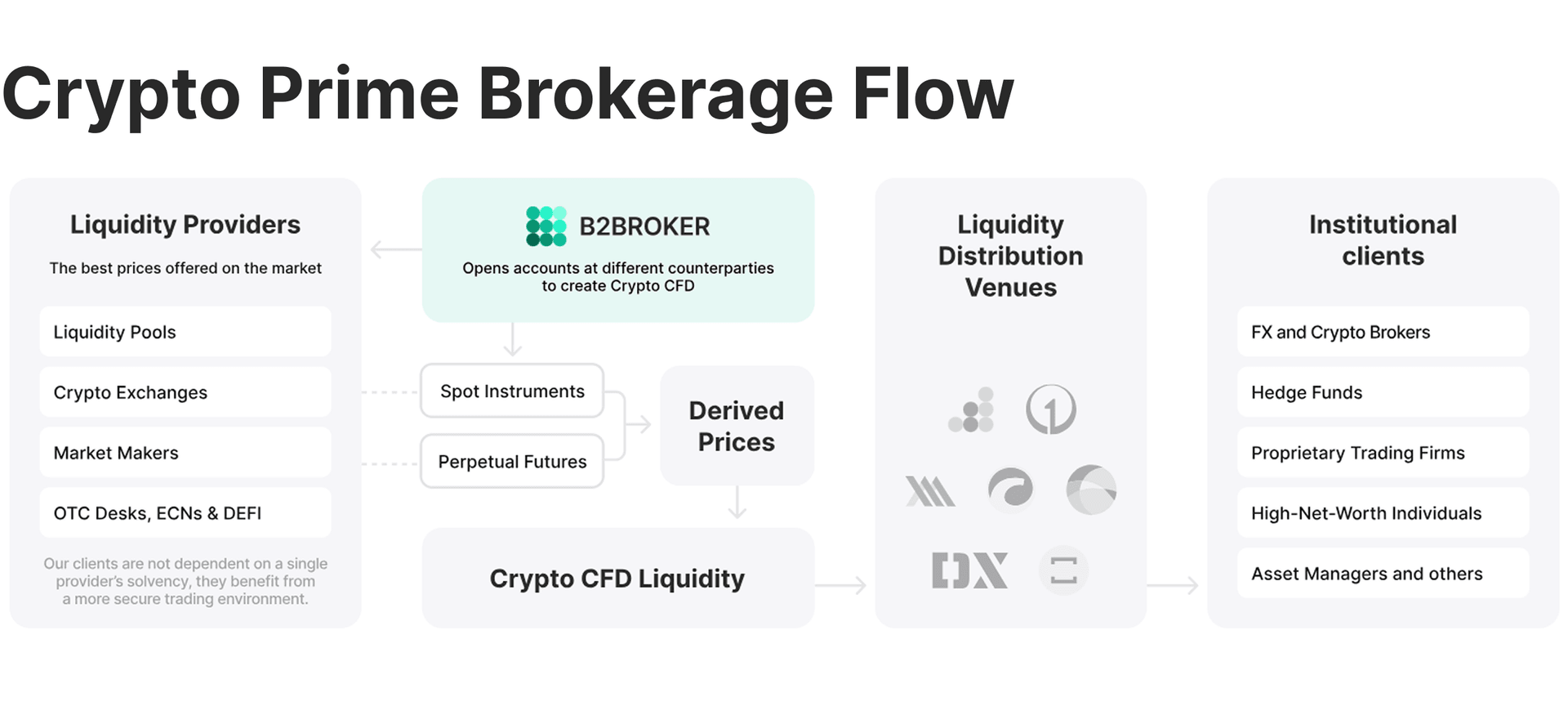
B2BROKER operates an aggregation model that pools liquidity from multiple top-tier providers across asset classes. For example, its liquidity bridge, B2CONNECT, consolidates crypto liquidity from 20 top-tier providers, including Binance, Kraken, Bybit, and others.
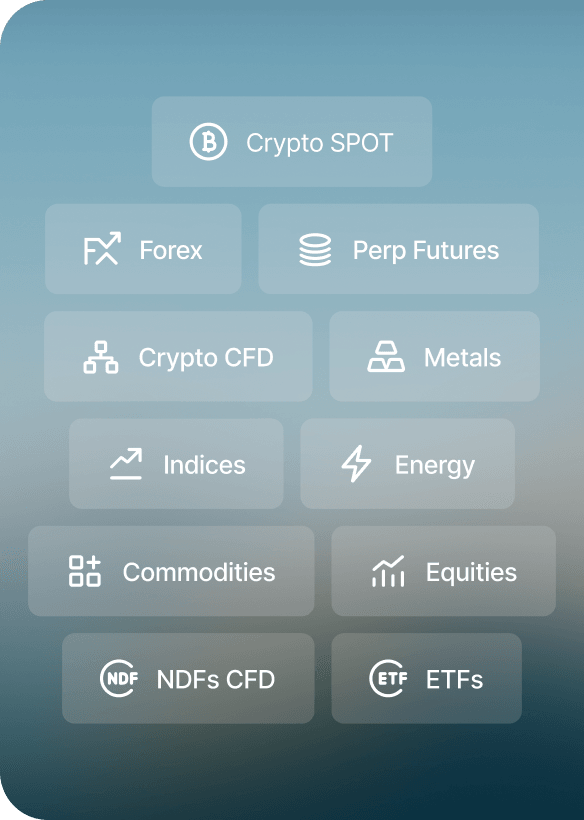
These combined streams are then aggregated into a single order book that brokers can access to offer competitive pricing for Forex, metals, indices, commodities, cryptocurrencies, ETFs, NDFs, and more.
Leverate, in comparison, supports deep liquidity connectivity with a higher emphasis on advanced risk management and exposure monitoring. This model gives more transparency over execution quality and asset diversity.
Deep, Reliable Liquidity Across 10 Major Asset Classes
FX, Crypto, Commodities, Indices & More from One Single Margin Account
Tight Spreads and Ultra-Low Latency Execution
Seamless API Integration with Your Trading Platform
Forex and Metals Coverage
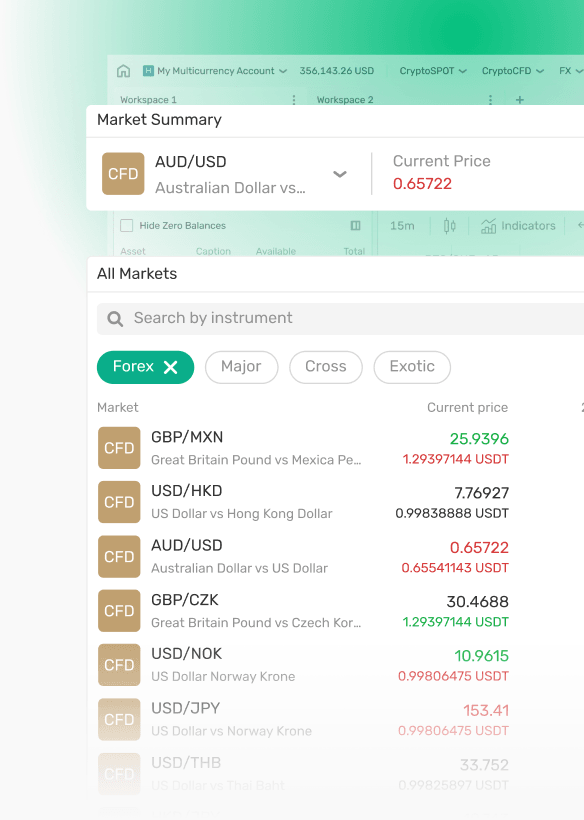
B2BROKER provides aggregated Forex liquidity for over 100 major, minor, and exotic FX pairs supported by Prime of Prime structures that reduce the burden of partnerships and overheads. In metals, it supports 10+ instruments, including gold, silver, platinum, and more commodity CFD liquidity with competitive spreads and fast execution.
On the other hand, Leverate supports 50 Forex pairs and seven commodity CFDs, whereas liquidity sourcing is not positioned as its primary competitive advantage.
Crypto and Tokenized Assets
B2BROKER offers reliable crypto liquidity, including deep pools for 130+ digital assets and tokenized instruments. This enables brokers and fintechs to expand into hybrid models with pre-integrated compliance frameworks and advanced risk management tools.
Leverate, on the other hand, supports crypto trading for 24 virtual assets. However, it places less strategic emphasis on crypto CFD markets in its positioning, and more on traditional CFD trading and proprietary risk monitoring tools.
Thus, platforms targeting professional traders or institutional digital asset flows may find B2BROKER’s infrastructure more advantageous.
Indices, Equities, and Additional Markets
B2BROKER’s multi-asset coverage extends beyond Forex and crypto into indices, equities, ETFs, and NDFs, totalling 10+ asset classes. This breadth enables revenue diversification without juggling multiple liquidity providers, while accessing a single margin account.
Leverate’s historical strength lies in its specific market approach, excelling in liquidity and platforms for CFD, binary options, and traditional markets. This setup is better suited to brokers with a narrower product focus or when targeting a particular niche.
Risk Management and Compliance Workflows
Risk and compliance infrastructure determine a brokerage’s sustainability in regulated markets. As scrutiny increases across jurisdictions, embedded compliance automation becomes a competitive requirement.
B2BROKER integrates compliance functionality into its CRM solution, B2CORE, offering KYC/AML workflows, automated reporting, margin controls, and back-office audit trails. These systems emphasize operational clarity and regulatory readiness.
On the other hand, Leverate’s proprietary risk engine focuses heavily on real-time exposure analysis and position monitoring, providing advanced dashboards that offer visibility into book risk, support data-driven hedging strategies, and enable risk decision-making.
Let’s compare the back-office management tools offered by both providers.
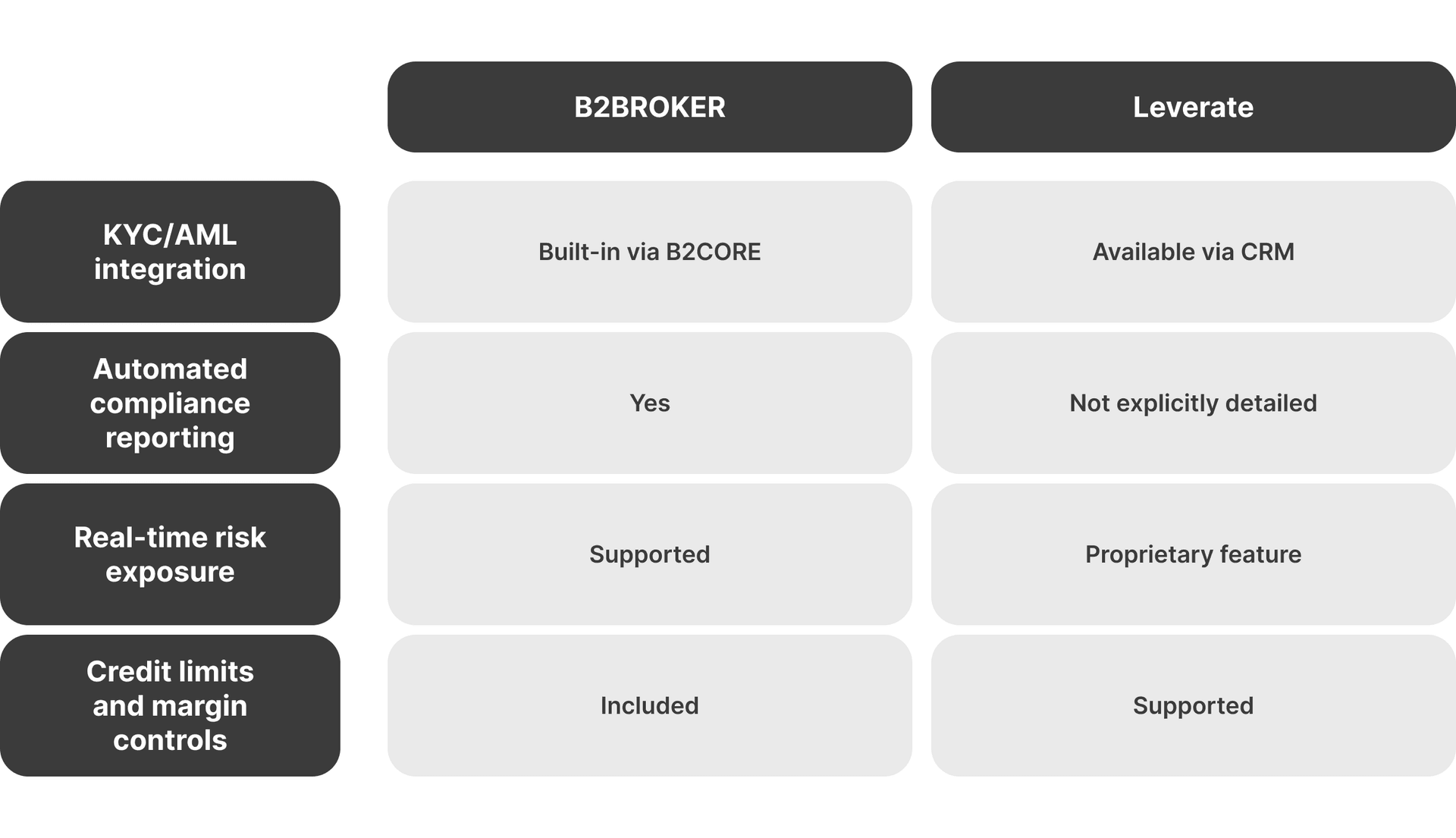
In practice, brokers operating across multiple jurisdictions may prioritize embedded compliance automation and auditable workflows offered in B2BROKER’s B2CORE, while those managing complex internal books may prioritize exposure analytics supported by Leverate.
Integrate B2CORE
Get an all-in-one CRM solution integrating finance management, trading, and IB modules in one dashboard
Client Onboarding and CRM Capabilities
CRM systems connect acquisition, onboarding, compliance, and retention into a single layer that admins can configure and monitor. Any misalignment in this funnel can lead to operational bottlenecks.
B2CORE is structured around operational efficiency. Its strength stems from its comprehensiveness, integrating KYC workflows, account management, reporting, and margin collateral management into a centralized interface. The entire workflow is automation-ready and compliant with multiple regulatory frameworks.
Leverate’s CRM emphasizes mobile access, marketing automation, and conversion optimization. It offers advanced analytics to track acquisition funnels and retention behavior, helping brokers refine client lifecycle and craft bespoke strategies.
The structural difference is clear. B2BROKER’s CRM supports operational scalability and compliance control, while Leverate supports engagement optimization and marketing analytics.
Therefore, the broker’s choice must determine whether operational friction or client-acquisition inefficiency represents their primary growth barrier.
All-In-One CRM & Back Office for Brokers and Exchanges
Fully Customisable Trader’s Room with Modular Features
Built-In IB Module, KYC, Payment Integrations, and Reporting Tools
Intuitive Interface that Boosts Client Engagement
Deployment Speed, Scalability, and Integration Paths
Time-to-market is another crucial factor that affects revenue capture. Infrastructure that can be deployed in weeks rather than months offers a tangible competitive edge.
For example, if a broker wants to capitalize on current crypto market opportunities, a pre-built platform is a better option for launching quickly and competing from day one, rather than wasting time on custom development and platform testing.
B2BROKER’s turnkey model, with pre-integrated liquidity, CRM, platforms, and compliance modules, shortens integration cycles. Multi-market liquidity access and multi-jurisdictional compliance ensure infrastructure readiness from the outset. Integrating with B2BROKER can be done via FIX APIs to scale operations or establish parallel data migration without service disruption.
Ready to Integrate with B2BROKER?
Connect with our experts to plan your platform deployment in a few days.
Leverate’s customization-oriented approach can extend deployment timelines due to configuration and tailoring processes. This setup is suitable for brokers seeking highly differentiated workflows and proprietary infrastructure.
The choice is yours; if you prioritize speed, multi-asset readiness, and infrastructure consolidation, B2BROKER’s turnkey solutions can reduce operational costs and quickly launch a platform. However, if you prefer unique infrastructure with custom-made features and tracking tools, Leverate offers advanced development support with full customization.
When B2BROKER Is the Better Fit for Your Growth Roadmap
The choice comes down to your strategic priorities. If your goal is to launch quickly with a fully integrated infrastructure, B2BROKER offers a clear advantage. Its turnkey model combines liquidity, platforms, CRM, compliance, and back-office systems into one cohesive environment, reducing vendor coordination and shortening time-to-market.
Brokers planning multi-asset coverage, especially those expanding into crypto and additional markets, benefit from aggregated liquidity within a single framework and integrated KYC/AML workflows.
Leverate may suit financial institutions focused on customization, conversion analytics, and proprietary tracking tools. Its solutions support extensive platform differentiation, with cutting-edge marketing automation and client retention features.
Ultimately, platforms that prioritize speed, infrastructure consolidation, and scalable multi-platform flexibility across MT4, MT5, cTrader, and Match-Trader benefit from B2BROKER’s structure, which reduces complexity and accelerates revenue generation.
Launch Your Brokerage Without The Wait
Skip the complex vendor integrations and deploy a fully regulated, multi-asset trading ecosystem in days.
Frequently Asked Questions to Compare B2BROKER and Leverate
- What licensing assistance does each provider offer?
B2BROKER provides licensing support as part of its turnkey packages to help brokers navigate regulatory requirements across jurisdictions. Leverate’s licensing support varies by engagement, so brokers should confirm what’s included during initial consultations.
- Can I migrate from Leverate to B2BROKER without service interruption?
B2BROKER can support phased migrations designed to minimize client-facing disruption while transitioning platforms and back-office workflows. The exact timeline and approach depend on your current infrastructure and integration scope.
- Which provider supports native copy trading across MT4, MT5, and cTrader?
B2BROKER offers integrated copy trading solutions across MT4, MT5, and cTrader within its white label packages, reducing reliance on third-party tooling. Leverate supports copy trading functionality, but its multi-platform coverage is typically less clearly documented.
Recommended articles