How Crypto B2B Payments Are Becoming a Competitive Advantage

Ask a crypto fund how it will pay into its trading account, and the answer is USDT the same day. Its working capital already sits on-chain. So does a growing share of the money moving between firms: stablecoin transfers reached $33 trillion in 2025, up 72% in a year .
A venue that can only take a bank wire loses that account before anyone discusses pricing. So crypto B2B payments now belong next to spreads and credit terms in every vendor review.
This guide covers how on-chain settlement works, how to keep price risk off your balance sheet, and how to choose a gateway.
Key Takeaways
- Crypto funds and OTC desks treat on-chain funding as a must-have, and a brokerage without it drops off the vendor list early.
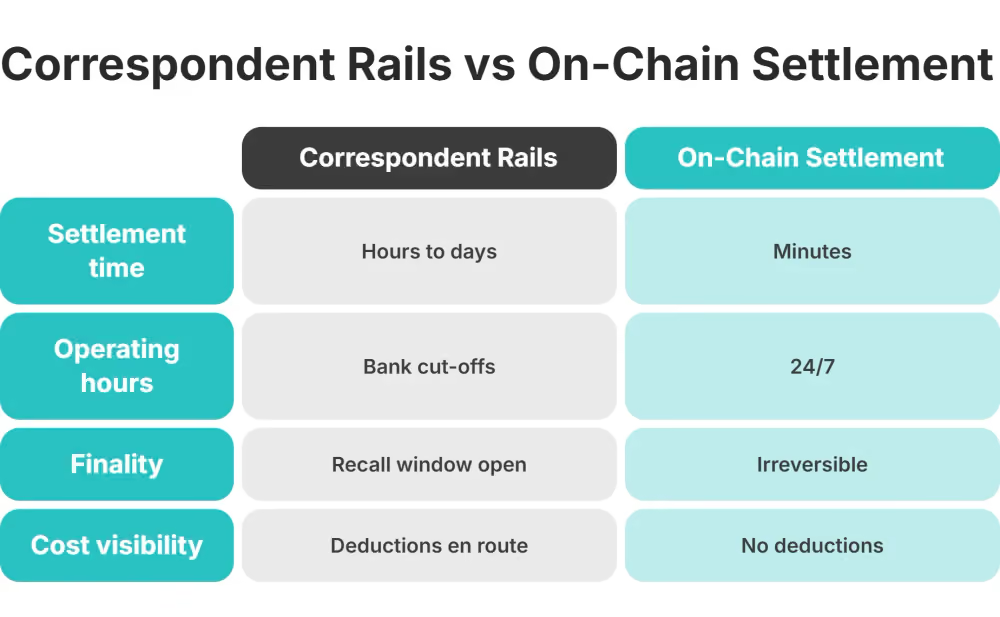
- A payment through correspondent banks waits for cut-off times and holidays, and its fees appear only after it lands.
- Paying in USDT or USDC keeps the dollar amount steady while the transfer confirms.
- Auto-conversion turns crypto you receive into fiat at once, so nothing volatile remains on your balance sheet.
- Sanctions screening and AML monitoring belong inside the payment system, so ask vendors about them before you sign.
Crypto Payments as a Competitive Requirement
For a counterparty that holds its money on-chain, the deciding question is whether you can receive a stablecoin payment and send one out. A no ends the evaluation, whatever the rest of your offer looks like.
Why Crypto-Native Clients Expect Crypto Rails
That question comes from crypto funds, digital asset OTC desks and DeFi treasuries. They settle with each other on-chain daily, so they measure your funding against transfers that clear in minutes.
A two-day wire ties up capital they planned to trade that day.
The Revenue Risk of Legacy-Only Payment Infrastructure
The damage goes beyond the prospects you lose. The desks you already serve wait for money to clear before they trade, and every wait is a reason to send the next order elsewhere.
None of it is recorded as a payments problem. The cost shows up only when someone asks why volumes fell.
Firms that still pay in fiat expect the same speed. J.P. Morgan's 2026 cross-border payments outlook finds clients expecting international transfers to match the speed, traceability, and around-the-clock availability of domestic payments .
Legacy Rails Breaking at Institutional Scale
Correspondent banking assumes a payment can wait until the next business day. A brokerage moving margin and collateral during the trading day cannot. Every extra currency and country widens the mismatch.
An official fix exists, and it is behind schedule. The G20's program to speed up cross-border payments wants 75% of wholesale transfers credited within one hour by the end of 2027, and today only about 55% arrive that fast . Until that gap closes, the delay is yours to manage.
Correspondent Banking Delays and Cut-Off Dependencies
A SWIFT payment passes through two or three banks and moves at the speed of the slowest one. Each bank has its own cut-off times and holidays, so a transfer sent on Friday afternoon in one time zone can sit until Tuesday in another.
Margin calls do not observe bank calendars.
Fee Opacity and FX Spread Compounding
You learn what a bank transfer really cost only when the money arrives. Each bank in the chain can take its own transaction fees and add its own FX markup, deductions you rarely see in advance.
That guesswork hurts cash flow more than the fees do. When a payment arrives short, your back office has to chase the missing amount one transfer at a time.
Crypto B2B Payment Rail Mechanics
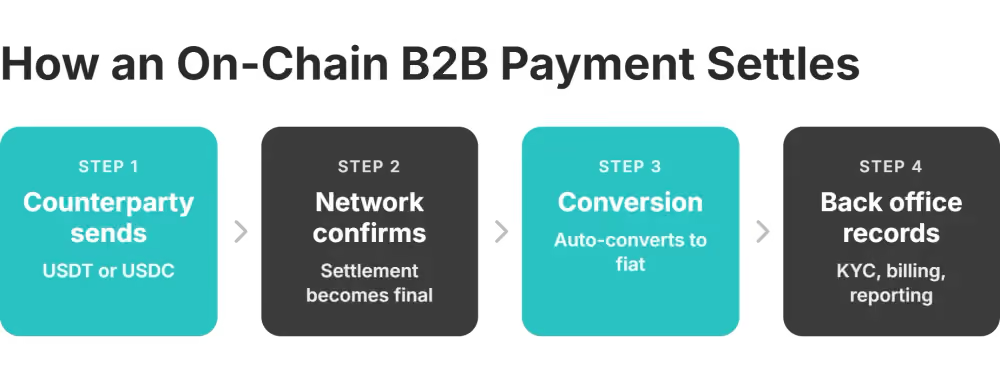
An on-chain payment replaces the chain of correspondent banks with one transfer on a public ledger such as Ethereum, usually in a stablecoin. No bank holds the money on the way. The questions left are when the payment becomes final and what happens to the asset once it lands.
Business payments already make up the largest share of that on-chain traffic. BCG's analysis puts B2B settlement at roughly 40% of real-economy stablecoin payments, growing 65% a year , driven by firms that need to pay at any hour.
On-Chain Settlement and Legal Finality
Legal finality is the moment a payment can no longer be undone. An on-chain transfer becomes final once the decentralized network has confirmed it enough times. After that, nobody can reverse it or file a chargeback.
A bank transfer can be recalled mid-process, so money that looks received can go back days later. Treasury teams keep a cash buffer for that case.
With on-chain payments, treasury records the money when the transfer confirms. That buffer goes away, and so does the reconciliation work it created.
Stablecoin Settlement as an Institutional Strategy
Institutional payments settle in USDT and USDC. Each is a token backed by the issuer's dollar reserves and redeemable at par, and it moves between wallets as a smart contract balance.
That backing is what keeps the amount stable while a transfer confirms. A seven-figure payment in a volatile coin can be worth less by the time it arrives.
You can hold a received stablecoin as a dollar balance or convert it to fiat when it lands.
Cross-Border Efficiency for Brokerages
Crypto rails help most where banks are hardest to reach. If you fund counterparties in several countries, on-chain payments remove the wait for each bank's cut-off and the local account you would otherwise need in every market.
The gain depends on which business you run, because a crypto broker and an exchange handle payment flows differently . The more countries you pay into, the bigger the saving. Prime brokers and market makers gain the most.
Counterparty Onboarding in Underbanked Markets
Banks have spent a decade pulling out of correspondent relationships. The number of active ones fell roughly 30% between 2011 and 2022 , with the steepest cuts in emerging markets and small jurisdictions.
If you settle on-chain, a counterparty in one of those markets is still easy to reach. The money arrives as soon as the network confirms, with no local bank account needed.
On-chain settlement also opens markets your competitors' banks have already left.

Volatility and Treasury Risk Management
Accepting crypto B2B payments puts a volatile asset on your balance sheet. Treasury's concern is how long you hold it before it turns into fiat. With the right setup, that is minutes.
Leave it alone and you are holding an open position nobody chose. Two things control that exposure: how fast you convert what you receive, and where it sits until then.
Auto-Conversion to Fiat or Stablecoins
Auto-conversion runs the moment a payment confirms. The gateway sells what you received for fiat currency or a stablecoin at the market rate, leaving your books with a dollar balance.
Treasury sets the policy once, per asset and per counterparty. Convert Bitcoin to USD automatically, keep USDC as it arrives.
Custody Arrangements and Asset Segregation
Any cryptocurrency you keep goes either into one omnibus crypto wallet or into separate wallets that keep each client's money apart.
Regulators care which one you choose. Many licenses require you to keep client assets separate, and institutional counterparties ask about it during due diligence.
Set this up on day one. Once the money is mixed, separating it becomes a migration project you have to explain to your regulator.
Compliance Infrastructure at Institutional Scale
Regulators treat crypto payments like any other licensed activity. The checks they expect sit inside the payment system and fire on every transfer.
Supervision is only getting tighter. ESMA's 2025 Annual Report describes closer oversight of crypto-asset markets , so expect crypto payments to face the same reporting and audit trails your fiat business already produces.
AML and Sanctions Screening Requirements
Screening happens before the money moves. The system checks the sender's wallet address against sanctions lists and risk databases, then credits the deposit or releases the payout. Catching a flagged address costs far less than finding it weeks later.
Transaction monitoring and client due diligence run alongside it, and their records go into the same case files your fiat AML program keeps.
Regulatory uncertainty has shrunk, but the paperwork still depends on where you operate. MiCA in the EU, the FCA's rules in the UK and VASP registration elsewhere each ask for something different, so your system has to produce reports and on-chain audit trails in each regulator's format.
Institutional Implementation Framework
Pick a gateway for B2B crypto payments the way you would pick a liquidity provider. You are checking how its settlement works and whether its API fits how your firm runs.
If you are thinking of building the gateway in-house, count the compliance and maintenance work that P2P settlement brings .
The kind of brokerage you run sets the requirements. Payment volumes and back-office work differ between a full-service and a discount brokerage , and the gateway has to fit yours.
Gateway Selection Criteria for Enterprise Operators
Check every candidate against the way you work:
- Supported assets: the exact chains and stablecoins your counterparties pay in, checked against the vendor's live list.
- Settlement architecture: when a payment becomes final, and whether auto-conversion is built in.
- API connectivity: FIX, REST and WebSocket endpoints that reach your OMS, EMS and treasury systems.
- Compliance tooling: wallet screening, transaction monitoring and reporting for every country you hold a license in.
- Back-office integration: reconciliation against accounts payable and accounts receivable, with billing and KYC data reaching your accounting systems without manual export.
- SLA terms: uptime, settlement guarantees and support response times, in writing.
A vendor that passes on paper still gets a staging test, because documented behavior and production behavior differ.
B2BROKER's Crypto Payment Infrastructure
When your trading platform and back office come from one vendor, the shortest route through that checklist is a payment layer already wired into it.
B2BROKER covers the payment leg through its partner B2BINPAY , integrated with B2CORE for back office, KYC and reconciliation. The integration already exists, so adding crypto payments does not become a middleware project.
Payments, screening and reconciliation sit in one flow, so a transfer does not get stuck between two systems. That matters most when you launch on a deadline, as with a white-label crypto exchange .
B2BINPAY: Supported Assets and Settlement Architecture
B2BINPAY handles payments and payouts in 350+ digital currencies, from Litecoin to USDC. USDT works across nine major blockchains, so one integration covers counterparties on different networks.
Auto-conversion to fiat or stablecoins, multi-currency wallets and know-your-transaction screening are built in. Its Mauritius entity holds a Virtual Asset Service Provider license from the Financial Services Commission (GB24203002), the license a compliance team asks to see.
Transaction data goes into B2CORE, where KYC, billing and reporting run on the same records.
Service has legal and jurisdictional limitations. Check T&Cs here .
Build Crypto Payment Capability Before Competitors Do
Crypto B2B payments have moved into the review every institutional client runs before signing. The brokerages that stay on the shortlist settle on-chain, convert what they receive so the price risk ends at confirmation, and screen every wallet before money moves.
Every quarter you wait, more of that volume settles somewhere else.
Payments touch client money, so the vendor's record matters as much as the feature list. B2BROKER has been building brokerage infrastructure since 2014, holds 10+ regulatory licenses and serves more than 1,000 corporate clients on the stack B2BINPAY plugs into.
If crypto payments are on your roadmap, start by scoping which markets and chains you need to cover. B2BROKER's team can work through that scope with you and show where B2BINPAY fits.
Frequently Asked Questions about Crypto B2B Payments
Are stablecoins better than wire transfers for B2B settlement?
For large cross-border transactions, stablecoins are faster and final: the money confirms in minutes, while a wire can spend days in the correspondent chain. Wire transfers still win where banking is strong and the counterparty works only in fiat.
What compliance infrastructure is required to accept crypto B2B payments at institutional scale?
A licensed firm needs transaction monitoring, wallet screening against sanctions lists and client due diligence, all running inside the payment flow. The tools also have to report to every regime you work under: MiCA, FCA rules or a VASP registration.
How do businesses manage volatility when accepting crypto B2B payments?
Auto-conversion is the common answer. What you receive becomes fiat or a stablecoin as soon as the transfer confirms, so no volatile asset stays on your books. The second control is custody, which decides where any crypto you keep sits and whether client money is held separately.
When does it make more sense to use crypto rails instead of traditional banking rails for B2B payments?
Crypto rails make the most sense when counterparties pay on-chain by default, when their countries have few correspondent banks left, or when bank cut-offs leave you short of cash during the day.
How do crypto payment rails integrate with back-office reconciliation and treasury systems?
Enterprise gateways offer REST and WebSocket APIs that send transaction data into your OMS, EMS and ERP or back-office systems as payments confirm. B2BINPAY connects to B2CORE, so reconciliation, billing and KYC work from one set of records.
Recommended articles
Subscribe to our newsletter