Liquidity Risk Management for Brokers: Key Regulations and Compliance Steps

Liquidity risk management for brokers is the discipline that determines whether your firm survives a fast-moving market event like a margin call spike, a sudden LP credit line reduction, or a wave of client withdrawals hitting within the same session.
Unlike solvency risk, which concerns whether your assets cover your liabilities over time, liquidity risk is a timing problem. A broker can be solvent on paper and still fail because cash is not available exactly when counterparties or clients demand it. Across financial markets, the global risk management market reached $15.40 billion in 2024 and is projected to reach $51.97 billion by 2033, reflecting how seriously financial institutions now treat this challenge.
Regulators have taken notice. FINRA, the FCA, and FSB working groups have all sharpened their focus on broker liquidity, demanding documented programs with intraday visibility and stress-tested contingency plans. This article explains what regulators expect and where liquidity pressure actually comes from, then walks through how to build a program that holds up when markets move against you.
Key Takeaways
- Liquidity risk differs from solvency risk: a broker can be fully capitalized but still fail on cash timing if intraday margin calls or withdrawal spikes are not anticipated.
- FINRA, FCA IFPR/MiFIDPRU, and FSB guidance all require brokers to maintain documented liquidity programs with real governance, measurable limits, and stress-tested buffers.
- The most common liquidity pressure points are intraday margin and collateral calls, LP funding concentration, and toxic client order flow. All require intraday monitoring.
- A compliant and functional liquidity risk program covers governance, risk appetite, metrics, monitoring, stress testing, and a trigger-based contingency funding plan.
- Technology (real-time dashboards, pre-trade controls, and FIX/API connectivity) turns compliance into an operational capability that supports confident growth.
What Regulators Expect From Brokers on Liquidity
Across jurisdictions, regulators have moved from general principles toward specific operational expectations, and the common thread is clear: end-of-day snapshots no longer satisfy examiners.
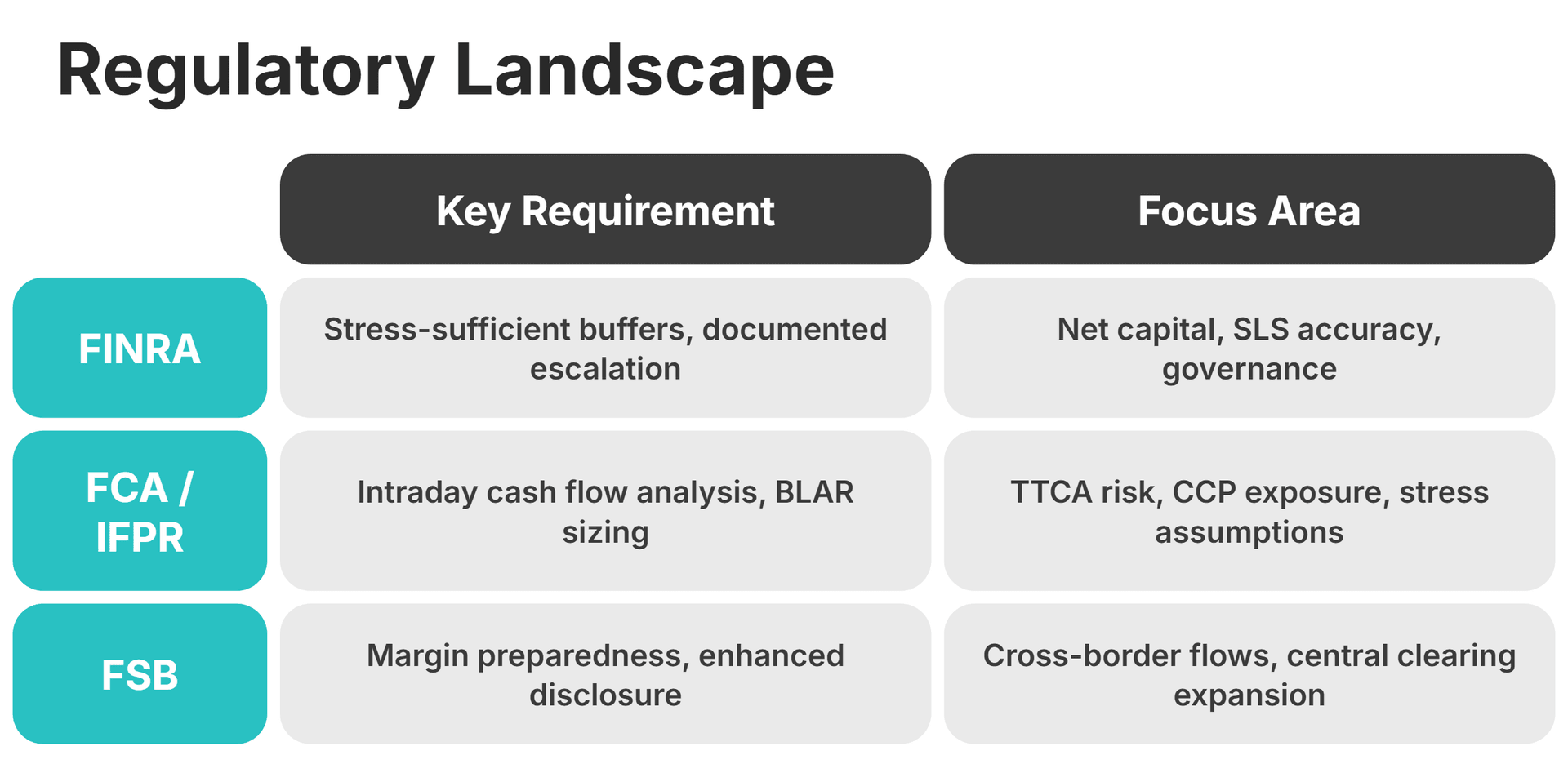
FINRA (U.S.): Net Capital, Buffers, and Governance
FINRA's 2025 Annual Regulatory Oversight Report identified recurring deficiencies in broker-dealer liquidity programs: inaccurate Supplemental Liquidity Schedule (SLS) reporting, miscategorized counterparties, and stress-testing assumptions that failed to reflect actual business risk.
Under Exchange Act Rule 17a-3(a)(23) (which mandates recordkeeping for risk management controls) and related FINRA guidance (Regulatory Notices 10-57, 15-33, and 21-12), FINRA expects broker-dealers to maintain stress-sufficient liquidity buffers and operate under documented escalation procedures, with senior management directly accountable for liquidity outcomes. FINRA also expects member firms to document their liquidity risk management framework and keep it current. A liquidity plan filed with the compliance team but never stress-tested against realistic scenarios will not survive an examination.
FCA IFPR / MiFIDPRU (UK): Intraday Visibility and Stressed Assumptions
The FCA's multi-firm review of liquidity risk management at wholesale trading firms (covering 26 large brokers, including inter-dealer brokers and CFD providers) found that many firms relied on inadequate stressed assumptions and failed to identify firm-specific risk sources.
Under MiFIDPRU 7 LATR, UK-regulated brokers must conduct time-granular cash flow analysis and hold qualifying liquid assets (the Basic Liquid Assets Requirement, or BLAR) and additional liquid assets (the Liquid Assets Threshold Requirement, or LATR) sized against stress-period outflows through the ICARA process. The FCA flagged "run-on-the-bank" risk from Title Transfer Collateral Arrangement (TTCA) reliance (a position that appears secure until a liquidity shock triggers rapid asset calls). Clearing and wholesale brokers face heightened scrutiny due to CCP exposure and concentration risk.
FSB Themes: What's Coming Next
Financial Stability Board recommendations are non-binding but have a reliable track record of becoming regulatory requirements within a few years. Current FSB themes include margin preparedness, expansion of central clearing, leverage constraints, and enhanced data disclosure for cross-border liquidity flows.
For brokers operating across multiple jurisdictions, early alignment with FSB themes reduces the cost of future compliance upgrades. Regulators are pushing toward deeper intraday granularity and more rigorous stress testing, with less tolerance for assumptions that have never been challenged.
Stress-Test Your Liquidity Program Against Real Scenarios
B2BROKER's integrated liquidity infrastructure provides the real-time data flows your risk team needs to build a defensible program
Where Liquidity Pressure Actually Comes From
Regulatory frameworks describe what programs must contain, but day-to-day operations reveal what they must actually withstand.
Intraday Margin and Collateral Calls
During volatile sessions, CCPs and prime brokers can issue multiple margin calls within hours. Brokers that model liquidity needs on daily averages instead of intraday peaks systematically underestimate their required buffers. Margin requirements can change rapidly during stress events, and firms that have not mapped their peak exposure windows will find their balance sheet assumptions breaking down precisely when they need them most.
Deloitte UK's analysis of the FCA review identified margin call risk as "one of the most material liquidity risk drivers" for wholesale brokers. Peak intraday demand is the relevant stress measure, and programs built on daily snapshots create a structural blind spot at the moment of greatest pressure.
Funding Dependencies and Concentration Risk
Single-funder reliance is a structural vulnerability. When a prime broker reduces credit lines or widens spreads under market stress, brokers with concentrated funding arrangements face cascading effects. In periods of acute liquidity stress, asset price dislocations can also reduce the value of collateral available to post against funding lines, compressing firms' liquidity at exactly the wrong moment. Diversifying across institutional liquidity providers reduces this exposure, but diversification must be managed actively. Funding arrangements should be reviewed under stress scenarios as rigorously as in stable-market conditions.
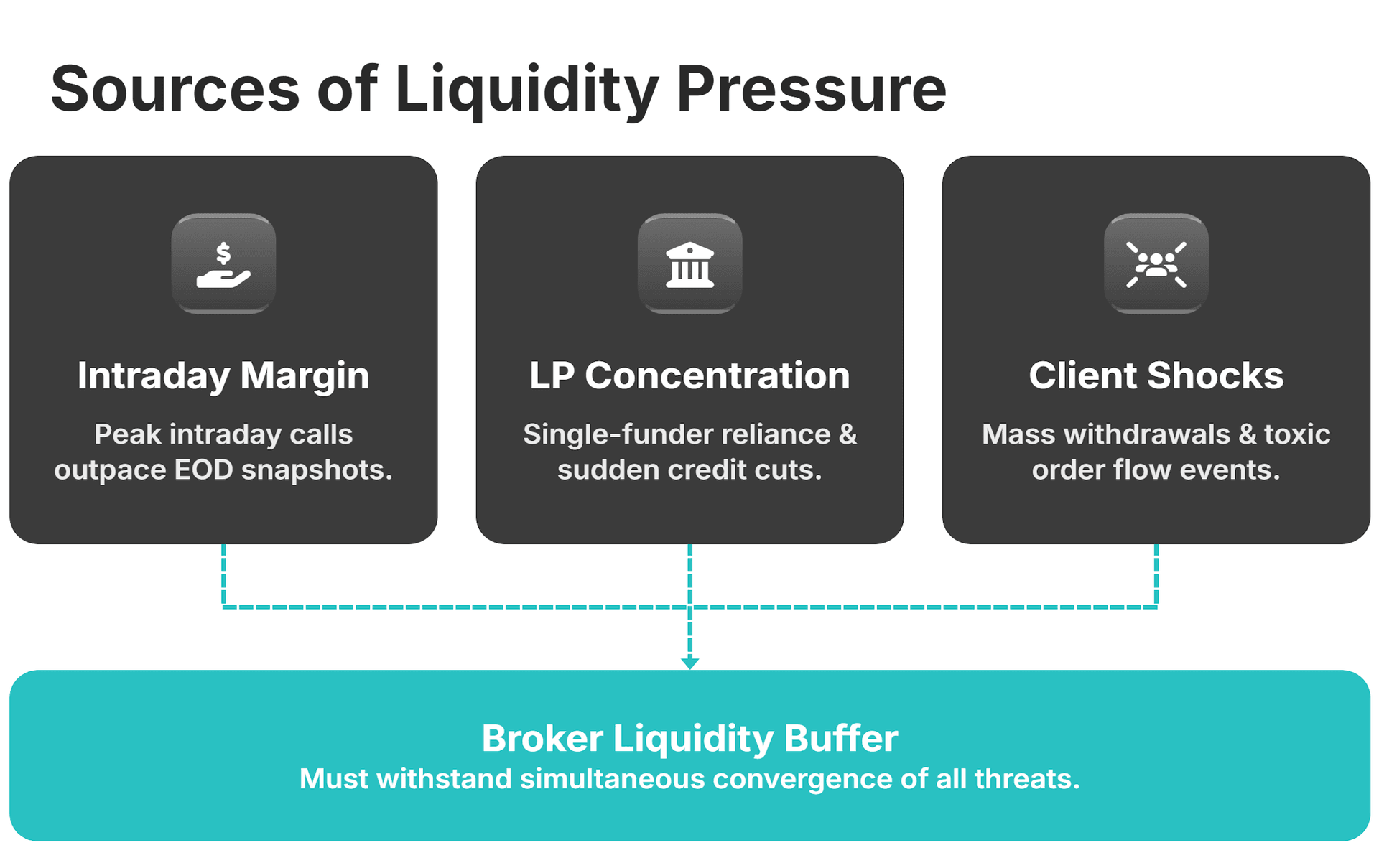
Client Flow Shocks and Toxic Order Flow
Large client withdrawals or hedge fund deleveraging can drain liquidity faster than any LP event, especially when institutional exposure is concentrated. Firms that use hedging strategies to manage directional exposure still face liquidity stress when hedges require collateral posting while client withdrawals accelerate. Toxic order flow (where informed clients systematically generate adverse selection) compounds P&L swings and can create unexpected liquidity outflows through rapidly changing margin positions. Credit risk from counterparty deterioration adds another pressure layer: a prime broker downgrade or margin methodology shift can trigger immediate collateral calls.
Early-warning monitoring for these patterns is especially critical because the lead time before a liquidity impact can be very short.
Get Institutional-Grade Liquidity for Your Brokerage
B2BROKER connects brokers to deep liquidity pools across 800+ instruments with real-time risk controls built in.
Building a Liquidity Risk Management Program
A functional liquidity risk program is an operational system with named owners, live metrics, and pre-built response playbooks. Effective liquidity risk management starts with defining what "adequate" looks like for your specific business model and then building the infrastructure to measure and defend that standard.
Metrics, Limits, and Monitoring
Core metrics include cash coverage ratios, days-of-liquidity measures, concentration limits across funding sources, and stress-adjusted liquidity buffers calibrated to the broker's actual business model.
Limits should trigger escalation before shortfalls occur. Monitoring must operate on an intraday basis with automated alerts, real-time position tracking, and documented breach-handling procedures. Reporting cadences should cover daily operational views and weekly management summaries, with immediate notification when thresholds are breached.
Governance and Risk Appetite
Board and senior management must own liquidity risk. Risk committees should set and enforce the firm's risk appetite (the level of liquidity risk accepted under normal and stressed conditions) and translate that appetite into operating limits and documented decision paths.
Strong governance accelerates response during stress. When the board pre-defines escalation paths and pre-approves authority for emergency actions, the firm can act within minutes.
Stress Testing: Scenarios and Calibration
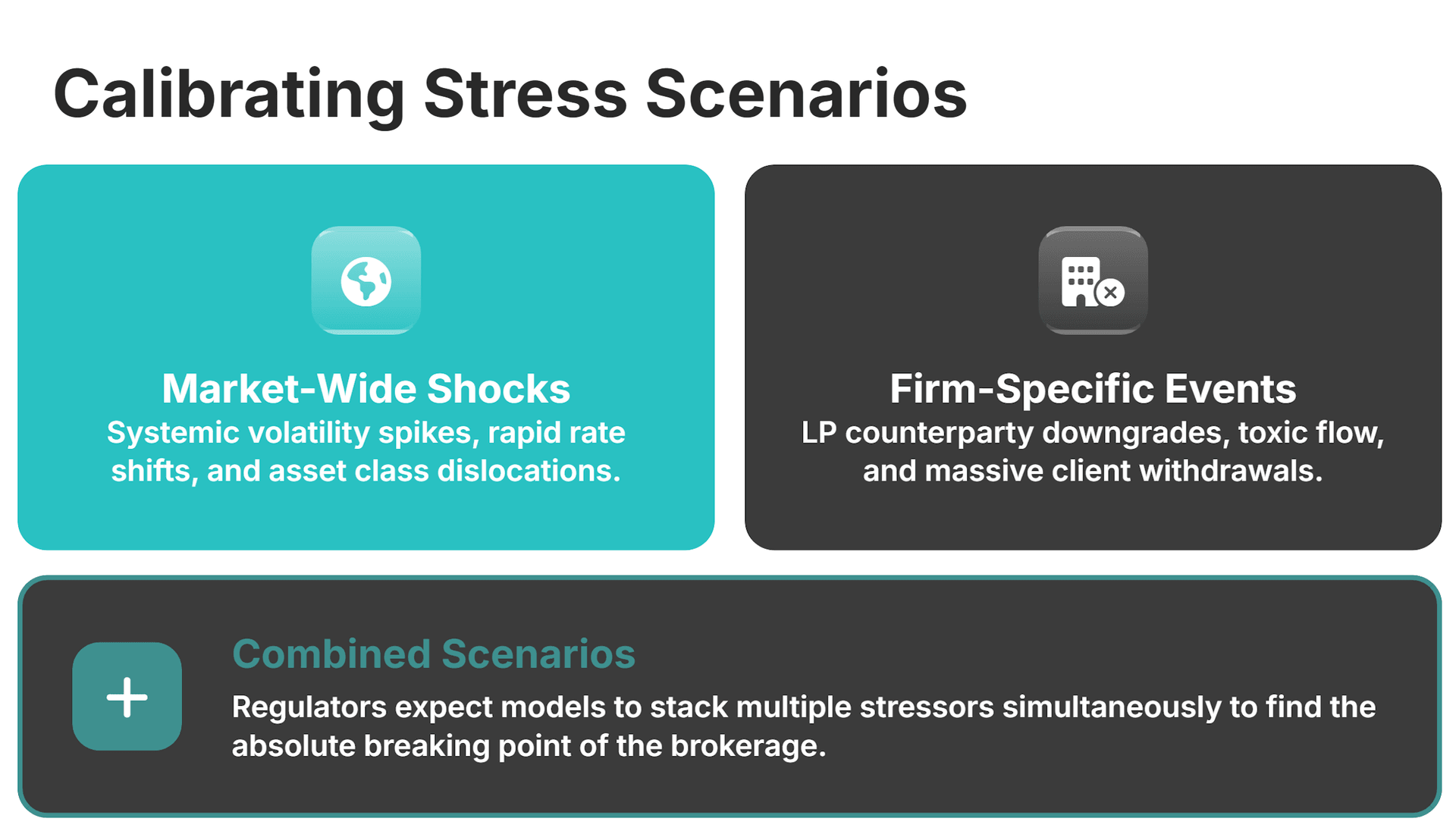
Scenario types should include market-wide shocks (2020 March volatility, the 2022 rate environment), firm-specific events (a major LP counterparty downgrade, a large client withdrawal), combined scenarios that stack multiple stressors simultaneously, and historical stress events calibrated to the firm's actual trading book and funding structure. Where derivatives or repo positions are held, scenarios should model the simultaneous liquidity stress across both hedging book and direct funding lines.
Scenarios must be severe but plausible, calibrated to actual historical events and current market structure risks. The FCA review specifically criticized firms for using scenarios that did not challenge their assumptions. Review scenarios at least quarterly and update them after material business changes or significant market events. The analysis must capture peak call timing across the full trading session.
Contingency Funding Plans: Triggers and Playbooks
Contingency Funding Plans (CFPs) are pre-built action playbooks that exist before a crisis begins. They should document quantitative triggers like liquidity ratio thresholds, qualitative triggers such as counterparty deterioration, and pre-approved response actions.
Pre-approved actions typically include position reduction, activation of backup credit facilities, HQLA liquidation, and tightening of client risk settings. Pre-approval exists for speed: intraday calls require immediate execution capability, with authority delegated in advance so the team can act without waiting for committee approval.
Technology That Makes It Operational
A well-designed program still fails without the technology to execute it.
Real-Time Dashboards and Pre-Trade Controls
Consolidated dashboards should surface cash positions, margin utilization, collateral status, and counterparty exposure in a single real-time view. Automated pre-trade controls can block or flag activity that would push liquidity utilization beyond defined thresholds before execution occurs.
Multi-system aggregation is critical. Trading, back-office, banking rails, and risk engines must feed into the same view, and mobile access for off-hours events is increasingly a baseline requirement.
FIX and API Integration
FIX and API connectivity enable near-real-time data flow between execution venues, liquidity providers, risk engines, and back-office systems. The quality of this integration directly affects risk outcomes: manual reconciliation introduces errors and delays that matter when a margin call arrives unexpectedly.
Standardized connectivity to major LPs and CCPs also supports scalability. As volumes and asset classes expand, a well-integrated infrastructure scales without requiring architectural replacement.
What to Look for in a Liquidity Risk Platform
Evaluate platform selection against regulatory requirements: does it support FINRA and FCA/IFPR obligations, and how does the vendor deliver rule updates? Is the system multi-asset ready? What support is available during a crisis?
The operational readiness of the technology is a regulatory factor. Regulators increasingly review systems and controls alongside written programs.
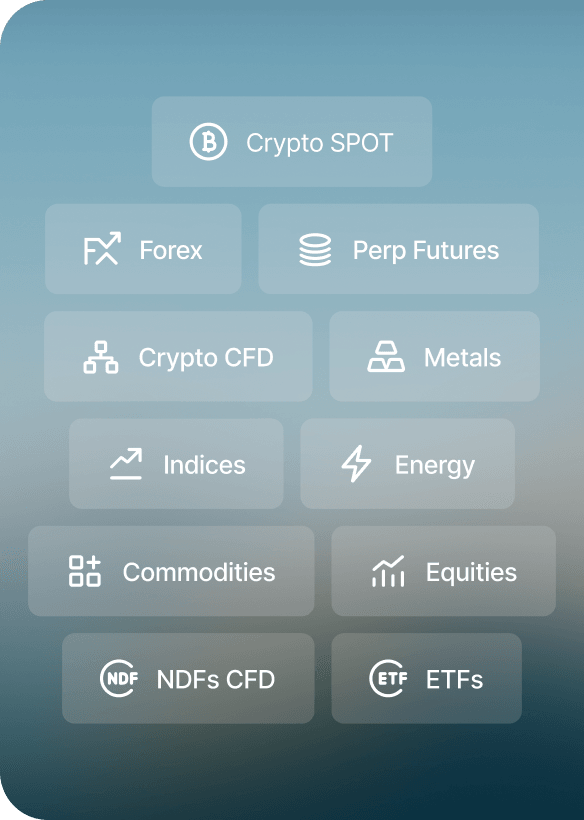
Deep, Reliable Liquidity Across 10 Major Asset Classes
FX, Crypto, Commodities, Indices & More from One Single Margin Account
Tight Spreads and Ultra-Low Latency Execution
Seamless API Integration with Your Trading Platform
From Compliance to Competitive Advantage With B2BROKER
Brokers that build genuine operational capability around liquidity risk gain something competitors lack: the confidence to grow without constant vulnerability to liquidity events.
Sound liquidity risk management practices protect profitability during financial crises and market disruption, when it matters most. A robust program protects capital during stress and satisfies FINRA, FCA, and cross-border regulatory expectations. It also strengthens relationships with prime brokers and institutional clients who conduct their own counterparty due diligence.
B2BROKER's integrated ecosystem (spanning multi-asset prime of prime liquidity, CRM infrastructure, wallet systems, and back-office solutions) supports the data flows and operational depth that a functional liquidity risk program requires. Our comprehensive support is designed to ensure your brokerage operates with the resilience needed to withstand deteriorating market conditions, enabling confident, sustainable growth.
Unify Your Liquidity Risk Infrastructure
B2BROKER's ecosystem spans multi-asset liquidity, real-time risk dashboards, and CRM, reducing vendor sprawl and improving data flow across your entire operation.
Frequently Asked Questions about Liquidity Risk Management
- What liquidity risk metrics are most relevant to margin trading?
Cash coverage ratios and intraday margin utilization are most relevant because they measure a broker's ability to meet margin calls during volatile periods. Stress-adjusted liquidity buffers add a forward-looking layer to that picture.
- How often should a broker update its stress-testing scenarios?
Brokers should review and update stress-testing scenarios at least quarterly, and immediately after significant market events or material business changes, so scenarios stay severe but plausible under current conditions.
- What is the difference between liquidity risk and solvency risk?
Liquidity risk is the inability to meet short-term obligations when they come due without unacceptable losses. Solvency risk is the inability to meet obligations overall because total assets are insufficient. A broker can be solvent but still fail if cash is unavailable when margin calls or withdrawals arrive.
- What should a contingency funding plan include?
A contingency funding plan should include quantitative and qualitative triggers, pre-approved actions such as accessing backup funding or reducing risk, clear escalation procedures, and assigned responsibilities. The plan must activate rapidly to handle intraday liquidity shocks.