Smart Order Routing: How It Works and Why It Matters for Execution


Smart order routing (SOR) is a core execution feature, rather than an optimization tool. It became increasingly popular as trading markets have become more fragmented across financial institutions, liquidity providers, and asset classes.
The pressing demand for rapid execution, consistent pricing, and a predictable trading experience prompted brokers to integrate a smart order routing system into their order flow.
This model works by routing orders across multiple venues and adapting execution decisions as market conditions change. Executing orders using SOR maintains pricing, reduces slippage, and ensures a predictable trading experience even during volatile or low-liquidity periods.
In this guide, we will explain how smart order routing works in practice, how decisions are made, and how brokers can deploy SOR solutions at scale.
Key Takeaways
- Smart order router enables brokers to achieve best execution across fragmented markets in real time.
- SOR reduces slippage and market impact by intelligently splitting and filling orders across venues.
- Modern SOR platforms support multi-market, multi-asset trading, not just derivatives or equities.
- Choosing the right SOR solution is a strategic infrastructure decision, not a plug-in upgrade.
What Is Smart Order Routing? (and Why Markets Need It)
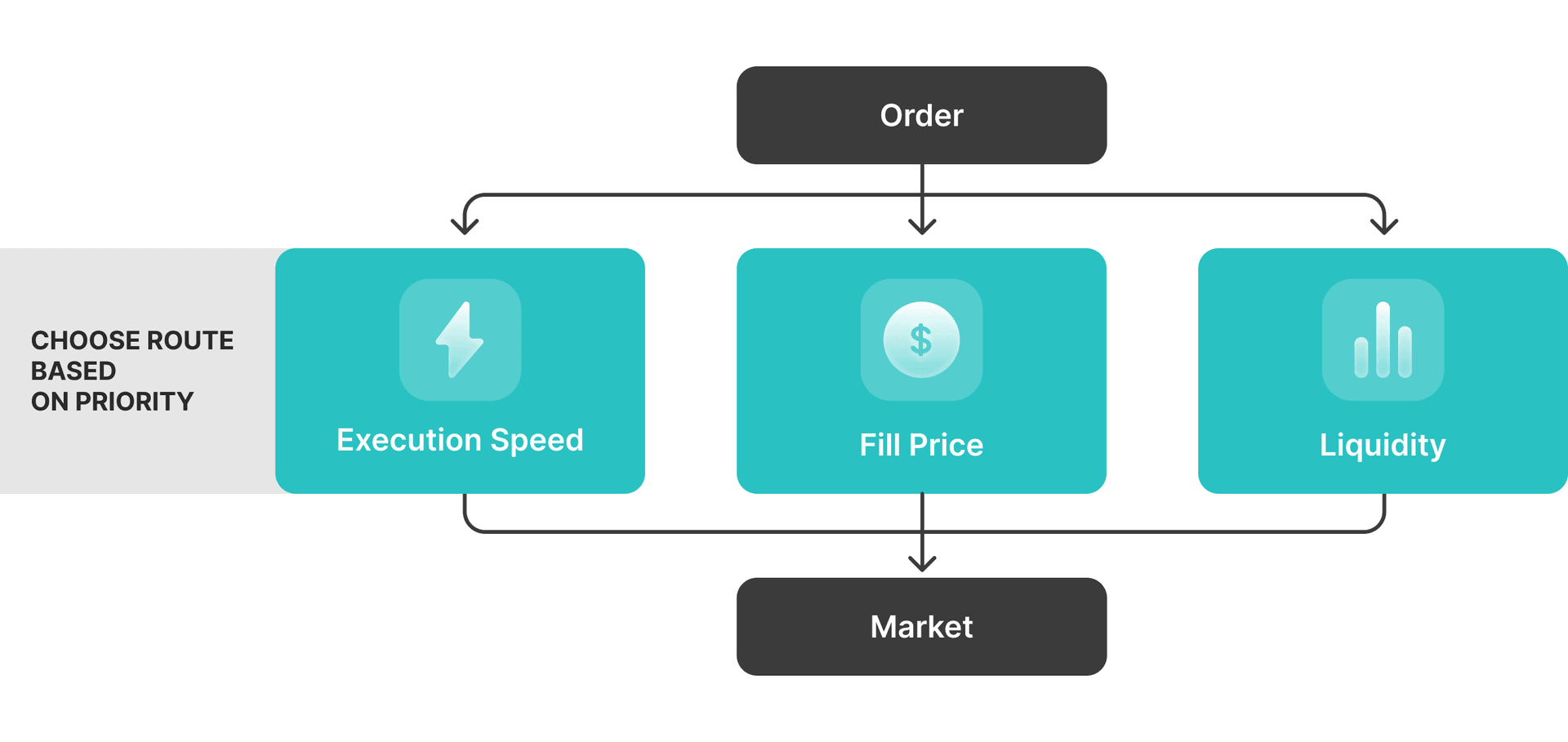
Smart order routing is an automated execution system that evaluates multiple trading venues simultaneously and determines the best destination to execute a trading order.
Instead of sending market positions to a single provider, an SOR analyzes variables, such as price, book depth, execution fees, latency, fill history, and venue reliability, before routing any order.
Unlike traditional centralized markets, where a single exchange often represents the majority of liquidity, SOR leverages fragmented liquidity across exchanges, ECNs, dark pools, prime brokers, and tier-1 liquidity providers. It gets even more scattered in crypto markets, with dozens of centralized and decentralized exchanges, DeFi platforms, and blockchain operators overlapping.
Otherwise, brokers will resort to manual or static decisions, sending orders to a preferred venue regardless of market changes, thereby failing to adapt to real-time liquidity shifts, increasing slippage risk, and missing best-execution opportunities.
How Smart Order Routing Works in Practice
Smart order routing is a continuous process rather than a one-time practice. Once an order is placed, the SOR aggregates real-time market data from connected execution venues, including prices, order book depth, and performance metrics.
Then, the system determines execution destination based on predefined routing logic, which entails sending the entire order to a single provider or splitting it across multiple pools to minimize market impact and improve fill quality. In case of partial fills, the SOR reassesses remaining quantities and reroutes them if better opportunities arise.
This process repeats for every order lifecycle, and execution decisions change when liquidity patterns shift, latency increases, or a particular venue underperforms—ultimately to find the best execution conditions.
Get High-Performance Infrastructure
Our pre-integrated brokerage solutions equip you with SOR execution, deep liquidity coverage, and custom features
Why Smart Order Routing Improves Execution Quality
Order execution quality is often misunderstood as a function that improves spreads. In reality, it makes trading more predictable and stable.
The primary value of smart order routing lies in its impact on execution outcomes. It enables brokers to access a wide range of liquidity and adapt to real-time conditions seamlessly, resulting in best-price streaming, lower slippage, and better filling rates.
Poor routing decisions can result in partial fills, execution delays, and unexpected price movements, leading to significant financial losses during high market volatility.
SOR mitigates these risks by distributing execution across multiple providers, minimizing overreliance on a single liquidity source, and dynamically responding to market changes. This is particularly important during low liquidity or sudden volatility, when static routing tends to fail.
Smart Order Routing Across Asset Classes
Smart order routing is not always a one-size-fits-all solution. Different asset classes and market conditions require unique structures, and an ideal SOR system must be updated and adapted accordingly.
Let’s explain how smart order routing works in different markets
Forex and Institutional Liquidity
In the foreign exchange market, liquidity is decentralized across banks, electronic trading systems, and prime-of-prime providers. There is no central order book, and pricing can vary significantly between venues.
As such, SOR depends on liquidity depth, execution behavior, and consistency rather than top-of-book pricing alone.
For brokers, this means selecting venues that offer the best fills at quoted prices, with predictable last-look behavior, and minimum execution delays. This approach helps brokers navigate market challenges by continuously evaluating liquidity provider performance and adjusting routing decisions in real time.
Crypto and Digital Asset Markets
Crypto markets introduce a different set of challenges. Liquidity in cryptocurrencies is fragmented across exchanges, CEX/DEX platforms, blockchain platforms, and other DeFi projects. Therefore, order books at each destination can be thin, and volatility can become very intense.
Therefore, SOR in crypto markets must account for exchange reliability, downtime risk, and execution consistency. Additionally, routing must spread execution across multiple exchanges to avoid venues with unstable performance and adjust dynamically during periods of rapid price movement.
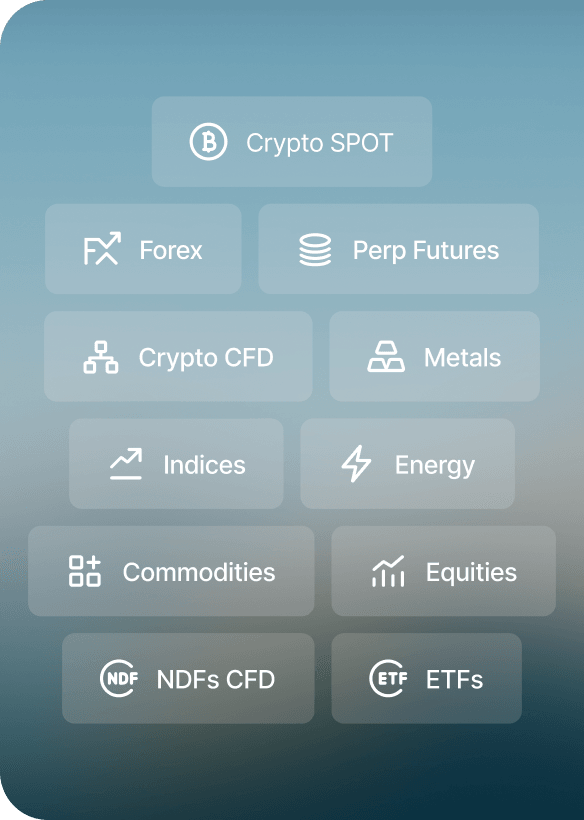
Deep, Reliable Liquidity Across 10 Major Asset Classes
FX, Crypto, Commodities, Indices & More from One Single Margin Account
Tight Spreads and Ultra-Low Latency Execution
Seamless API Integration with Your Trading Platform
Routing Strategies Brokers Use to Optimize Execution
The execution algorithm is built on top of the smart order routing foundation, which is configured and refined over time. Typically, brokers start with basic routing rules and evolve to more adaptive, data-driven strategies as their execution requirements mature, attempting to optimize venue performance, fill ratios, execution speed, and transaction costs.
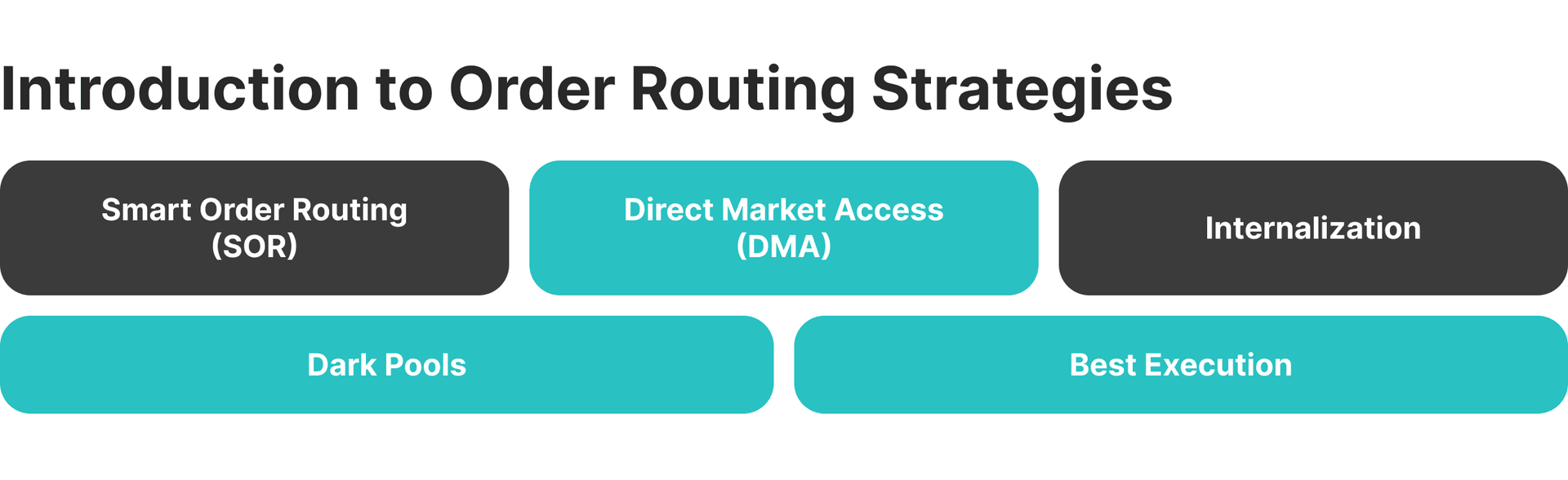
This shift mirrors a broader progression in routing strategy. The most effective way to manage SOR is to treat it as an ongoing optimization process, regularly adjusting parameters based on execution analytics, market structure changes, and client trading behavior.
Dynamic vs Static Routing Logic
Old-school, static routing rules imply that brokers always send orders to one or selected venues that offer the lowest fees, which may work in stable conditions, but break down during volatility or liquidity shifts.
On the other hand, dynamic routing logic allows brokers to respond to real-time market conditions, rerouting orders as prices, depth, and venue performance change.
This adaptability is critical for maintaining execution quality despite changes in market prices, volatility patterns, and user behavior. Brokers that rely on static routing often experience inconsistent fills and higher slippage during stressed conditions.
Partial Fill and Order Size Management
Handling partial fills intelligently is another key execution challenge. Large orders executed in a single venue can deplete price and asset availability in one pool, causing major market shifts and degrading pricing. Therefore, SOR addresses this by breaking orders into smaller segments and distributing them across venues, reducing impact and execution drag.
To achieve this, smart order routing continuously monitors fill progress and adjusts order sizes to help brokers offer better trading conditions and ensure predictable outcomes.
Smart-Routing Liquidity Bridge
Our high-performance liquidity bridge connects you to top liquidity pools and trading venues to execute in milliseconds
Dark Pools, Lit Venues, and Market Impact Trade-offs
Dark pools offer a unique value for SOR brokers. As order sizes increase, platforms make trade-offs between execution transparency and immediacy. Dark pools can reduce market impact by hiding order intent, thereby increasing execution uncertainty.
Smart order routing enables brokers to manage this dilemma dynamically, sending orders to dark pools initially to minimize impact, then shifting processing to lit venues if fill probability declines. This flexibility is necessary for brokers in fragmented financial markets, where liquidity is widely dispersed, and trading conditions change frequently.
Dark pool trading involves significant financial companies and key players in closed exchanges. Here’s what makes these pools good for public markets.
06.12.23
Regulatory and Best Execution Considerations
Intelligent routing plays a critical role not only in achieving the best execution, but also in demonstrating it. Regulators and clients increasingly expect brokers to disclose how execution decisions are made and what data and systems contribute to best-execution principles.
Therefore, brokers implementing smart order routing must maintain detailed audit trails, execution reports, and operational transparency. These practices vary across jurisdictions and must be embedded in the liquidity infrastructure from the get-go, rather than treated as an additional feature.
How Brokers Should Evaluate a Smart Order Routing Solution
Choosing a smart order routing solution is a strategic infrastructure decisions that improve the broker’s operational reliability and the trader’s experience. Trading platforms must evaluate SOR algorithms based on execution outcomes, scalability, and software alignment.
Market Coverage and Liquidity Access
The routing system must cover a broad range of trading venues, asset classes, and deep order books. Not every fast SOR is useful; a fast system is ineffective if it lacks access to high-quality liquidity.
Therefore, brokers should prioritize resilience and execution consistency across different market conditions over raw speed alone.
Technology, Integration, and Risk Controls
Successful SOR deployment depends on seamless API connectivity with trading platforms, risk management systems, and reporting workflows. The system must fit naturally within the trading infrastructure, not as an isolated tool.
Brokers must also ensure built-in safeguards, testing environments, and real-time monitoring to maintain execution integrity at scale.
Smart Order Routing as Execution Infrastructure
Smart order routing is a foundational execution infrastructure. It supports scalability, regulatory compliance, and client trust by ensuring that orders are executed efficiently and transparently across fragmented markets.
Those who invest in robust, adaptive SOR infrastructure are better positioned to deliver consistent execution, manage risk, and compete effectively in multi-asset trading environments.
B2BROKER provides institutional-grade infrastructure that unifies smart order routing, liquidity aggregation, risk controls, and multi-asset execution within a single ecosystem—helping brokers scale with confidence as market complexity grows.
All this is with less hassle, quick time-to-market, and full customization that suits your business needs.
Have a Question About Your Brokerage Setup?
Our team is here to guide you — whether you're starting out or expanding.
Frequently Asked Questions about Smart Order Routing
- What problem does smart order routing solve for brokers?
Smart order routing helps brokers execute trades efficiently across fragmented markets by automatically selecting the best venues based on price, liquidity, and execution quality. It reduces reliance on single venues and improves consistency in fill rates and pricing, especially during volatile or low-liquidity conditions.
- How is smart order routing different from basic order routing?
Basic routing sends orders to a predefined venue or liquidity source, while smart order routing evaluates multiple venues in real time. SOR dynamically adjusts routing decisions based on market conditions, partial fills, and execution outcomes, making it better suited for modern multi-venue and multi-asset trading environments.
- Does smart order routing eliminate slippage?
No. Smart order routing cannot eliminate slippage entirely, but it can significantly reduce it by accessing deeper aggregated liquidity and optimizing how orders are split and routed. Effective SOR focuses on minimizing market impact and improving execution consistency rather than guaranteeing fixed prices.
- Is smart order routing only relevant for large or institutional brokers?
While SOR originated in institutional trading, it is now widely used by mid-sized and growing brokerages. Modern SOR solutions make institutional-grade execution accessible without the capital or infrastructure requirements of tier-1 firms, allowing smaller brokers to compete on execution quality.
Recommended articles