White Label vs Custom Development: The 2026 Broker's Decision Framework

Launching a competitive brokerage in 2026 demands precise technology decisions. Founders and technical directors face a defining infrastructure choice before entering the market, with the core technology debate centered on white-label vs custom development.
White label development uses a licensed, production-ready trading stack that a broker brands and configures. Custom development funds a broker-owned platform with control over architecture and roadmap.
This guide provides a practical decision framework for evaluating these two distinct paths. We analyze total ownership costs alongside precise time to market metrics. You will learn the specific operational scenarios that justify each technological approach.
Key Takeaways
- White-label platforms cut the launch window down to 4–12 weeks and drop the five-year ownership cost by three to five times.
- Building from scratch demands a dedicated roster of 5–10 engineers plus an annual maintenance budget hitting 15–25% of the original price tag.
- Vendor-managed infrastructure absorbs the daily compliance workload by pushing security patches and regulatory updates directly to the platform.
- Custom code makes financial sense only when your core business strategy requires unique algorithms unavailable in standard API configurations.
Why Brokers Revisit Build vs. Buy
Established brokers and startups alike revisit build vs. buy when the platform starts shaping growth limits. A new asset class, a new region, or a shift in client mix often forces a second look at licensing, resourcing, and operational ownership.
In 2024, the US securities brokerage market reached about $200 billion, with projections of roughly $240 billion by 2029 (4.23% CAGR). The discount brokerage segment also scales fast, moving from $24 billion in 2024 to $33 billion by 2029 (6.3% CAGR). Faster expansion leads to tighter pricing expectations and a higher support load for platform teams.
The 2026 cycle adds specific triggers. Compliance work keeps expanding in scope. Clients expect multi-asset access as a baseline feature. Margins stay tight, so delays and rework turn into direct P&L impact.
The decision also evolves with the business model. A broker build and a crypto exchange build, for example, create different priorities for custody, market structure, and workflows, which change what “right stack” means in practice.
Teams achieve better outcomes when they reassess regularly. Annual reviews based on incident history and delivery velocity keep the technology strategy aligned with current business goals.
Focus on Growth, Not Infrastructure
Let us handle the technical maintenance and compliance updates while you concentrate on client acquisition and revenue.
What Is White Label Development for Brokerages?
White-label development involves licensing a fully functional trading platform from a technology provider. This pre-built solution lets the broker rebrand the interface and configure specific parameters to serve their client base and business needs. This model mirrors how platforms in e-commerce and healthcare license core infrastructure to accelerate market entry.
Implementing a white-label solution provides immediate access to essential brokerage components. These systems include the core trading infrastructure, back-office management tools, and automation necessary for daily operations:
- High-performance trading engine for order execution
- Integrated CRM for client lifecycle management
- Payment gateways for funding
- Reporting dashboards for financial monitoring
- Pre-configured compliance and KYC frameworks
Technology providers assume the burden of ongoing maintenance and security patches. They automatically manage regulatory updates, reducing the technical overhead for the brokerage team.
Today's licensed systems run on modular architecture. Brokers use APIs to build a specific client experience on top of a proven foundation, getting the exact visual layout and workflow their brand needs, while the core codebase remains secure and untouched.
The deployment process focuses on onboarding and configuration rather than coding from scratch. Reviewing the stacks of white-label crypto exchanges or brokers reveals that setup often takes just weeks. Rapid deployment helps firms enter markets during periods of high volatility.
What Is Custom Development for Brokerages?
Custom development involves building a trading infrastructure from the ground up using an internal team or contracted engineering development company. This path differs from licensing because the brokerage owns the source code and maintains complete control over the system architecture.
Choosing a custom app build requires significant upfront capital and extended development timelines. Full ownership grants total control over the user experienceь but it shifts the entire burden of technical maintenance and infrastructure scaling to the firm.
Building custom solutions makes strategic sense when the competitive edge depends on proprietary technology that the market does not offer off the shelf. Common examples include a unique risk engine or an execution workflow that ties directly to unit economics.
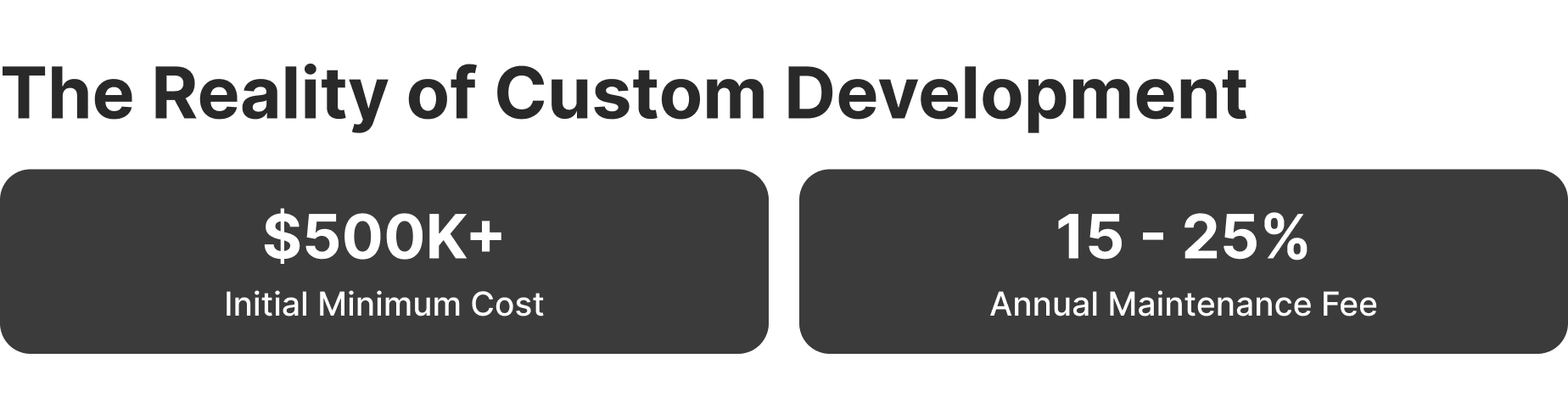
The cost model includes more than the initial platform and app development. In practice, full-platform budgets often land around $500K–$2M+, then expand with the operating surface area. Cost lines usually include:
- Security audits and pen tests
- Compliance work and certifications
- Infrastructure scaling and observability
- Ongoing feature development
Operational ownership becomes a long-term commitment. Teams plan for annual maintenance that often runs 15–25% of build cost, plus a permanent development team for incident response and platform performance work.
This path fits well-funded brokers with clear differentiation goals and the capacity to run a continuous delivery cycle. Strong governance matters, since roadmap decisions directly affect reliability and audit readiness.
Head-to-Head Comparison on Crucial Criteria
This section compares the trade-offs and benefits of white-label and custom development through four dimensions that drive broker outcomes in 2026: speed to market, total cost of ownership, flexibility, and risk management. Each subsection focuses on practical decision inputs that map to launch planning and operating budgets.
Speed to Market
Launch timelines shape cash flow and market positioning. Teams typically plan 4–12 weeks for a white-label go-live once licensing, integrations, and onboarding flows reach production readiness. Faster launches translate into earlier revenue generation and immediate competitive positioning for new brokerage firms.
The development time for custom platforms land in a different range for comparable functionality. Many programs run 12–24 months, since the scope includes architecture decisions, QA cycles, and production hardening before the first stable release.
These timelines often face compounding delays from scope creep and integration challenges. Regulatory approval processes further extend the path to going live, delaying the brokerage’s market entry significantly.
Total Cost of Ownership
Initial investment figures only represent the beginning of a financial commitment. A comprehensive total cost of ownership (TCO) analysis reveals the true burden of maintaining a brokerage. Over a five-year period, white-label solutions typically cost three to five times less than custom-built systems.
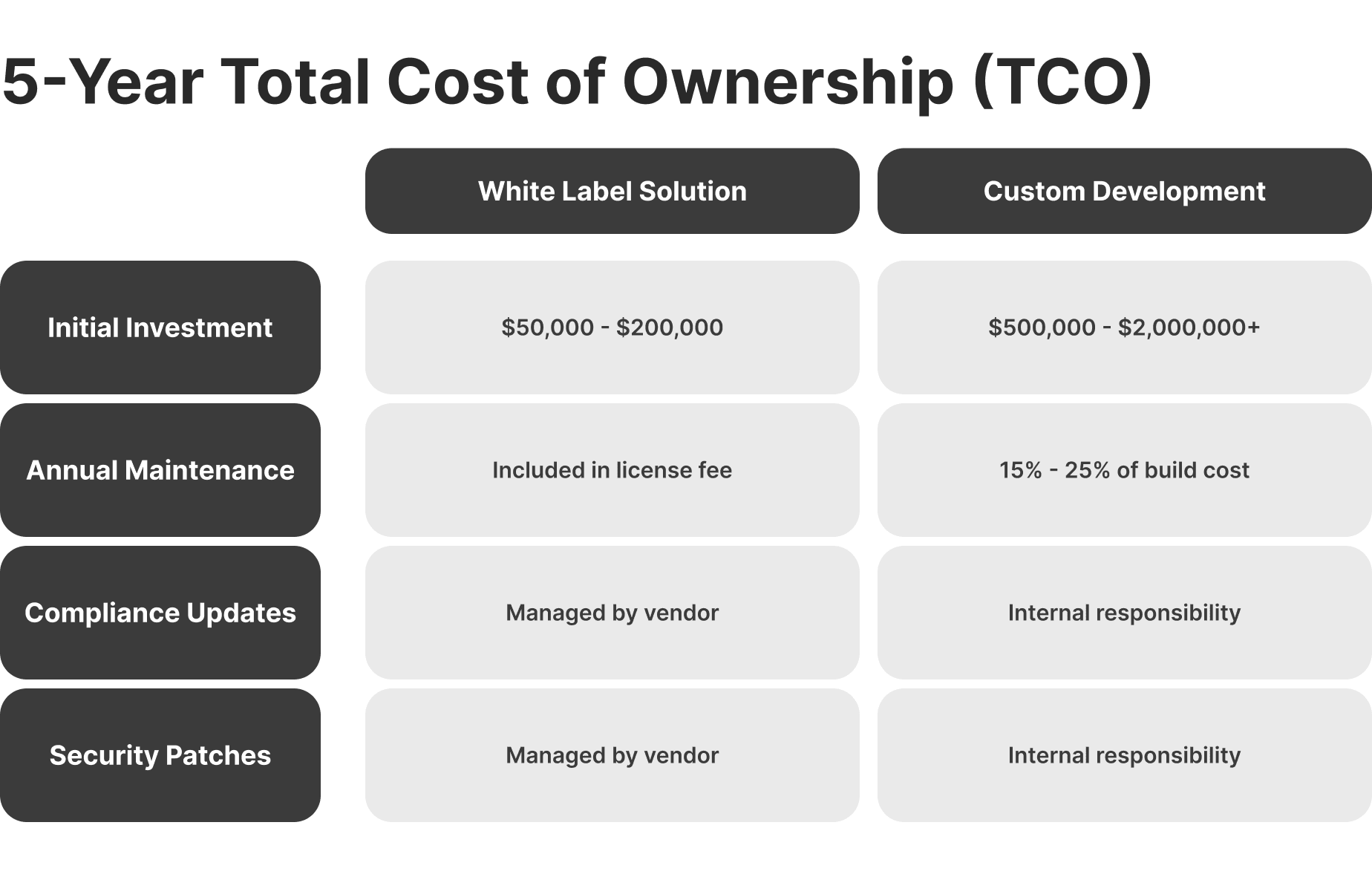
Development costs compound because every technical requirement, security vulnerability, routine bug fixes, or new feature demands internal engineering resources. At the same time, the cost of a white-label model shows how shared infrastructure can lower the individual entry price.
Many brokers underestimate the ongoing operational burden of proprietary code. Scaling a team to manage server stability or database optimization adds significant overhead. Selecting a licensed model converts these unpredictable capital expenditures into fixed, manageable operating costs.
Customization Options in White-Label Systems
Modern white-label solutions provide deep architectural access, challenging the myth that white-label software is generic. These platforms utilize modular designs that support significant brand differentiation. Brokers achieve unique market positioning through several technical avenues:
- Branded UI and portal layout
- Configurable onboarding and permissions
- Reporting formats and exports
- API integrations for CRM and payments
- Modular feature switches per product to match business requirements
Differentiation tailored to specific needs often sits inside these boundaries. Teams can tune risk parameters per symbol and enforce client segmentation rules through configuration. Some vendors also support custom plugins for pricing logic or reporting, using documented APIs.
Customization depth varies widely between providers. Due diligence should include a live walkthrough of the configuration console and a review of the integration limits of a white-label app. The decision test stays simple: does the strategy require capabilities no vendor can deliver through configuration? If not, white label likely suffices.
Compliance and Risk Management
Established white-label vendors maintain various regulatory certifications and embed KYC frameworks into their core architecture, pushing compliance updates automatically to address changing legal requirements.
Proprietary development shifts the entire burden of regulatory alignment to the brokerage. The firm assumes full responsibility for security certifications and audit readiness. Managing these requirements internally demands a permanent staff of legal and technical specialists.
Compliance failures carry severe consequences like license revocation or heavy financial penalties. Using a white-label provider offers a strategic advantage by leveraging expertise built across multiple jurisdictions. This collective knowledge is difficult to replicate with a small internal team.
Brokers effectively share the cost of compliance infrastructure across the vendor’s entire client base. This economic model provides access to enterprise-grade security without the associated price tag of an isolated build.
Decision Checklist for CTOs and Founders
Choosing a development path requires translating technical comparisons into a concrete business decision that addresses specific business strategy and internal capabilities.
The framework below focuses on three inputs that drive outcomes in production: differentiation strategy, internal delivery capacity, and vendor reliability under stress.
Map Strategic Differentiators
Start by listing 3-5 specific capabilities that will define your competitive edge in a crowded market. Identify which of these features require technology that does not exist in any current white-label ecosystem. Building a proprietary stack often leads to over-engineering when a desire for full control overshadows what branding can achieve more effectively.
If your list contains fewer than 2 items requiring a unique code, a licensed solution better serves the business. Most brokers achieve uniqueness through platform configuration rather than expensive new development. Reserve custom builds for creating a genuine competitive advantage that rivals cannot easily duplicate.
Audit In-House Engineering Resources
Custom development requires deep technical expertise and ongoing operational support, not just delivery skills. Platform teams need capacity for security monitoring and performance work, as well as a release process that runs year-round.
A practical benchmark for a custom platform is 5–10 dedicated engineers at a minimum, with additional DevOps or security coverage depending on uptime targets.
Recruiting and retaining fintech talent adds significant project management overhead to the project budget. High competition for developers in this sector increases recruitment and training costs. Brokers must factor in these expenses when calculating the true feasibility of starting a custom development project.
Validate Vendor Support and Licensing
Vendor dependency becomes a delivery risk when contracts leave key terms unclear. Due diligence should cover support response time for critical incidents and the cadence of compliance updates, then connect that cadence to release notes.
Contract review should confirm data ownership and exit provisions, then document integration limits for third-party services. Ask for an 18-month roadmap that includes upgrade paths and deprecation policy, then validate it against references at a similar scale.
Choosing providers with strong financial stability and transparent development cycles mitigates vendor dependency risk while ensuring future scalability.
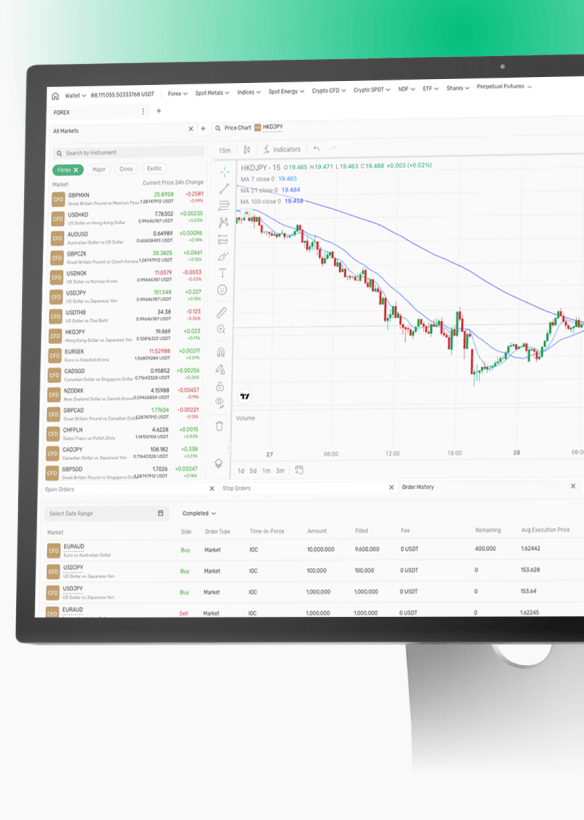
Power your Brokerage with Next-Gen Multi-Asset & Multi-Market Trading
Advanced Engine Processing 3,000 Requests Per Second
Supports FX, Crypto Spot, CFDs, Perpetual Futures, and More in One Platform
Scalable Architecture Built for High-Volume Trading
Accelerate Time to Revenue With the Right Partner
For many brokers in 2026, white-label development offers a cost-effective and direct path to revenue. It shortens delivery timelines and keeps ownership cost predictable, while still supporting product differentiation through configuration and integrations.
B2BROKER provides a comprehensive ecosystem beyond basic software solutions licensing. Our infrastructure includes deep multi-asset liquidity and ready-made trading platforms like cTrader and B2TRADER. We also offer secure wallet solutions along with advanced CRM and back-office frameworks for unified operations.
We bring over a decade of industry experience to every partnership, holding 10 regulatory licenses and serving more than 1,000 corporate clients worldwide.
Professional 24/7 support mitigates operational risks during high-growth periods. Continuous platform innovation supports your scalability requirements and long-term success. The right technology partner accelerates your initial launch while providing the stability needed for permanent market expansion.
Turn Months of Development Into Weeks
Get a fully integrated white-label platform with liquidity, CRM, and compliance tools ready for your brand.
Frequently Asked Questions about White Label vs Custom Development
- Can a white-label solution transition to custom later?
Yes. Many firms launch on white label model, then replace specific modules over time, such as onboarding or reporting. This staged approach keeps core infrastructure stable while unique features move into production.
- How does white-label application development affect valuation?
Early-stage investors usually value revenue traction and operating discipline more than owning code. Custom development adds value when proprietary technology creates a defensible moat or improves unit economics in a measurable way.
- What level of customization is typically available in white-label systems?
Most modern platforms support brand-level UI changes, configurable workflows, and API integrations for third-party services. Some vendors also offer modular feature toggles and plugin frameworks that extend functionality without rebuilding the core stack.