Is 2026 the Right Year to Start a Crypto Business?


The regulatory groundwork crypto operators spent a decade waiting for is now in force. The European Banking Authority moved into direct supervision under MiCA in 2025, a year it calls transformational. Thus, central banks now track crypto infrastructure and other digital assets as part of routine financial stability work.
That shift changes the question itself. In 2022, anyone asking why start a crypto business had to argue that the market was real. In 2026, the market's reality is settled. What needs evaluating is whether your team is positioned to enter a regulated industry.
This guide works through that evaluation, from business model selection to the build-versus-white-label decision and the vendor question behind both.
Key Takeaways
- MiCA, VARA, and MAS regimes are in force, which turns a crypto launch into a compliance-first project with a published licensing path.
- An exchange, a prime brokerage, and a payments business each demand different infrastructure; scope those requirements before shortlisting any technology partner.
- Building a compliant exchange from scratch typically runs 12–24 months, while a white-label deployment takes weeks. That gap decides who reaches clients first.
- Assembling the stack from point solutions creates integration debt and reconciliation gaps that grow with client volume.
- Evaluating cost structure, licensing strategy, software selection, and operational readiness before launch catches most of the risk that otherwise surfaces after go-live.
The 2026 Case for Crypto Business
Every serious answer to why start a crypto business in 2026 leads back to regulation rather than price action. Frameworks that spent years in consultation are now law, and the crypto investors who waited for them trade through regulated venues.
Regulatory Maturity and Institutional Adoption Trends
MiCA gave the EU the first comprehensive rulebook for crypto-asset service providers. For any business targeting EU clients, CASP authorization has moved from a future consideration to an entry requirement.
The ECB's May 2026 Financial Stability Review puts crypto-assets and stablecoins on its resilience agenda as a new asset class to be monitored. Central banks do not put a market on that agenda unless they expect it to stay.
The same maturation shows outside the EU. VARA in the UAE and MAS in Singapore both run structured licensing programs for exchanges and payment firms, which lets an operator plan a jurisdiction strategy on published requirements.
Why the Competitive Window Still Favors New Entrants
Clarity lowers the risk that used to deter serious entrants. A published licensing path means a new crypto company no longer bets everything on a regulatory reversal. Conversations with banks and institutional clients start from a license number.
Supervision also levels the field. Incumbents built their positions in an unregulated era, an advantage that counts for less now. A new entrant that clears authorization competes on execution quality and product depth from day one.
The window narrows over time, though. Consolidation in regulated markets tends to favor operators with an established compliance record. Every cycle a crypto startup waits out adds to the credibility gap it will need to close later.
Which Crypto Business Model Fits You?
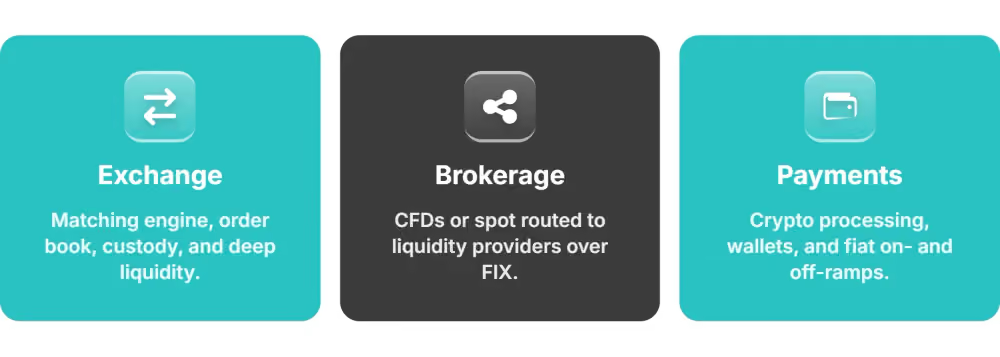
Grouping exchange, brokerage, and payments under one label causes expensive mistakes: each carries its own infrastructure bill and licensing scope. So, the first pre-launch decision is which business you are actually building.
Crypto Exchange: Spot, Derivatives, and Margin
An exchange is the most infrastructure-heavy model in the category. The order book needs matching capacity that holds up under institutional flow, with sourced liquidity behind it. Every account must also clear a know-your-customer (KYC) and AML stack that satisfies the jurisdictions served.
Licensing defines the perimeter before any of that runs. MiCA requires CASP authorization for the crypto-asset services offered; VARA and MAS impose equivalent regimes. Starting a crypto exchange in 2026 therefore begins with the compliance file.
Prime Brokerage and Multi-Asset Brokerage Models
Prime brokerage and multi-asset brokerage serve professional traders, hedge funds, asset managers, and corporations. The baseline requirement is liquidity aggregation across FX, crypto, indices, commodities, and metals, with margining and reporting that hold up across every asset a client trades.
These models also sit across two worlds. The technology partner has to show a track record in traditional market infrastructure as well as crypto, since institutional clients will test both sides.
Crypto Payment Processing and Settlement Infrastructure
Crypto payment processing at this level is a B2B infrastructure business, several layers below a checkout button. The operator runs settlement rails on blockchain technology, letting merchant and institutional clients accept, convert, and settle crypto across Bitcoin, Ethereum, and stablecoins such as USDC. Compliance obligations attach to every transfer.
The model rewards integration with trading ecosystems. Providers such as B2BINPAY , therefore, build payments as one layer of a larger stack, where settled funds stay inside the architecture that executes the trades.
Operators serving on-chain counterparties may extend into decentralized finance (DeFi), where liquidity pools supply the depth instead of a central order book. That shift changes the custody and compliance model again.
Infrastructure Requirements by Business Model
Requirements mapping is the step that turns a business model choice into a vendor shortlist. What follows is the minimum operational bar for the two most common builds.
Exchange Operations: Matching Engine and Liquidity
Throughput is the first number to pin down. B2TRADER , B2BROKER's multi-asset trading platform, processes up to 3,000 requests per second, which is the class of capacity an operator needs once algorithmic flow joins retail traffic.
Liquidity depth decides how that capacity feels to clients. A thin book widens spreads at peak load, and worse fills follow. The first accounts to notice are the high-volume ones the revenue model depends on.
Payments Infrastructure: Compliance and Settlement Rails
A payments business starts from custody discipline: hot wallets sized for daily settlement, cold storage holding the rest. Transaction monitoring runs on top of that split, flagging suspicious transfers ahead of AML reporting deadlines. Each payout also carries transaction fees the settlement model has to absorb or pass on.
Reconciliation is the requirement operators most often under-scope. Matching payment receipts to ledger entries across several networks is a daily job. Gaps in it surface during audits, when they are most expensive to explain.
Building wallet infrastructure for a business is its own technical project. Its custody model and settlement workflow have little in common with anything on the trading side.
Pre-Launch Evaluation: Four Critical Pillars
Four decisions made before launch absorb most of the risk that otherwise appears after it. Cost, licensing, software, and go-to-market each deserve a written evaluation, because every one of them gets harder to change once clients are live.
Cost Structure: Build Drivers vs. Licensing Costs
Comparing an in-house build against a white-label license on setup price alone misreads both. A build concentrates its cost in people and keeps billing after launch. The categories that dominate:
- a development team senior enough to build and then maintain matching, risk, and back-office systems;
- a compliance stack engineered per jurisdiction, with each new market adding scope;
- liquidity access, which takes relationships as well as capital;
- security audits and certifications that recur annually.
A white label flips that profile into a setup fee plus a predictable license, with the vendor carrying maintenance. The honest comparison is total cost of ownership over 24–36 months, counting integration upkeep and the revenue lost while out of the market. Exact figures vary too widely by jurisdiction to quote a universal number.
Regulatory Licensing: MiCA, VARA, MAS, and Offshore Paths
Jurisdiction choice sets the ceiling on banking access, including a business bank account, plus client geography and counterparty credibility. That puts it at the top of the sequence, ahead of any software decision. Four pathways cover most 2026 launch plans:
- MiCA (EU). CASP authorization, operational resilience under DORA, and ongoing regulatory compliance, in exchange for passportable access to the entire EU market.
- VARA (UAE). A structured licensing program with strong recognition among MENA institutional clients.
- MAS (Singapore). A credential Asia-Pacific institutions weigh heavily.
- Offshore registrations. Faster and cheaper to obtain, at the price of restricted banking options and limited institutional reach.
Supervisory attention keeps rising. The FSB's 2025 review found uneven implementation of its global crypto framework and pressed jurisdictions to close the gaps. Licensing early in a tier-one jurisdiction positions an operator ahead of that tightening.
Software, Liquidity, and Operational Readiness
Three criteria separate production-grade platforms from demo-grade ones: latency under real load, coverage of the asset classes your clients trade, and depth of back-office integration.
Ask for the numbers in writing. A vendor that will not commit to throughput benchmarks and an uptime SLA in the contract is telling you how the relationship will run after go-live.
Liquidity belongs on the readiness checklist as well. Signed tier-one agreements need to be in place before the launch date, because renegotiating terms under live client pressure weakens every clause.
Marketing: Attracting an Audience
Institutional buyers rarely arrive through broad awareness campaigns. Account-based marketing, where the pipeline is a named list of target firms, matches how a small buying committee actually evaluates infrastructure.
LinkedIn carries most of that motion, as a publishing channel for operator-focused analysis and a direct route to the executives who sign these contracts.
Events cover the in-person side of the same job. TOKEN2049 and iFX EXPO put new operators in the same room as liquidity providers and prospective clients.
Two quieter channels compound over time. Partnerships with established providers signal operational credibility to counterparties, and SEO aimed at decision-stage queries keeps qualified traffic arriving long after any single campaign ends.
Build From Scratch vs. White Label
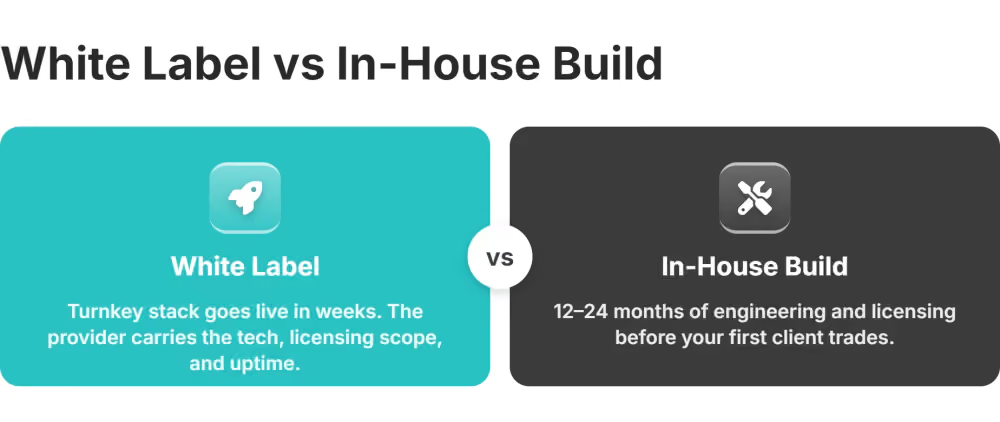
Most operators make this call once. The common failure is underestimating the build: the comparison is really about scope and time, since cost follows from both. Where speed carries the business case, launching an exchange quickly and on a limited budget is a solved problem on the white-label side.
Development Timeline and Team Requirements
A compliant, institutional-grade exchange takes 12–24 months to build in-house. The roster that timeline assumes:
- matching engine engineers,
- compliance officers who translate each license into controls,
- security architects,
- back-office developers,
- DevOps and regulatory counsel around them.
Every additional jurisdiction widens the compliance workstream, so multi-market plans stretch the schedule further. The calendar is a cost in itself, because eighteen months of building is eighteen months in which funded competitors onboard the clients you planned to win.
Time-to-Market: The Turnkey Deployment Advantage
A white-label deployment compresses the same scope into weeks. The compliance tooling arrives already built, and the liquidity relationships come with the platform. Connectivity that takes months to engineer in-house is live on day one.
The trade-off is real: customization runs inside the vendor's boundaries, and the product roadmap is partly theirs. Contract terms and careful vendor selection keep both risks manageable. For most operators, the arithmetic across timeline and maintenance still lands on the turnkey side.
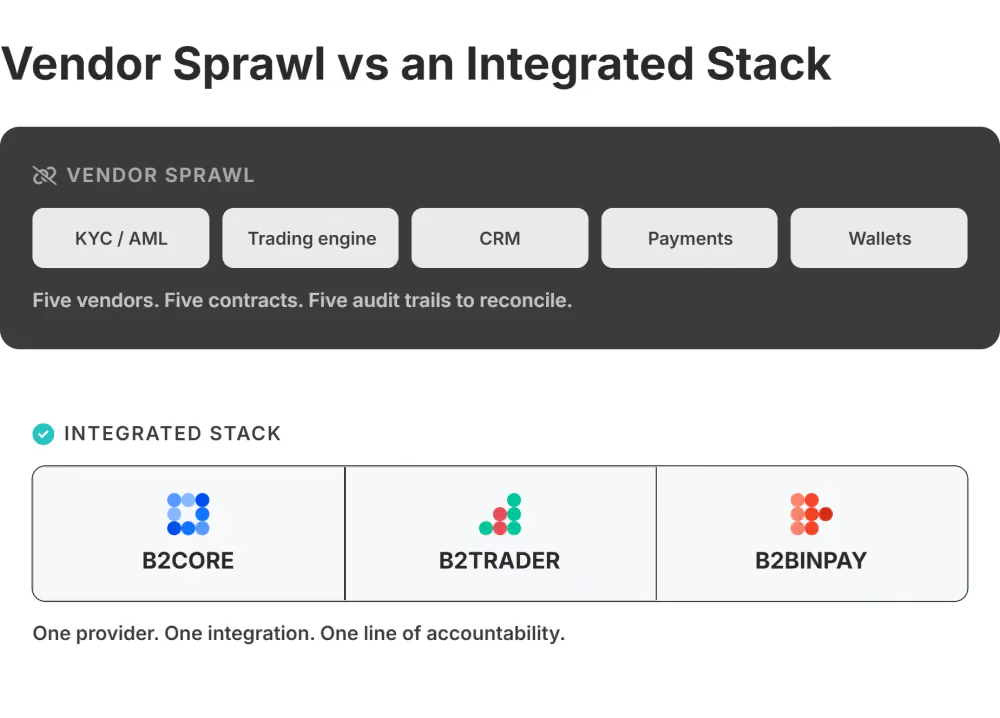
B2BROKER packages the longest build phases into that deployment. B2TRADER covers execution, B2CORE covers CRM and back office, and B2BINPAY covers payments, shipped as one integrated stack in about four weeks.
Why an Integrated Ecosystem Outperforms Point Solutions
One decision remains after model, license, and platform: whether the stack arrives from one vendor or five. It shapes daily operations more than any single feature choice.
Vendor Sprawl as an Operational and Compliance Risk
Sprawl starts innocently, with a specialist provider for each layer of the business. Follow one failure path to its end: the KYC provider and the trading platform keep separate ledgers, so a client's status change lands in one system minutes before the other.
In a volume spike, that lag becomes a reconciliation mismatch. Under regulatory examination it becomes a finding, since the audit trail now lives in two places that disagree.
Regulators have noticed the pattern. IOSCO's market outages review found that failures at third-party providers running critical functions, matching engines included, can take a whole venue offline. A point-solution assembly multiplies exactly those provider boundaries.
The B2BROKER Stack: Liquidity, Execution, and Back-Office
B2BROKER builds the stack as one architecture:
- B2TRADER handles trading and OTC execution, with FIX 4.4/5.0, REST, and WebSocket connectivity;
- B2CORE runs CRM and back office with embedded KYC/AML workflows;
- B2BINPAY settles payments inside the same perimeter.
Shared data models make reconciliation happen by construction. A single SLA leaves one accountable party when something breaks.
Behind those guarantees stand 500-plus professionals and licenses across multiple jurisdictions. In practice that buys support coverage around the clock and regulatory fluency in the markets clients enter.
Why to Start Your Crypto Business with B2BROKER
Why start a crypto business in 2026? Because the decision no longer depends on predicting regulators. The rulebooks are live. Infrastructure that once took years to assemble now ships as a deployment.
B2BROKER puts that whole deployment behind one contract: the four-week timeline, liquidity integrated into the platform, and a single vendor accountable for the stack. The evaluation framework above maps directly onto what the ecosystem delivers, from licensing support to execution and settlement.
If the model fits and the jurisdiction is chosen, the remaining variable is execution speed. Talk through your launch plan with a team that deploys these stacks for a living.
Frequently Asked Questions about Starting a Crypto Business
Why start a crypto business in 2026 instead of waiting?
MiCA, VARA, and MAS are enforced today, so a compliant entrant starts building a regulatory track record immediately. Every year of waiting widens the credibility gap against operators already accumulating that record.
What licenses and compliance systems do I need to start a crypto business?
The license depends on jurisdiction and model: MiCA CASP authorization for the EU, VARA for the UAE, MAS for Singapore. Every pathway expects a KYC/AML stack, transaction monitoring, and jurisdiction-specific reporting from day one.
Is it better to build a crypto platform from scratch or use a white-label solution?
An in-house build of a compliant exchange typically takes 12–24 months and a senior multidisciplinary team, while a white label deploys in weeks. Once maintenance overhead and time out of market are counted, most operators come out ahead on the turnkey side.
What infrastructure do I need to launch a crypto exchange or brokerage?
An exchange needs a high-throughput matching engine, aggregated liquidity, and a KYC/AML stack that is live before the first client onboards. A brokerage adds back-office systems for onboarding, billing, and risk, plus FIX or REST connectivity to upstream liquidity providers.
Why does vendor sprawl create compliance and operational risk for crypto businesses?
Every additional vendor adds an integration to maintain and splits the audit trail across another system boundary. Those seams fail during volume spikes and regulatory examinations, exactly when the cost of failure peaks.
Subscribe to our newsletter