ECN vs STP: Key Differences Every Broker Should Know


The global forex market processes $9.6 trillion in daily trades , and every order flows through a broker operating on one of two core execution models: ECN or STP. For forex trading businesses, the choice between an Electronic Communications Network and Straight Through Processing model shapes how orders are routed, how spreads are priced, which clients the brokerage attracts, and what infrastructure the business needs to build.
Most ECN vs STP explanations are written for traders choosing an account type. This guide is for brokerage operators, founders, and fintech executives who need to make an infrastructure decision. Both models sit under the no-dealing desk (NDD) model umbrella, but they are not interchangeable. Understanding the real distinctions helps you design a brokerage that matches your target client base, capital structure, and long-term growth plan.
Key Takeaways
- ECN brokers connect traders to a competitive liquidity network and usually charge a commission. STP brokers route orders to liquidity providers and usually earn through spread markup.
- ECN models suit professional traders, scalpers, and algorithmic systems that need raw spreads and market depth.
- STP models suit retail-focused brokerages that need simpler pricing, faster deployment, and lower operational overhead.
- The strongest brokerages often use a hybrid model, with STP for standard retail flow and ECN for professional or high-volume tiers.
- B2BROKER's Prime of Prime infrastructure can support ECN, STP, and hybrid routing from a single liquidity connection.
What Is an ECN Broker?
An ECN, or Electronic Communications Network, broker connects traders to a network of liquidity providers such as banks, non-bank market makers, hedge funds, and other market participants. The broker does not act as the counterparty. It routes orders into a competitive environment and charges a transparent commission. For ECN forex brokers, this agency role is the core value proposition.
The defining feature is price discovery through competition. When a trader places an order, it is matched against the best available opposing liquidity in the network. The broker passes the raw spread to the client and charges a fixed commission per lot. During peak liquidity, major pairs can trade at or near zero spread before commission. During volatility, those spreads can widen, so brokers still need clear risk and client communication rules.
ECN brokers also provide Level II market depth data, showing the full order book: all available bid and ask prices across liquidity sources, with volumes at each price level. This transparency is what professional and algorithmic traders rely on for precise entry and exit decisions.
From an infrastructure standpoint, operating an ECN brokerage requires direct connectivity to Tier 1 forex liquidity provider partners, a high-performance matching engine capable of processing thousands of orders per second, and low-latency co-location to minimize slippage. The technical burden is higher than STP, but so is the execution quality that the broker can market to sophisticated clients. This is also where direct market access positioning becomes credible.
ECN Key Characteristics:
- Raw interbank spreads passed directly to clients
- Fixed commission fees per trade (typically $2–$7 per lot per side)
- Full Level II market depth visibility
- Anonymous order matching — no dealing desk intervention
- Supports scalping, high-frequency, and algorithmic trading strategies
- Accessible minimum deposits ($0–$500 at most retail brokers; $20,000+ at institutional tier)
What Is an STP Broker?
An STP (Straight Through Processing) broker routes client orders automatically to external liquidity providers with no manual dealing desk handling. The broker aggregates quotes and real-time market prices from several sources and sends each order to the most suitable provider based on price, depth, and routing rules.
The revenue model is different from ECN. STP brokers usually add a markup to the spread received from liquidity partners. Clients see one all-in bid/ask price and no separate commission line. For many retail traders, that simplicity is easier to understand than raw spread plus commission.
The STP model is simpler to operate than ECN and requires less infrastructure overhead. It deploys faster, supports a wider range of account types, and handles smaller trade sizes more efficiently. These characteristics make STP the dominant model for retail-facing forex brokerages, especially when paired with MetaTrader front ends, particularly in emerging markets.
One important nuance: STP brokers do not show Level II order book data by default. Clients see the best available price but not the full depth behind it. For retail traders with no need for order flow analytics, this is rarely a concern. For professional scalpers or institutional clients, it can be a deciding factor.
STP Key Characteristics:
- Spread markup added to interbank rate (typically 0.3–1.0 pip)
- No commission charged — revenue embedded in spread
- Automated routing to multiple liquidity providers
- No dealing desk — no conflict of interest with client trades, unlike dealing desk brokers
- Supports fixed and variable spread account types
- Lower capital requirements and faster time to launch
- Suitable for smaller trade sizes and retail account bases
ECN vs STP: Side-by-Side Comparison
Order Routing and Execution
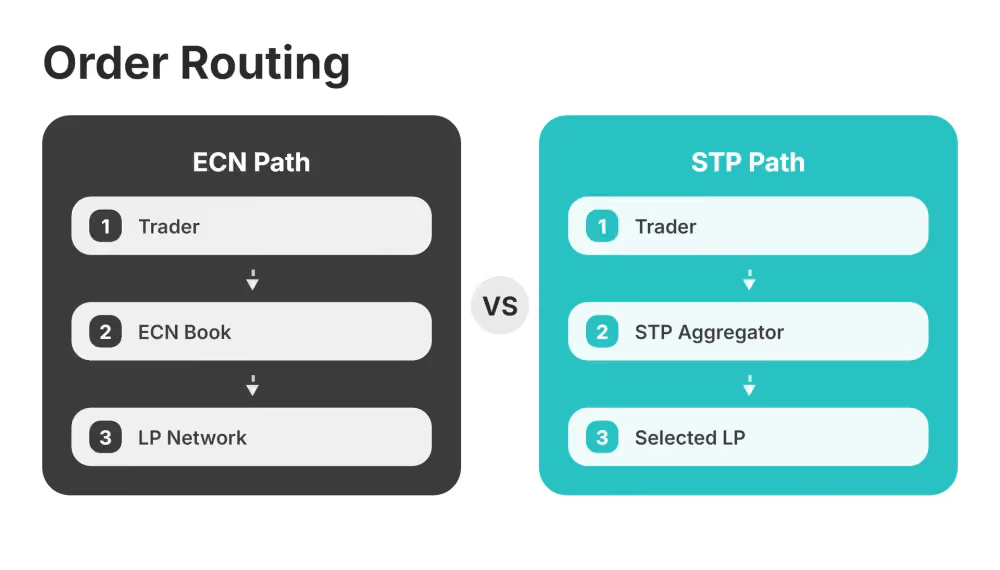
From an order execution and trade execution perspective, the fundamental routing difference between ECN and STP is the market they connect to. ECN brokers route directly to the central interbank market and match orders anonymously within a competitive order book. The bank or institution on the other side of the trade has no knowledge of who you are, where your stops are, or what strategy you are running.
STP brokers aggregate pricing from multiple liquidity providers and route orders to whichever provider offers the best price at that moment. The process is automated and free of dealing desk intervention or requotes, but the destination is a pre-selected set of liquidity partners rather than an open competitive network. For latency-sensitive accounts, execution speed and fast execution claims must be backed by measurable infrastructure performance.
In normal market conditions, ECN execution can deliver tighter effective spreads on high-volume instruments. STP execution can be slightly less transparent because the client does not see every depth layer. Brokers evaluating a third route should review the DMA trading platform model, which has different connectivity and market-access requirements.
Spreads and Fee Structure
ECN brokers pass raw spreads and charge commission. STP brokers embed revenue in the spread. For low-frequency retail traders, STP may be commercially easier to understand. For high-frequency traders and algorithmic systems, ECNs' raw-spread-plus-commission model often yields lower total trading costs.
The regulatory context matters here. FCA reviews of CFD providers have emphasized fair value, cost disclosure, and the need for firms to consider customer outcomes. Brokers should therefore define pricing in a way that is commercially sustainable and easy for clients to understand.
Transparency and Market Depth
ECN brokers publish full order book depth to clients — the complete list of available buy and sell orders across the liquidity network at each price level. This is valuable for:
- Identifying support and resistance zones based on real order concentration
- Assessing liquidity before executing large orders (to minimize market impact)
- Running order flow analysis algorithms
According to BIS OTC foreign exchange turnover data , FX spot markets accounted for 31% of global turnover at $3 trillion per day in April 2025.
STP brokers show clients the best available price, not the full book. For retail traders executing standard 0.1–1 lot positions, this distinction is irrelevant. For institutional-sized orders or algorithmic strategies that need full order visibility, ECN is the clear choice.
Minimum Deposit and Trader Suitability
ECN accounts at retail brokers typically start with minimum deposits of $0 to $500, though some brokers set the bar at $1,000 or more. Institutional or VIP-tier ECN accounts may require $20,000 or more, reflecting the infrastructure costs and the typical trade sizes these models are designed for.
STP accounts are more accessible: minimum deposits often range from $50 to $500. The lower barrier makes STP more appropriate for retail client acquisition strategies, demo account funnels, and brokerages targeting developing markets or beginner traders.
Which Model Is Better for Your Brokerage Business?
There is no universal answer. Choose the model that matches the clients you want to serve and the infrastructure you can operate reliably.
Choose ECN if:
- Your target clients include professional forex traders, prop firms, or algorithmic trading operations
- You want to position your brand around maximum transparency and institutional-quality execution
- You have the technical infrastructure in-house (or a provider) to support high-frequency order processing
- Your business model is built on volume commissions rather than spread revenue
- You operate in a jurisdiction where conflicts of interest regulations push brokers toward agency models
Choose STP if:
- You are building a retail-facing brokerage targeting individual traders with accounts under $10,000
- You want a faster time to market and lower initial infrastructure costs
- Your revenue model relies on spread markup (simpler accounting, no per-trade commission reconciliation)
- You operate in regions where fixed spread accounts are more commercially attractive
- You plan to offer copy trading, PAMM, or managed account products (STP's simpler pricing works well with these)
Consider a Hybrid Model:
Many modern brokerages operate both models. STP can serve the standard retail base, while ECN can support professional tiers and execution-sensitive clients. This works best when both routes connect to one Prime of Prime liquidity provider and one reporting layer.
How B2BROKER Supports Both ECN and STP Models
B2BROKER operates as a Prime of Prime liquidity provider , which means it sits between Tier 1 banks and retail/institutional brokers in the liquidity chain. This position gives B2BROKER direct access to deep interbank order books, which it distributes to client brokerages under both ECN and STP execution models.
For ECN brokerages, B2BROKER provides aggregated, multi-asset liquidity distribution from a single margin account with full order book transparency and low-latency execution infrastructure. For STP brokerages, it offers aggregated pricing feeds with automated routing, spread configuration tools, and flexible markup settings.
Both configurations are accessible through a single liquidity connection, which means brokerages building hybrid models do not need to maintain separate relationships with different providers. The B2CORE back-office platform integrates directly with B2BROKER's liquidity infrastructure, handling client account management, reporting, and risk controls regardless of which execution model the brokerage runs.
B2BROKER's liquidity covers 1,500+ instruments across 10 asset classes, including forex major and minor pairs, crypto, indices, commodities, and equities CFDs, giving brokerages the range to serve diverse client needs under either execution architecture.
Frequently Asked Questions about ECN vs STP
What is the main difference between ECN and STP brokers?
ECN brokers connect traders directly to a competitive interbank network, passing raw spreads while charging a fixed commission per trade. STP brokers route orders to specific liquidity providers and earn their revenue by adding a markup to the spread instead of charging a commission.
Are ECN brokers better than STP brokers?
Not necessarily. ECN brokers are ideal for high-volume and algorithmic traders who need raw spreads and deep market visibility, while STP brokers offer simpler pricing and lower minimum deposits that perfectly suit retail traders.
Can a broker operate both ECN and STP models simultaneously?
Yes, many modern brokerages operate hybrid models, using STP for retail accounts and ECN for professional tiers. This setup requires an institutional liquidity provider that can support both routing configurations through a single infrastructure connection.
What type of liquidity provider do ECN and STP brokers use?
Both models rely on deep, aggregated institutional liquidity. ECN brokers connect to a broad, competitive network of Tier 1 banks and hedge funds, whereas STP brokers typically route orders to a Prime of Prime intermediary that aggregates pricing from multiple top-tier sources.
Recommended articles


Subscribe to our newsletter