The Real Cost of Starting a Forex Broker in LatAm

A brokerage launch budget usually survives the platform invoice and the license application. Roughly 10% of brokerage accounts that churn do so over what comes after go-live: banking rejections, licensing delays, and product restrictions that surface once the capital is already committed.
A plan for starting a forex broker in LatAm has to carry the cost of a rejected bank account and an approval that slips two quarters.
The sections below compare how the six largest markets in Latin America regulate the forex market for retail traders. They weigh offshore licensing against local pathways and list the controls your technology stack has to enforce.
Key Takeaways
- License fees are a minor share of launch cost; banking, payments, compliance staffing, and delay-driven burn decide the real budget.
- The six markets run six different regulatory frameworks, so each country needs its own entry assessment.
- Copy trading classification and banking failures break brokerages after go-live, when the acquisition budget is already gone.
- Offshore licensing shortens time to market; local pathways improve banking access and credibility at higher capital and governance cost.
- A multi-jurisdiction stack needs configurable KYC, geofencing, payment routing, entity-level workflows, and automated IB payouts in one back office.
The Hidden Cost Behind Forex Broker Launches in LatAm
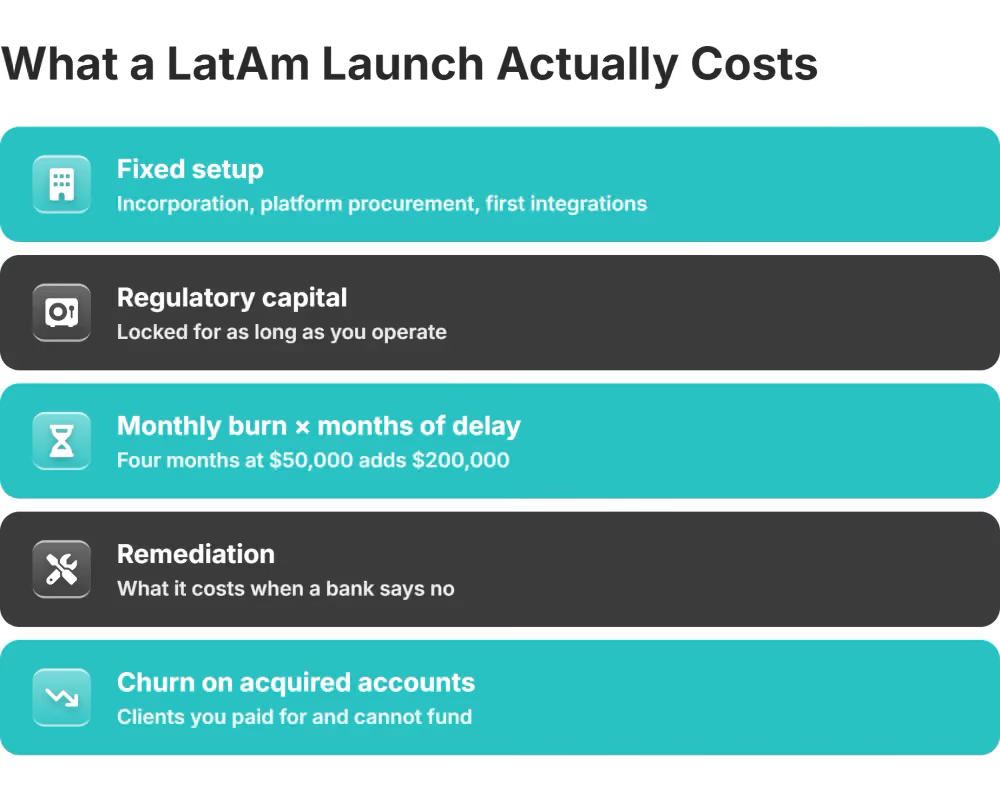
License fees rarely decide the size of a launch budget in the region. Time does. Every month between the first spend and stable revenue carries costs that rarely make it into the first forecast.
Budgets for starting a forex broker in LatAm usually get the fixed setup right and underestimate everything alongside it. Regulatory capital has to stay on the balance sheet for the life of the license, earning nothing for the business.
Delay hits the running costs hardest. Local counsel and in-country staff keep billing whether or not the approval has arrived, while reserves held by payment providers and collateral for liquidity lines stay locked the entire time.
Before you commit capital, work out how many months of delay the plan can absorb and what fixing a bank rejection would cost. Those two numbers move the budget more than the license fee does.
A Jurisdiction-by-Jurisdiction Regulatory Comparison for LatAm Brokers
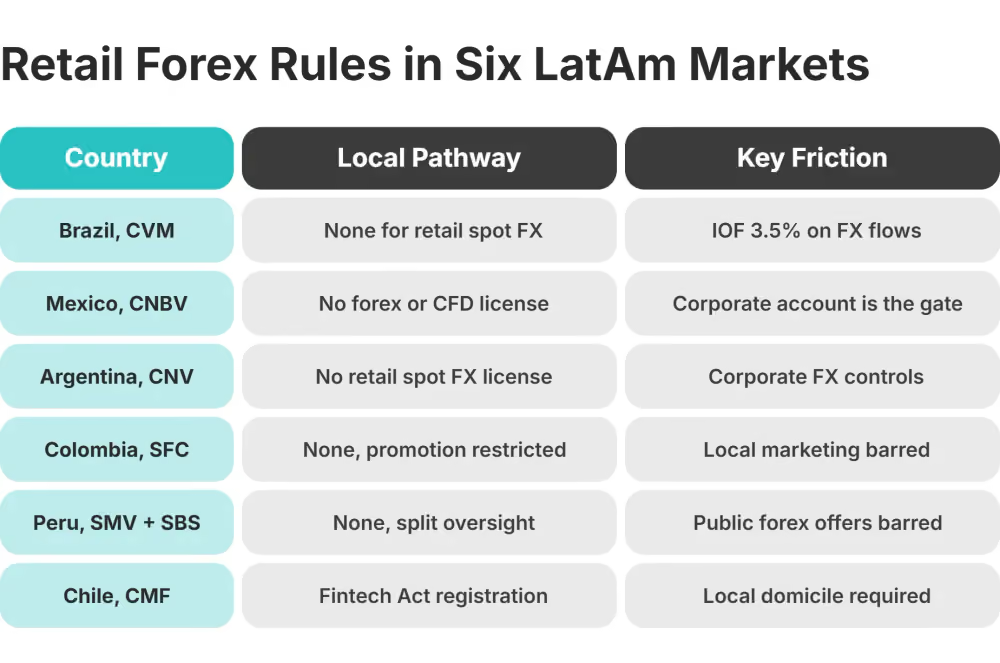
Five of these six markets give a retail forex broker nothing to apply for. With no local license covering the product, brokers serve those clients from abroad and live with the banking and marketing limits that follow. Chile became the exception only with its Fintech Act.
Because these frameworks keep moving, verify each position against current primary materials and have local counsel sign off before you form an entity.
Brazil
The CVM authorizes no domestic broker to offer retail spot forex and treats CFD offers marketed inside Brazil, forex included, as irregular. Brazilian residents may invest overseas on their own initiative, and that allowance covers only what they seek out themselves. Once your firm promotes into Brazil, the CVM's position applies to you, so agree the marketing perimeter with local counsel before you spend on acquisition.
Funding costs changed in May 2025, when two decrees raised IOF on most cross-border FX transactions to 3.5% , up from 1.1% on currency purchases and transfers abroad. Model conversion at the new rates and price local deposits through Pix, the instant payment rail everyone there expects.
Mexico
A Mexican launch turns on whether a bank will open the corporate account. The CNBV issues no dedicated retail forex or CFD license under the Ley del Mercado de Valores, so there is no permit to obtain and no application to time.
Vet a prospective banking partner against what Banco de México reports about system stability . That reporting covers the banks themselves, not their broker clients, and it has no bearing on your own permission to operate.
Argentina
In Argentina the currency controls set what the operation costs. The CNV supervises capital markets without licensing retail spot forex, so the rules that matter are the ones on moving money in and out.
In April 2025 the central bank removed the purchase limits on individuals , while the rules for companies stayed tight. A company still cannot buy foreign currency in the official market for anything other than operations, and dividends reach non-resident shareholders only from fiscal years starting in 2025. Model repatriation on those terms and stress-test it against market volatility.
Colombia
Colombia restricts the marketing before it restricts the trading. The Superintendencia Financiera does not license retail forex brokers and says that no platform or firm is authorized to promote forex domestically.
One narrow channel exists. Promotion to residents has to run through a representation office, a local brokerage house, or a financial corporation licensed by the SFC. Budget for that structure or leave the country out of the acquisition plan.
Peru
Peru gives a broker two diligence tracks instead of one licensing process. The SMV oversees the securities market, the SBS covers banking and AML, and neither licenses international retail forex brokers serving individuals. The SMV also warns that no company in Peru is authorized to offer forex products publicly, which rules out mass-media advertising.
On the banking track your AML file gets tested before an account opens, against standards the supervisor publishes for the banks it examines . Securities-side permissions need separate verification, because supervising a market is not the same as licensing a broker.
Chile
Chile is the one market of the six with a route you can apply for. Its Fintech Act counts CFDs as financial instruments. Intermediating them professionally requires registration plus a service-specific CMF authorization , with capital and guarantee requirements scaled to the service. Foreign firms also need a domicile in the country.
The framework says much less about conduct. Chile sets no leverage cap and draws no line between retail traders and professional clients, so those policies come from you. The CMF authorization still carries disclosure and risk-management duties that your own standards have to satisfy.
Where Launches Break Down: Copy Trading Bans and Banking Access Failures
Most stalled launches in the region break after the platform is live, on a product feature that turns out to be regulated or on deposits that stop clearing.
Copy trading is the most common product trap. A regulator that reads position mirroring as portfolio management or investment advice pulls the broker into licensing obligations it never scoped. That reading extends to social trading built on the same mechanics.
Offer copy trading only where it is permitted, with the suitability checks and disclosures each regulator expects, and keep the switch at entity level. A firm that cannot disable the feature in one country when a regulator reclassifies it ends up pulling it everywhere.
Banking failure starts with a declined corporate account and ends in churn. Without a local bank, funding moves to high-risk acquiring, where forex is priced alongside gambling and the processor holds a rolling reserve against future disputes on top of the higher fee.
Card declines in this tier run at 20% to 40% against 5% to 10% for mainstream e-commerce , and a trader whose card fails twice rarely tries a third time.
Contract a local acquirer and a second licensed provider before launch, and disclose the brokerage model to both. A provider that knew what it onboarded will not drop you later. When one degrades, the platform sends deposits to the other. Where banks will not serve forex at all, price out compliant stablecoin settlement with counsel.
These barriers rarely clear after go-live, so payment diligence belongs in the licensing phase, next to choosing platforms and payment processors .
Offshore Licensing vs Local Regulatory Pathways: Choosing Your Trade-Off
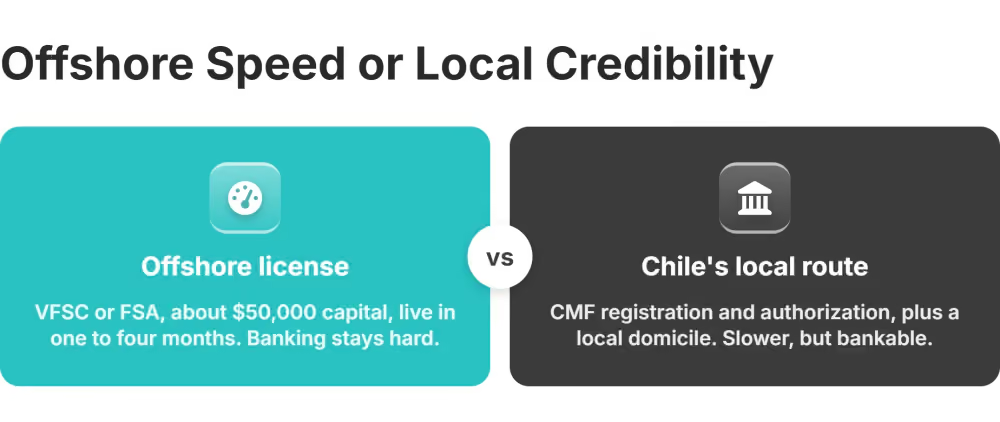
Offshore licensing accelerates incorporation, but it does not by itself deliver market access. Local pathways buy credibility and better banking at the price of higher capital requirements and longer approvals.
Score both structures on what actually moves a launch:
- time-to-market and permitted products
- bankability and marketing reach
- capital, local substance, and reporting load
- enforcement exposure and client recourse
The two routes differ most in time. A Seychelles FSA securities-dealer license asks for about $50,000 in paid-up capital and clears in two to four months , and Vanuatu's VFSC asks for much the same. The Mauritius FSC and the Cayman Islands cost more and carry more weight with banks, while Chile's route runs through a CMF review and a local domicile first.
Clients across these markets already hold accounts with brokers licensed by the UK's Financial Conduct Authority (FCA), CySEC, or ASIC, and that is the comparison your prospects will make.
The same trade-off runs through technology, where building venue software in-house costs around $500,000 and takes one to two years, against a white label or turnkey deployment measured in weeks.
When one license cannot cover every target market, the working answer is usually a hybrid model: an offshore company for speed, plus local entities in the markets where the extra cost buys real banking access. Counsel-validated routing rules then decide which clients each entity serves.
Technology Requirements for Multi-Jurisdiction Compliance
Every rule your counsel validates has to become a control the stack enforces automatically. Manual compliance stops scaling at the second jurisdiction, because each exception has to be resolved under whichever rulebook covers that client.
At minimum, a multi-jurisdiction stack needs:
- KYC and AML workflows that apply each entity's rules by default
- feature geofencing that switches products on and off per jurisdiction
- separate ledgers and role controls for every entity
- immutable audit trails you can export for a regulator on request
- payment routing that reroutes around a failed processor
- automated multi-tier payouts to introducing brokers
MetaTrader 4, MetaTrader 5, and cTrader carry their own licensing terms per entity, and the instruments you list, from currency pairs to indices and commodities, follow the license behind them.
Your execution model matters as much. A dealing desk that internalizes flow as a market maker reports differently from a book routed out to liquidity providers. The stack has to carry both.
If you are sizing the full build, start from the complete brokerage technology stack , from trading platforms and liquidity access to CRM and hosting.
Before signing with any vendor, ask for a live demonstration of four exception scenarios:
- shutting copy trading down in one entity while it stays live in the others
- rerouting payments after a processor rejection
- recalculating multi-tier IB payouts after a commission change
- exporting a regulator-ready audit trail on demand
Ask every back office on your shortlist to run all four live in front of you.
Turning Regulatory Complexity into a Launch Advantage with B2BROKER
Disable copy trading for one country's residents, and every entity serving those clients inherits the change, with no ticket to your support team and no development work. You configure each rule once, and the platform enforces it wherever it applies.
B2CORE applies that model across onboarding, account management, payments and partner payouts, with each entity carrying its own settings.
For a team starting a forex broker in LatAm, each new market then costs less to add than the one before it. Adding a country means creating an entity and setting its rules.
Ask the same questions about the vendor behind the stack. B2BROKER has operated since 2014, helped launch more than 500 brokers, and holds 10+ regulatory licenses.
Bring your target jurisdictions to a working session and leave with a per-country launch plan.
Frequently Asked Questions about Starting a Forex Broker in LatAm
What does starting a forex broker in LatAm cost?
Licensing is one line among many. Regulatory capital, legal structuring, banking and payment setup, and the burn during approval delays land on the same budget. Model each jurisdiction separately and hold a contingency for delays.
How should brokers compare LatAm jurisdictions before launching?
Compare the licensing pathway, permitted products, copy trading classification, banking access, and expected approval timeline market by market. Check current primary-regulator materials before forming entities, because these frameworks keep moving.
Should a LatAm forex broker pursue offshore or local licensing?
Offshore licensing shortens deployment in the five markets with no local broker license, though marketing, payment, and conduct obligations stay. Chile's route costs more capital and time but improves banking access, which is why many firms end up with a counsel-validated multi-entity structure.
How can copy-trading restrictions and banking access delay a LatAm launch?
A regulator that reads copy trading as portfolio management or investment advice can force feature changes or licensing steps mid-launch. Banking friction stalls launches the same way, so validate local acquiring and settlement redundancy before go-live.
What technology does a multi-jurisdiction LatAm broker need?
It needs entity-specific onboarding and KYC, geofenced product permissions, audit trails, payment routing, and automated multi-tier IB payouts. B2CORE centralizes these controls in one back office with native connections to trading, liquidity, and payment infrastructure.
Recommended articles

Subscribe to our newsletter