How Forex Brokers Make Money from Spreads and Markups


There is no single answer to how forex brokers make money in foreign exchange, one of the world's largest financial markets. An STP desk earns one way, an ECN venue another. A hybrid or treasury-led firm differs again.
Every model feeds on client trading flow, and there is more of it than ever. Average monthly volume per 1,000 active accounts has climbed from $3.0 billion to $4.2 billion since 2021, according to Finance Magnates . Heavier flow means more spread and commission to capture, and the execution model decides how much of it a broker keeps.
This guide maps the major revenue sources to the model and infrastructure behind each, so you can match the right streams to your target client mix.
Key Takeaways
- Spread markup is the first revenue engine for most brokers. An STP desk marks up its providers' raw pricing and quotes a wider one to clients, earning predictable income as volume grows.
- ECN brokers charge a transparent commission per lot and keep the quoted spread near raw. Their income tracks how actively clients are trading forex, tying the economics to active accounts.
- Swap charges and interest on client deposits bring in recurring income with no extra trading. Both grow when clients hold leveraged positions overnight or leave large balances idle.
- Hybrid execution drives most broker earnings today. Client segmentation decides which flow the broker hedges with a provider and which it keeps on its own book.
- Execution model choice shapes the whole revenue stack. STP, ECN, and B-Book setups each lean on different liquidity and back-office systems, so the model you pick sets the infrastructure you build.
The Revenue Architecture Behind a Forex Brokerage
A brokerage's business model stacks revenue across four layers, and execution design decides which ones scale:
- Transaction income from spreads and commissions
- Financing income from overnight swaps
- Treasury income from interest on client balances
- Ancillary fees from partner programs and add-on services
Each layer maps to a client segment with its own capital intensity and fixed cost. Transaction income grows with forex trading activity, while treasury revenue comes from the balances clients leave on deposit.
Whether a stream actually turns a profit depends on the client mix a broker serves and on how much regulation and capital its model demands, and each one needs its own controls as volume grows.
Spread Markup: The Primary Revenue Engine for STP Brokers
STP revenue comes from spread markup, which stays healthy only when a few conditions hold:
- Liquidity providers stream clean, tight raw pricing
- Clients accept the quoted spread the broker shows them
- Volatility stays inside a normal range
When any of these slips, the model compresses fast. Institutional raw EUR/USD trades inside a fraction of a pip in normal sessions; a retail client sees 0.6 to 1.5 pips on EUR/USD at competitive brokers, and a touch more on GBP/USD. That gap is STP markup, and the ECN and STP execution models a broker runs decide how much becomes per-trade revenue, set by aggregation quality. Compressed retail spreads are permanent, and brokers push back on three fronts:
- Aggregating more liquidity providers to tighten raw pricing
- Sharpening routing logic so the system rejects weak fills
- Building separate pricing tiers for VIP cohorts and beginners who barely notice a fractional pip
How Raw Spreads Become Quoted Spreads
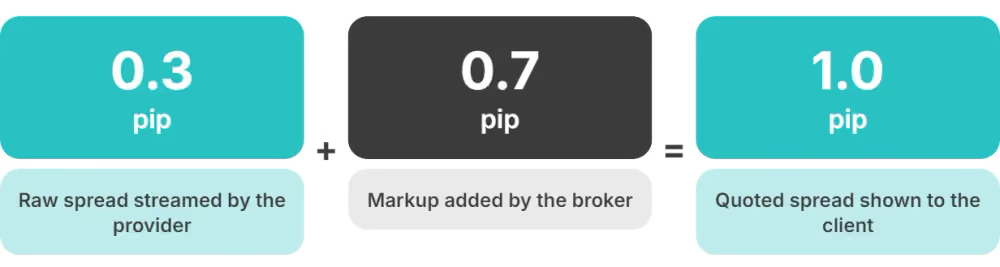
A provider streams EUR/USD at a 1.10000 bid and a 1.10003 ask price, a 0.3-pip raw spread. The broker adds 0.7 pips across both sides and shows the client 1.09997 by 1.10007, a 1.0-pip quoted spread, keeping that markup on a one-lot trade minus any provider rebate and realized execution costs.
Quoted spread equals raw spread plus markup. Realized margin equals markup minus rebates, slippage, reject costs, and carry, and that second number is the one that funds payroll.
Margin Compression During High-Volatility Periods
Under volatile market conditions, provider spreads widen faster than client-facing pricing reacts, so the client sees a tighter quote than the live market price on the broker's feed. Across many clients hitting the same pair, markup capture can turn negative for a session. Execution gets worse at the same moment: fills come slower and slippage widens, so even the spread the broker does capture comes back thinner.
Commission-Based Revenue in ECN Models
ECN brokers charge an explicit commission for transparent execution. With no spread internalization to fall back on, it works only when trading volume covers the heavier infrastructure and support, and the economics ride on how much each active account trades.
The same one-lot trade costs differently under each model. An STP client might pay about 1.2 pips all-in, and the broker keeps it. An ECN client pays roughly 0.2 pips of raw spread plus about $3.50 per side. There the spread passes straight through to the liquidity provider, and only the commission stays with the broker. So the client can pay less while the broker still earns more per dollar of volume, as long as that trading account trades enough to cover its servicing cost.
When commission is the only revenue line, low-frequency retail rarely covers onboarding and support, so ECN setups lean toward high-volume accounts: active retail traders and professional or prop desks.
Per-Lot Fee Structures and Volume Thresholds
ECN commissions run roughly $2 to $3.50 per side per standard lot. Fusion Markets sits near the bottom at about $2.25, Vantage and FP Markets land around $3, and lower-volume tiers push closer to $3.50. Which schedule fits a broker comes down to break-even volume and client profile, the core choice between flat fee and volume fee pricing structures . Above set monthly volumes, the rate then steps down in tiers.
An account trading 20 lots a month at $3 per side brings in $120 round-turn before discounts, with acquisition and support costs, plus overhead, taken out before profit. Per-lot pricing pays off only with high-frequency flow; casual micro-account flow runs net-negative.
Overnight Swap Fees as a Recurring Revenue Stream
Swap income lands every day and climbs when clients hold leveraged positions past the rollover, so even a modest carry book rivals commission revenue. Every currency pair carries a rate differential. The broker funds open positions at tom-next rates, adds a markup, then books the swap to the client as a debit or credit, and most retail trading platforms add an admin fee. These charges draw scrutiny, and the FCA's 2025 review of CFD providers flagged firms applying overnight charges they could not justify.
Because the forex market settles spot trades two business days out, a position held through Wednesday books three days of funding at once, concentrating overnight revenue into one triple-swap rollover. These clients turn structurally profitable at moderate volume, given a swap engine that prices against live rates and reports cleanly.
Interest Income on Client Deposits
Treasury income can match what a broker earns from trading, and higher policy interest rates have turned it into serious money even when trading cools. The math is simple. At 5%, $100 million of client balances throws off about $5 million in gross interest a year, before costs. Even a smaller $50 million book, held in segregated accounts at around 4.5%, still brings in roughly $2.25 million.
How much of that the broker keeps depends on where it is regulated. FCA-regulated firms work under the Client Assets Sourcebook (CASS) regime and CySEC firms under MiFID II, while some jurisdictions require part or all of the interest to go back to clients. Running it is operationally heavy, too. On top of the normal back-office stack, the firm has to handle:
- Segregation of client money from house funds
- Daily reconciliation of every balance
- Clear disclosure of how interest is treated
Weak controls flip a treasury gain into a regulatory liability. The B2CORE back-office solution keeps it in one place, tracking every balance and accrual alongside the client communications that document them.
A-Book, B-Book, and the Hybrid Execution Reality
By 2026, hybrid execution runs most brokerage operations. A broker's book choice reflects its risk appetite and hedging capacity and shifts with client behavior, and most firms route dynamically, order by order.
A-Book and B-Book handle a client order in opposite ways. A-Book passes it to liquidity providers, so the broker acts as an intermediary, earning its markup or commission with almost no market risk. B-Book warehouses it in-house: the broker becomes the counterparty, acting as a market maker that earns when clients lose, net of payouts. Hybrid (C-Book) runs both, with routing rules weighing the client's profile and instrument against position size and net exposure.
Internalization carries a cost: capital strain grows as client wins concentrate, and an unhedged B-Book in a sharp move can erase months of spread revenue in hours.
How Client Segmentation Determines Book Placement
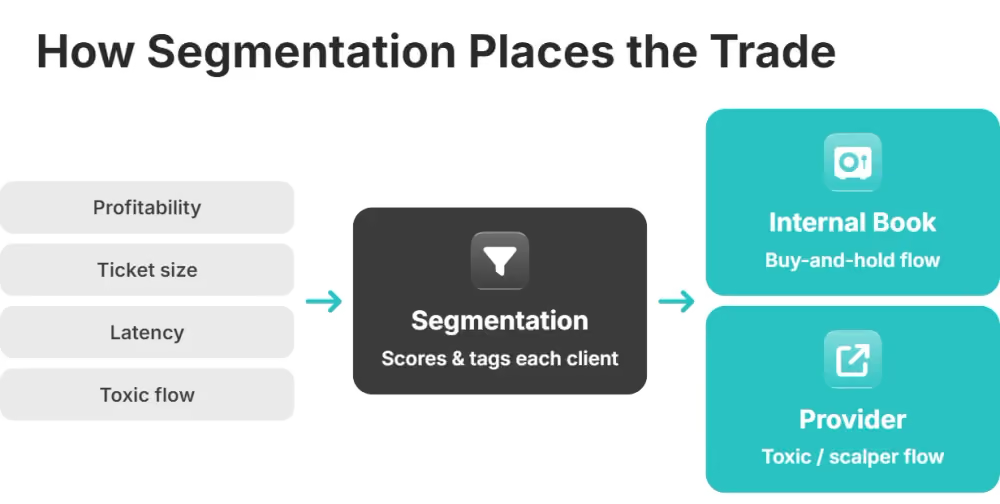
Segmentation scores each client on a set of signals before routing its trades:
- Profitability over a defined window
- Average ticket size and typical hold time
- Latency profile and news-trading frequency
- Toxic-flow markers like fills landing consistently near the spread or systematic gap exploitation
The output is a tag that routes new trades to the internal book or out to a provider, with per-instrument and per-size overrides. The broker routes out scalpers that chew through markup and hedges them, while buy-and-hold flow stays internal, its payout cost below the spread already captured. Keeping tags current as behavior shifts takes live trade surveillance.
Hedging Infrastructure as a Risk Management Tool
The right tooling makes B-Book risk measurable: provider connectivity and hard exposure limits, paired with automated routing, turn internalization into a portfolio decision inside defined limits. It rests on external market access and credit, so a broker needs prime-of-prime credit lines to externalize size the moment an exposure threshold trips, while the back-end handles partial hedges and residual exposure.
Ancillary Revenue Streams That Scale With the Business
Ancillary fees rarely lead a model, but they lift margins as account counts and partner networks grow, and a broker with 50,000 active accounts and a solid IB network sees them add up. The stack mixes recurring and usage-based fees:
- IB and affiliate rebates
- White-label licensing fees
- Premium analytics and signal tools
- VPS hosting for algorithmic clients
- Payment-processing markups and currency conversion fees
- API access tiers for institutional clients
The line worth holding separates durable revenue from reputation-damaging nickel-and-diming: premium tools and tiered API access keep clients, while surprise inactivity and withdrawal fees lose them. A well-structured IB or affiliate program scales faster than direct acquisition, running on attribution and rebate logic that survives an audit.

Execution Model Choice Determines Infrastructure Requirements
Choosing a revenue model is a technology decision before a marketing one, as it shapes the whole business model. Every execution path sets its own requirements for liquidity and matching, and for the compliance and support behind them. Pick the model without matching infrastructure, and either the stack underperforms or a remediation bill eats the margin.
What Each Execution Model Requires
- An STP desk needs aggregation across several liquidity providers and low-latency routing, plus dynamic markup logic and reporting that ties every fill to its quote and venue.
- An ECN venue needs a matching engine and tighter LP onboarding, with audit-grade transparency and tiered commission calculation.
- A hybrid broker needs all of that, plus segmentation and routing logic and hedging automation that connect its trading systems to live credit.
The same logic spans asset classes: running FX alongside crypto and derivatives like CFDs or futures adds integration and regulatory demands as the instruments grow complex.
B2TRADER as the matching engine, B2CONNECT for liquidity, and B2CORE for client lifecycle and back-office form a stack built for that, so a firm's revenue model and its operations stay in step as it grows.
Build a Revenue Model That Works at Scale From Day One
The brokers that keep compounding revenue aligned their execution model and infrastructure with their target client mix before the first trade settled.
We built the B2BROKER ecosystem as one integrated stack so that alignment is deliberate: multi-market liquidity runs from one account, execution through B2TRADER, and client lifecycle and back-office through B2CORE, with one payments layer underneath. The revenue architecture stops being the accidental result of mismatched vendors.
We have run this stack since 2014, now serving 1,000+ corporate clients under 10 regulatory licenses.
Building a forex brokerage from the ground up means pressure-testing the revenue model before infrastructure spend locks in the trade-offs. Talk to our team to design a model matched to your client mix and the execution strategy and regulatory perimeter you operate within.
Frequently Asked Questions about How Forex Brokers Make Money
How do forex brokers make money from spreads?
An STP desk adds a markup to the raw provider price and quotes a wider one to the client, keeping the difference as transaction revenue. Margins on major pairs are thin, so fast routing and aggregation quality matter as much as the markup itself.
How do commissions work in ECN forex brokerage models?
ECN brokers pass through near-raw spreads and charge a fixed fee per lot or per order. Pricing stays transparent, and the model demands stronger reconciliation and stable provider links. On a low-activity retail book, that fee rarely covers servicing costs unless clients trade often.
Do forex brokers make money when clients lose?
A B-Book broker can, since it warehouses flow in-house and takes trader losses above payouts as the broker's profit, which creates a conflict of interest. Most firms run hybrid books, routing and hedging part of that flow, so the real test is whether segmentation and surveillance keep execution fair.
What other revenue streams do forex brokers rely on?
Beyond spreads and commissions, brokers earn from overnight swap markups and a range of account fees, with interest on client deposits as another line. That deposit income becomes material when balances are large and policy rates stay high, steadying margins when dealing income softens.
How does the execution model affect a broker's profitability?
Execution architecture shapes a broker's cost structure and risk transfer, so A-Book, B-Book, and hybrid setups end up with very different economics. An integrated stack like B2TRADER and B2CORE helps a broker scale with fewer control gaps and faster time to market, which matters when margins depend on reliable execution.
Recommended articles

Subscribe to our newsletter