7 Tests for the Best Matching Engine Software for Crypto Exchanges


Vendor decks for crypto matching engines lead with one number: latency in microseconds. Few of those decks show the test conditions behind it, the failover behavior when a data center overheats, or the true cost of running the system for three years.
The distance between a benchmark slide and production is wide. Gemini, a NASDAQ-listed exchange, spent 2025 re-architecting its cloud access and cut round-trip latency from 8 to 12 milliseconds down to roughly 2, a reminder that where and how you measure changes the answer.
This guide turns vendor selection into seven concrete tests, each with measurable thresholds and the questions to put in an RFP. Work through them and you can separate the best matching engine software for crypto exchanges from the marketing around it, whether you are building fresh or leaving a MetaTrader stack.
Key Takeaways
- Judge an engine under real load. Latency consistency during volatile bursts and sustained throughput ceilings tell you more than a single headline speed figure.
- Treat matching algorithm choice as strategy. Price-time priority, pro-rata, and TWAP each shape fill fairness, queue behavior, and market quality differently.
- Pair order type coverage with pre-trade risk controls. An engine should carry institutional order types and still enforce credit and position checks without adding latency.
- Make failover a selection criterion. Recovery time and recovery point targets, state replication, and clean audit trails decide whether an outage stays contained.
- Weigh the ownership model early. For brokers leaving MetaTrader, a white-label engine with cross-margin, liquidity connectivity, and CRM integration removes most of the hidden build load.
Test 1: Latency and Throughput Under Real Load
Judge the engine under load rather than on a lab peak. Vendors quote a headline ultra-low latency figure measured on an empty book, but production means deep books and bursts. Demand numbers that survive that gap, and reject any figure that arrives without its test conditions.
What Institutional-Grade Latency Actually Means
Vendors sell ultra-low latency, but institutional-grade latency is the full round trip a client sees: the gateway, pre-trade risk checks, the match, the confirmation, and the market data fan-out back to the tape. Engine matching time can read in single-digit microseconds while the number reaching the trader sits far higher.
Gemini designed its trading system for end-to-end latency below 500 microseconds. When it moved cloud access into an AWS Local Zone in New York , it cut round-trip time from 8 to 12 milliseconds to about 2. Deployment topology set that figure, since the core loop was already faster than the round trip.
Throughput Benchmarks Worth Trusting
A peak orders-per-second throughput claim means nothing without the order mix, cancellation ratio, persistence settings, and risk checks that were live during the run. Ask for all four; their absence is where production bottlenecks hide.
Set the bar to your market rather than a vendor's record. A scalable trading engine on the LMAX Disruptor pattern clears around 5 million operations per second on one order book, but real risk and persistence layers cut that figure.
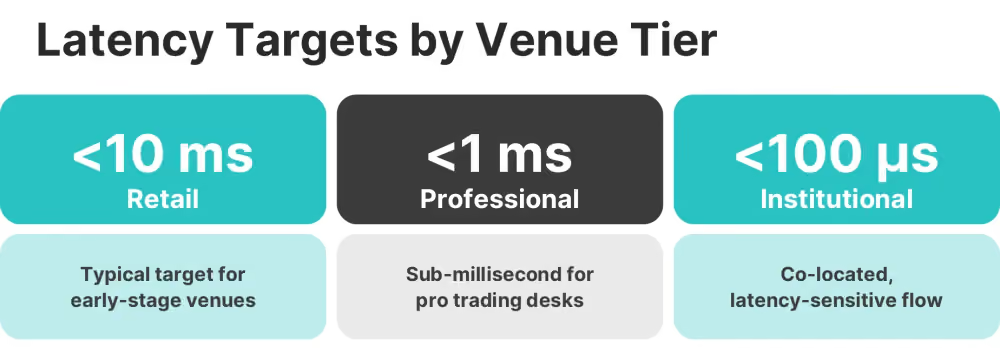
Retail platforms target execution under 10 milliseconds, professional desks sub-millisecond, and co-located institutional setups under 100 microseconds.
Test 2: Matching Algorithm Fit for Your Market Structure
Match the algorithm to your market. The order matching logic that decides who fills first at a given price level sets queue fairness, maker incentives, price discovery, and how your book looks to a surveillance team. Choose wrong and you bleed liquidity providers or draw regulatory questions about fill order.
Price-Time Priority vs. Pro-Rata vs. TWAP
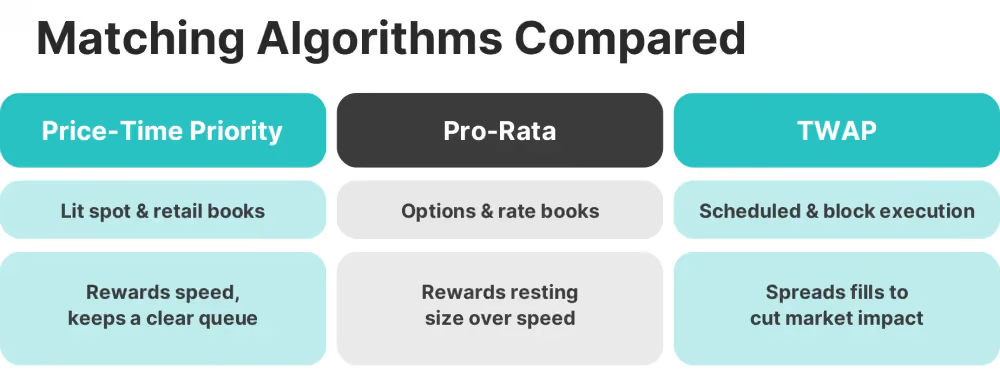
Price-time priority, also called first in, first out (FIFO), fills the earliest order at a given price first. It stays the default for lit order books because the rule is simple to explain and hard to game.
That is the logic the SEC's Order Protection Rule under Regulation NMS enforces for US equities, barring trades at a price worse than the best price publicly quoted.
Switch only with a reason. Pro-rata splits a fill by resting size and suits options and interest-rate books where depth beats speed, while TWAP spreads execution over time for scheduled or block workflows.
Test 3: Order Type Coverage and Pre-Trade Risk Controls
Filter on order types before you discuss customization. A credible engine ships market, limit, stop, immediate-or-cancel, fill-or-kill, post-only, and iceberg orders as standard, matching how market makers and execution desks actually trade. Anything missing becomes a post-launch feature request and engineering debt.
Pre-trade risk management is the other half. The engine must run credit, position, fat-finger, and validation checks in the matching path rather than downstream, or a mispriced or oversized order slips through before anything catches it. Put four questions in the RFP:
- How does cancel-replace behave under load?
- Is self-trade prevention enforced in the engine, or bolted on afterward?
- Where does liquidation logic sit, and who can trigger it?
- Does every action write to an immutable audit trail?
Test 4: Failover Architecture and Disaster Recovery Standards
Matching engines fail in production during volatility spikes, upgrades, and infrastructure faults. Recovery design belongs in the selection process rather than the onboarding call.
The October 2025 sell-off wiped out more than 19 billion dollars in leveraged positions in a day. Trading volumes surged past capacity and knocked over parts of Binance and Coinbase while market participants scrambled to manage exposure.
Compare architectures on concrete terms. Active-passive keeps a standby ready to take over; active-active runs real-time redundancy across nodes. Each model carries its own recovery time objective, recovery point objective, and sequencing guarantees.
The recovery time objective is how long you stay down; the recovery point objective is how much data you can lose. Ask for those numbers, then ask for evidence, since a recording of a real switchover under simulated load tells you more than any architecture diagram.
Test 5: Multi-Asset and Cross-Margin Support at the Engine Level
Require multi-asset matching at the engine. One engine that matches spot, perpetuals, CFDs, and FX means a single risk, settlement, and monitoring layer, lower headcount, and faster listing of new trading pairs as you add asset classes.
Insist on native cross-margin. When the engine tracks a trader's exposure across positions, it nets collateral instead of locking margin in silos, which frees client capital and simplifies your risk desk. An overlay added later cannot match that, because the engine already holds the position state.
Test 6: Integration Ecosystem Depth
Map your integrations before you compare match times, because integration depth decides launch speed and operational risk more than raw performance does. Every protocol the engine does not speak becomes an adapter you build and maintain: FIX and REST APIs, WebSocket for real-time data, plus CRM, charting, surveillance, liquidity, and reporting modules.
A proprietary ecosystem cuts that work when the pieces are built to connect.
Liquidity Provider Connectivity
For liquidity, one feed is not enough. Require multiple liquidity provider adapters, market data normalized into one format, smart routing across sources, session monitoring, and clean failover when a provider drops.
Test 7: Build vs. Buy vs. White-Label TCO
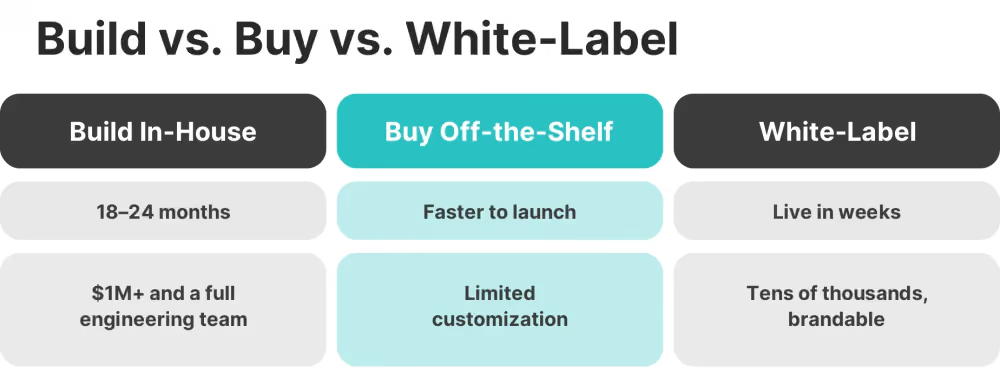
Performance shortlists a vendor, while the ownership model sets your cost for years. The three paths diverge sharply:
Building in-house buys maximum control at the highest cost. A stable exchange stack takes 18 to 24 months and three to four backend engineers at 150,000 to 250,000 dollars each a year, pushing the total past a million dollars before the first trade settles.
Buying an off-the-shelf license moves faster but limits customization.
White-label sits between them : you license a proven engine, brand it, and extend it, with deployments in weeks and cost in the tens of thousands.
The Hidden Costs of Building In-House
The build budget hides most of the bill. Beyond matching logic you staff risk services, QA automation, observability, compliance archiving, disaster recovery, exchange APIs , and constant performance tuning, each its own system.
The bigger cost is what those engineers stop building. While they maintain core infrastructure, they ship no client-facing features and open no new markets.
How to Evaluate a White-Label Vendor's Stability and Support
A white-label contract binds you to the vendor's survival, so vet the company as hard as the software. Ask who owns the roadmap, what the uptime SLA commits to, how often releases ship, which reference clients run the engine, how escalation works mid-session, and whether the vendor will still be solvent in five years.
When markets move, 24/7 support from the team that owns the product beats a lower headline price.
Choose a Matching Engine That Passes All Seven Tests with B2TRADER
Run the seven tests against your shortlist and the field narrows fast. Few engines hold up on latency, algorithm fit, risk controls, failover, multi-asset support, integration depth, and total cost at once.
B2TRADER , B2BROKER's multi-asset trading platform built around its own matching engine, is designed to clear all seven. It gives brokers proprietary control, independence from MetaTrader licensing, native B2CORE connectivity, TradingView charting, cross-margin support, and a scalable base for spot and crypto trading. The engine handles around 10,000 orders per second, a figure worth confirming against your own load profile.
B2BROKER has built trading and back-office infrastructure since 2014, and its platform now serves more than 1,000 corporate and institutional clients under licenses across several jurisdictions. That track record is the evidence the seventh test asks any white-label vendor to show.
If you are scoping an exchange build or planning a move off MetaTrader, the fastest way to judge B2TRADER is to run it through your own version of these seven tests.
Frequently Asked Questions about Matching Engine Software
How do I evaluate matching engine latency for an institutional crypto exchange?
Measure round-trip time under realistic market bursts rather than lab snapshots, and ask for the methodology behind every figure. Jitter distribution and the latency added by pre-trade risk checks shape usable execution as much as the headline number.
What matching algorithms should crypto exchange software support?
Price-time priority covers most lit spot books because it is simple to explain and hard to game. Add pro-rata or TWAP only when a derivatives or scheduled-execution workflow genuinely calls for them.
What order types and risk controls should the best matching engine software include?
Baseline coverage runs market, limit, stop, IOC, FOK, post-only, and iceberg. The engine should also enforce credit, position, and fat-finger checks inside the matching path without adding meaningful latency.
How should a crypto matching engine handle failover and disaster recovery?
Look for replicated state, deterministic recovery, and explicit RTO and RPO targets rather than failover treated as a hosting add-on. Complete audit trails matter too, since one outage can become an execution and compliance event at the same time.
Should you build, buy, or white-label matching engine software?
For most scaling brokers, white-label reaches live markets faster and at lower execution risk than an in-house build. It also fits firms leaving MetaTrader that want proprietary control without rebuilding an exchange stack from scratch.
Recommended articles
Subscribe to our newsletter