All About Trade Execution Transparency for Brokers

Trade execution transparency is the practice of disclosing how your brokerage routes and fills client orders. For growth-stage brokers expanding into new markets or onboarding more sophisticated order flow, it determines whether clients can verify they received a fair outcome on every trade.
Identical orders sent to two brokers can produce different fills depending on routing logic and liquidity depth at the moment of execution. Clients who notice those differences will ask questions. The brokers who can answer with timestamped evidence keep the relationship.
This guide walks through what trade execution transparency actually covers and which metrics are worth publishing. It is written for businesses that already run execution but want a defensible framework that their compliance desk and sales team can both use.
Key Takeaways
- Trade execution transparency covers two windows: pre-trade (quoted prices, order handling rules) and post-trade (fill timestamps, venue outcomes, slippage data).
- Four metrics form the baseline of any credible disclosure program: venue selection logic, price deviation at fill, fill latency by percentile, and slippage/price improvement frequency.
- MiFID III scrapped the old RTS 28 annual reporting obligation in 2024, but the underlying best execution duty remains fully in force and now demands a demonstrable, testable process.
- A transparency program breaks down when infrastructure layers don't feed into a single reporting pipeline, so audit the data flow from aggregator to client report before publishing anything.
What is Trade Execution Transparency?
Every client order passes through a chain of internal decisions before it becomes a fill. Your system picks a venue, matches at a price, and sends back a confirmation. Trade execution transparency is the practice of logging the chain and making it available to the client who placed the order.
The industry breaks this into two windows:
Pre-trade transparency lives on the client's side, before they hit submit. It includes the quoted price and visible liquidity on the book, along with your published order-handling rules.
Post-trade transparency kicks in once the fill is done. The broker shares execution timestamps, which venue matched the order, and outcome data like slippage or price improvement.
Both windows feed into what regulators call "best execution" verification. In simple terms, you need evidence showing that your infrastructure sought the best available outcome given the market at that specific moment.
Why Comparing Brokers Remains Difficult
Even market participants who publish detailed execution data often measure it differently. Broker A might start the slippage clock at the matching engine, while Broker B starts it at the gateway, 2–3 milliseconds earlier. Both report valid numbers, but a client comparing those figures side by side draws the wrong conclusion.
Four Data Points Every Program Should Track
A transparency framework becomes useful when it covers these areas on a fixed, recurring schedule:
- Venue selection logic. Which liquidity destination received the order, whether a stock exchange, ECN, or internal pool, and what criteria did your routing engine use to route it?
- Price deviation at fill. How far did the actual execution price move from the quote the client saw at submission?
- Fill latency. Time between order receipt and execution confirmation, ideally reported at the 50th and 90th percentile.
- Slippage and price improvement frequency. What share of orders filled worse than expected, and what share filled better?
Why Transparency Matters for Brokers and Their Clients
Execution transparency pulls double duty for any growing brokerage. It shapes how regulators evaluate your financial services operations and how clients decide whether to stay.
The compliance case is straightforward. When a regulator asks how you handled a specific client order last Tuesday, you either have the timestamped record or you don't. A broker that already logs and publishes execution data can respond to a supervisory request in hours instead of scrambling for records over days. Reputation risk also plays a role here. One viral complaint about unfair fills on a trading forum can drive away more prospects than a six-figure fine.
The business case runs deeper than most teams expect. Most brokers still compete on spread width, but sophisticated clients evaluate the total cost of trading. That includes fill speed and how often they receive price improvement. Brokers who publish those numbers attract the segment of traders who actually read execution reports before funding an account.
Why does that segment matter? These clients tend to deposit more and churn less. They chose you based on verifiable performance, so a single rough session won't push them to a competitor.
Published execution data also contributes to price discovery by showing where orders actually get filled. If a client questions a fill, you can point to the report.
One Pipeline, Audit-Ready Reports
B2CORE connects your CRM, back-office, and reporting layer into one audit-ready pipeline.
Key Execution Metrics Brokers Should Disclose
Metrics give clients a common language for comparing brokers. The key is to keep definitions consistent and segment the data by instrument and order type so the numbers remain meaningful over time.
Three metrics form the core of most credible disclosure programs.
Fill Speed Distribution
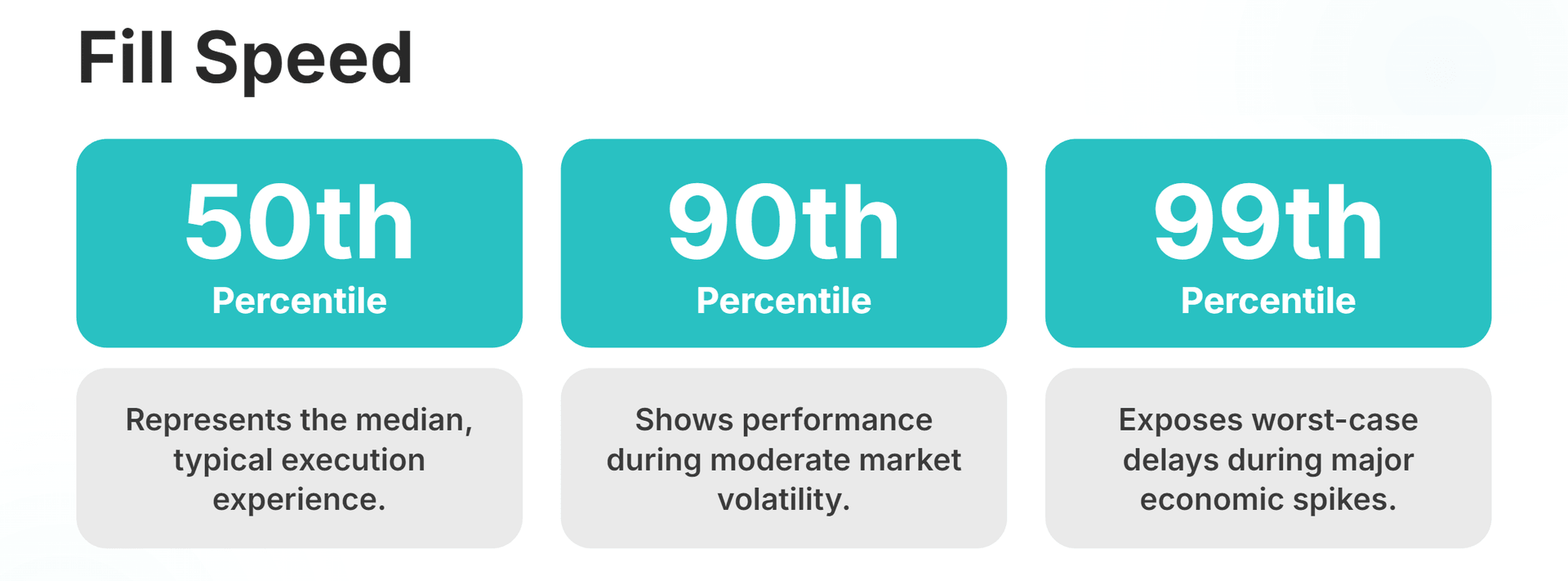
Fill speed measures the time between order receipt and execution confirmation, typically in milliseconds. Reporting a single average here is misleading because a single slow fill during a news spike can be obscured by thousands of fast ones. Publishing the 50th, 90th, and 99th percentiles gives a fuller picture, showing clients both the typical experience and the worst-case scenario.
Why does execution speed matter beyond bragging rights? In volatile financial markets, every extra millisecond increases the chance that the price moves between submission and fill. Brokers investing in low-latency execution infrastructure can demonstrate tighter percentile ranges, which directly reduces slippage exposure for their clients.
Slippage Occurrence Breakdown
Slippage is the difference between the price a client expects at submission and the price that actually prints. It can go both ways: negative slippage means the client got a worse price, while positive slippage (price improvement) means they got a better one.
Reporting a single average like "0.2 pips" obscures what really happens. Clients need frequency and magnitude broken out by asset class (forex, crypto, metals, indices) and time of day. Slippage naturally increases during high-volatility windows like central bank decisions, and transparent brokers report those spikes openly.
For a deeper look at how brokerages manage this operationally, see this guide on how brokers deal with slippage.
Price Improvement Ratio
Price improvement happens when a client receives a better fill than the quoted price at submission. Reporting it as a percentage of total orders gives clients a clear read on how often the routing logic works in their favor.
Strong price improvement numbers usually come from quality liquidity aggregation paired with smart order routing. If the aggregator pulls from deep pools and the router selects the best available price at the moment of execution, price improvement shows up consistently in the data.
Technology Stack That Enables True Transparency
You can commit to publishing execution data, but the commitment means nothing if your infrastructure doesn't capture the right events at the right moment. Transparency is a logging problem first and a reporting problem second.
Three technical components form the minimum viable trading system for transparency.
Liquidity aggregator and bridge. The aggregator connects your execution engine to multiple liquidity sources and lets you aggregate pricing across all of them, recording which provider quoted what price at the moment of routing. Without that record, you can't explain why a specific venue received the order.
The bridge layer between your trading platform and the aggregator must pass timestamps through cleanly, with no gaps or rounding. Brokers working with an institutional liquidity provider that already supports multi-source connectivity can skip months of custom integration work here.
Matching engine with microsecond-level timestamps. The matching engine is where orders meet liquidity, and the timestamp it produces becomes the single source of truth for fill-latency calculations.
If your engine logs only to the millisecond, you lose the ability to diagnose issues that matter in microseconds, especially during fast-moving sessions around economic releases. Look for engines that tag each event with a sequential ID alongside the timestamp, so you can reconstruct the exact order of operations during post-trade review.
FIX drop-copy and post-trade analytics. A FIX drop-copy session creates a real-time mirror of all execution messages flowing between your platform and liquidity venues. This feed goes to a separate analytics layer where your team can run post-trade checks.
The analytics flag anomalies like latency spikes or slippage outliers, which means your dealing desk catches issues before they affect a large number of clients. Over time, the same data powers the periodic execution reports you publish.
Each component produces its own data stream, and the three streams need to feed into a single reporting layer. Gaps between them create blind spots that weaken any market transparency claim.
Power your Brokerage with Next-Gen Multi-Asset & Multi-Market Trading
Advanced Engine Processing 3,000 Requests Per Second
Supports FX, Crypto Spot, CFDs, Perpetual Futures, and More in One Platform
Scalable Architecture Built for High-Volume Trading
Workflow From Order Receipt to Post-Trade Report
Having the right technology stack is one piece of the puzzle. The other piece is making sure every stage of the order lifecycle generates queryable evidence. Here's what that looks like step by step.
Order Capture and Validation
The moment an order hits your system, the clock starts. Your platform records the exact timestamp of receipt, along with the quoted market price and the spread the client saw at submission.
What should be logged at this stage?
- Timestamp of order receipt (microsecond precision where possible)
- Quoted price and spread at the moment of submission
- Available liquidity depth snapshot
- Validation outcomes: margin checks, limit order parameters, instrument eligibility
Each of these records serves a specific purpose later. The liquidity snapshot serves as a reference point for slippage analysis, and the validation log provides your support team with an immediate answer when a client asks why an order was rejected or delayed.
Routing and Fill
Once validated, the order moves to the routing engine. Your engine may send flow to market makers, ECNs, or bank liquidity pools depending on the order parameters.
The critical record here is why the engine picked a specific venue. Was it the best available price? The deepest market liquidity at that moment? Logging the decision criteria makes best execution documentation concrete.
Partial fills add complexity. A 10-lot EURUSD order might get 6 lots filled on one venue at 1.08420 and the remaining 4 lots on another at 1.08425. The client should see one blended price on their confirmation, and your system should store the per-venue breakdown for anyone who wants to drill down.
Real-Time Monitoring
Your dealing desk should see execution problems as they develop, before they ripple across the client base. Set alerting thresholds on slippage and latency. When a threshold triggers, the alert goes to a named person with a documented playbook: assess the scope and pull the affected venue if needed, then log every step for the post-incident review.
End-Client Reporting
All the captured data feeds into client-facing reports. What should each report include?
- Fill price against the quoted price at submission
- Time to fill in milliseconds
- A venue that matched the order
Offer on-demand access for individual trades alongside periodic summaries, monthly or quarterly, so clients can spot trends. If the report requires a quant to interpret it, the format needs work.
From Order Entry to Client Report
Our ecosystem of solutions captures the full order lifecycle and automatically turns it into client-facing reports.
Regulatory Drivers Shaping Transparency Standards
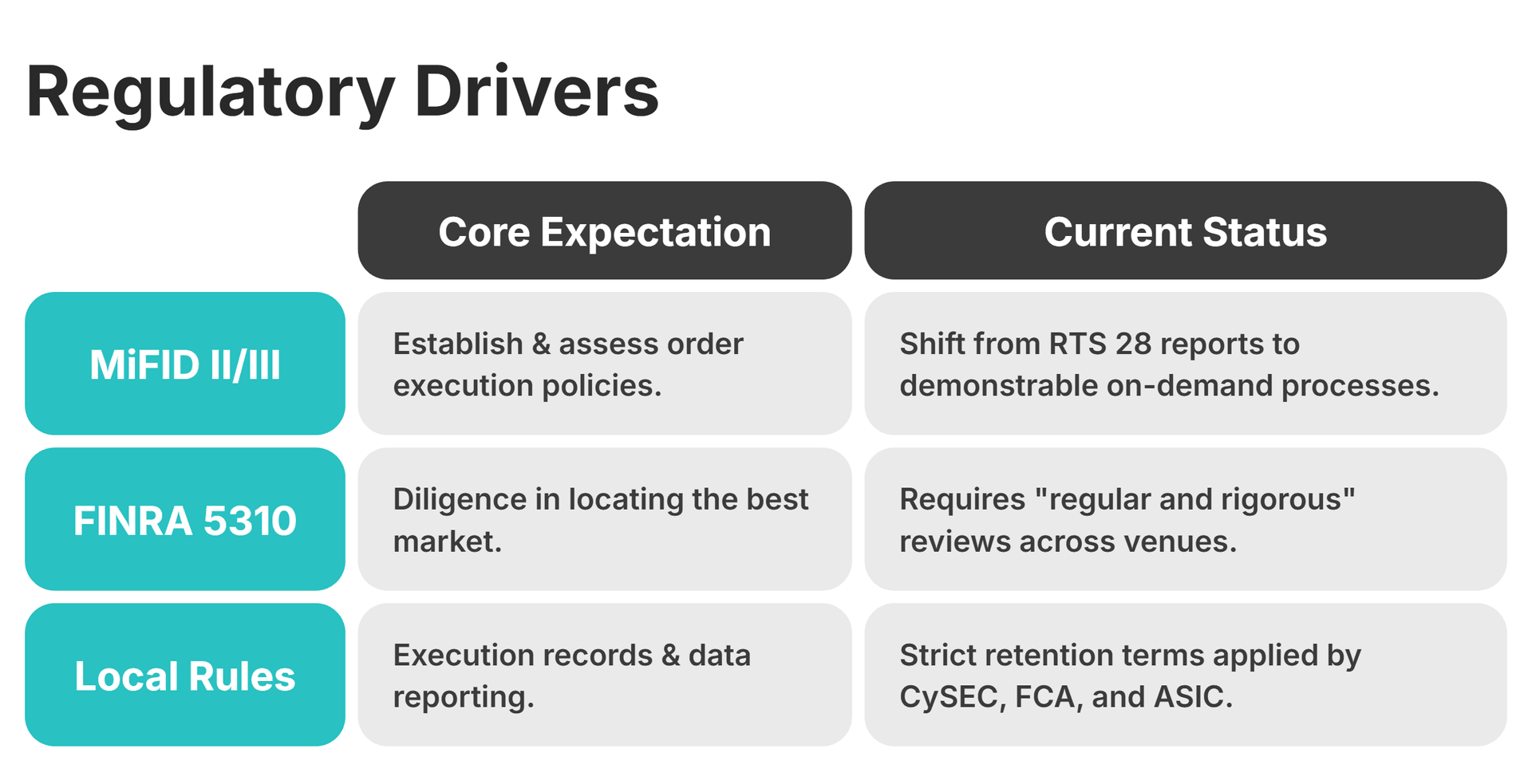
Regulatory pressure across global capital markets keeps moving in one direction: brokers need to prove, with data, that they pursued best execution. Three frameworks come up most often in compliance planning.
MiFID II Best-Execution Rules
Article 27 of MiFID II requires investment firms to obtain the best possible result for clients when executing orders across any financial instrument. The original framework included RTS 28 reports, where firms had to publish annual data on their top five execution venues and execution quality. ESMA eventually concluded that those reports were rarely read and scrapped the obligation through the MiFID III review, adopted by the European Parliament in early 2024.
The best execution duty itself remains fully in force, though. ESMA published a final report in April 2025 with a new draft RTS specifying how firms must establish and assess the effectiveness of their order execution policies. The shift is away from periodic checkbox reporting and toward a living process that firms can demonstrate on demand.
A huge number of brokers outside the EU use MiFID II as a benchmark when designing their own transparency programs.
FINRA Reporting Obligations
Under Rule 5310, FINRA member firms must use reasonable diligence to locate the best market for a security and get the client the most favorable price given current conditions. If a firm does not check execution quality on every single order, it has to run what FINRA calls "regular and rigorous" reviews across order types and venues.
FINRA operates under the oversight of the Securities and Exchange Commission (SEC). Rule 5310 serves as a core mechanism for investor protection in the US. While it originally focused on equity markets, its best execution principles now extend to fixed income and options as well.
Local Licensing Conditions
Many jurisdictions outside the EU and the US fold best execution expectations directly into their licensing terms. CySEC, the FCA (post-Brexit, with its own diverging rulebook), and ASIC each specify how long you must retain execution records and what data you must report.
Brokers operating across multiple regions need their retention and reporting practices to match the strictest applicable standard in every jurisdiction where they hold a license. Each jurisdiction reflects its own market structure and supervisory priorities.
Checklist for Assessing Liquidity and Technology Partners
Your transparency program is only as strong as the partners behind it. Before signing with a liquidity or technology provider, run through these four checks:
- Liquidity depth and quality. Ask the provider how many venues feed into their aggregator and whether you get per-venue pricing visibility. A shallow pool means more slippage, and that shows up directly in the execution reports your clients read.
- Audit-ready data access. You need raw tick-level execution data exportable on demand. Some providers gate this behind support tickets with a multi-day turnaround, which creates problems when a regulator sends a data request with a 48-hour deadline.
- API and platform integration. Test the provider's API against your actual MT4/MT5 or cTrader environment before signing. Gaps in integration tend to stay hidden until a reporting deadline or a client dispute forces the issue.
- SLAs on reporting latency. Get a written commitment on how quickly post-trade data becomes available for your reports. If the SLA says T+2 and your regulator expects same-day, you have a gap.
Building a Culture of Execution Transparency
A broker can have microsecond timestamps and full FIX drop-copy logging, but if no one reviews the output on a set schedule, reporting gaps go unnoticed. These initiatives help prevent that:
Cross-Department KPIs
Dealing desks and compliance teams both touch execution quality, but they often measure it differently. If each department tracks its own metrics using its own definitions, gaps stay hidden. Set shared KPIs tied to order execution quality, like median fill latency or slippage rate by asset class, and review them together on a fixed schedule. A monthly cross-functional review is a good starting cadence.
Ongoing TCA Reviews
Transaction Cost Analysis (TCA) measures execution outcomes against market benchmarks at the time of each order. Run it at least quarterly to compare venue performance and validate routing logic. During high-volatility stretches, increase the cadence.
Client Communication Protocols
Set a fixed schedule for sharing execution reports with clients and name a specific person who handles escalations. When slippage spikes during a volatile week, the report should explain the cause and describe what you adjusted. Clients who see that kind of honesty tend to stay longer than clients who only ever receive flattering numbers.
Accelerate Transparent Execution with B2BROKER
Building a credible transparency program requires every layer of your infrastructure to work together, from liquidity aggregation and timestamped logging through to analytics and client-facing reporting. Gaps between these layers are where audit failures and client disputes originate.
B2BROKER provides the full technology stack brokers need to operationalize transparent execution, from multi-asset institutional liquidity across 10 asset classes and trading platforms to CRM and back-office tooling.
Operating since 2014, with 10 regulatory licenses worldwide and over 1,000 corporate clients, we deliver an integrated ecosystem where execution data flows from aggregator to client report without manual stitching.
Reach out to our team to map your current infrastructure gaps and build a transparency roadmap tailored to your regulatory and business requirements.
Your Transparency Roadmap Starts Here
Walk us through your current setup, and we'll pinpoint where execution data drops off.
Frequently Asked Questions about Trade Execution Transparency
- How often should brokers publish execution reports?
Most brokers publish quarterly, though some regulators require annual best execution disclosures at a minimum. Adding on-demand access to individual trade details between cycles strengthens the program.
- Do transparent brokers always offer the best spreads?
No. Spread is one component of total trading cost. A broker with slightly wider spreads can deliver better overall outcomes through faster fills and consistent price improvement.
- Can a startup broker achieve full transparency without in-house developers?
Yes. Turnkey providers that bundle liquidity aggregation, timestamped logging, and pre-built reporting can deliver audit-ready transparency to a new broker without custom development.