Turnkey Forex Broker Solutions: What the Stack Should Include

Launching a forex brokerage means bringing at least six systems online at once. Trading platform connectivity, a CRM and client portal, and liquidity access have to run alongside payment processing, KYC and AML workflows, and IB management, each exchanging accurate data with the others from the first client.
The stakes rise with the market. With global forex trading averaging $9.6 trillion a day in April 2025, according to the BIS Triennial Survey , even minor gaps between systems can quickly translate into operational risk. In this context, a turnkey forex broker solution earns its place by holding those layers together, making operational coherence a more critical factor than setup cost or raw speed.
This guide breaks down what a complete stack should include, how to compare providers on the depth of their integrations, where the technology stops and legal obligation begins, and why a purpose-built brokerage CRM ends up as the control point that ties every operating layer together.
Key Takeaways
- A turnkey forex broker solution is one integrated stack rather than a bundle of separate tools, and it does not replace licensing, legal review, or capital planning.
- The Forex CRM works as the operational system of record. It links onboarding, KYC status, account management, payment visibility, and IB attribution in a way that generic, adapted platforms cannot match.
- Partner and IB management belongs in the stack from day one. Adding it later breaks attribution and creates reconciliation risk.
- Judge providers on how deeply their integrations are maintained rather than how many they list. Reliable data exchange between systems decides operating resilience.
- Post-launch scalability tests a provider harder than launch speed does. The stack has to absorb new payment providers, larger client volumes, and multi-asset trading without a rebuild.
What a Turnkey Forex Broker Solution Actually Delivers
A turnkey forex broker solution is an integrated infrastructure package that runs a brokerage across its core operating layers, from onboarding through execution, funding, and partner payouts. It keeps the core brokerage systems connected, so the company does not have to build and maintain every link between onboarding, trading, funding, and partner management manually.
What the technology delivers is coordination: connected systems, automated workflows, and maintained integrations between components. What it does not deliver is regulatory authorization, a license, legal compliance, or working capital. That boundary matters when you scope a vendor relationship, because it defines what still sits on your side of the table.
The payoff is less about speed and more about reduced integration complexity. When onboarding, trading, funding, and IB payouts all move through systems that already exchange reliable data, you spend far less time reconciling records and chasing mismatches between tools that were never built to talk to each other.
What the Stack Should Include
A turnkey forex broker stack should cover every core operating layer: onboarding, trading infrastructure, liquidity, funding, back-office operations, CRM, and partner management. The value comes from how these components work together. If one layer is poorly integrated, the whole setup can still create operational gaps, even when the rest of the stack is strong.
Trading Platform Connectivity
Trading platform connectivity is the execution layer, and it decides how client accounts get created, how access is controlled, and how account data moves between the CRM and the trading environment. A turnkey stack should support the platforms your target market actually uses, including MetaTrader 4 and 5, cTrader, and B2TRADER.
Platform preference keeps shifting, which raises the integration stakes. MetaTrader 5 passed MetaTrader 4 by trading volume in the first quarter of 2025 and reached roughly 62% of MetaQuotes retail volume by the third quarter, per Finance Magnates . A stack that connects natively to both protects you through that migration.
Connectivity also shapes the client experience. It governs how accounts are provisioned, how deposits and withdrawals show up in the trading environment, and how the Trader's Room reflects account status back to the client.
Forex CRM and Trader's Room
The Forex CRM and Trader's Room function together as the operational system of record, well beyond simple client management. They connect onboarding, KYC status, trading account management, payment visibility, and IB attribution in one place.
The Trader's Room is the client-facing side, where users open accounts, move funds, and reach their platforms. Its link to the back-office CRM sets how fast and how accurately those events settle.
Liquidity Infrastructure
Liquidity infrastructure sets pricing access, execution workflow, and the room you have to manage risk, which makes it a core layer rather than an optional extra. Its practical job is connecting the broker to liquidity providers and pricing sources through ECN or STP routing, then feeding the risk workflows, whether the desk runs an A-book or a B-book, that sit on top of them.
B2BROKER approaches this as a global prime of prime liquidity and technology provider across multiple asset classes and markets, and that kind of breadth is what a growing book needs when volatility widens spreads.
Payment Gateway Integrations
Payment gateway integrations carry deposits, withdrawals, and the integrity of every funding event, which puts payment service providers (PSPs) in front of the operations team responsible for real-time reconciliation.
The connection cannot stand alone. Payment flows have to read KYC status and account permissions so that funding is gated correctly at each stage of the client lifecycle, and a deposit never clears for an account that has not passed verification.
KYC and AML Workflow Tooling
KYC and AML workflow tooling automates document collection, verification routing, client permissions, and audit visibility as processes embedded in onboarding. For a COO, the operational effect is direct, since it sets how quickly accounts activate and how cleanly the audit trail holds up.
The cost of getting this wrong is measurable. Across the industry, financial-institution fines for AML and related failings reached about $6.6 billion in 2023, up from $4.2 billion the year before, according to Fenergo .
Tooling that keeps verification and monitoring tight lowers that exposure, though it supports the broker's obligations without replacing them. You still have to obtain jurisdiction-specific licenses, engage legal counsel, and meet regulatory requirements on your own.
IB and Affiliate Management
IB and affiliate management earns a place in the core stack from day one, well before any later growth phase. Brokerages that grow through partners depend on accurate attribution, dependable commission logic, clean payout workflows, and a partner portal that shows the numbers.
Retrofit any of that after launch and you inherit attribution gaps and reconciliation problems that are hard to unwind. Attribution accuracy is a direct B2CORE capability, which is why founders planning a partner-led model should scope it during infrastructure evaluation.
Risk Management, Reporting, and Security Controls
Risk management tooling, real-time reporting, and security controls form one combined layer that a CTO reads for technology risk and a COO reads for visibility. Automation keeps those controls running without manual checks, so confirm that the stack carries all three, since security added late is harder to retrofit.
On the security side, look for concrete controls such as 2FA, SSL encryption, DDoS protection, and AML controls. These belong in the stack as baseline infrastructure, and they reduce specific risks without erasing fraud, cyber, or compliance exposure entirely.
Why the CRM Functions as the Control Layer
A purpose-built brokerage CRM is the system of record that every other layer reports into, and generic tools adapted from Salesforce or HubSpot cannot reproduce that role natively. The gap is architectural, so no amount of configuration effort closes it.
Brokerage work runs on logic those platforms were never designed to hold: trading account structures, wallet and funding workflows, KYC routing, IB commission rules, direct platform connectivity, and regulated client records. Bolting these onto a general CRM means constant integration engineering, usually through brittle API connectors, and data that fragments across systems, so each client lifecycle event becomes another place for records to drift apart.
When the CRM holds the record instead, every event flows through one environment, from onboarding to trading access. Reconciliation gets more accurate, and operations leaders see the whole brokerage in a single view.
How Turnkey Infrastructure Controls Setup Overhead
Turnkey infrastructure controls setup overhead by collapsing costs that otherwise arrive as separate line items. Read it as a resourcing decision instead of a promise of savings.
Building a brokerage stack independently spreads spending across several distinct budget lines, each with its own owner:
- Software development and licensing
- Integration engineering for every platform and payment provider
- CRM deployment and configuration
- Client portal setup
- KYC vendor connectivity
- Dedicated support function
- Ongoing maintenance
A turnkey model folds most of those into one relationship, which makes the total cost easier to see and plan against.
The other effect is on time. Assembling the stack yourself means building and integrating each layer in sequence, where one dependency waits on the last. A turnkey provider removes that sequence, so a launch that would take many months of engineering can move in weeks. For a founder managing a launch calendar, that compression is often the deciding factor.
Turnkey vs. White-Label: Understanding the Distinction
The distinction between turnkey and white-label comes down to scope. A white-label solution usually gives you branded access to an existing platform or trading environment, so you run under your own name without building the underlying technology. A turnkey model, sometimes called a forex turnkey solution, reaches wider, covering CRM, back office, payment workflows, liquidity connectivity, and support as one operating base.
Where providers draw the line varies, so the label alone tells you little. The question worth asking is whether a given package covers the operating layers your brokerage needs, regardless of which of the two words the provider prefers.
If you are weighing platform-level options first, comparing the best white label trading platform options on core features, integration requirements, and selection criteria is a useful step before moving up to broader infrastructure.
Compliance Obligations: What the Technology Covers and What It Does Not
Compliance tooling and legal responsibility are two different things, and a turnkey stack only addresses the first. The technology automates the operational side of compliance: document collection, verification routing, client permissions, AML controls, and audit visibility. Those are workflow capabilities, and they make onboarding and audit preparation faster.
They are not regulatory authorization. You remain responsible for jurisdiction-specific licensing, legal review, and the ongoing obligations that come with operating a regulated business.
International standards set the bar here. FATF Recommendation 10 calls for customer due diligence such as verifying identity and identifying beneficial owners before a relationship opens, with enhanced checks for higher-risk clients.
Strong tooling helps you meet those expectations efficiently, and the quality of that tooling is fair to compare across providers.
Scaling After Launch: What the Stack Must Support
Scalability tests a turnkey provider more severely than launch speed does, so weigh it as its own criterion. A brokerage that gains traction has to add payment providers, widen its IB network, absorb higher client volumes, and extend into multi-asset trading across forex, CFDs, and cryptocurrencies.
That growth also introduces new trading instruments and account types, from prop trading desks to PAMM and MAM structures for money managers.
Judge a provider on how the stack behaves once that pressure arrives. A platform that needs a rebuild to absorb growth hands you technical debt and operational risk at the moment you can least afford either.
Turnkey Forex Broker Options: A Comparative List and Evaluation Table
Comparing turnkey forex broker options comes down to a short set of operational questions, each one something you should be able to answer before signing. The table below frames the criteria that separate a forex brokerage stack that holds up from one that only looks complete on paper.
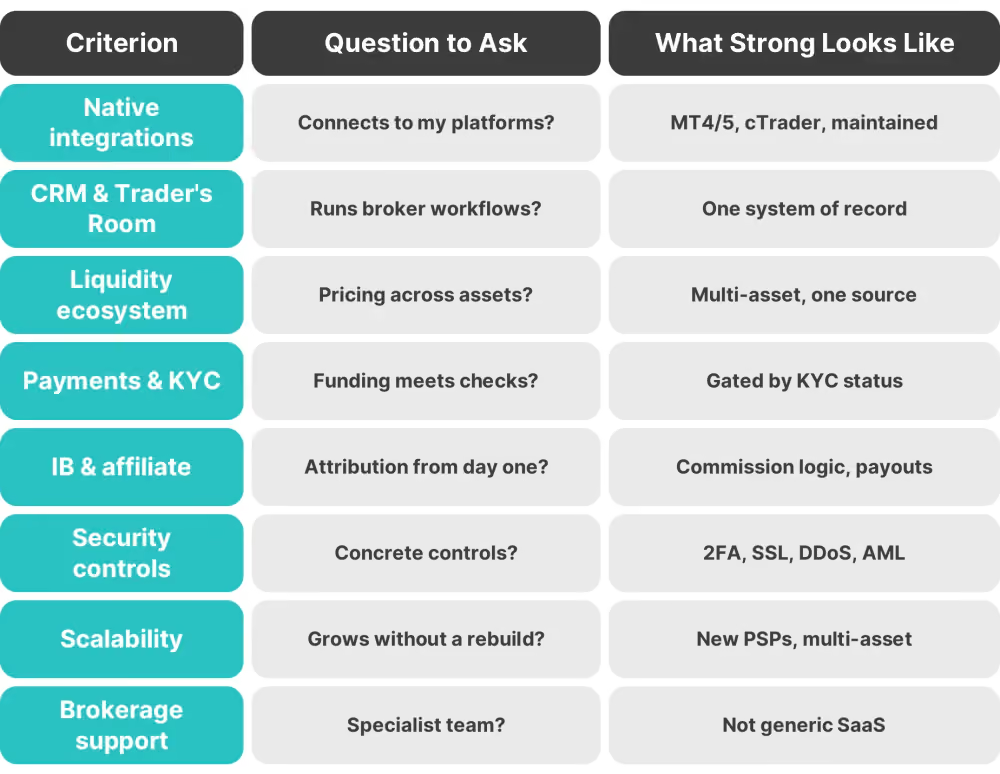
Two points deserve weight beyond the table. Integration depth beats integration quantity every time, because a provider can list dozens of connectors while few are natively maintained, updated on schedule, and tested across real client lifecycle events.
Support is the second point. A support team without brokerage-specific context cannot resolve a live incident at the speed this environment demands.
How B2CORE Supports a Turnkey Forex Broker Operating Model
B2CORE , B2BROKER's flagship Forex CRM and back-office system, connects the operating layers described above into outcomes a brokerage can run on. Client onboarding and KYC/AML workflows move new accounts from signup to verified and funded through automation rather than manual handoffs between tools.
Multi-platform trading account management lets one team oversee accounts across every connected platform, and payment gateway integrations keep funding visible and reconciled in real time. The IB and affiliate module tracks partner activity from the first referral, and the Trader's Room gives clients one place to manage accounts, move funds, and reach their trading platforms, which shapes the day-to-day trading experience.
Those outcomes rest on native integrations and API access to MetaTrader 4 and 5, cTrader, B2TRADER, and third-party KYC and payment providers. B2CORE is available as a white-label solution, so a broker can launch a fully branded client portal and mobile app, backed by security controls that include 2FA, SSL encryption, DDoS protection, and AML controls.
Around it sits the rest of B2BROKER's ecosystem: liquidity aggregation, trading platforms, back-office systems, copy trading, and crypto payment processing. Taken together, they form one operating environment rather than a set of separate purchases, which is the practical case for judging a turnkey provider on how well its parts already fit.
As a technology and liquidity provider, B2BROKER has operated since 2014 and works with more than 1,000 institutional and corporate clients. That record spans liquidity, trading platforms, and back-office infrastructure delivered as one connected stack with dedicated technical support.
Making Your Final Turnkey Infrastructure Decision
Choosing a turnkey forex broker provider is an infrastructure decision, and its consequences run for years. The right stack lowers setup overhead, carries the full client lifecycle, and grows with the brokerage as it adds platforms, payment providers, IB partners, and asset classes. The wrong one resurfaces later as a rebuild you never budgeted for.
The most reliable way to judge fit is to test a provider against the operating layers your brokerage actually needs, then look at how deeply those layers integrate and how well the support behind them understands brokerage operations.
Frequently Asked Questions about Turnkey Forex Brokers
What is the difference between a turnkey forex broker solution and a white-label solution?
A white-label solution gives you branded access to an existing trading platform, while a turnkey solution covers the wider operating stack, from CRM and payments to liquidity, compliance tooling, and IB management. The useful test is whether a package covers every layer you need, regardless of which label it carries.
Does a turnkey forex broker package handle licensing and regulatory compliance?
Turnkey technology runs compliance workflows such as KYC collection, AML controls, and audit trails, yet the broker keeps full responsibility for licensing, legal counsel, and ongoing regulatory obligations. The stack supports compliance operations without conferring regulatory authorization.
Why does a brokerage need a purpose-built CRM instead of adapting Salesforce or HubSpot?
Brokerage CRMs handle trading account logic, funding workflows, KYC routing, IB commissions, and regulated records as core functions. Adapting a generic platform means heavy integration work and data that fragments across systems at every client lifecycle event.
What should I look for when comparing turnkey forex broker providers?
Weigh native platform integrations, CRM and Trader's Room depth, liquidity breadth, payment and KYC connectivity, IB management, security controls, and post-launch scalability. Check whether integrations are natively maintained and whether support understands brokerage operations rather than generic SaaS.
How does IB and affiliate management fit into a turnkey forex broker setup?
IB and affiliate management covers attribution, commission logic, payouts, and partner visibility, and it works best built in from launch. Adding it later creates attribution gaps and reconciliation complexity.
Recommended articles

Subscribe to our newsletter