Asset Class Diversification for Brokerages: An Infrastructure Guide

Client demand for multi-asset access is now measurable. In a 2026 survey of more than 6,000 retail traders , 65% ranked fast switching between crypto, equities, forex, and commodities inside one account among their top platform priorities. For a brokerage, meeting that demand costs far more than adding symbols to a list.
The expansion plans that fail tend to fail in the same place: the gap between listing an instrument and supporting it at execution quality. A margin model built for session-based FX, for example, breaks against an asset that trades around the clock.
This guide covers asset class diversification for brokerages as an infrastructure problem: which classes to add, in what order, and what must already work before each launch.
Key Takeaways
- Diversification is an infrastructure decision. Adding instruments without aligning the liquidity, margin, and compliance layers creates operational risk that compounds with each new class.
- Expansion can spread revenue across market cycles and widen the client base, and both outcomes hinge on execution quality and operational readiness.
- Sequencing is a structured evaluation across seven criteria: demand signals, client segment fit, liquidity availability, margin complexity, compliance burden, platform readiness, and monetization fit.
- Multi-asset expansion introduces brokerage-side risks that portfolio diversification theory never mentions: counterparty exposure from untested liquidity relationships, margin models stretched across incompatible volatility profiles, and support load that spikes with every launch.
- Cross-margin collateral management is the prerequisite for single-account multi-asset trading; without it, clients end up in siloed accounts or the brokerage ends up with unmanaged cross-asset exposure.
- Third-party platform licensing can constrain instrument availability and experience design, so platform control belongs on the evaluation list for any significant expansion plan.
What Asset Class Diversification Means for Brokerages
Asset class diversification for brokerages means offering clients more ways to trade across different asset classes and building the infrastructure to support each one properly.
Infrastructure separates brokerage diversification from portfolio diversification. Clients choose an asset allocation inside an investment portfolio; the brokerage provides the investment options. Every new class changes how that brokerage sources liquidity, calculates margin, and reconciles accounts.
A platform can list a new symbol in a day. Supporting that symbol at depth takes liquidity, margin logic, and onboarding workflows that were designed for it.
A brokerage becomes genuinely multi-asset when each instrument class executes at the depth and reliability clients expect. A firm that adds crypto to its symbol list without crypto-specific liquidity and margin parameters has created execution risk waiting to surface in production.
Why Brokerages Diversify: Four Operating Outcomes
Multi-asset expansion can support four operating outcomes. Each one depends on execution quality, and none is guaranteed by the act of adding instruments.
Revenue Mix Resilience
A brokerage that earns everything from one asset class rises and falls with short-term market fluctuations. The swings are large: global FX turnover reached $9.6 trillion per day in April 2025 , up 28% from 2022, and a single-market brokerage has nothing to cushion a move in the other direction.
Instruments that respond differently to volatility and interest-rate cycles can spread that dependence, provided each one brings enough volume to pay for its own infrastructure. An instrument with low client adoption still carries full compliance and operational overhead, so it eats into margins. Diversification may support long-term growth, but it cannot guarantee it.
Addressable Client Expansion
Crypto-native traders, FX and CFD traders, and clients using ETFs often have different trading needs. A brokerage that serves several of them from a single account reaches more clients without building a separate platform for each group.
The demand data backs this up: in the survey cited above, 52% of respondents already hold equities alongside crypto . Traders who spread money across classes prefer platforms where one funded account covers all of them.
Client Lifecycle Coverage
A client who can rebalance positions as their time horizon changes has fewer operational reasons to open an account elsewhere. Futures activity is already large: global futures volume rose 8.6% in 2025 to 30.64 billion contracts . The retention effect holds only when the brokerage supports those workflows reliably; a poorly executed second asset class gives the same client a fresh reason to go.
Institutional Credibility
Institutional clients evaluate infrastructure depth, and asset count alone carries little weight. A desk runs due diligence on your liquidity relationships and risk controls before routing any flow. A brokerage that demonstrates this depth across several classes reaches a client segment that purely retail-focused platforms cannot serve.
Which Asset Classes to Add First: A Prioritization Framework
Sequencing matters as much as the decision to expand: instruments added before the checks below stack operational risk with each launch.
Before committing to any instrument class, score it against seven criteria:
- Demand signals. What existing trading behavior says clients actually want before the brokerage funds new investments in infrastructure.
- Client segment fit. Whether the instrument matches the sophistication and risk tolerance of the current base.
- Liquidity availability. Whether existing or prospective liquidity relationships cover the class at usable depth.
- Margin complexity. How far the instrument stretches the current risk model.
- Compliance burden. What obligations the class triggers in your operating jurisdictions.
- Platform readiness. Whether execution and account workflows for the instrument are supported today.
- Monetization fit. How the class earns: spreads, commissions, or both, and at what expected volume.
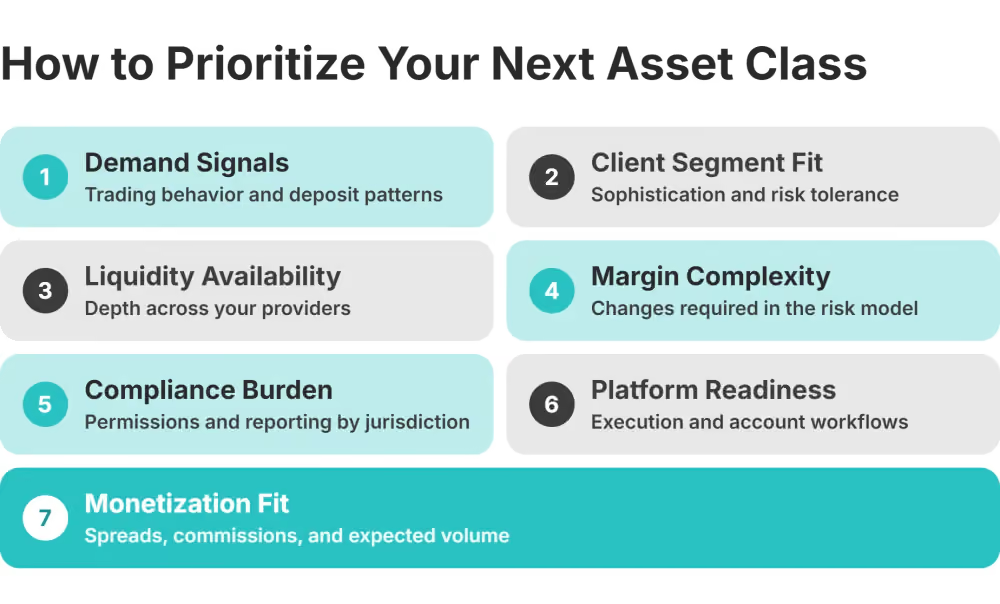
The same criteria produce different answers depending on where a brokerage starts.
Crypto-First Expansion Path
For a crypto-first broker, FX and CFDs are often the nearest step. The heaviest single piece of work is institutional FX liquidity connectivity. The margin model and CRM permissions then extend to the new session-based instruments.
Identity verification is typically already strong at crypto-native firms. The compliance gap sits in instrument-specific transaction monitoring and suitability documentation.
Forex or CFD-First Expansion Path
A forex or CFD broker moving toward crypto faces a custody question first. Crypto CFDs reuse the margin model already in place and avoid custody entirely; spot crypto requires a custody or settlement arrangement and a back office that can handle its conventions. Adding fixed income products or index funds creates a different integration path, while a platform without native spot execution turns crypto expansion into an integration project.
New Brokerage Path
A new brokerage without a legacy platform has more freedom in sequencing, but it has to build everything at once. Launching with two or three high-demand categories, each proven at real volume before the next one, keeps the team's attention where clients already trade.

Risks and Operational Challenges Brokerages Must Plan For
Diversification changes how a brokerage's risk is distributed. It removes none of it, and it introduces instrument-specific exposures that deserve the same rigor as the core business.
Counterparty risk arrives with every new liquidity relationship. A provider that quotes tight spreads in a demo can widen sharply during volatility events, exactly when execution quality decides client outcomes. Run a pilot with stress testing before client flow depends on a relationship that has never carried production volume in the new class.
Margin model complexity grows with each volatility profile added to the book. An asset that trades around the clock with weekend gaps behaves nothing like a session-based instrument, and one set of margin parameters cannot cover both safely. Each class needs its own margin rates and liquidation triggers calibrated to market fluctuations.
Compliance exposure expands when an instrument class carries licensing or reporting obligations the brokerage has not operated under before. Retroactive fixes cost more than planning: an authorization question raised after an instrument is live can force the brokerage to pull the product while the review runs.
Operational overhead piles up when several classes launch at once, because every new instrument type brings more support tickets and more reconciliation work. Launching one class at a time, with the support team prepared before each go-live, keeps that load manageable.
Infrastructure Requirements for Multi-Asset Brokerage Operations
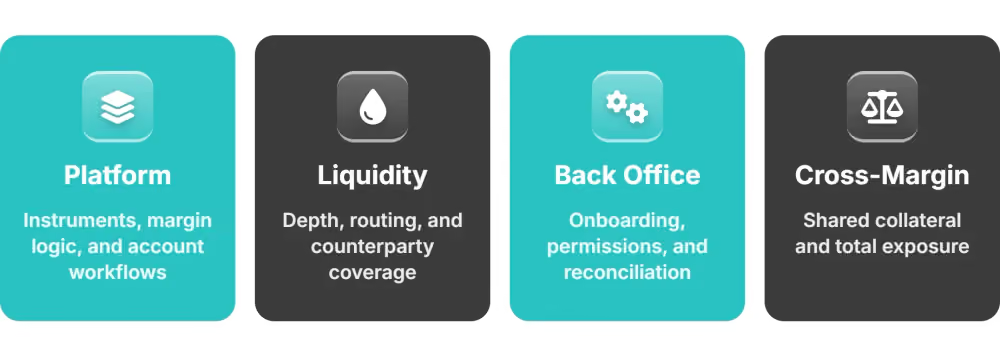
The infrastructure layer decides whether expansion delivers the outcomes above or turns into unmanageable complexity. Four components carry most of the weight, and each deserves a real evaluation before any instrument goes live.
Platform Scalability and Roadmap Control
A trading platform has to support the account architectures and margin models each asset class requires. Most platforms can display new symbols; the real test is whether the platform executes each class with the right margin logic and order types.
Third-party licensing becomes a visible constraint as the expansion plan grows: when new instruments depend on an external vendor's roadmap, the brokerage moves at the vendor's speed.
Proprietary platform ownership or a white-label model puts instrument rollout and experience design under the brokerage's own control, which is why modern brokers increasingly run more than one trading platform .
Liquidity Connectivity
Liquidity relationships are class-specific. An arrangement that prices FX and precious metals at depth does not automatically extend to crypto, so evaluate depth, latency, and counterparty risk independently for each instrument type, even behind a single aggregated provider.
An aggregated liquidity layer helps here: it gives the brokerage one connection to many sources and routes each order to the best venue for its instrument and size.
Cross-Margin Collateral Management
Single-account multi-asset trading, where a client holds FX, crypto, and index positions from one funded account, requires margin architecture built for it. The client needs to move collateral freely between positions; the brokerage needs one view of total exposure across everything that is open.
Without that architecture, the choice is stark: restrict clients to siloed accounts per asset class, which wastes their capital and invites churn, or accept cross-asset exposure the risk engine cannot measure. Both options become harder to control as volume rises.
CRM, KYC, and Back-Office Integration
Every added asset class changes how clients are onboarded, what they may trade, and how positions reconcile. A CRM built around one product type tends to absorb new instruments through workarounds, such as manual permission grants and custom fields that reporting never sees. Those workarounds turn into audit gaps as the book grows.
Brokerages need onboarding paths and product permissions configured per instrument and jurisdiction, plus one ledger reconciling everything. The same back-office layer decides how one operation serves several markets at once and how the infrastructure scales as volume grows .
Regulatory and Compliance Considerations
Each new asset class can bring regulatory obligations of its own, depending on the instrument type and the financial markets where the brokerage operates. Run compliance planning alongside the infrastructure work so regulatory constraints shape the launch plan.
Regulators classify products by how they work, not by what they are called. In February 2026, ESMA reminded firms that derivatives marketed as perpetual futures , including those on crypto-assets, likely fall within existing national product intervention measures on CFDs.
A brokerage adding a new derivative class should therefore assume the strictest plausible classification until legal analysis says otherwise.
The day-to-day work sits in a few places. KYC and AML checks need tuning to each instrument's risk profile. Where suitability rules apply, client data such as net worth and liabilities may affect product access. The system, not a manual review, should decide which client categories can trade which products, so the rules apply consistently and the audit trail proves it.
Reporting duties also differ by class and jurisdiction, so map out the full set of obligations for each instrument before it goes live.
Technology can carry the workflow, but accountability stays with the regulated entity: compliance remains a brokerage function, and the platform only enforces the rules the brokerage sets.
How B2BROKER Supports Multi-Asset Brokerage Expansion
B2BROKER is a global prime-of-prime liquidity and technology provider specializing in multi-asset and multi-market solutions. Its stack is built around the operational problems this article has walked through.
Proprietary Multi-Asset Platform
B2TRADER is B2BROKER's proprietary multi-asset trading platform for crypto, CFD, and forex brokerages. Because it is built and maintained inside the B2BROKER ecosystem, it gives operators an alternative to MetaTrader licensing, with direct control over roadmap, instrument availability, and trading experience design.
For multi-asset operators, the platform covers the requirements this guide has outlined:
- Single-account access to products from spot and futures markets.
- Cross-margin collateral management that lets traders alter collateral allocations for flexibility and risk control.
- Native TradingView integration for charting.
- Web and mobile access, including B2TRADER Mobile with one-tap order management and transparent tiered leverage.
- Dynamic tiered commissions for instrument-specific monetization control.
- White-label availability for operators who want branded platform control without custom development.
That control matters most at expansion time. A brokerage that needs a new instrument type or adjusted margin parameters works with its platform provider instead of waiting on an outside product schedule.
Ecosystem Integration
B2TRADER connects natively with B2CORE for CRM and back-office workflows, B2COPY for copy trading across the expanded instrument set, and B2CONNECT for liquidity. One integrated stack means a trade, its CRM event, its copy allocation, and its liquidity routing stay within one accountable system, with no custom-built bridges between vendors to maintain.
B2BROKER backs the stack with 24/7 customer support, which stops being a nice-to-have the moment a brokerage operates instruments across global trading sessions with no downtime window.
Your Infrastructure Roadmap: Moving from Strategy to Execution
The decisions in this guide run in parallel. Asset class diversification for brokerages can stall when liquidity, margin, compliance, or platform controls fail under production load.
Use the sequencing framework to pick the next instrument, then validate it against the infrastructure requirements and stress-test the failure modes from the risk section before it goes live.
Since 2014, B2BROKER has built a track record that now includes 10 regulatory licenses and more than 1,000 corporate clients. That operating history is why brokers rely on it as a reliable partner for multi-asset infrastructure.
Frequently Asked Questions about Asset Class Diversification
What's the difference between asset class diversification for a brokerage and portfolio diversification for a trader?
A trader uses an investment strategy to build a diversified portfolio inside an account. Brokerage diversification changes the business itself: how it sources liquidity, runs margin, handles compliance, and earns revenue.
Which asset classes should a forex broker evaluate first when expanding beyond FX and CFDs?
The honest answer depends on existing client demand, available liquidity, and compliance obligations in the broker's jurisdictions. Crypto in CFD form usually carries the lowest infrastructure delta, while spot crypto, futures, and exchange-traded funds each add custody, margin, or connectivity requirements of their own.
Can a brokerage run multiple asset classes through a single trading account for clients?
Yes, when the platform supports cross-margin collateral management with exposure aggregation across all open positions. Before offering it, confirm the platform can allocate collateral flexibly across classes, monitor cross-asset exposure in real time, and apply liquidation logic that sees the whole book.
What are the biggest operational risks when a brokerage adds new asset classes?
The main four are counterparty exposure from liquidity relationships untested at volume, margin model complexity across different volatility and settlement profiles, compliance obligations that differ by instrument and jurisdiction, and operational overhead from instrument-specific onboarding, permissions, and support. All four compound when several classes launch at once without a sequenced plan.
Do brokerages need a different trading platform to support multiple asset classes, or can they add instruments to an existing setup?
It depends on whether the existing platform supports the margin logic and account architecture the new classes require; many platforms display new instruments while lacking the back-end support they need at scale. Brokerages planning significant expansion should judge whether their current platform gives them enough roadmap control or whether a proprietary or white-label alternative fits better.
Recommended articles

Subscribe to our newsletter