How Brokers and Liquidity Providers Work Together Today

Think of the relationship between a broker and a liquidity provider as the hidden nervous system of the global trading industry. For anyone looking to launch or scale a trading venue, understanding this dynamic is far from academic. It is a strictly operational necessity. While your average retail trader just sees a sleek interface and a buy button, the actual reality of that execution relies entirely on how well the broker connects with their pricing sources.
In plain terms, liquidity providers are the institutions supplying the massive capital and executable prices that make trading possible. Without them, a retail platform is essentially a supermarket with completely empty shelves. How a platform operator selects and integrates these partners will ultimately dictate their business model, their daily risk exposure, and their bottom line.
This guide tears down the operational mechanics of this partnership. We will look at the distinct roles each party plays, follow the journey of a single order through the technology stack, and evaluate the operating models you need to know about.
Key Takeaways
- Brokers focus on connecting traders to the markets and managing the client experience, while their liquidity partners supply executable bid-ask pricing and the sheer capacity to absorb large orders.
- Deciding between an ECN, a market maker, a prime-of-prime, or a hybrid setup directly impacts your spreads, your execution quality, your daily risk, and your required capital reserves.
- Using prime-of-prime access opens up institutional-grade execution for smaller firms by removing the need to secure direct Tier 1 bank credit relationships and massive collateral.
- Execution outcomes rely heavily on technology. Things like FIX connectivity, bridge stability, smart order routing, and real-time risk controls are non-negotiable.
- Finding the best partner means verifying their depth consistency, their readiness for regulatory reporting, platform compatibility, and whether they actually answer the phone at 3 AM when something breaks.
Discover the Tools That Power 500+ Brokerages
Explore our complete ecosystem — from liquidity to CRM to trading infrastructure.
Broker vs. Liquidity Provider: What Are the Core Roles?
If you want to optimize your trading infrastructure, you have to decouple your service layer from your execution layer. Separating these responsibilities makes it much easier to see how pricing and risk actually move through your stack.
Fundamentally, a broker is the client-facing intermediary. They handle the service layer. On the flip side, the liquidity provider acts as the price-making and capital-providing counterparty working behind the scenes.
Market Access and Client Servicing
Brokers serve as the gateway to the financial markets for everyday retail users and professional traders alike. Their main job revolves around distribution and service. Their core responsibilities look something like this.
First, they handle client onboarding, which means dealing with the endless headache of KYC and AML procedures. Then they provide the actual platform, hosting trading interfaces like MetaTrader 4, MetaTrader 5, or cTrader. They also configure the risk parameters, setting leverage limits, margin stop-out levels, and deciding on the commission structures. Once a client hits trade, they route those orders to the execution venue. Finally, they ensure all of this activity stays compliant with local regulators like the FCA or CySEC.
While they provide the access, they rarely hold the massive inventory of assets needed to settle billions in daily volume. For that heavy lifting, they rely on an institutional liquidity provider for brokers.
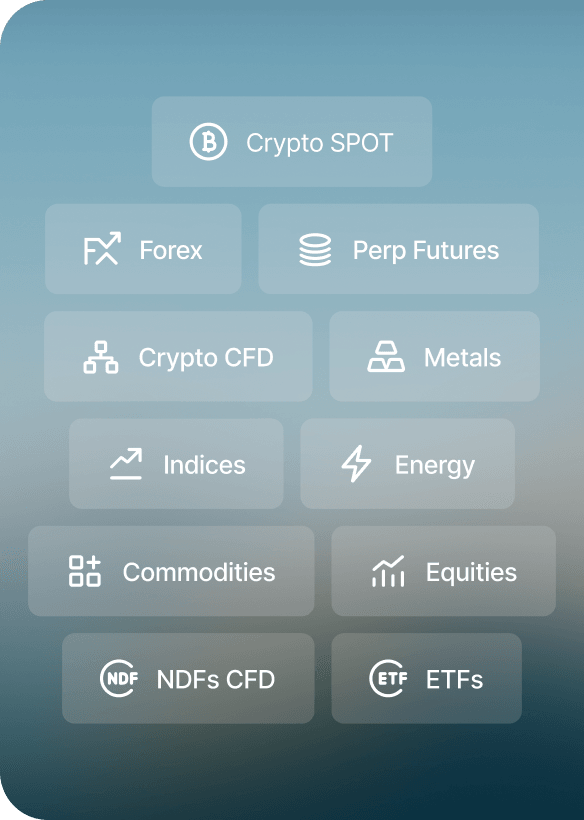
Deep, Reliable Liquidity Across 10 Major Asset Classes
FX, Crypto, Commodities, Indices & More from One Single Margin Account
Tight Spreads and Ultra-Low Latency Execution
Seamless API Integration with Your Trading Platform
Capital Provision and Price Quoting
The providers on the other end are typically major banks like Deutsche Bank or JPMorgan, non-bank market makers, massive hedge funds, or high-frequency trading firms.
When we talk about liquidity providers in forex and crypto, we mean entities that continuously stream buy and sell quotes to brokers. They are always standing ready to take the other side of a trade. If a retail client wants to buy EUR/USD, the provider is the one selling it. These institutions don't want to deal with retail clients directly. Their entire model relies on volume economics and capturing the spread rather than profiting off individual client losses. The sheer scale of these operations is staggering, with daily volumes often reaching into the trillions across global foreign exchange markets.
How Order Flow Travels From Trader to Liquidity Provider
Watching an order move from a retail screen to an institutional bank is fascinating. It is a high-speed technological handshake, and operations teams absolutely need to understand how the data moves.
Here is what happens during a standard trade in a straight-through processing environment.
The trader clicks buy on a currency pair in their terminal. Instantly, the broker’s server checks if the trader has enough margin and is actually authorized to make the trade. If everything looks good, the broker’s bridge software translates that order into the FIX protocol and fires it off to the liquidity provider. The provider accepts the order, fills it from their order book, and shoots a confirmation back. Finally, the broker updates the trader’s terminal to show the open position.
This whole process takes milliseconds. Brokers often use aggregation to pull streams from multiple providers. If one bank rejects a trade because the market is too volatile, the broker’s smart order routing technology instantly tries the next available provider. For a deeper dive into these mechanics, you can explore how do liquidity providers work.
Main Operating Models Connecting Brokers and LPs
There is no single right way to build your brokerage. The model you choose depends entirely on your capital resources, your target audience, the products you want to offer, and how much risk you can stomach.
ECN Direct Market Access
With an electronic communication network model, the broker acts purely as a conduit. Client orders go straight into a pool where banks and other market participants compete to fill them.
The benefits here are clear transparent pricing, usually tighter raw spreads, and absolutely no conflict of interest because the broker just earns a fixed commission. The downside is that brokers have very little control over spread widening during crazy news events. Your execution quality depends entirely on the deep liquidity pools you manage to tap into. This setup is usually best for brokerages targeting algorithmic traders or pros who demand absolute transparency.
Market Maker Internalization (B-book)
Market making brokers take the opposite side of their client’s trades. If the client buys, the broker is the one selling.
This eliminates external routing latency completely, and the broker gets to capture the full spread. However, it creates an obvious conflict of interest. To keep things from blowing up, mature market makers will hedge their net exposure with external providers once it hits a certain risk threshold. This is a solid approach for businesses that need a liquidity provider as a backup but want to monetize smaller retail flow in-house.
Prime-of-Prime Aggregation and Hybrid Routing
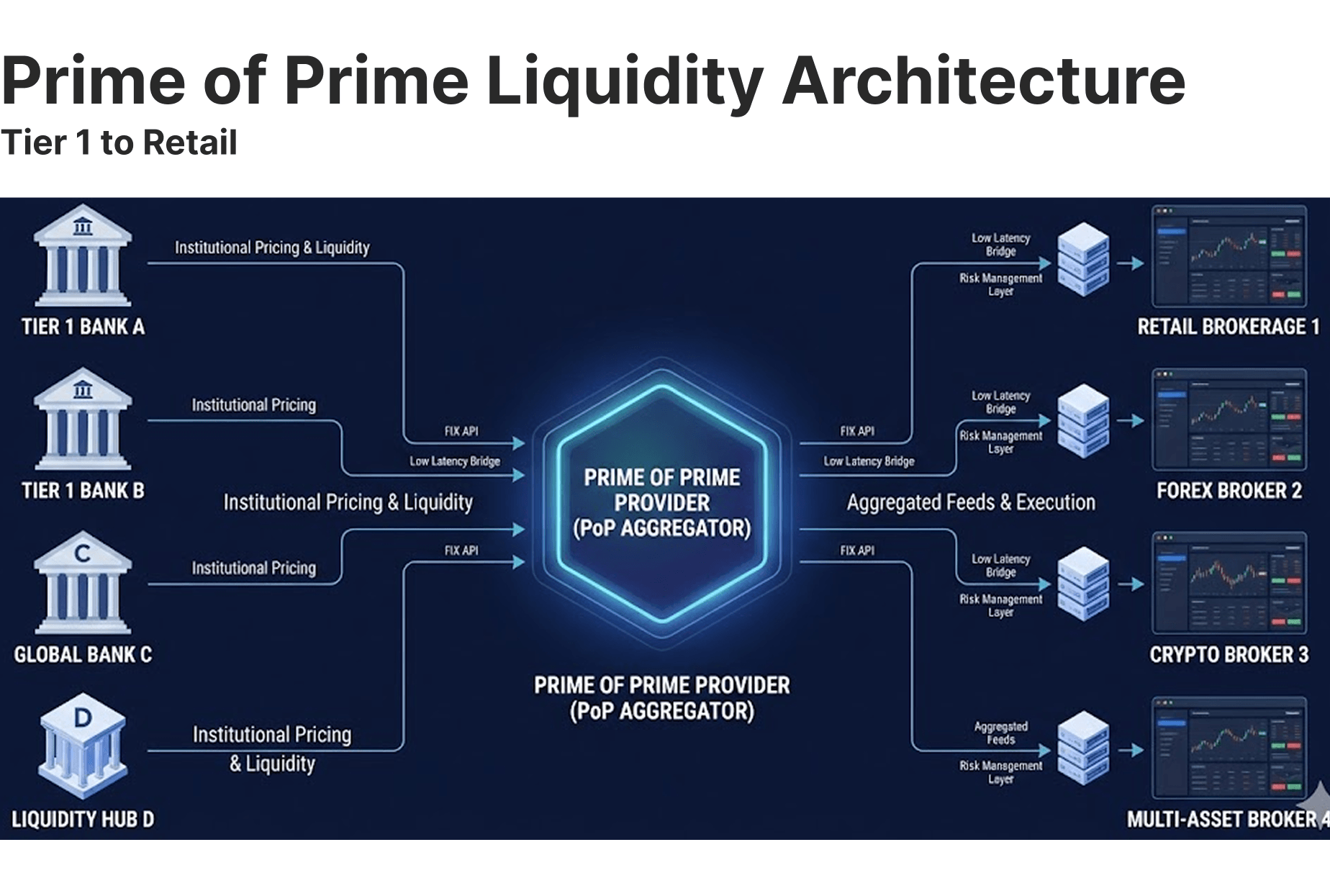
Prime-of-prime providers are essentially the middlemen that aggregate pricing from Tier 1 banks and deliver it to smaller brokers. Understanding the broader financial definitions of these structures offers great foundational context for anyone scaling a trading operation.
Most modern brokers use a hybrid approach. They route huge or toxic flow to the prime-of-prime via their A-book, while keeping smaller, uncorrelated flow in-house on their B-book. This offers much lower entry barriers than trying to partner with a bank directly, gives you aggregated multi-asset depth, and simplifies your counterparty headaches.
Why Prime-of-Prime Liquidity Solves Capital Barriers
For almost every new or mid-sized brokerage, knocking on the door of a Tier 1 bank like Citibank is a waste of time. These banks want to see balance sheets north of 50 million dollars and charge astronomical monthly minimums.
How PoP Reduces Barriers While Improving Execution
Prime-of-prime providers fix this access issue. They hold the massive capital requirements with the banks and basically rent that access out to smaller brokers.
Instead of locking up millions in collateral, a broker can open an account with 50,000 to 500,000 dollars depending on what they need. Because the provider is pooling streams from multiple banks, the resulting market depth is usually way deeper than what a single bank would give you anyway. Plus, a good setup allows you to scale across forex, metals, and crypto all through a single margin account. This takes the pain out of cross-border liquidity management.
Key Benefits for Brokers, Liquidity Providers, and Traders
When the partnership between a broker and an LP is dialed in, the entire trading ecosystem runs smoother.
Brokers get massive scalability. They can process thousands of orders per second without holding any inventory themselves. They also get the ability to hedge their exposure instantly, preventing catastrophic losses while accessing hundreds of different instruments through a single connection.
Liquidity providers get access to retail flow they would never be able to service on their own. They get exposure to uncorrelated trading strategies from all over the world, and they do it efficiently by dealing with one broker instead of thousands of individual traders.
Traders are the ultimate winners. Competition between the providers compresses the bid-ask spread. Automated matching cuts down on slippage, and they experience way fewer re-quotes and rejections when the markets get choppy.
Selecting the Right Liquidity Provider for Your Brokerage
Picking your provider is a massive infrastructure decision. Ripping out a provider later involves painful legal agreements, messy tech integrations, and endless testing. You have to look past the flashy marketing claiming zero pip spreads and focus on operational reality.
Execution Quality: Depth, Spreads, and Fills Under Stress
Everyone has competitive spreads when the markets are quiet. The real test is what happens during Non-Farm Payrolls or a sudden geopolitical crisis. You need to know if their order book completely vanishes when volatility spikes. Ask for historical data on their fill ratios, rejection rates, and average slippage. Poor depth will lead to terrible slippage and angry clients, which can permanently destroy your brand.
Operational Fit: Technology, Regulation, and Support
Your provider needs to connect seamlessly with your existing bridge and platform. You also need to verify they are regulated in a respectable jurisdiction to ensure your funds are safe and you are ready for audits. Figuring out how to become a forex broker almost always hinges on these upstream regulatory relationships.
And don't forget support. The markets never stop moving. If your feed drops at 3 AM, you need a dedicated support desk on the phone immediately, not an automated email telling you they will reply in 24 hours.
Critical Technology Components for Seamless LP Integration
Your execution performance is really a technology outcome. You could have access to the deepest liquidity pool in the world, but it is useless if the pipe connecting it to your platform is broken.
Connectivity Stack: FIX API and Bridge Layers
The Financial Information eXchange API is the universal language for institutional trading. It is what allows your server to talk to their server in a matter of milliseconds.
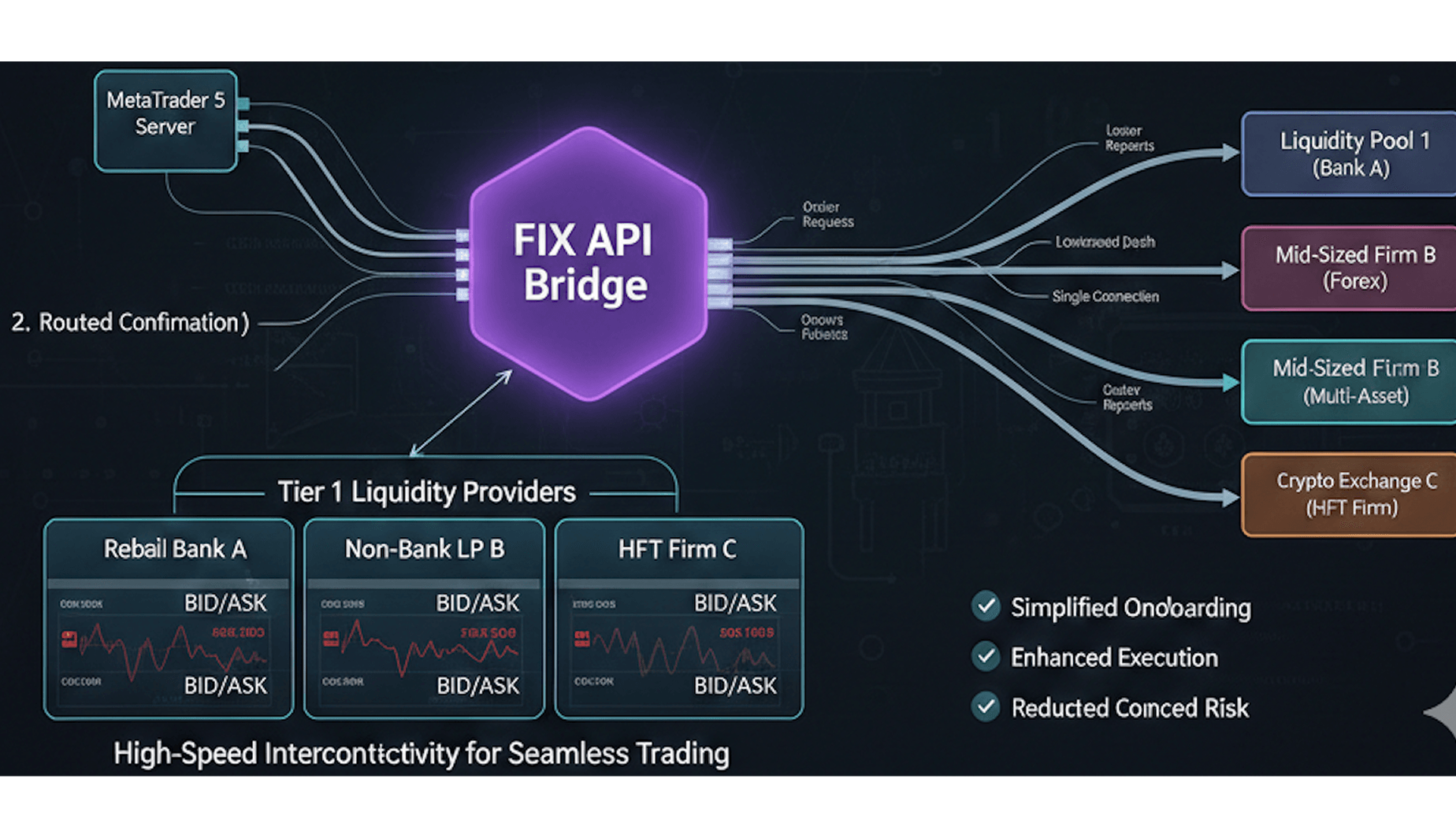
The bridge is the middleware sitting between your trading platform and the provider. The quality of this bridge dictates the speed of the trade and the stability of your connection. A cheap bridge will cause price freezes even if the provider is working perfectly.
Aggregation, Smart Order Routing, and Real-Time Risk Controls
Aggregation tech stacks the order books of multiple providers on top of each other. If one bank offers EUR/USD at a certain price and another offers a slightly worse price, the aggregator always shows you the best option. Smart order routing uses automated logic to decide exactly where to send the trade to get the best fill. Staying informed on these technological shifts is crucial, as algorithmic routing fundamentally changes the currency landscape year after year.
Brokers also need a system to watch their exposure live. If a specific client or asset class blows past your risk limits, the system needs to alert the dealing desk or just automatically hedge the position.
Power your Brokerage with Next-Gen Multi-Asset & Multi-Market Trading
Advanced Engine Processing 3,000 Requests Per Second
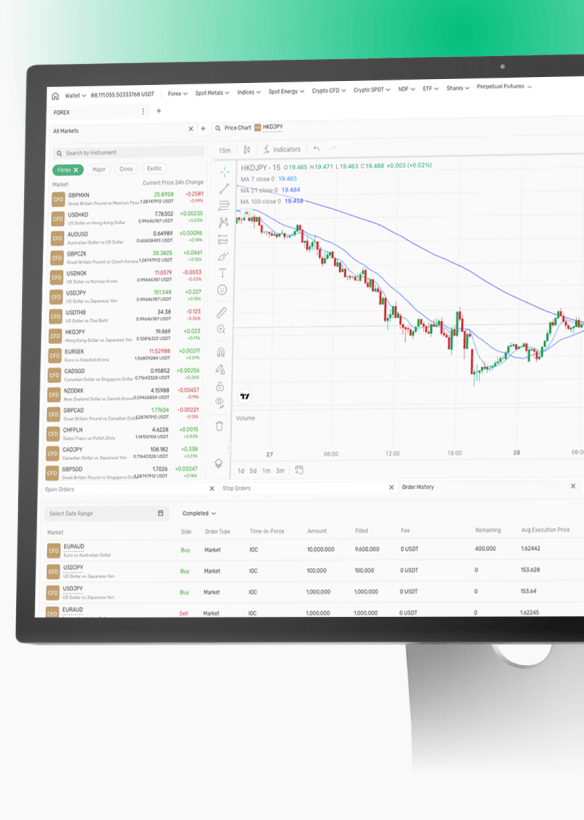
Supports FX, Crypto Spot, CFDs, Perpetual Futures, and More in One Platform
Scalable Architecture Built for High-Volume Trading
Strengthening Your Liquidity Setup
Knowing how brokers and their liquidity partners interact is the bedrock of your strategic planning. Whether you are running a brand new startup or trying to optimize a massive multi-asset firm, your partner sets your ceiling for growth.
If you are looking to upgrade, start by auditing your current rejection rates and seeing how bad your spreads widen during news events. Map out your connectivity to see if you are dangerously reliant on a single provider. Request sandbox access from a prime-of-prime to compare spreads in real-time. Do your homework on their regulatory status, and negotiate an SLA that actually guarantees uptime.
By fusing institutional-grade multi-asset aggregation with bulletproof bridge technology and back-office systems, you can make sure your infrastructure is just as tough as the Tier 1 banks standing behind it.
B2BROKER delivers institutional‑grade liquidity, multi‑asset aggregation, and integrated execution infrastructure to support brokerages from launch to scale.
Have a Question About Your Brokerage Setup?
Our team is here to guide you — whether you're starting out or expanding.
Frequently Asked Questions about Brokers and Liquidity Providers
- What is the difference between tier 1 and prime-of-prime liquidity?
Tier 1 liquidity comes straight from major global banks and requires massive collateral deposits and deep credit relationships. Prime-of-prime providers pool this Tier 1 liquidity and offer it to smaller brokers, drastically lowering the capital requirements and operational hurdles.
- Can a retail broker become its own liquidity provider?
Yes, a broker can internalize their flow as a market maker, essentially acting as the liquidity provider for their own clients. However, you need serious capital to absorb winning trades, sophisticated risk management systems, and the right regulatory licenses to pull this off legally.
- How complex is a typical liquidity provider integration?
It really depends on your tech stack. If you are using standard MetaTrader bridges and FIX API connectivity, you can usually integrate a new provider in a few weeks. But if you are running a custom trading platform or have complex risk workflows, expect to spend several more weeks on development, testing, and getting your reconciliation set up perfectly.