How Does a Broker-Dealer Work? A Practical Guide for Brokerages


Broker-dealers operate in a regulatory and technological environment that demands far more than trade execution. Today, they function as fully regulated businesses that must balance compliance oversight, technology infrastructure, and reliable liquidity access on a daily basis.
So, how does a broker-dealer work? This article breaks down the day-to-day workflow behind each trade, from routing to clearing choices. It also covers supervisory controls and revenue mechanics, helping teams plan a restructure or launch of a scalable business with fewer operational surprises.
Key Takeaways
- Broker-dealers function as agents executing client orders or principals trading against their own inventory.
- Revenue models combine transaction commissions, bid-ask spreads, and interest from margin financing.
- Operational integrity requires segregating client funds and maintaining automated audit trails for regulators.
- Consistent execution relies on deep liquidity access to minimize slippage and ensure fill stability.
What Is a Broker-Dealer?
A broker-dealer is a licensed financial institution authorized to execute orders for buying and selling securities. Depending on its license, it acts on behalf of clients or trades for the firm's own account.
The broker function involves acting strictly as an agent, providing brokerage services for the account of others. The firm routes client orders to external exchanges or liquidity pools to obtain the best execution price. Revenue in this model comes from commissions or markups charged for matching buyers with sellers.
The dealer role shifts the firm into a principal position. The entity commits its own capital to buy securities into inventory or sell from existing stock to capture bid-ask spreads. This activity requires sophisticated risk management to handle market exposure on proprietary positions.
Fidelity Investments is the largest broker-dealer firm as of 2026, managing over $15 trillion in assets under administration.
How Broker-Dealers Actually Operate Day to Day
A registered broker-dealer runs a daily workflow from order entry to risk checks, routing, clearing, and reporting. Each handoff leaves an audit trail that supervisors review and regulators test during exams.
This section outlines how these entities support trading activity in practice, both when acting on behalf of clients and when committing their own capital.
Acting as a Broker for Clients
In the broker role, the firm captures orders through approved platforms or advisor tools. Pre-trade controls validate account permissions and buying power, then the order management system routes instructions to exchanges, ATS venues, or liquidity providers based on configured logic and venue connectivity.
Execution performance depends on routing decisions and market access. Financial Industry Regulatory Authority (FINRA) Rule 5310 requires firms to exercise reasonable diligence in seeking favorable execution terms. To meet that obligation, broker-dealers track:
- Fill rate by venue and order type
- Price improvement or slippage versus the quote at entry
- Rejection frequency tied to routing rules
- Time to execute from order acceptance
Execution sits upstream from clearing and financing. Clearing firms handle settlement processing, while prime brokerage supports custody, margin financing, and multi-market access for eligible clients.
Acting as a Dealer for the Firm
In the dealer role, the firm trades with its own capital under defined limits. Some firms register as market makers and quote two-sided markets in assigned securities. Trading desks manage that activity through inventory targets and real-time position controls.
Risk teams monitor inventory valuation and concentration exposure throughout the session. They set thresholds for position size and intraday drawdown, then escalate breaches to supervisors. Dealers also manage hedges and financing costs when positions sit on the balance sheet.
Compliance controls protect client interests when the firm trades as principal. Supervisors enforce information barriers between client flow and proprietary strategies. Surveillance tools flag patterns that indicate, ensuring the firm complies with applicable securities laws. Compliance then documents the review and outcome.
The Role of Market Making and Liquidity
Liquidity determines how reliably a brokerage can execute client orders at the displayed market. It affects pricing stability and the firm’s exposure during active trading. When liquidity remains strong, orders transact closer to quoted prices and with lower market impact.
Market making contributes to that stability by continuously quoting buy and sell prices. In the United States, exchanges require registered market makers to maintain quotes during core trading hours and meet minimum capital requirements.
From an operational perspective, liquidity directly influences:
- Spread width and transaction cost
- Order fill consistency during active sessions
- Slippage when a trade size exceeds the available volume
- Execution performance during volatility
For multi-asset brokerages , liquidity infrastructure becomes even more critical. Equities, Forex, and digital assets operate on different schedules and volume patterns. Coordinated liquidity access across different asset classes supports predictable execution and protects the broker-dealer’s capital during periods of elevated activity.
Underwriting and Capital Market Functions
Underwriting is a core function of investment banks, enabling issuers to raise capital. This typically occurs during an initial public offering (IPO) or a debt issuance. The broker-dealer evaluates the offering, sets a price, and agrees to distribute the securities to investors.
Not every broker-dealer performs underwriting, as it applies mainly to firms involved in capital market transactions rather than day-to-day trade execution. It becomes relevant when companies seek funding and not when clients place routine market orders.
Regulation and Compliance: The Framework Broker-Dealers Operate Within
Regulation sets the operating rules a broker-dealer follows every day. U.S. Securities and Exchange Commission (SEC), a main securities regulator, and FINRA, a self-regulatory organization, exam teams evaluate supervision through concrete artifacts. Policies, logs, and retained communications show how the firm controls order handling, customer assets, and employee conduct.
Capital and customer protection sit at the center of that review. Finance teams compute net capital under SEC Rule 15c3-1 and escalate breaches immediately. Operations teams apply customer protection controls under Rule 15c3-3 and reconcile balances throughout the day to avoid unresolved breaks.
Supervision depends on repeatable workflows. Firms maintain written supervisory procedures and map them to specific roles. Compliance teams retain required business communications and preserve order and trade records in approved systems. Surveillance analysts document each alert resolution with timestamps and reviewer notes.
Brokers must maintain broker-dealer registration and be members of the Securities Investor Protection Corporation (SIPC) to safeguard assets.
In 2025, the SEC imposed significant penalties on firms for recordkeeping failures, totaling more than $63 million. That outcome shows how weak documentation can convert into direct costs and remediation work.
Common Broker-Dealer Business Models
Business models follow the client segment a firm targets and the regulatory scope it accepts. A firm that runs advisory activity needs different controls and workflows than a firm that focuses on self-directed execution.
Full-Service and Wirehouse Broker-Dealers
Full-service firms employ financial advisors and registered representatives to help clients define financial goals. They offer comprehensive financial planning, supporting complex portfolios of mutual funds, derivatives, and even real estate investment trusts. Large firms like Charles Schwab or Morgan Stanley exemplify how this model scales.
The “wirehouse” label came from firms that connected offices through dedicated communication lines. In modern practice, it describes large broker-dealers with centralized policies and standardized platforms. For a deeper look at service models and operating tradeoffs, see our guide on full-service vs. discount brokers .
Independent Broker-Dealers and RIAs
Independent broker-dealers run under the same core registration obligations while keeping tighter control over their operating structure. Many support networks of advisors and smaller offices, then rely on external liquidity providers and custodians for settlement and custody workflows.
A registered Investment Adviser, or RIA, often works alongside an independent broker-dealer when the business combines advice with brokerage execution. The RIA owns the advisory relationship under fiduciary standards. The broker owns trade handling, supervision, and books-and-records duties tied to execution activity.
How Broker-Dealers Make Money
Broker-dealers build revenue around two operating drivers: client activity and balance-sheet usage. An execution-first firm ties income to order flow and venue economics. A dealer-heavy firm ties income to quoting, inventory, and risk limits that shape how much capital the desk can deploy.
Commissions, Spreads, and Execution Revenue
In the agency workflow, firms charge commissions or apply markups to execution services. Pricing often varies by instrument and account type. The operational focus sits on routing quality, stable fills, and predictable trading costs because clients judge fees against observed execution outcomes.
In the dealer workflow, firms earn from bid-ask spreads when they quote and take the other side of trades. Many firms also monetize financing linked to trading activity, including margin lending. Risk teams set exposure limits and margin rules, since financing revenue scales with outstanding balances and market volatility.
Service-Based and Advisory Revenue
Full-service broker-dealers add advisory revenue on top of execution. Many managed-account programs price advice as an annual percentage of assets under management, with public fee schedules commonly listing ranges around 0.5% to 2% depending on service tier and balance size.
Firms also charge for operational services that clients treat as part of the relationship:
- Account and custody-related fees
- Platform access and data packages
- Reporting, statements, and bespoke support
Revenue mixes differ by model and investment products offered, but each stream ties back to workflows the firm can measure, supervise, and scale.
Broker-Dealer vs. RIA: How the Roles Differ in Practice
A broker-dealer registers under the Securities Exchange Act of 1934 and follows SEC and FINRA requirements tied to transaction activity. The firm runs execution controls, supervises registered personnel, and maintains capital discipline. Technology centers on order routing, trade reporting, and surveillance evidence.
An RIA registers under the Investment Advisers Act of 1940 and operates under a fiduciary standard when delivering advice. The firm manages portfolios and documents recommendations. Systems focus on portfolio accounting, fee billing, and compliance workflows tied to advisory activity.
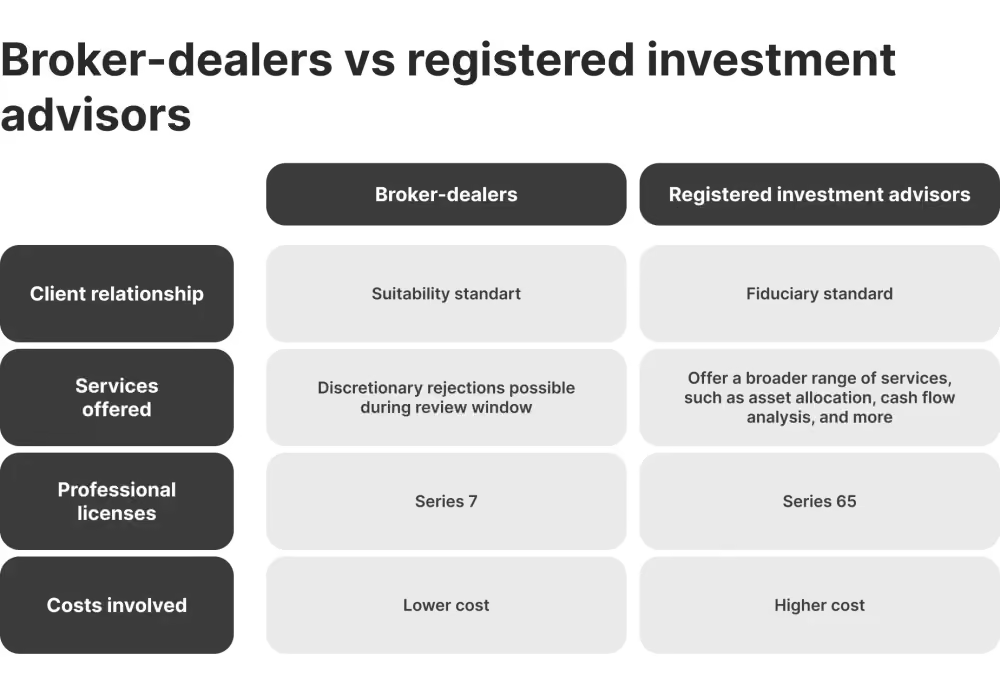
The operational footprint follows the registration:
- Broker-dealer: execution stack plus controls for trading activity.
- RIA: advisory stack plus controls for client guidance and disclosures.
Technology as the Backbone of a Modern Broker-Dealer
Modern broker-dealers depend on integrated technology to support execution, supervision, and reporting.
Trading Platforms
Trading platforms sit at the front of the workflow. They capture order intent, apply account permissions, and generate the timestamps that later support supervisory review. Platform uptime and session stability also shape client support load because outages trigger ticket spikes and trade disputes.
CRM and Back-Office Systems
CRM and back-office tools anchor client lifecycle operations. Teams store onboarding evidence, account settings, and communications metadata in one place, then link that data to trading activity. A clean data model reduces manual reconciliation across departments when the firm handles investigations or audits.
Compliance Tooling
Compliance systems rely on complete, searchable records. SEC Rule 17a-4 requires broker-dealers to preserve certain records for at least six years, with the first two years kept in an easily accessible place.
Liquidity and Execution Infrastructure
Execution infrastructure connects the platform to venues and manages routing logic. Teams monitor gateway health and message throughput, then tune routing rules based on venue performance reports. A unified execution layer also simplifies control testing because compliance reviews one routing policy set, not one per channel.
How Broker-Dealers Scale Without Increasing Risk
Growth increases operational pressure. More clients mean more onboarding reviews and supervision checks, while higher trading volume raises exposure and reporting demands. Expanding into new asset classes or jurisdictions also introduces additional regulatory requirements.
That’s why scaling requires structured systems. Early infrastructure choices set the ceiling for safe growth:
- Integrating CRM, order management system (OMS), and back office so data stays consistent across systems.
- Automating surveillance and case management so analysts focus on exceptions.
- Standardizing operational playbooks for new assets and jurisdictions.
When systems and processes align early, adding accounts or markets increases throughput without multiplying control gaps.

How This Connects to Starting a Broker-Dealer
Operational fluency is the absolute prerequisite for launching a new brokerage firm. Founders must align their initial business plan with the actual mechanics of trade execution and settlement.
You can explore specific setup steps in our guide on how to start an online brokerage business . Building this logic into the blueprint prevents expensive infrastructure overhauls post-launch.
Choose Infrastructure That Supports Broker-Dealer Operations
Infrastructure choices shape daily execution quality and the evidence you can produce during an exam. Treat vendors as part of your operating model, not a procurement line item. Your stack needs to support order flow, supervision, and post-trade control without manual patching across teams.
Look for a setup that stays coherent when you add asset classes or jurisdictions. That means consistent client permissions, centralized risk limits, and reporting that maps cleanly to local rules. Fragmented tooling creates reconciliation work and weak audit trails once volumes rise.
Key criteria to screen partners:
- Liquidity access with transparent routing logic and execution reporting you can audit
- Regulatory readiness through time-stamped logs, retention controls, and exportable records
- System integration via stable APIs between platforms, back office, and other components of the stack
- Scalability discipline with redundancy, incident workflows, and capacity planning
B2BROKER fits into this layer as an infrastructure partner for brokerages that need multi-asset connectivity and institutional-grade liquidity . Our ecosystem also includes trading platform integrations, back-office tooling , and turnkey brokerage setups that align with your execution approach:
A-book routes client orders to external liquidity, B-book internalizes flow on your books, and the hybrid C-book approach applies routing rules by instrument, client tier, or risk limits.
Understanding the Broker-Dealer Model Before You Build
Broker-dealers operate as sophisticated financial organizations that manage capital and compliance within a strict legal framework. Long-term success depends on viewing the firm as a complex business entity with diverse operational responsibilities.
Mastering these internal mechanics helps you select the appropriate model and build compliant systems. This solid foundation supports scaling your trading volume while avoiding unnecessary friction.
Frequently Asked Questions about Broker-Dealers
What does a broker-dealer do on a day-to-day basis?
On a daily basis, a broker-dealer executes client trades, manages liquidity access, monitors risk and compliance, and maintains records required by regulators. Depending on its business model, the firm may also engage in proprietary trading, market-making, or advisory activities.
How is a broker-dealer different from a brokerage platform or trading app?
A trading app is merely the software interface, while a broker-dealer is the regulated financial institution operating behind it. The firm holds the licenses, protects client funds, and bears the legal responsibility for every trade execution.
Do all broker-dealers act as dealers or market makers?
No, many firms act strictly as agents, routing orders to external venues without taking balance-sheet risk. Only those with specific licenses and capital capacity act as dealers, trading against clients or holding proprietary inventory.
What infrastructure does a broker-dealer need to operate?
Operations require a trading platform, a back-office CRM for account management, and bridges to external liquidity providers. These systems must integrate with compliance tools to automatically report transactions and monitor surveillance alerts.
How do broker-dealers make money?
Revenue comes primarily from transaction fees, commissions, and bid-ask spread capture on trade flow. Firms may also generate income through margin financing interest or asset-based advisory fees, depending on their service model.
Recommended articles


Subscribe to our newsletter