Spot vs Margin Crypto Exchanges: What Are the Key Differences and Which Should You Start?

The crypto market offers brokerages many opportunities, and building a crypto exchange platform is one way to capitalize on its high volatility, speculative activity, and aggressive sentiment that drive prices up and down.
However, choosing the right business mode, between spot or margin crypto exchange, is challenging because it directly influences capital requirements, risk exposure, regulatory complexity, and the technical infrastructure you need to build a consistent platform.
In short, spot exchanges function primarily as transactional venues with clear ownership and contained risk, while margin exchanges provide lending and leverage, which impose significant exposure risks.
In this article, we will break down how spot and margin crypto exchanges work, which model suits you better, and how to choose the right integration approach for your venture.
Key Takeaways
- Spot exchanges facilitate buying and selling instruments using the trader’s available funds.
- Margin exchanges support leverage, which enables traders to borrow money and move high-value market orders.
- Spot trading platforms are simpler, while margin trading adds another layer of borrowing, risk monitoring, and liquidity management.
- Spot exchange platforms gain from transaction and exchange fees, while margin trading brokerages earn from funding, interest, and liquidation fees.
Discover the Tools That Power 500+ Brokerages
Explore our complete ecosystem — from liquidity to CRM to trading infrastructure.
What Is Spot Trading in Crypto?
Spot exchanging entails buying and selling cryptocurrencies on the spot, hence the name. This approach allows users to acquire crypto assets and other securities at the market price and claim ownership over the subject asset.
Similarly, sellers can exchange Bitcoin, Ethereum, or other virtual coins for fiat money at the current market price. Prices at the crypto spot exchange fluctuate according to the demand and supply forces.
Spot exchanging is more straightforward, especially for users who want to get their first coins. When a buy/sell order is placed, the exchange software executes the position immediately and at the same price. Some rate deviations may happen when executing, due to slippage, where rapid market movements cause the request to settle at a slightly different price.
This model comes at a lower risk profile because it does not include leverage or borrowing. As such, clients exchange using the money they have available in their account, and the platform processes just that.
Launching a Crypto Spot Exchange
Setting up a spot crypto exchange business requires comprehensive research to understand applicable laws and users’ needs.
You can start a crypto exchange from scratch by developing your software, payment processing systems, matching engines, and back-office support systems. You can also utilize a crypto exchange white-label solution that provides pre-integrated features and liquidity connections.
Ready to Start Your Own Spot Exchange?
Offer spot trading, fully integrated payment gateways, real-time monitoring, and liquidity pools.
White-label exchange platforms are ready-to-use templates that offer core functionalities and layouts that can be customized to suit your business objectives and preferences. Here’s how you can start:
- Search for a reliable turnkey solution provider and inspect their licenses, testimonials, reputation, and reviews.
- Check out the range of services they provide and the supported digital assets (including crypto coins, tokens, and stablecoins).
- Research the market to find out the most demanded cryptocurrencies and payment preferences.
- Integrate a payment gateway service to accept transactions in various currencies, including fiat money, e-wallets, and cryptos.
- Schedule a meeting with the platform provider to discuss the features you want, plan deployments, and agree on delivery terms.
After launching your spot crypto exchange, promote your platform through marketing campaigns, SEO-friendly content creation, affiliate programs, and incentives to early users.
Pros and Cons of Spot Trading
Spot trading is often treated as the baseline model that is used to measure other crypto products and exchange platforms. It offers various benefits for brokers looking capitalize on the hype of most cryptocurrencies, with some challenges that you need to consider.
Pros
- Simpler operational model and risk measures.
- Straightforward compliance with minimum borrowing mechanisms.
- Requires less invested capital and reserve requirements.
- Clear asset ownership without time or funding pressures.
- Less complex infrastructure and integration requirements.
Cons
- Inefficient capital utilization due to limited investment options.
- Does not support short selling.
- Restricted hedging, arbitrage, and leverage trading strategies.
- Limited profit models—focused on transactional commissions.
- Lower attractiveness for high-frequency trading environments.
Power your Brokerage with Next-Gen Multi-Asset & Multi-Market Trading
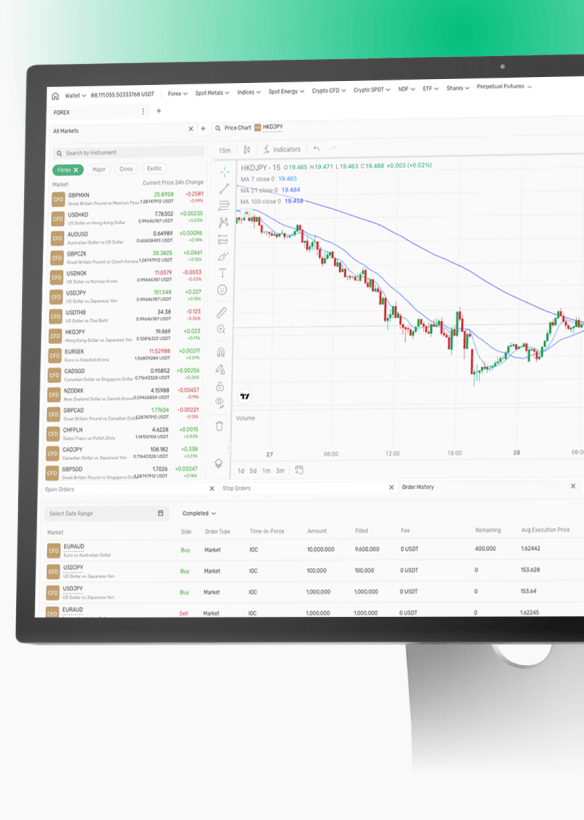
Advanced Engine Processing 3,000 Requests Per Second
Supports FX, Crypto Spot, CFDs, Perpetual Futures, and More in One Platform
Scalable Architecture Built for High-Volume Trading
What is Crypto Margin Trading?
Margin trading is buying and selling BTC and other digital assets without having to afford the entire position value. These accounts involve borrowing from the broker, which is known as leverage.
Trading with leverage enables investors to open long or short positions by paying a fraction of the total value while the broker finances the remaining amount.
Leverage is calculated in ratios. For example, a 1:100 leverage ratio means that traders can open $100-value positions by paying $1. This allows traders to capitalize on the cryptocurrency market’s massive gains and amplify their potential profits, however, at a higher risk.
The risk associated with leverage stems from being indebted to the broker, with the platform preserving the power to liquidate current position or collateral holdings to compensate for the broker’s losses.
Launching a Margin Crypto Exchange
Crypto margin exchanges facilitate CFD and futures trading, which do not entail direct asset transfer or actual coin ownership because margin trading means entering a contract with a value that mirrors the underlying asset’s price.
Trading with margin involves margin requirements and a margin call. This mechanism ensures the position is running and prevents operators from losing money from declining positions. Therefore, to launch a margin crypto exchange, it is essential to do the following:
- Understand the applicable regulations about offering crypto CFDs and leverage. Some jurisdictions limit leverage on crypto markets.
- Ensure sufficient capital pooling from investors or by using savings and joint ventures. You must hold a buffer when offering margin accounts.
- Adopt advanced technologies to ensure seamless margin trading, position tracking, and maintenance requirements.
- Ensure highly secure protocols, from KYC and AML compliance to ultra-safe blockchain wallets for storing crypto and digital assets.
This approach ensures you safeguard your platform and the trader’s money in a highly speculative market niche while employing high-risk trading strategies.
Pros and Cons of Margin Trading
Margin trading is often used by experienced traders seeking trading efficiency rather than simplicity. Therefore, you must prepare for the advantages and disadvantages of this exchange model.
Pros
- Improved capital efficiency for traders using leverage.
- Supporting short selling to capitalize on rising and falling markets.
- Supporting hedging, arbitrage, and market making through margin.
- Higher revenue potential from borrowing funds to amplify potential gains.
- Enhanced trading volumes from attracting high-volume and professional traders.
Cons
- Significant risk exposure due to lending and collateral liquidation.
- Reputational risk stemming from mandatory liquidation mechanisms.
- Continuous oversight that requires advanced monitoring tools.
- Complex regulatory requirements and consumer protection concerns.
- Higher infrastructure requirements and maintenance costs.
Key Differences Between Spot and Margin Exchanges
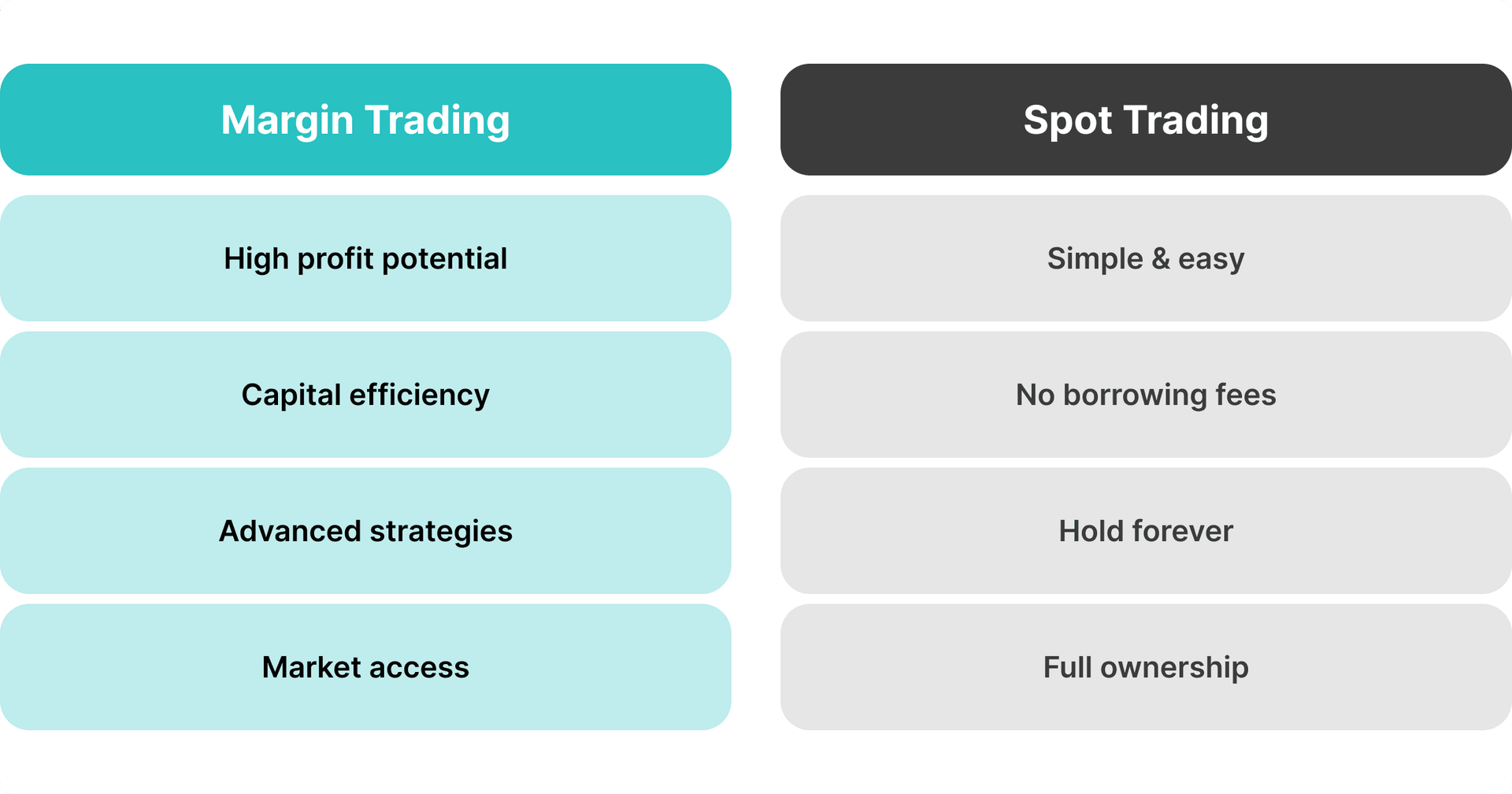
At the platform level, choosing between spot and margin trading defines how a business operates, manages risks, and generates revenue. Each model has its own capital and liquidity needs, ownership types, regulations, and infrastructure complexity. Let’s explain in more detail.
Ownership Versus Borrowing
Spot trading is built on the concept of direct asset ownership. As such, once a trade is executed, the underlying asset is transferred to the buyer in full, with no further obligations. The exchange does not assume credit exposure, and its responsibility is limited to custody and settlements.
Margin trading, on the other hand, relies on collateralized borrowing, where the buyer gains exposure to the subject asset without owning it. Instead, they borrow money to buy a contract that mimics the instrument’s value.
Trading with margin involves leverage, which imposes counterparty risk, interest accrual, and continuous margin calculations. Therefore, operators must have real-time position-tracking tools and adequate reporting to monitor collateral adequacy and balance-sheet sensitivity.
Capital and Liquidity Requirements
Spot exchanges focus on providing deep liquidity and access to order books. Thus, capital requirements are mostly tied to operational reserves, custody safeguards, and liquidity access to a range of assets.
On the other hand, margin exchanges must support leveraged notional volumes that far exceed deposited capital. Therefore, operators need sufficient lending pools, liquidity buffers, and stress-testing funding mechanisms.
While leverage amplifies trading activity and, consequently, liquidity, it also increases the risk of liquidity gaps during volatile markets, necessitating extreme scenario testing and institutional liquidity streams that support demand spikes.
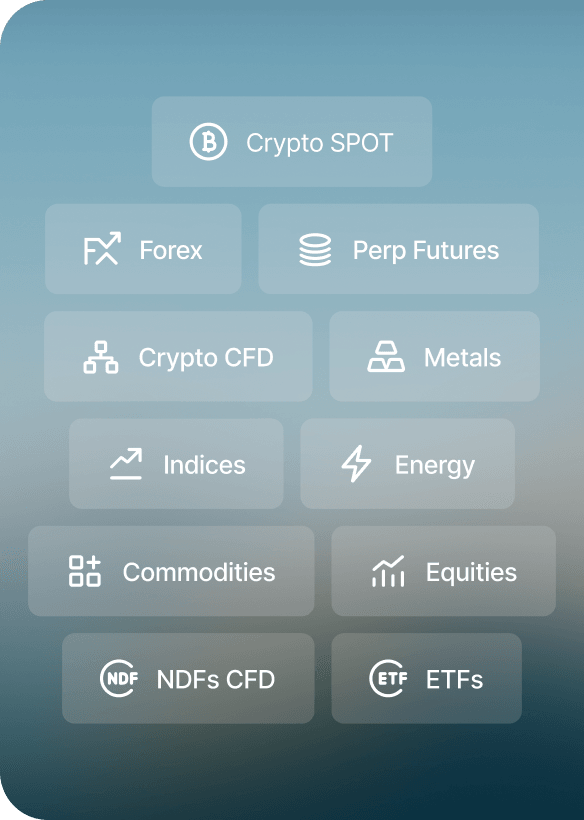
Deep, Reliable Liquidity Across 10 Major Asset Classes
FX, Crypto, Commodities, Indices & More from One Single Margin Account
Tight Spreads and Ultra-Low Latency Execution
Seamless API Integration with Your Trading Platform
Risk Management and Exposure Control
When operating in spot markets, your risk management is mostly defensive. As such, you need to minimize the impact of settlement issues, market price fluctuations, and custody security protocols. Moreover, losses are centered at the user level, without losses resulting from market exposure or additional lending.
Margin exchanges, however, must actively monitor credits, exposure risk, and volatility patterns, as client losses directly affect the platform capital or liquidity providers. Therefore, brokers must configure liquidation engines, maintenance margin thresholds, profile-based leverage limitations, and real-time exposure monitoring.
Technology and Infrastructure Complexity
Operating a spot exchange often requires robust matching engines, wallet infrastructure, liquidity back-ups, and reliable settlement systems. These systems are relatively linear, involving fewer conflicting scenarios and potential conflicts.
In contrast, margin exchanges introduce multiple layers of complexity, including collateral management, interest rate calculations, liquidation screening, and live margin validation. These intricate systems must operate with minimal latency and high precision because failure can trigger cascading liquidations or negative balances, affecting the broker’s capital.
Regulatory and Compliance Considerations
Spot trading typically involves clear asset ownership frameworks and simpler regulatory classifications, making it easier to license and operate as a spot exchange platform. Compliance focuses on custody safeguards, market abuse prevention, and transaction monitoring.
On the other hand, margin trading comes with increased regulatory scrutiny due to leverage, lending relationships, and heightened consumer protection concerns. Therefore, operators may face stricter capital requirements, enhanced disclosure obligations, and higher approval thresholds.
Revenue Models and Monetization
Most spot exchanges generate revenue through collecting fees from transactions, listings, and other financial services, such as custody or fiat/crypto exchanges and gateways. As such, revenue mostly stems from trading volume but remains relatively predictable.
Margin exchanges support additional monetization streams, including interest on borrowed funds, liquidation penalties, and funding spreads. These models can significantly increase the broker’s revenue per client, however, only if the market conditions are in the broker’s favor. Consequently, higher earnings come with higher exposure, as adverse market events can offset gains through operational or reputational damage.
Operational Responsibility During Market Stress
When markets become extremely volatile, spot exchanges generally continue operating and matching orders with limited intervention. For example, price discovery may be turbulent, but the platform’s role remains largely passive.
This is not the case for margin exchanges, which face a far more active operational burden. They must execute liquidations, manage collateral shortfalls, deploy insurance funds, and, in some cases, socialise losses. As such, decision-making under stress becomes critical in margin exchanges, as execution delays or operational failures can affect traders, liquidity providers, and the platform itself.
Client Profile and Flow Quality
Spot exchanges mostly attract retail users, beginner traders, and institutional investors seeking transparent market access. Activity patterns tend to be more predictable, with lower turnover and limited use of leverage.
On the other hand, margin exchanges attract professional, algorithmic, and latency-sensitive participants who move larger positions. While this flow increases volume and revenue potential for brokers, it also intensifies operational demands and risk exposure. These platforms have higher expectations around execution quality, uptime, and risk controls, because they attract sophisticated participants.
Spot vs Margin: Which Business Is Better?
Spot exchanges operate as transaction venues, matching buyers and sellers with simplified risk boundaries. They require clearer infrastructure, face limited balance sheet exposure, and can reach the market faster due to fewer technical and operational dependencies.
Margin exchanges, in contrast, act as risk-bearing platforms, managing leverage, lending, liquidations, and funding, which demands advanced technology, real-time monitoring, and disciplined risk controls.
From a business perspective, spot exchanges rely on volume-driven trading fees, with relatively lower operating and compliance costs that make launching quite straightforward. Margin exchanges offer additional revenue streams, such as interest, funding, and liquidation fees, but are subject to higher costs associated with capital allocation, compliance oversight, and risk management.
Ultimately, the decision is a strategic choice. Many businesses start with spot trading to establish liquidity, regulatory footing, and operational discipline, before expanding into margin trading to scale and capitalize on higher trading volumes.
Starting a Crypto Exchange with Turnkey Solutions
Turnkey crypto exchange solutions allow brokers, fintech firms, and financial institutions to enter the market quickly without building complex infrastructure from scratch.
Pre-built technology, integrated liquidity, and compliance-ready components significantly reduce time-to-market, development costs, and operational risk, so that firms can focus on growth rather than engineering.
B2BROKER provides a flexible infrastructure that supports launching spot trading, which can expand into margin trading as your business evolves. This staged approach, coupled with a fully-integrated ecosystem, institutional-grade liquidity, and rapid execution, lowers initial complexity and ensures long-term scalability.
Launch Your Exchange Efficiently with B2BROKER
Most operators suffer when making the shift from spot to margin trading. B2BROKER removes this barrier by offering scalable, ready-to-deploy turnkey solutions that you can customize to your preferences.
B2BROKER’s white-label solutions support modular exchange infrastructure, prime-of-prime liquidity, and built-in risk management to ensure you monitor client activities more granularly.
Schedule an initiation call to strategize on your platform and build your custom exchange platform with B2BROKER.
Start Your Crypto Spot or Margin Exchange in Days
Explore how our turnkey solutions speed up your market entry to capture today’s opportunities more effectively
Frequently Asked Questions about Spot vs Margin Crypto Exchanges
- Is margin trading riskier than futures trading?
Margin trading and futures trading are both leveraged products, where traders can lose more than their initial investment. Futures introduce contract-specific complexities, such as expiries, rollovers, and settlements, while margin trading centres on collateral levels, funding costs, and liquidation thresholds.
- How do risks differ between spot trading and margin trading?
Spot trading limits risk to the invested capital, as no leverage or borrowing is involved, while margin trading increases exposure through leverage, amplifying gains and losses, and introducing liquidation and funding risks.
- What is a margin call?
A margin call is a request from the broker for a trader to deposit additional funds when the collateral falls below required levels. For exchanges, it is a critical risk tolerance mechanism that helps prevent negative balances and systemic losses.