Should You Build an Exchange or Buy Turnkey Tech?

A CTO comparing the two paths in 2026 has an 18-month internal roadmap on one side and a licensed stack that can be live in weeks on the other. To build exchange with turnkey solutions is to take the second one: the matching engine, liquidity feeds, client back office, wallets and hosting arrive wired together, for your team to configure under your brand and your license.
The internal build puts each of those components back on your engineers, who design, integrate and test them before the first client trades.
The calendar that decides between the two sits outside both plans. Since July 1, 2026, no firm may serve EU clients without a MiCA authorization. A regulator's review now sets the launch date the engineering roadmap has to fit inside.
Key Takeaways
- A licensed stack replaces open-ended engineering spend with a setup fee, a monthly license and a liquidity fee tied to volume.
- Deployment breaks into configuration, integration and testing, then a licensing review that is the one stage outside your control.
- A new venue borrows its depth from outside market makers. The layer that merges their quotes belongs inside the stack, not in a separate contract.
- Regulatory readiness shapes launch feasibility as much as engine speed or liquidity depth. Its program keeps running long after the license arrives.
- Exit risk falls when the contract guarantees data ownership and migration terms, whoever the vendor is.
Why Turnkey Solutions Win in 2026
Regulators and clients now judge an exchange as financial infrastructure. That standard brings licensing, resilience testing and custody controls with it. A vendor spreads the cost of those controls across every venue on its platform. An operator running them for a single venue carries the whole bill.
Traders also expect stablecoin deposits and withdrawals on day one, and they expect that to hold through a sell-off.
Predictable Pricing Versus In-House Development Costs
Turnkey licensing converts engineering spend that no one can forecast into a fee schedule you read before signing. The schedule usually has a setup fee, a recurring license fee and a liquidity fee tied to volume, with the commissions you charge clients left yours to set.
Each component multiplies the next, taking the in-house budget with it. The matching engine needs a wallet layer, the wallet layer needs KYC and payment integrations, and every integration that slips a month adds a month of payroll for the whole team waiting on it.
Faster Time-to-Market at Institutional Scale
A turnkey deployment compresses launch from months of engineering to weeks of configuration, integration and testing, leaving the license review as the longest item on the plan. Supervisors ask to see the systems they are licensing. A stack that is already running answers that at the first meeting.
The weeks divide into phases you can put on a calendar:
- environment provisioning and branding of the web and mobile front ends
- integrations with liquidity feeds, payment providers and the KYC vendor
- quality assurance, including failover tests and a replay of a volatile session
- the regulator's review of your application and its questions about the stack
- go-live with a hypercare period
B2BROKER quotes four to eight weeks to go live for most clients, with the technical setup taking days and the rest of the time going to regulatory steps and payment-provider onboarding.
Total Cost of Ownership: Build Versus Buy
Total cost of ownership favors turnkey once the bill includes what in-house estimates leave off. Of the five lines that keep charging an internal build after launch, a licensed stack settles three.
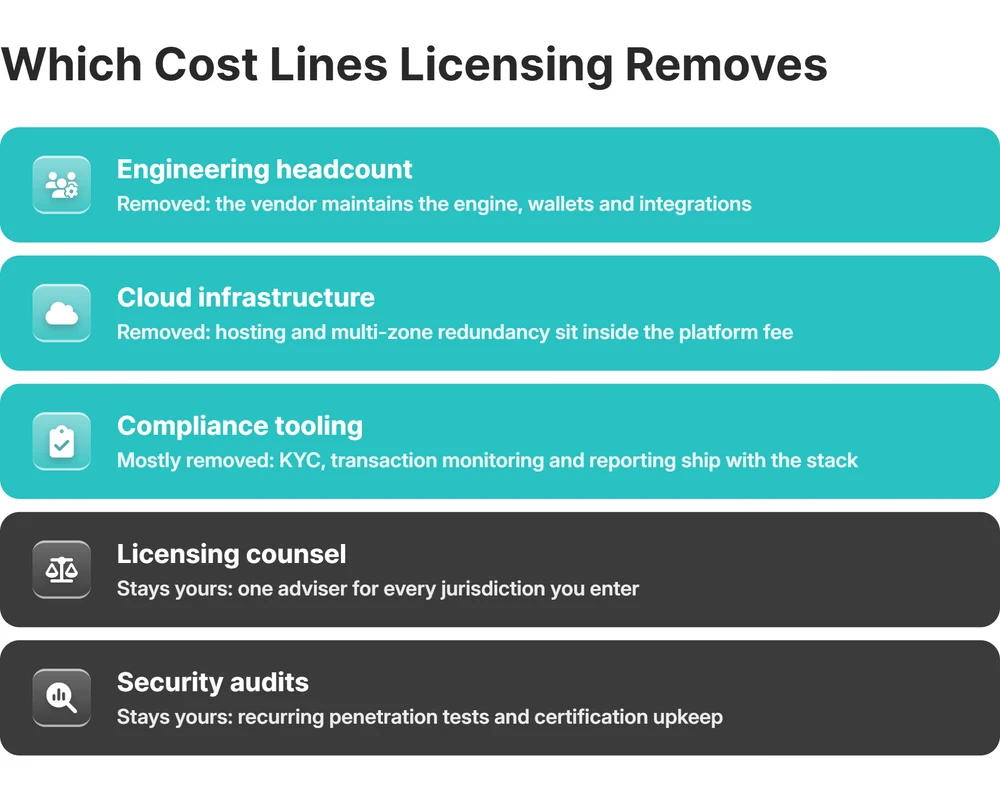
The compliance line alone is large. The FCA's cost-benefit analysis for the UK cryptoasset regime puts a trading platform's bill at £5.5 million in transition costs and £3.2 million a year afterward. That is the bill for one jurisdiction. It lands on the operator whether the platform was built or licensed.
The two lines that stay behind scale with your own footprint: every extra jurisdiction adds legal fees, and security audits come round again every year.
Core Architecture of a Turnkey Exchange
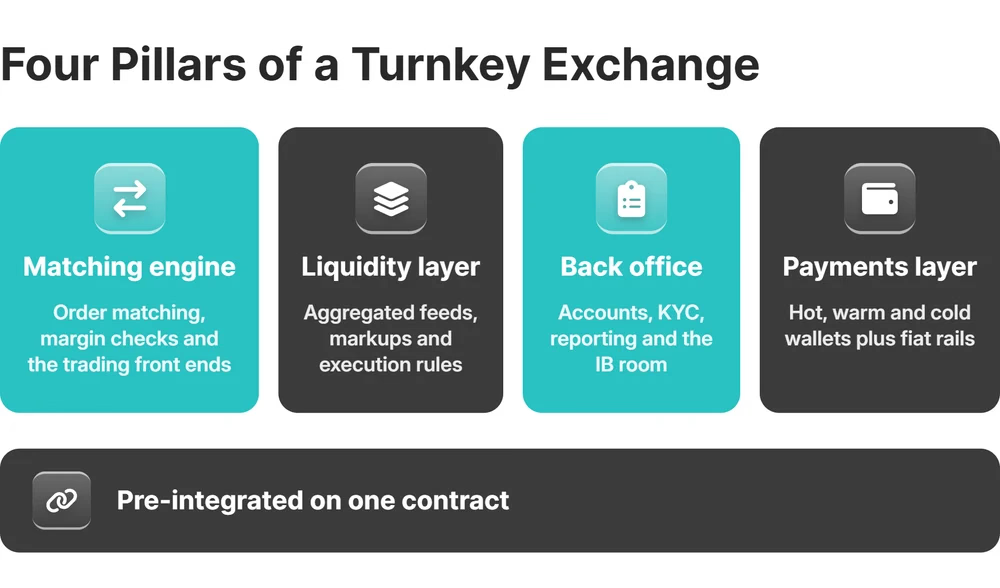
When you build exchange with turnkey solutions, four pillars ship as one package: the matching engine, the liquidity layer, the back office and the payment rails, already connected to each other.
One path carries every request: the client's funding in the back office and the execution both land in the same ledger the compliance team reports from.
B2BROKER's Crypto Exchange Turnkey follows this pattern: B2TRADER matches, Multi-Asset Liquidity and B2CONNECT feed the book, B2CORE runs accounts, KYC, wallets and reporting, and partner B2BINPAY covers crypto deposits and withdrawals. When you compare other vendors' digital asset exchange software, ask which of the four pillars are their own code.
Matching Engine and Trading Technology
The matching engine's throughput and latency under stress decide whether a venue survives its first volatile day. On October 10, 2025, more than $19 billion in leveraged positions were liquidated across crypto venues in 24 hours.
Binance's matching engine stayed up. An internal transfer subsystem degraded for half an hour under database load. Capacity has to reach every subsystem an order touches, from margin checks to internal transfers.
B2TRADER is rated at up to 3,000 requests per second. Any throughput figure describes one test setup. The order mix, cancel ratio and risk checks that were live during the run decide what the figure is worth on your own load profile.
Liquidity Aggregation as a Core Capability
The order book your clients see is only as deep as the feeds behind it. That puts liquidity aggregation inside the turnkey stack. Kaiko's July 2026 exchange report shows that BTC depth within 1% of mid-price fell 40 to 50 percent across the market during the downturn.
A new venue has none of that depth of its own. It borrows depth from market makers and centralized exchanges through a layer that merges their quotes. That layer decides what price your client trades at, which order gets rejected and what the back office reconciles at night. Adding it after launch through a separate API splits pricing, risk and reconciliation between the platform vendor, the liquidity vendor and your own team.
On the B2BROKER stack, a prime-of-prime feed for spot and perpetual futures sits in the same aggregation layer as any provider you connect over FIX, with markups and execution rules under your control.
Back-Office, KYC, and Payment Infrastructure
Every regulator asks the same three questions across back office, KYC and payment rails: which client, which funds, which trades. One system answers all three. Under the FCA's incoming CASS 17 regime, any firm safeguarding qualifying cryptoassets must keep ownership records and reconciliations and apply controls to private key management. MiCA places its own safeguarding duties on EU service providers.
When those functions come from three vendors, the record is stitched together at reporting time. In B2CORE, the client's account, KYC file and wallets sit in one system with reporting. The wallet layer arrives as wallet-as-a-service, with hot, warm and cold segregation and cross-chain reconciliation in one ledger.
Comparison at a Glance
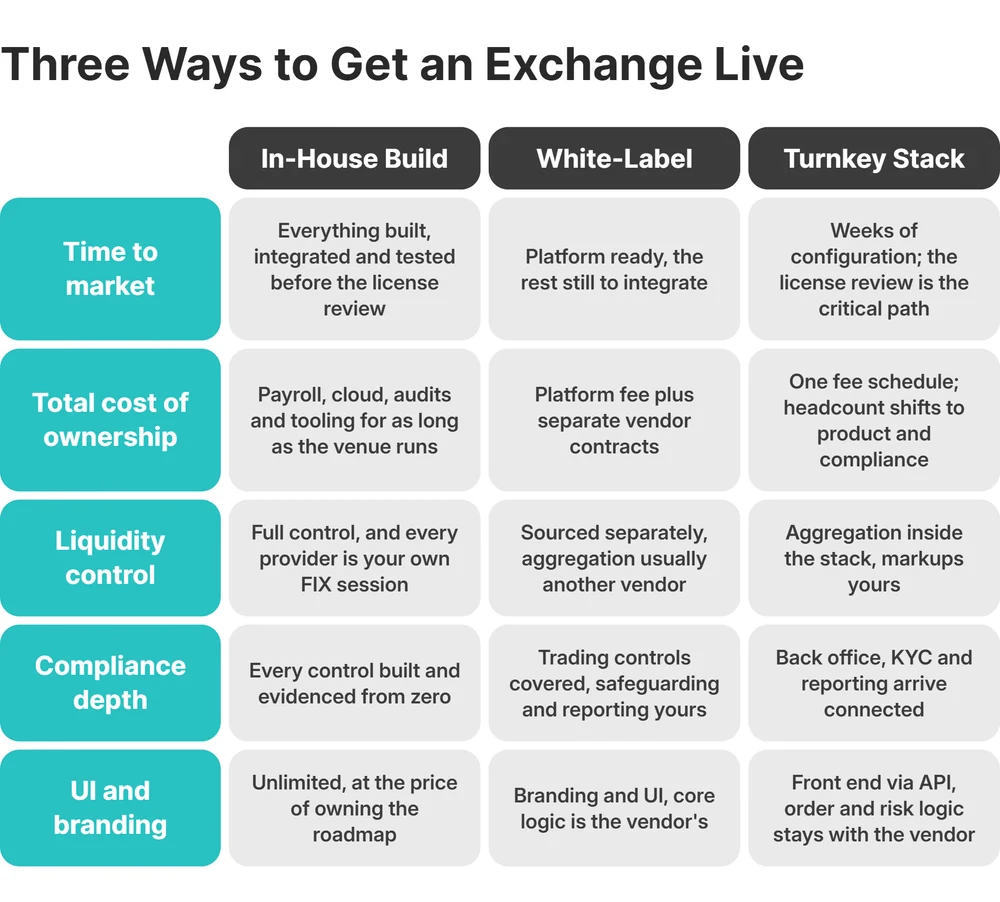
In-house, white-label and the turnkey approach differ in launch speed, cost, liquidity, compliance and front-end control.
What separates a white-label crypto exchange from a turnkey one is how many other contracts you sign: white label usually covers the branded platform alone, while turnkey brings liquidity, back office and payments under the same agreement.
Regulatory Readiness for 2026
Regulatory readiness in 2026 decides whether you may launch at all and when. Nothing about that work stops at the grant.
The Financial Stability Board's 2023 framework sets the international baseline: governance with clear lines of responsibility, risk management covering material risks, data systems that can report, and disclosures on all three. The stack you license has to produce evidence for each, in every market you enter. A venue can now read the rules it has to meet, part of what makes 2026 a workable year to start a crypto business.
The same evidence pack still meets very different scrutiny from one market to the next: the FSB's 2025 peer review found gaps in how jurisdictions regulate crypto-asset service providers, with only two covering crypto borrowing and lending in full.
MiCA and EU CASP Licensing
The grandfathering window closed on July 1, 2026. No exchange can onboard EU clients without CASP authorization from a national competent authority. ESMA expects any provider without authorization to have wound down by that date, clients' assets included.
One authorization passports across the European Economic Area, leaving the stack with a single set of safeguarding and record-keeping requirements to meet, even where national AML expectations still differ. Authorization also pulls the venue into DORA, the EU's digital operational resilience regulation, which treats crypto-asset service providers as financial entities.
Licensing Considerations Beyond Europe
Exchange licensing requirements differ sharply by jurisdiction, with several regimes mid-transition in 2026 and 2027. In the UK, the full set of regulated activities applies from October 25, 2027. Firms already operating there have between September 30, 2026, and February 28, 2027 to file for the savings provisions.
Elsewhere the split runs between regulators that fold crypto into existing financial law, as Singapore and Hong Kong do, and those that wrote a bespoke regime, as the EU and Dubai did. A stack serving two of them carries two configurations for segregation, reporting formats and the products retail clients may trade.
Six Steps to Launch Your Exchange
A turnkey project runs through six stages in a fixed order, each narrowing the choices in the next: the niche sets the licenses, the licenses set the provider shortlist, and the provider sets what the front end can do.
Define Your Business Model and Niche
Choose the niche by the liquidity depth available in each asset class and by the licenses that asset mix triggers. Spot crypto sits under MiCA in the EU. Margin trading, perpetual futures and CFDs on crypto pull in derivatives rules, different capital requirements and different liquidity sources.
Depth follows the same logic: it concentrates in BTC, ETH and the largest altcoins, leaving a venue built around long-tail tokens little to borrow and wide spreads to explain.
Evaluate Providers, Security and Liquidity Together
Provider evaluation, the security review and the liquidity check all run through the same one-on-one meetings with the vendor's team. Score each of the three against evidence the vendor can produce:
- signing controls, whether multisig or MPC: how many approvals a withdrawal needs and who can change that policy
- a written SLA naming an uptime percentage, service credits and 24/7 incident response with recovery objectives
- throughput figures reported with the order mix and risk checks that were live in the test
- the ISO 27001 scope statement and the date of the last SOC 2 Type II report
- the supported cryptocurrencies and the depth behind each, checked against the niche from step one
- which components are the vendor's own code and which are subcontracted
The signing question earns the top of that list. Chainalysis counts more than $3.4 billion stolen in 2025, $1.5 billion of it taken from Bybit in February through a compromised signing workflow, and notes that attacks on private key infrastructure now get around cold wallet controls at centralized services.
Anti-money laundering screening deserves the same treatment. Ask what the engine screens against and how quickly a flagged transaction reaches a human.
The liquidity item is the one to test live. A provider's API contract proves that quotes exist, with only a live book at your own sizes showing whether the engine prices and risk-checks against them.
Then read the contract. Under DORA, an EU venue's contract for an ICT service supporting a critical or important function must already contain service levels, audit rights and exit assistance. FG26/6, the FCA's operational resilience guidance for cryptoasset firms, expects a firm to keep every important business service inside its impact tolerance through a severe but plausible outage. Ask for the recovery path in words. A venue that cannot describe it has not tested it.
Customize the Front End, Then Plan Support
Front-end customization comes down to what the platform exposes and where the vendor draws the line on changes. On the B2BROKER stack, white-label scope covers the interface and branding across web and mobile terminals, with REST, WebSocket and FIX APIs carrying quotes, orders and positions for a front end of your own.
The order ticket logic, margin engine and risk controls stay on the vendor's side of that line. Have the contract name what you may change yourself and what waits for a vendor release.
Support terms belong in the same contract. Crypto markets have no weekend close. The SLA has to name the maintenance windows, their notice periods and the escalation path from your first-line team to the vendor's engineers. Ask how upgrades are released, whether you can defer one and who tests it against your configuration.
Vendor Lock-In and Exit Strategy
Your real exit risk is set by who owns the data and what the contract says about migration. Vendor size tells you nothing about either.
EU regulators now write both questions into law. DORA obliges a financial entity to keep an exit strategy for every ICT service supporting a critical or important function, with transition plans to move the service and its data to another provider or back in-house. Its technical standards require an exit plan per contract, reviewed and tested on a schedule. A contract without data-export rights or transition assistance leaves that plan undeliverable.
Data Ownership and Contractual Protections
The contract should state that you own client records and trade history, and how long the exit period runs. Before signing, request:
- named export formats for client, KYC, ledger and trade data
- an exit assistance clause that does not depend on the vendor's agreement at the time
- a defined transition period during which the service keeps running
- notice rights over subcontractors that hold your data
The case to build exchange with turnkey solutions comes down to how many relationships you have to manage. The matching engine, liquidity layer and back office come from one vendor. The payment leg comes from a partner already integrated with that stack. Fewer contracts leave fewer exit plans to keep current, though the payment partner's terms remain its own. Assembling point solutions gives you one exit plan per vendor and a reconciliation between every pair of them.
The vendor behind that stack deserves the same scrutiny you gave the technology. B2BROKER has been building exchange and brokerage infrastructure since 2014, has helped launch more than 500 brokers and serves over 1,000 corporate clients on that infrastructure today.
Put the exit questions to the vendor before you compare fees, and price both paths against the same launch date.
Frequently Asked Questions about Turnkey Exchange Tech
Does a turnkey exchange solution support multi-asset trading beyond cryptocurrency?
Yes. B2TRADER runs crypto spot, perpetual futures, crypto CFDs, FX, indices, metals, energies, equities and ETFs on one cross-margin account. Adding an asset class is a configuration change.
How much in-house technical staff do you still need after launching with a turnkey provider?
You no longer need an engineering team to build and maintain the exchange itself. You still need compliance, client support and a product owner who holds the configuration, the vendor relationship and your data exports.
Can a turnkey exchange platform integrate with a broker's existing CRM or trading systems?
Yes. FIX, REST and WebSocket connectivity lets an existing CRM, order management or risk system stay in place, subject to an integration check. Confirm the API depth for your specific systems during the evaluation step.
What trading volume or client base makes a turnkey exchange financially viable?
There is no single threshold: the fee schedule scales with volume and a build carries no sunk cost to recover. Model the fees against your first-year volume, keeping in mind that the gap between your client fee and the wholesale price is your margin.
Can a firm eventually transition from a turnkey exchange to proprietary in-house technology?
Yes, if the contract grants data portability and migration assistance. Confirm export formats, the transition period and the exit assistance clause before signing. Those terms decide how clean the move will be.
Recommended articles


Subscribe to our newsletter