What Are Crypto ETFs? A Product Breakdown for Brokers

Crypto exposure has moved into the ordinary brokerage account. US spot Bitcoin ETFs held about $78 billion in assets by mid-July 2026, two and a half years after the first fund listed.
Those investors expect their broker to carry the product, because they never wanted a wallet or an exchange login.
What are crypto ETFs, then, and what does it take to offer them as a product line? The short definition comes first, then the decisions that cost money.
Key Takeaways
- Spot crypto ETFs hold coins through regulated custodians; futures-based funds hold futures contracts, which adds roll costs and basis risk and changes the margining you plan for.
- Authorized participants keep an ETF's price near net asset value through creation and redemption arbitrage, and when they step back in a stressed market, clients feel the resulting premium or discount in their fills.
- Licensing follows categorization: MiCA governs crypto-asset services in the EU, assets that qualify as MiFID II financial instruments stay under securities law, and US treatment is still decided case by case.
- ETF CFDs, options, and futures each impose their own margin and settlement mechanics, which dictate part of the technology stack.
- A weak link anywhere between the liquidity feed and the client's account shows up as a rejected order or a bad fill, regardless of which layer caused it.
What Are Crypto ETFs?
A crypto ETF is an exchange-traded fund that tracks the price of one or more cryptocurrencies. A client buys it through a regular brokerage account, with no crypto wallet to secure and no exchange account to open. The position clears and settles like any other listed security.
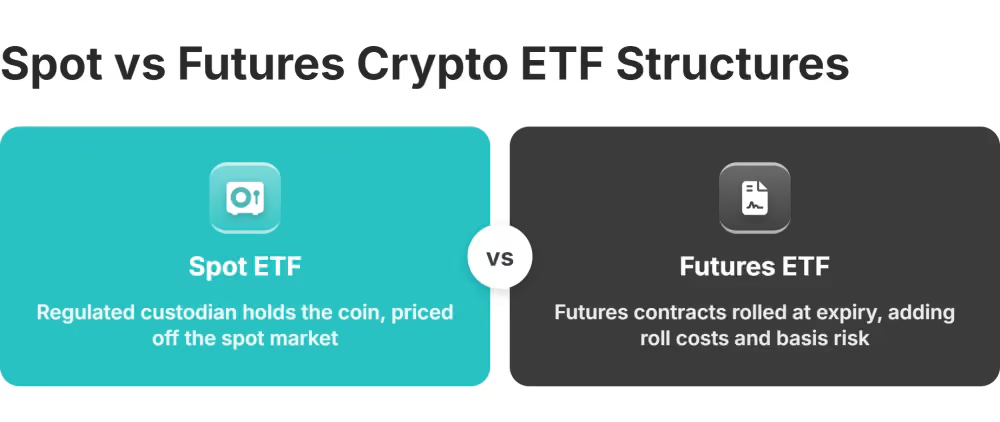
For a broker, the split between structures matters more than the definition. A spot fund holds the underlying coin through a regulated custodian and tracks the spot price directly. The coins stay on the blockchain, and the client holds a security.
A futures-based fund holds futures contracts instead. Rolling them forward at each expiry produces costs and tracking gaps that spot structures avoid. Bitcoin futures ETFs came first in the US, starting with ProShares' BITO in 2021.
Spot funds in the US are exchange-traded products (ETPs). Their shares are registered under the Securities Act, not the Investment Company Act of 1940 that governs most equity ETFs.
The structure sets the fund's custody arrangement. What you then offer clients determines your margining model and which liquidity partners can quote the instrument.
Creation, Redemption, and the Liquidity Function
An ETF's market price can drift away from the value of what the fund actually holds, its net asset value (NAV). Closing that gap is a paid job, and it belongs to authorized participants (APs), the large trading firms a fund issuer authorizes to create and redeem its shares.
When the fund trades above NAV, an AP hands the issuer the underlying assets or cash, receives newly created shares in return, and sells them into the market at the higher price. When the fund trades below NAV, the AP buys shares on the market and returns them to the issuer for the assets they represent.
Either way the AP keeps the difference between the two prices, and that arbitrage pulls the market price back toward NAV. Since the SEC allowed in-kind creations and redemptions for US spot Bitcoin and Ethereum ETFs in 2025, APs can move the coins themselves instead of cash, which removes a conversion step from every creation.
Nothing obliges APs to keep doing this. When they widen their own spreads or step back in a stressed market, the fund can trade at a premium or discount to NAV until the arbitrage resumes. Any instrument your platform prices off the fund inherits those episodes.
When you pick a liquidity partner for ETF-linked instruments, you are choosing who absorbs those swings on your side of the trade.
Why Brokerages Are Adding Crypto ETFs
Clients who once opened accounts on offshore exchanges now want the same exposure inside a regulated one. A brokerage that cannot supply it watches that flow go to a competitor. Serving it became possible only when regulators approved spot funds.
Whether the product line pays for itself comes down to licensing exposure in every market you serve and liquidity risk that peaks exactly when clients trade.
Client Demand and Revenue Potential
Exchange trading in these funds is heavily concentrated. During a single July 2026 session, $1.1 billion changed hands across the thirteen US spot Bitcoin ETFs, and BlackRock's IBIT took nearly 79% of it.
That concentration works in a broker's favor at launch. A short list of tickers, led by the largest spot Bitcoin and Ether ETFs, covers most of what clients will ask for. The first integration stays narrow, and you need quotes on only a few instruments.
Cost matters as much as brand in deciding which funds dominate. IBIT charges a 0.25% management fee against GBTC's 1.50%. That expense ratio gap explains why $27.4 billion has left the older fund since it converted from a trust into an ETF.
Advisers and wealth platforms are the buyers behind that demand, using the ETF wrapper to diversify client portfolios. The same institutional adoption of crypto is why your own clients now ask for it.
An ETF-linked product line widens the instrument list for clients you already serve, and it gives introducing brokers something to sell to investors who never wanted digital wallets or an exchange account. The revenue shows up as spread and commission on volume that would otherwise leave.
Regulatory and Licensing Exposure Across Jurisdictions
Confirm how every target market categorizes the instrument before signing with liquidity or technology partners. The classification decides which license the product needs, and the answer changes at each border.
In the EU, the Markets in Crypto-Assets Regulation (MiCA) has governed crypto-asset service providers since 30 December 2024. But a crypto-asset that qualifies as a financial instrument under MiFID II falls outside MiCA and stays under existing securities law. ETF-linked instruments generally land in that category, even though the underlying is a crypto asset.
In 2024, anyone asking what are crypto ETFs got one practical answer: Bitcoin funds. The SEC's generic listing standards adopted in September 2025 removed case-by-case approval for qualifying spot funds, and spot Litecoin, Solana, and XRP products listed within weeks.
The range of digital currencies inside these wrappers grew faster than the rules for classifying them. Regulators still judge each instrument on its own facts, so US licensing review runs case by case.
Compliance and Liquidity Risk Exposure
The broker's book carries the risk in an ETF product line before any client feels it. How the product is categorized sets which suitability disclosures you owe and which license covers it; a product classified wrongly at launch becomes a finding against that license.
Liquidity risk arrives on top of that, and it peaks with client activity. Crypto ETF spreads track the volatility of the underlying. Quotes widen exactly when volume spikes, and that is when hedging the aggregate book costs most.
Exchanges running crypto order books manage the same liquidity and compliance pressures . Brokers can borrow their answer directly. Write the hedging and disclosure rules while the product is still on paper. Then the desk has limits in place for its first stressed session.
Crypto ETF Instruments Brokers Can Offer
A brokerage can list the ETF itself, but leveraged and short exposure comes from instruments built on the fund. The practical menu holds three entries: CFDs, options, and futures on ETFs. The mix you choose shapes what your platform has to support, since each carries its own margin and settlement mechanics.
ETF CFDs
An ETF CFD gives a client leveraged long or short exposure to the fund's price without owning shares, which moves the operational work from custody to margining. The broker manages client collateral and monitors exposure in real time, and its execution model decides whether it hedges the aggregate book or passes the flow through.
A platform that pools collateral across instruments keeps that workload manageable. B2TRADER does this through cross-margin collateral management, where a client's positions draw on one margin pool instead of siloed per-instrument balances. Asset coefficients can be retuned per account group without taking the platform offline.
Its TradingView integration gives clients the charting and order entry they already know, with balances, margin, and fills syncing in real time.
ETF Options and Futures
Options and futures suit brokers whose desks already manage derivatives risk. The two differ in who has to post margin and what happens at expiry.
An option gives its buyer the right, not the obligation, to trade at a set price. The premium the buyer pays for that right is the most they can lose, while the writer who sold it keeps the premium and stays exposed until expiry or assignment.
A futures position is repriced every day, and the day's gain or loss moves as cash between the two sides. At expiry the position has to be closed, rolled, or settled.
Pick the instrument your desk can actually manage. Futures need someone covering that variation margin every session, and a book of written options carries assignment risk that needs watching.

Architecting Client Access and Liquidity Integration
Client access needs liquidity sourcing, trading platform integration, and CRM provisioning working together, the same layers that sit under a full crypto exchange build . The broker's question is where reliable pricing comes from and how a verified client gets to trade against it.
When one layer is weak, the client sees a rejected order or a fill far from the quote and blames the brokerage, because the provider behind it is invisible.
Liquidity Provider Evaluation Criteria
Evaluate a liquidity provider for ETF-linked instruments against five measurable criteria:
- Execution quality. Fill rates and slippage, measured under stressed conditions, since calm-market numbers flatter everyone.
- Coverage. The ETF underlyings and instrument types you plan to list, available from one integration.
- Spread stability. How far quotes widen during volatility spikes, checked against historical quote data.
- Latency. The time between quote and fill, because price movement inside that gap becomes your execution cost.
- API depth. FIX, REST, and WebSocket connectivity that matches the systems you already run.
Ask for the underlying data. Fill and rejection statistics from a stressed week, plus the quote history behind the spread numbers, tell you more than any sales deck.
CRM and Trading Platform Integration
The final layer connects a sourced price to a verified client. B2CORE covers the account side.
Its onboarding runs on configurable verification levels. The KYC tier can rise with a client's transaction volume, and checks route either to an external provider or to in-house manual review. The IB module calculates multi-tier commissions and runs the payouts.
B2TRADER covers the trading side, feeding sourced liquidity into live client positions under the cross-margin model, with ETFs among the asset classes already configured on the platform.
A client onboards in B2CORE and trades in B2TRADER. The two connect over API, and the back office bills commissions on the trading accounts the client uses. That connection turns a signed liquidity agreement into a product clients can trade. Before integration starts, confirm which system owns the account record and which one is the source of truth for margin balances.
Adding Crypto ETFs to Your Brokerage
In operational terms, what are crypto ETFs? They are a product line with a four-step build, where each step gates the next.
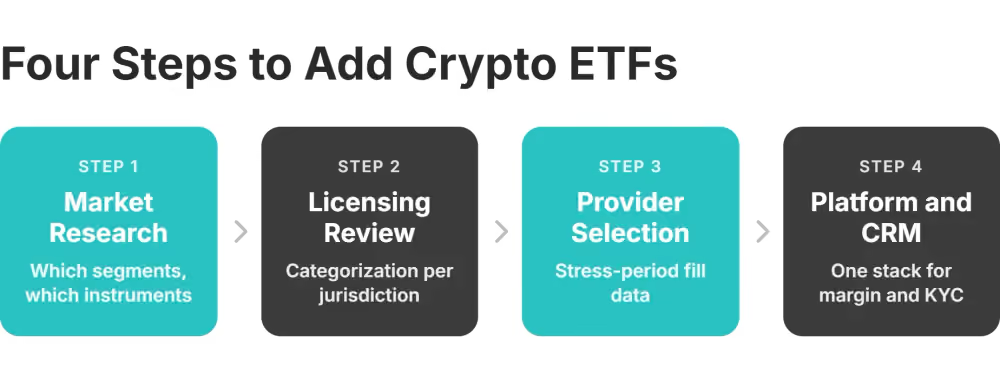
Licensing comes first for a reason. Every later step inherits that decision, and reversing it after integration means paying for the build twice.
Steps three and four are where the number of vendors matters most. B2BROKER covers the liquidity, the trading platform in B2TRADER, and the back office in B2CORE, which puts provisioning, liquidity wiring, and risk parameters into a single configuration sprint instead of three vendor schedules. It also leaves one counterparty to score against the five criteria.
Evidence usually answers the partner question. B2BROKER has operated since 2014, helped launch more than 500 brokers, and holds 10+ regulatory licenses.
If ETF-linked instruments sit on your roadmap for the next two quarters, start with the licensing review and scope the integration against the systems you already run. A call with the team that would run it is the quickest way to size both.
Frequently Asked Questions about Crypto ETFs
What is the difference between a spot crypto ETF and a crypto futures ETF?
A spot fund holds the cryptocurrency itself through a regulated custodian; a futures fund holds derivatives contracts and never touches the coin. That difference changes the margining and the liquidity partners a broker needs.
Do crypto ETFs hold actual cryptocurrency?
Only spot structures do, through regulated custodians named in the fund's prospectus. Futures-based products hold contracts, so counterparty risk sits with the clearing chain rather than a coin custodian.
What risks should brokers consider before offering crypto ETF-linked products?
Categorization risk comes first, since licensing and suitability obligations follow from how each jurisdiction classifies the instrument. Liquidity risk comes second; volatility widens spreads at the very moment the desk carries its largest exposures.
How can a brokerage add crypto ETF CFDs to its platform?
Source liquidity from a provider scored on execution quality, coverage, and spread stability, then connect that feed to the trading platform and CRM to keep margining and client onboarding in sync. B2TRADER covers the platform side and B2CORE the back office.
What licensing considerations apply when offering crypto ETFs across jurisdictions?
In the EU, MiCA governs crypto-asset services, but assets that qualify as MiFID II financial instruments stay under securities law. Because US classification is still decided case by case, the licensing review belongs at the start of the project, before vendor contracts get signed.
Recommended articles
Subscribe to our newsletter