Why Manual KYC for Forex Brokers Fails at Scale

A signup campaign lands two hundred applications over a weekend, and by Monday the funded-account queue has stalled. Each file waits for a compliance analyst to open an email, read an ID scan, and check an address by hand. Deposits sit idle while approvals lag, and some applicants give up before they ever fund.
That backlog signals a deeper problem. KYC for forex brokers runs across the entire client relationship, and manual review turns growth into a compliance liability rather than a milestone. Fenergo found that 67% of financial institutions lost clients to slow onboarding in 2024, up from 48% a year earlier.
This guide maps where manual review fails as volume climbs, how regulators in the UK, Cyprus, Australia, and the US shape the obligations, and what the build, buy, or integrate decision looks like once you treat compliance as part of the client lifecycle instead of a one-time checkpoint.
Key Takeaways
- For forex brokers, KYC covers more than onboarding. It runs through risk profiling, periodic re-verification, and monitoring for the life of the account.
- Manual review creates queue backlogs, uneven risk decisions, and thin audit trails that weaken a broker's position during a regulatory inspection.
- Because brokers serve several entities and client countries, KYC workflows have to adjust to jurisdiction-specific document rules, risk thresholds, and record retention.
- KYC sits inside a wider anti-money laundering (AML) program built to stop financial crime, so KYC checks connect to sanctions screening, PEP controls, transaction monitoring, and fraud prevention.
- Embedding KYC in a purpose-built CRM ties compliance decisions to account activation and back-office actions, which cuts integration sprawl as the brokerage grows.
What KYC Actually Requires From a Forex Broker
Broker Know Your Customer (KYC) checks start with identity and keep going from there. Under FATF Recommendation 10, you verify customer identity and any beneficial owner before opening the relationship, establish the purpose of the account, and monitor it afterward.
KYC is the customer due diligence layer, while AML is the wider control framework built to detect money laundering, terrorist financing, and other illegal activities through screening, monitoring, and reporting. The FCA, CySEC, ASIC, and FinCEN all expect both, and they judge a broker on how account activation decisions get made and recorded.
Customer Identification and Document Verification
The baseline data set is small and specific: legal name, date of birth, residential address, nationality, contact details, and a government-issued ID. Checked through identity verification against reliable documents, that data satisfies the Customer Identification Program (CIP) at the core of customer due diligence for a retail applicant.
Corporate and institutional clients raise the bar. Your firm have to identify beneficial owners, and both the FinCEN CDD Rule and FATF set the trigger at anyone holding 25% or more of the entity plus one person with control. Know Your Business checks add company registration, ownership structure, and source-of-funds context, which matters because forex brokers rarely onboard retail flows alone.
Ongoing Monitoring and Periodic Re-Verification
Approval starts the obligation rather than closing it. Re-verification triggers when a document expires, a client updates their profile, an account shows suspicious activity, a sanctions list changes, or a jurisdiction's review cycle comes due. Each event sends the file back for another look.
Monitoring connects to transaction surveillance and enhanced due diligence. Under the UK Money Laundering Regulations 2017, brokers apply EDD to politically exposed persons and their close associates, and the FCA updated its PEP guidance on 7 July 2025. High-risk countries, unusual funding patterns, and leverage that does not fit a client's stated profile all raise the same requirement.
Where Manual KYC Breaks Down at Scale
Manual KYC fails on throughput, consistency, and evidence long before it fails on regulatory compliance. Analysts can read only so many files an hour, they score risk differently from one another, and the paper trail they leave is hard to reconstruct later. Every extra manual touchpoint in the KYC process carries a cost too, because it delays a deposit, adds headcount, and pushes back the first trade that earns revenue.
Review Bottlenecks That Delay Account Activation
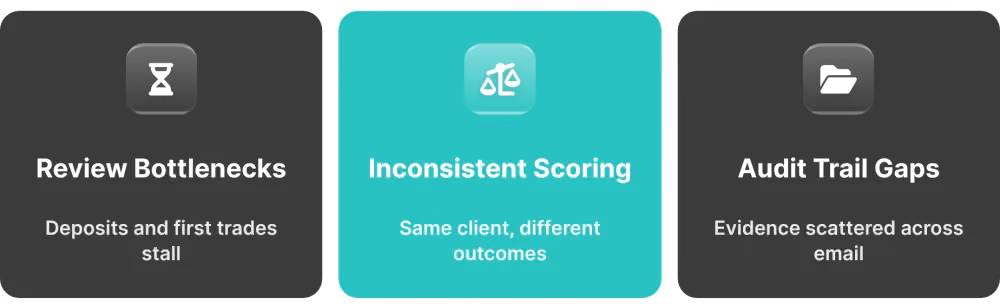
Pending reviews hold up deposits, platform access, and the first trade, and the damage peaks exactly when volume spikes during a campaign or a volatile session. A queue that clears in a day at low volume can stretch to a week when applications triple.
The failure points are concrete: unreadable document uploads, duplicate requests sent to the same client, manual language checks on foreign IDs, and handoffs between Compliance, Operations, and Support that lose time at each step. Automated verification returns a real-time decision in about 20 seconds on average, where a manual review can run from several minutes to hours.
Inconsistent Risk Scoring Across Compliance Teams
When risk assessment lives in an analyst's head, two similar clients can get different treatment. One reviewer sets an enhanced due diligence threshold high, another sets it low, and acceptance criteria drift across the team. That variance becomes a real problem when a regulator asks why two comparable applicants were handled differently and the answer sits in someone's memory.
Configurable customer risk models, mandatory fields, and rule-based escalation paths remove that variance without removing human judgment, bringing consistency to risk management. The system applies the same thresholds to everyone, and analysts still review the cases that genuinely need a person to decide.
Audit Trail Gaps That Expose Brokers During Regulatory Inspections
Inspections turn on evidence, and manual processes lose it. Undocumented overrides, approvals discussed over email, and missing timestamps create inspection risk even when the original decision was sound. FATF Recommendation 11 requires records kept for at least five years and detailed enough to reconstruct each case for investigators.
The practical standard is easy to state and hard to meet by hand: show who approved what, when, under which rule, and which documents or screening results supported the outcome. A folder of scattered emails cannot answer that under time pressure.
The Multi-Jurisdiction Problem Manual Processes Cannot Solve
Forex KYC gets complicated because of regulatory fragmentation across licenses, client domiciles, and legal entities. A broker running an FCA-regulated entity, a CySEC entity, an ASIC entity, and an offshore arm faces different triggers, templates, retention rules, legal requirements, and approval chains in each one. Parallel spreadsheets and local workarounds hold together at small scale and break as soon as volume and headcount grow.
The variation is specific. Accepted identity documents differ by country, PEP handling ranges from basic screening to a full source-of-wealth review, sanctions screening depth changes with risk appetite, and source-of-funds evidence and review frequency tighten for higher-risk segments. A process that treats every applicant the same way either over-collects from low-risk clients or under-collects from high-risk ones. These jurisdiction tiers map directly onto the white-label forex broker regulations each license carries, where accepted documents, retention periods, and reporting duties all differ.
KYC as a Client Lifecycle Function
KYC works best as a workflow that follows the client through the life of the account rather than a checkpoint cleared once at signup. Identity status should shape what happens next, from funding permissions and trading access to withdrawal checks, IB payouts, and reactivation after a dormant period. When compliance data lives in a separate verification portal, none of those downstream actions can read it without a manual export.
Lifecycle thinking changes the system design. A profile update or an expired document should trigger the next step inside the CRM automatically, so a stale record blocks a withdrawal before the money moves instead of after. Periodic reviews, event-driven re-KYC, and institutional client updates then become part of the same record the desk already uses. Making those jurisdiction-specific triggers fire inside the same record depends on CRM customization for brokerages , so the compliance rule and the workflow it gates never drift apart.
Build, Buy, or Integrate: KYC Architecture Decisions for Forex Brokerages
The architecture question comes down to four variables: how much control you keep, how fast you can deploy, how much integration work you take on, and what the system costs to run across the client lifecycle. Most brokers still need an external verification vendor for document checks and sanctions data, so the real decision is about orchestration, data ownership, and keeping the workflow in one place. On a white-label MT5 deployment, MT5 white-label compliance adds server-side reporting and audit duties that the platform license alone does not resolve.
Deploying a Standalone KYC Vendor
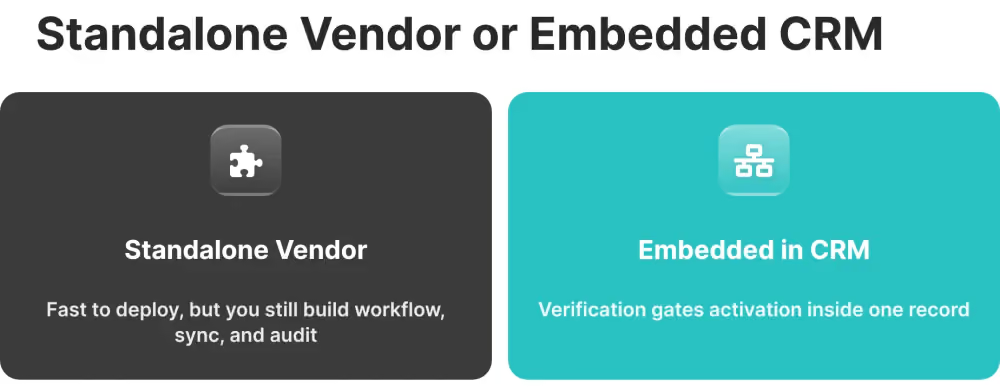
A standalone vendor gets you moving fast. Identity verification providers serving financial services such as Sumsub and ShuftiPro offer document verification, biometric authentication, digital identity checks, and sanctions screening across most countries, and they return automated results in seconds. For a broker that needs verification live this quarter, that speed is worth a lot.
The cost shows up in everything the vendor does not do. You still build the workflow logic, sync verification status back to accounts, handle exceptions, store the audit evidence, and write the rules that gate account activation. Each of those lives in another system, and each integration becomes one more thing to maintain when a jurisdiction changes its KYC requirements.
Embedding KYC Within a Purpose-Built Brokerage CRM
A brokerage CRM built for this work keeps onboarding, verification states, approvals, trading accounts, payments, and client communication on one operational record. Because the data already sits together, a KYC decision can gate account activation directly instead of waiting for a nightly sync between separate tools.
This is the class of solution a platform like B2CORE represents. It integrates third-party verification checks while it governs entitlements, alerts, and retention, and it keeps the downstream brokerage workflow in the environment the operations team already runs.
Invalid YouTube videoId: B2oGBF10dQ
How B2CORE Operationalizes KYC Within the Full Client Lifecycle
B2CORE acts as the control layer that connects onboarding, KYC status, trading account creation, payments, and IB operations inside one brokerage CRM. A generic CRM misses the brokerage-specific context that makes this work: native API connections to trading platforms like MetaTrader 4 and 5, cTrader, and B2TRADER , integrated payment gateways, role-based permissions for compliance and support, and the workflows a desk runs every day.
In practice, that means concrete steps instead of a feature list. B2CORE can request missing KYC documents automatically, hold account activation behind an approval gate, fire re-KYC alerts when a document expires or a review falls due, and write every action to a central audit log that answers the who, when, and under-which-rule question an inspector will ask. The same B2CORE back office record carries a client from first application through funding and ongoing review.
Scale Your Brokerage Without Scaling Your Compliance Headcount
Scalable KYC comes from workflow design and system integration. Adding reviewers to broken KYC procedures raises cost without lifting the throughput ceiling, so the fix has to change the workflow itself. A broker that automates document intake, standardizes risk scoring, strengthens AML compliance, and keeps a single audit trail can take on more volume without a matching rise in compliance headcount, and the same setup holds up better when a regulator asks how a decision was reached.
B2BROKER has built brokerage technology and back-office infrastructure since 2014. Its platform serves more than 1,000 corporate and institutional clients and operates under regulatory licenses across several jurisdictions. That operating history shaped how its compliance tooling handles the KYC work forex trading brokers face day to day.
If manual KYC is capping how fast you can onboard funded clients, the constraint is architectural. A brokerage CRM that embeds verification, approval, and monitoring in one place turns KYC compliance from a bottleneck into part of the activation path.
Frequently Asked Questions about KYC for Forex Brokers
Does forex require KYC?
Regulated forex brokers must verify client identity before opening accounts and activating them, because KYC sits inside the broker's wider AML and CFT framework. The exact obligation varies by license, client domicile, and entity structure, which is why multi-jurisdiction brokers need configurable onboarding rules.
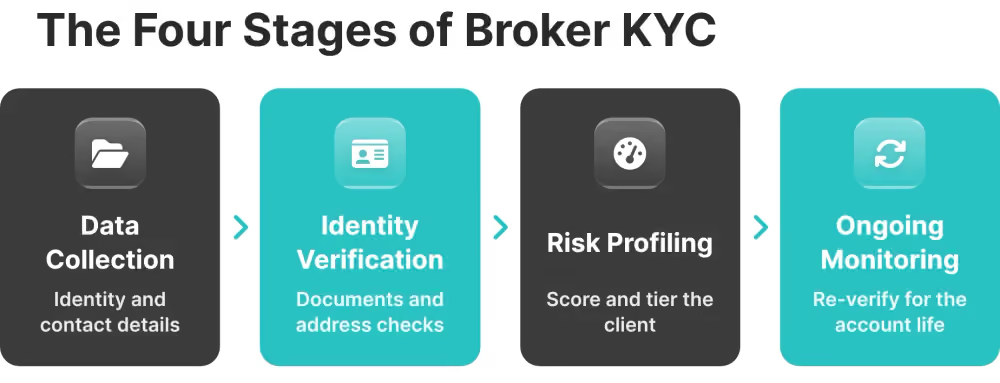
What are the four steps of KYC for forex brokers?
Customer data collection, identity and address verification, risk profiling, and ongoing monitoring after onboarding. That last stage often generates more work than initial approval, through periodic review, sanctions rescreening, and event-driven re-verification.
What documents are required for forex KYC verification?
Most brokers collect full legal name, date of birth, residential address, contact details, and a government-issued photo ID. Higher-risk cases add proof of identity, proof of address, and source-of-funds or source-of-wealth evidence.
What is the difference between KYC and AML in forex?
KYC is the customer due diligence layer, while AML is the broader framework covering screening, monitoring, investigations, and reporting. In a brokerage they should run as one system, linking onboarding to sanctions checks, PEP screening, and post-trade surveillance.
Should forex brokers build KYC in-house or use a CRM with embedded workflows?
Building in-house offers control but usually adds implementation time, vendor orchestration, audit burden, and cross-jurisdiction maintenance. A platform such as B2CORE can lower that overhead by centralizing document workflows, status tracking, and third-party KYC integrations.
Recommended articles

Subscribe to our newsletter