How Brokers Evaluate Institutional Liquidity Providers

Institutional liquidity providers are core to the broker’s execution flow. They directly influence pricing, execution consistency, and risk exposure. Most platforms consider only the commission and depth of their trading partner, but there’s a whole layer of client retention, long-term profitability, future scalability, and branding when it comes to finding the best liquidity provider.
Liquidity quality is crucial for institutional and high-volume traders, as it determines the platform’s stability during peak market conditions and unexpected price shifts. In contrast, subpar streams lead to slippage spikes, trade rejections, client disputes, and regulatory risks.
This guide explains how brokers evaluate institutional liquidity providers and how to evaluate LPs based on integration considerations, risk management principles, and accessibility.
Key Takeaways
- Institutional liquidity providers impact execution quality, spreads, and broker credibility.
- Brokers must evaluate the LP’s stability during volatility, integration complexities, and long-term scaling considerations.
- Aggregation and prime-of-prime models make institutional liquidity accessible without hefty capital requirements.
Discover the Tools That Power 500+ Brokerages
Explore our complete ecosystem — from liquidity to CRM to trading infrastructure.
What Do Institutional Liquidity Providers Offer Brokers?
Institutional liquidity providers are entities that supply prices, market depth, and settlement capabilities to brokers for order execution. Unlike retail-focused providers, institutional LPs deliver aggregated order flow, tight spreads, and stable pricing that support high-volume traders during tense market conditions.
As such, they do more than merely quote prices. Institutional partners enable brokers to internalize or hedge flow efficiently, manage exposure in real time, and offer end-users consistent execution across different market conditions.
Brokers partner with institutional liquidity providers to access deep order books, ensure predictable fill rates, and get enterprise-grade reporting capabilities.
Institutional LPs can be classified into three main categories:
- Tier-1 Banks: Offering direct market access but requiring significant capital, credit lines, and operational infrastructure.
- Non-bank Market Makers: Providing competitive pricing and flexibility, but must be evaluated against balance sheet strength.
- Prime-of-Prime Liquidity Providers: Aggregate prices from multiple liquidity pools and give enterprise-grade access to smaller brokers.
FIX connections, liquidity bridges, and aggregation hubs are common ways for brokers to interact with institutional providers, without having to engage in direct bilateral agreements.
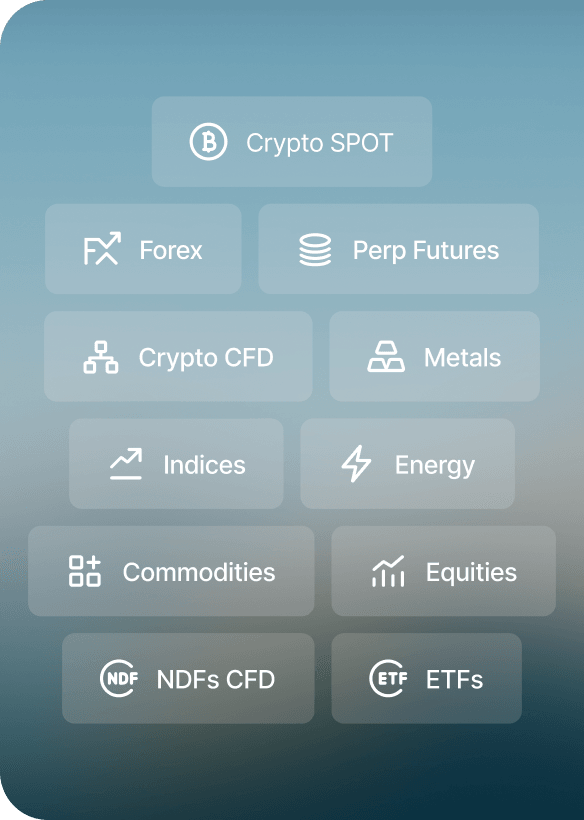
Deep, Reliable Liquidity Across 10 Major Asset Classes
FX, Crypto, Commodities, Indices & More from One Single Margin Account
Tight Spreads and Ultra-Low Latency Execution
Seamless API Integration with Your Trading Platform
Why Liquidity Quality Matters for Broker Performance?
It stems from the definition of liquidity—the ease with which brokers can execute orders, settle positions in the market price, and find matching orders. As such, the quality directly impacts spreads, slippage, rejection rates, and client trust.
Therefore, even the smallest execution inconsistency can compound into significant financial costs at scale, especially in competitive financial markets, where execution quality becomes the deciding factor in client retention and trading volume.
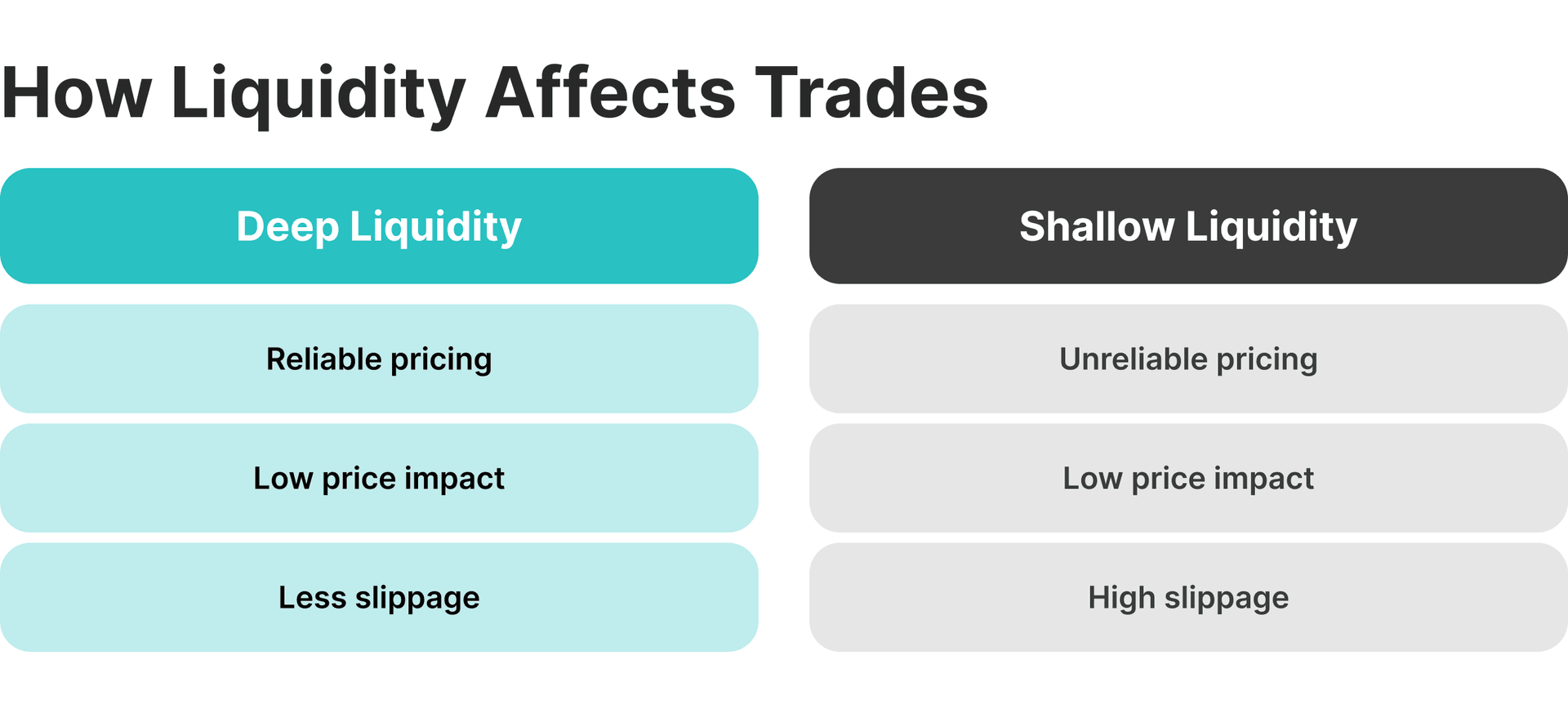
Getting high-quality liquidity is crucial for brokers to offer tight spreads without exposing themselves to unmanaged risk. It enables brokers to support smooth execution and reduce negative slippage during peak trading hours.
Conversely, poor liquidity leads to wider spreads, increased requotes, and execution delays, making the provider’s behaviour especially important during volatile markets, where news events, sudden price action, and trading volumes change frequently.
Moreover, unreliable streams increase exposure to complaints, disputes, and supervisory scrutiny, as regulators increasingly expect brokers to ensure execution quality stays within standards, is fully transparent, and is monitored.
Core Criteria Brokers Use to Evaluate Institutional Liquidity Providers
Brokers must evaluate institutional liquidity providers using a structured framework that assesses strategic fit, future scalability, and behavior during stress market conditions—not only first-time price investment.
Regulation, Licensing, and Institutional Credibility
Legal status is the baseline requirement for any institutional relationship. Brokers must verify licenses, operating jurisdictions, and regulatory history to ensure alignment with their own compliance obligations.
Providers must be able to supply documentation and audit trails for activities involved in execution and settlement. Institutional credibility means reputation and longevity. Therefore, working with regulated liquidity providers leaves a positive mark on your business, attracting new clients and partners to engage with you.
Liquidity Depth and Execution Behavior
When partnering with an institutional provider, brokers must assess real depth using executable order book data, historical fill rates, and spread behavior under stress.
Top-of-book pricing alone is insufficient. What matters is how much volume is available across multiple price levels and how execution behaves as order size increases or market changes.
Similar to trading portfolio diversification, relying on multiple sources reduces execution risk by preventing reliance on a single counterparty. Additionally, aggregation improves resilience by maintaining pricing continuity even when individual sources pull back, ensuring much more stable prices and execution performance.
Pricing Models and Cost Transparency
Institutional liquidity providers typically offer pricing through raw spread plus commission models, markup structures, or volume-tiered pricing. Each approach affects broker margins, client pricing, and risk exposure differently.
- Raw pricing provides transparency and flexibility but requires careful margin management.
- Markup models simplify pricing but can obscure true execution costs.
- Volume-tiered structures reward growth but must be aligned with realistic trading projections.
Trading conditions that change frequently and prices that fluctuate with every volatility introduce operational risk and complicate client communication. Therefore, brokers favor predictable, transparent pricing that aligns with their business model rather than the lowest headline cost.
Technology Integration and Infrastructure Compatibility
The tech stack is a primary determinant of scalability and operational stability, and brokers must ensure complete synergy between systems. FIX connectivity, platform bridges, latency performance, uptime guarantees, and disaster recovery capabilities must be carefully evaluated when assessing a prospect LP.
Key areas to evaluate include test environments, sandbox access, existing trading platforms, risk systems, reporting tools, and technical documentation. Providers must offer integration support and be prepared to troubleshoot issues efficiently.
Looking for Platform Tech Evaluation?
Assess your infrastructure readiness before integrating with a liquidity provider
Post-Trade Operations and Ongoing Support
Post-trade services affect operational efficiency and risk management. Brokers must assess reporting quality, reconciliation processes, dispute resolution mechanisms, and support availability.
Additionally, responsiveness during market stress is critical. Providers must offer clear escalation paths and be capable of resolving execution issues quickly and transparently. Weak post-trade support can turn minor execution issues into client-facing problems.
Risk Management and Compliance Capabilities
Finally, institutional liquidity providers must be evaluated not only on pricing and depth, but on how risk management and compliance are embedded into execution workflows. As such, risk controls must operate at the same speed as order routing and execution.
Effective providers support real-time exposure monitoring, deterministic execution behavior, and automated safeguards. These capabilities help prevent losses from escalating during volatile or abnormal market conditions and support regulatory compliance.
Tier-1 Liquidity vs. Aggregation and Prime-of-Prime Models
Direct tier-1 liquidity access means maximum control and depth. However, it also comes with substantial capital requirements, credit relationships, and operational infrastructure, making it impractical for many brokers to keep up with this high complexity and the minimum deposits needed.
Aggregation and prime-of-prime models provide a suitable alternative. They pool liquidity from multiple tier-1 and non-bank sources and offer them in an institutional-grade execution. This way, they reduce capital requirements without direct partnerships, while maintaining depth, resilience, and reliable execution standards.
B2BROKER offers one of the most reliable execution models, leveraging aggregated PoP liquidity from tier-1 financial institutions. B2BROKER’s multi-asset coverage comes with world-class matching engines, 10 asset classes of liquidity, and advanced risk management tools — all through a single margin account.
Key Steps to Integrating an Institutional Liquidity Provider
Integrating with a top-tier institution liquidity provider requires careful planning and execution. The following roadmap provides guidance on finding the best alternative, evaluating their offerings, and achieving business longevity.
Assess Infrastructure and Connectivity Readiness
Firstly, brokers need to evaluate the server capacity, network latency, and redundancy systems, making sure the provider’s infrastructure supports high-volume and algorithmic trading during increased market activity.
You must also consider geographic proximity to trading hubs as a key factor in determining execution speed. Infrastructure readiness should be validated before integration to avoid performance setbacks later.
Select the Right Connectivity Method
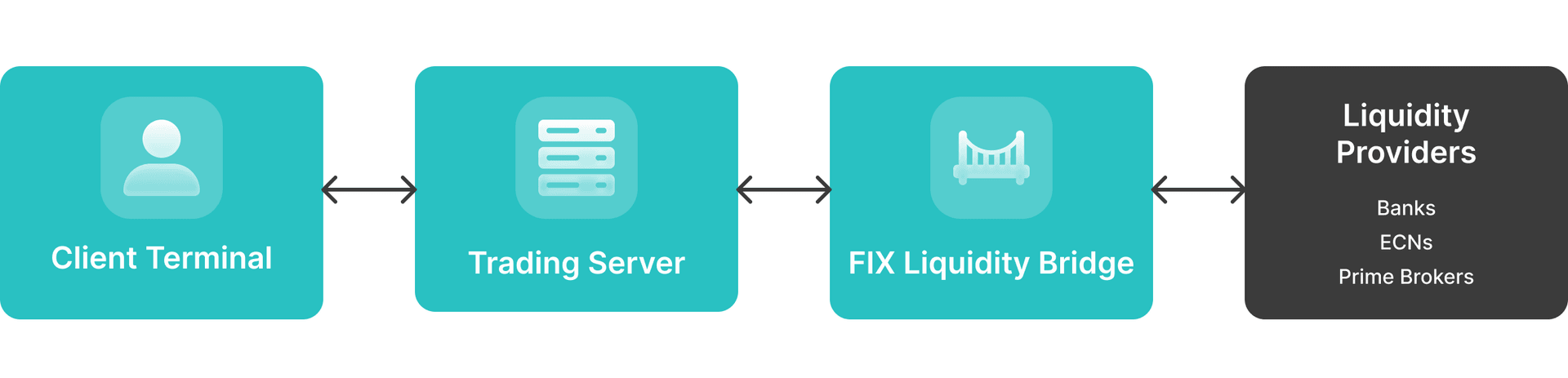
Connectivity options include direct FIX, platform bridges, APIs, and turnkey solutions. The optimal choice depends on your brokerage size, technical capabilities, and operating models.
Smaller brokers often prefer turnkey solutions to simplify integration and platform setup, while larger trading firms and hedge funds may opt for direct connectivity to ensure rapid, low-latency execution.
Configure Risk Controls and Routing Logic
Risk management is critical for liquidity infrastructure; they safeguard your platform during unexpected exposure, inconsistent flow, or increased margin risk.
As such, risk controls must be aligned with liquidity behavior, client profiles, and market conditions. This includes exposure limits, margin rules, stop-out logic, and routing preferences. Proper configuration prevents execution risk from causing substantial financial losses.
Test Execution Quality Before Going Live
Before going live, you need to evaluate your infrastructure, validating network latency, slippage rates, fill patterns, and failover systems.
Besides testing in controlled environments, you must stress-test your platform under real market conditions, including high volatility and low liquidity.
Get Institutional-Grade Liquidity
Access liquidity on 10 asset classes with pre-integrated risk controls, superior matching engines, rapid connectivity models, and more
Expanding into Multi-Asset and Crypto Liquidity Solutions
With the growing market demand, institutional brokers are increasingly looking to access both traditional FX and digital asset liquidity within a single, unified operational framework. This makes multi-asset capability no longer optional; it is driven by client diversification demand, cross-asset trading strategies, and the need to stay competitive in a rapidly evolving market.
However, expanding into cryptocurrency goes beyond securing tight pricing. Brokers must assess institutional-grade custody models, regulatory exposure across jurisdictions, and how well crypto liquidity integrates with existing trading infrastructure, risk management, and reporting systems.
Choosing the right liquidity provider, therefore, becomes a strategic decision that impacts compliance, scalability, and business resilience.
Multi-Asset Aggregation Options
Multi-asset aggregation enables brokers to source Forex, crypto, equities, commodities, and CFDs through a single liquidity connector, without having to manage multiple vendors independently.
It is easier to deal with unified pricing formats, order routing, execution logic across diverse asset classes—ultimately simplifying margining, exposure management, and reporting practices.
This centralized ecosystem reduces operational complexity while allowing brokers to scale product offerings without fragmenting their infrastructure.
Crypto Liquidity Provider Evaluation Criteria
Crypto liquidity has evaluation criteria that differ slightly from those applied to traditional FX providers. Brokers must assess exchange connectivity, depth across major spot and derivatives venues, stablecoin pair availability, and execution consistency during extreme volatility.
Key factors to oversee when selecting a crypto liquidity provider include spread stability during rapid market moves, liquidity withdrawal risk, and the ability to maintain predictable execution under stressed market conditions.
Bridging Traditional FX with Digital Assets
Brokers can offer FX and crypto execution without duplicating infrastructure by working with liquidity providers that support unified platforms, consistent pricing logic, and shared risk controls.
Solutions supporting MT5, proprietary platforms, or API-based systems allow both asset classes to be delivered through a single liquidity relationship, enabling centralized execution, margin management, and exposure monitoring across traditional and digital markets.
How Brokers Move Forward with the Right Liquidity Partner
Structured provider evaluation enables you to scale without compromising execution quality and grow without hefty investment requirements. The process begins with defining brokerage objectives, shortlisting alternatives, testing integrations, and continuously monitoring performance.
B2BROKER’s is a globally recognized single-integration partner for 500+ brokers around the world, supporting institutional-grade liquidity, an advanced tech stack, and powerful risk management systems—all through one framework that simplifies your brokerage operations and keeps you competitive.
Frequently Asked Questions about Liquidity Provision
- What makes an institutional liquidity provider different from a retail source?
Institutional liquidity providers offer deeper market depth, tighter and more stable spreads, and more predictable execution, especially during volatile conditions. They also provide professional-grade technology, reporting, and risk controls designed to support regulated brokers at scale.
- How do brokers test liquidity quality before committing to a provider?
Brokers typically run parallel testing in demo or limited-production environments to evaluate spreads, slippage, fill rates, and latency across different market conditions. Special attention is paid to execution behavior during news events, low-liquidity hours, and large order sizes.
- Why is risk management considered part of liquidity evaluation?
Liquidity directly affects exposure, slippage, and execution risk, so risk controls must be embedded into the execution layer itself. Brokers assess whether providers support real-time exposure monitoring, deterministic execution behavior, and automated safeguards that prevent losses from escalating.
- Can smaller brokers access institutional liquidity without tier-1 capital requirements?
Yes. Prime brokers and aggregation models allow smaller and mid-sized brokers to access institutional liquidity through pooled relationships and shared infrastructure. These models reduce minimum deposits while still providing access to deep order books and professional execution.