7 Reasons Modern Brokers Need More Than One Trading Platform


In February 2024, MetaQuotes revoked MT4/MT5 licenses from dozens of prop firms without warning. Within nine months, 80 to 100 of them shut down. The firms that survived had one thing in common: they already ran a second platform.
Single-platform dependency is a compounding risk. This guide covers seven reasons why modern brokers need more than one trading platform, the operational risks that build up the longer you stay on one stack, and a practical integration model that keeps complexity under control.
Key Takeaways
- Multi-platform architecture lets brokers serve retail brokerage account holders and institutional desks on their own terms, preserving lifetime value instead of eroding it through product compromises.
- Execution quality varies meaningfully by venue; routing flexibility lets brokers optimize fills and reduce the hidden cost of suboptimal pricing.
- Regulatory ring-fencing is cleaner at the platform level, creating distinct audit trails for retail and institutional flows that regulators increasingly expect.
- Platform redundancy protects revenue continuity: a single-platform broker can freeze all trading during an outage, but a distributed architecture keeps clients active when one system fails.
- Vendor diversification improves negotiating leverage and accelerates go-to-market for new asset classes. It also reduces the long-term cost of technology lock-in.
Why One Trading Platform No Longer Meets Broker Demands
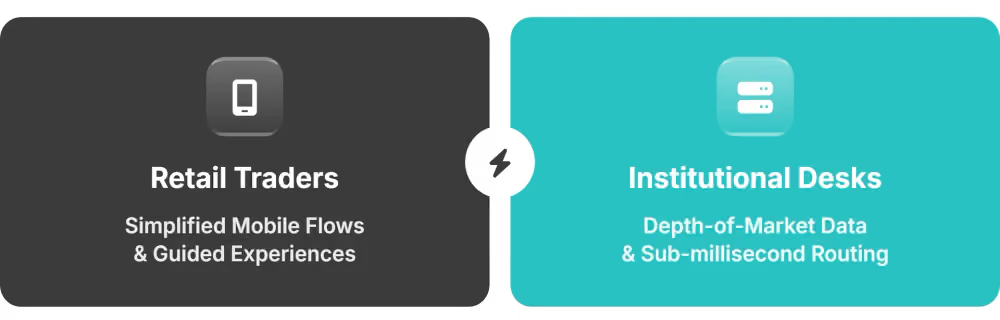
Client expectations have fragmented. Retail traders on mobile need simplified flows, while institutional desks running algorithmic strategies need depth-of-market data and sub-millisecond routing. Serving both from one platform forces product compromises that erode the experience on each end.
Even if you could solve the UX problem with a single platform, regulation adds a new layer of strain. The FCA and CySEC impose different leverage caps and fund segregation rules for retail versus institutional flows. Running both through a single system is technically possible, but operationally fragile during audits.
Beyond compliance, the numbers on execution quality make the case even harder to ignore. A 2025 study published in the Journal of Finance sent 85,000 identical market orders through six accounts at multiple brokers simultaneously.
The researchers found round-trip execution costs ranging from 0.07% to 0.46% across accounts, a gap the authors called "astonishing." Scaled to the $28 trillion in annual retail trading volume across those brokers, every single basis point of execution difference represents $2.8 billion in annual costs to clients. A brokerage running one venue has no way to benchmark against those numbers. Adding a second platform creates the visibility needed to identify where high-quality execution is leaking.
Seven Business Drivers for Adopting Multiple Trading Platforms
Brokerages of any size can run multiple platforms today. The architecture lets a growing firm serve more clients better, protect revenue, and cut compliance exposure at the same time. Each driver below ties to a measurable operational or financial outcome.
1. Broader Asset Coverage and Revenue Diversification
A single platform cannot handle FX, crypto, equities, ETFs, and derivatives with equal depth. Each of these different asset classes has its own matching logic and liquidity sources, operating under its own regulatory constraints. The range of financial products a brokerage can offer depends directly on its platform architecture.
Regional demand patterns make this concrete. Two markets, two completely different product mixes:
- Europe: 43% of global CFD trading volume, 19 million active retail traders in 2024.
- Southeast Asia: Vietnam at 21% crypto ownership (three times the global average), Indonesia ranking third globally with $157.1 billion in crypto value received in 2024.
These numbers describe two fundamentally different demand profiles. A broker serving both regions on one platform is forcing a CFD-first stack onto a cryptocurrencies-first audience, or vice versa. Matching specialized platforms to each market captures flow that a single-stack architecture would miss entirely. Each new instrument vertical improves allocation across your client base and raises wallet share per client at a fraction of the acquisition cost.
2. Segmented Client Experiences for Higher Lifetime Value
Mobile-first platforms and mobile app experiences drive retail acquisition, especially among beginners opening their first brokerage account. Advanced desktop environments retain experienced traders who need deep order books, margin account support, and API access for algorithmic execution. Forcing both segments onto one interface weakens acquisition on one end and retention on the other.
Platform segmentation solves this architecturally. Today, most new CFD accounts globally are opened via smartphone, which means the retail stack must be mobile-native from day one. The professional stack must deliver functionality and depth that justifies higher commissions. Running both on separate multi-asset platforms expands your addressable market without forcing either segment into a UX compromise.
3. Execution Quality Through Venue Arbitrage
With so many venues available, manual order routing at scale is impossible today. Smart order routing (SOR) algorithms scan all connected venues in real time and split each order to capture the best available fill.
The price improvement is measurable. According to Greenwich Associates , SOR users achieve an average gain of 9 basis points compared to non-users. On high-volume flow, that gap compounds fast. For brokerage firms routing across multiple brokers and venues, even a few basis points translate into a significant P&L impact.
Beyond price improvement, running multiple platforms gives you a built-in benchmark. Compare fills side by side and you will identify underperforming venues within days.
4. Redundancy Against Platform Outages
Platform outages hit hardest when financial markets are moving fastest. On August 5, 2024, during a sharp stock market sell-off driven by market volatility, Charles Schwab, Fidelity, and Vanguard all experienced login failures. The Dow dropped over 1,000 points. Downdetector logged 15,000+ Schwab users unable to access their brokerage accounts. Clients who wanted to buy the dip or cut positions had no way in.
Three months later, a cooling system failure at CME Group's CyrusOne data center halted Globex for nearly 11 hours. Futures and options across FX, commodities, and equity indices froze. CyrusOne later confirmed the root cause was human error: staff failed to drain cooling towers before freezing temperatures. CME processes over 26 million contracts daily, with roughly $1 trillion in notional value through E-mini S&P and Nasdaq alone.
Distributed platform architecture converts a total outage into a partial one. When the primary system goes down during a volatility spike, secondary platforms keep client access and order flow alive. For brokers building failover into their trading systems, the question is how much revenue a single-platform outage would cost during a peak session in global markets.
5. Regulatory Ring-Fencing of Trading Flows
The FCA, CySEC, and ASIC each set their own rules for retail and institutional flows. Leverage limits diverge. Fund segregation rules differ. Conduct standards vary by jurisdiction. One platform trying to satisfy every regime at once creates a single compliance failure point.
Platform-level ring-fencing solves this structurally. When retail client flows run through one platform and institutional flows through another, audit trails separate naturally. Compliance teams can demonstrate regulatory separation because the data never mixes in the first place.
Data separation is only part of the picture. Regulators have also started targeting how retail platforms influence user behavior. Separate platforms let you set different UX standards for each regulatory regime and avoid cross-contamination of compliance obligations.

6. Faster Go-To-Market for Emerging Asset Classes
A brokerage dependent on one vendor's roadmap is constrained by that vendor's priorities and release schedule. Meanwhile, the different markets clients want access to are scaling fast. Interest rates on tokenized treasury products, perpetual swaps on cryptocurrencies, and prediction markets all have real client demand.
Multi-platform architecture provides optionality. Plug in a specialized platform for a new asset class and the rest of your stack keeps running unchanged.
7. Negotiation Leverage Over Technology Vendors
Single-vendor dependency means a vendor that knows you cannot migrate has little incentive to sharpen pricing or accelerate feature requests. The most vivid recent example played out in February 2024.
MetaQuotes revoked MT4/MT5 licenses from True Forex Funds without warning. Within weeks, the company pulled access from dozens of additional firms. Brokers like Blackbull Markets were forced to immediately drop their prop firm clients or risk losing their own MetaTrader license. Between February 2024 and late 2025, an estimated 80 to 100 prop firms ceased operations . MetaTrader's market share among prop firms dropped from 48% to 24% within nine months.
Running multiple platforms in parallel means you negotiate from operational independence, and vendors who know you can shift volume elsewhere tend to offer better terms.
Hidden Operational Risks of Staying Single-Platform
The seven drivers above build the business case for multi-platform architecture. Less visible are the compounding risks that accumulate when a brokerage stays on a single platform over time. Each risk below feeds into the next.
Concentration risk: All client flow routes through one failure point. When that platform has an incident, no alternative exists, and the revenue impact scales with the length of the outage.
Vendor lock-in: As integrations deepen (CRM connections, liquidity bridges, compliance reporting, and client data), the cost of switching compounds. Vendors price accordingly.
Feature stagnation: The brokerage's product roadmap becomes bound to one vendor's development schedule. If a competitor deploys a capability faster through a specialized platform, your response time is limited by your vendor's priorities.
Pricing opacity: Execution costs stay hidden when there is only one venue. Brokers often discover they have been overpaying only after a client runs a comparison elsewhere.
Compliance fragility: One platform architecture must satisfy all regulatory regimes simultaneously, or exceptions must be managed manually. As jurisdiction count increases, this fragility compounds.
These risks never show up as line items on a P&L. They compound quietly until a vendor dispute or a regulatory finding forces a reactive migration far more disruptive than proactive diversification would have been.
Integration Models That Keep Vendor Sprawl Under Control
The legitimate concern with multi-asset , multi-platform architecture is operational complexity. More platforms mean more data streams and more reconciliation work. The question is how to capture the benefits of diversification without letting integration overhead eat them.
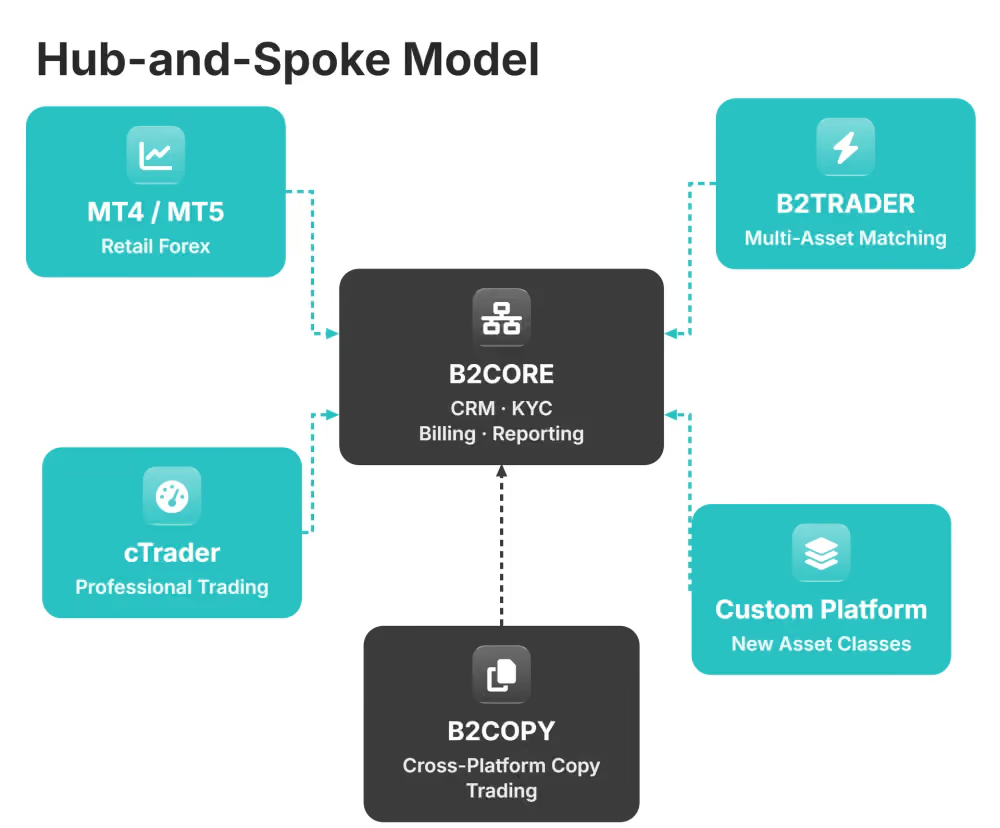
The answer is a hub-and-spoke model. One back-office platform serves as the central hub. It runs client onboarding and CRM on one side, risk management and billing on the other, all feeding into a single reporting layer. Trading platforms connect as spokes, pushing client data and compliance reporting into the hub regardless of which platform generated the trading activity. The hub-and-spoke approach streamlines reconciliation because every platform reports into the same pipeline.
The connection point between hub and spokes is the protocol layer. Standardizing on FIX 4.4/5.0 for order routing and REST/WebSocket APIs for data feeds keeps every spoke integration consistent and auditable, even as you add new platforms over time.
In B2BROKER's stack, this hub role belongs to B2CORE . Onboarding, KYC, billing, and multi-asset account analytics all feed into the same reporting pipeline, which means adding a new trading platform does not require rebuilding the compliance or billing layer.
Metrics to Prove ROI on a Multi-Platform Architecture
Platform diversification costs money to implement, so proving its return requires consistent measurement against a pre-deployment baseline. Five metrics matter most, and each one maps to a specific driver from the sections above:
- Execution cost savings: Average fill quality compared between platforms in basis points; compounding effect on high-volume flow
- Revenue protected during outages: Trading activity on secondary platforms during primary system incidents
- Client retention by platform: Brokerage account tenure, LTV, and churn rate differences between segmented and non-segmented client groups
- Compliance efficiency: Audit preparation time reduction and fewer regulatory findings from flow mixing
- Vendor cost optimization: SLA improvements and fee reductions achieved through competitive leverage
Track all five against the pre-deployment baseline. Without that baseline, you cannot separate platform-driven improvements from broader market shifts.
Accelerate Multi-Platform Deployment with B2BROKER
The case for multi-platform architecture is both operational and financial. Single-platform dependency concentrates risk, locks you into one vendor, weakens compliance boundaries, and leaves execution quality unmeasured. Platform diversification, built on a unified back-office hub, addresses all four.
B2BROKER's ecosystem is built for this architecture. B2CORE sits at the center, handling onboarding, KYC, billing, and compliance reporting for every connected platform, so nothing requires manual reconciliation. At the execution layer, B2TRADER delivers institutional matching engine performance. Copy trading flows between platforms through B2COPY , which routes master accounts on MT4, MT5, cTrader, or B2TRADER to followers on any other spoke.
The payments and liquidity layers complete the stack. B2BINPAY handles crypto transactions. Separately, institutional-grade liquidity aggregation plugs all platforms into deep, multi-asset pools through a single connection.
B2BROKER holds licenses in multiple jurisdictions and has supported forex brokers, crypto exchanges, and institutional clients for over a decade, which means the infrastructure is already running in production at the scale these integrations demand.
Frequently Asked Questions about Using Multiple Trading Platforms
How do you prevent multiple trading platforms from creating operational chaos?
The solution is a hub-and-spoke model where your CRM acts as the central hub for all data and trading platforms serve as specialized front-end spokes. Standardized protocols like FIX and REST keep every integration auditable.
At what point in a brokerage's growth should it consider adding a second platform?
You should add a second platform the moment your current system forces compromises, such as a retail interface frustrating institutional traders or an outage freezing all client activity. Proactively diversifying is always cheaper and safer than migrating reactively during a crisis.
How does multi-platform architecture affect regulatory compliance?
It actually simplifies compliance by creating distinct, ring-fenced audit trails for different jurisdictions and client types (retail vs. institutional). Structural separation prevents a single regulatory finding from contaminating your entire global operation.
How do you maintain consistent execution quality across multiple platforms?
You achieve consistency by centralizing smart order routing and risk management behind the scenes. Every client gets optimal fills regardless of which front-end platform they use. The unified backend also gives you an objective benchmark for execution quality.
What's the realistic timeline and cost to deploy a second trading platform?
By partnering with an integrated technology provider, most brokers can launch a second platform in 6 to 12 weeks. Using pre-built connections between liquidity, execution, and back-office systems eliminates the massive technical debt of custom development.
Recommended articles
Subscribe to our newsletter