Multi-Venue Liquidity Framework: From Aggregation to Execution

Multi-venue liquidity means a brokerage or exchange sources prices and executes orders across multiple trading venues. An aggregation layer consolidates those quotes and available depth into a single executable stream, keeping your execution model stable despite market fragmentation.
Market makers and brokers typically connect to several exchanges or ECNs through multiple liquidity sources. The aggregation engine normalizes each feed and builds a composite order book that reflects the best executable pricing.
This guide gives brokers and dealing desks a practical framework for deciding when multi-venue liquidity fits the next growth stage. You will learn what to measure and how to configure your stack so execution quality improves while operations stay controlled.
Key Takeaways
- Aggregating liquidity from multiple venues creates deeper order books and tighter bid-ask spreads than relying on a single provider.
- Smart order routing logic dynamically directs trades based on price, depth, and fill probability to optimize execution quality.
- Distributing flow across several liquidity sources significantly reduces rejection rates and slippage during market volatility.
- Real-time risk controls and automated position limits are essential to manage net exposure across connected venues.
Discover the Tools That Power 500+ Brokerages
Explore our complete ecosystem — from liquidity to CRM to trading infrastructure.
What Is Multi-Venue Liquidity?
Multi-venue liquidity is an aggregation of bid and ask quotes and order book depth from multiple trading venues into one executable stream. Brokers, market makers, and other market participants use that stream to price instruments and execute client order flow with a single, normalized view.
Global markets distribute liquidity across exchanges, ECNs, dark pools, derivatives exchanges, and OTC counterparties. Spot FX also runs without a central exchange, so no single venue holds the full picture for price and available size at any moment.
In this context:
- A venue means any execution destination that accepts orders, including Multilateral Trading Facilities (MTFs) and OTC.
- Aggregation means collecting quotes, normalizing them to a common format, then building a composite best bid and best offer.
- Execution means filling orders against the optimal price found across these combined sources.
A simple setup shows the mechanics. A forex broker connects to three tier-1 banks and two ECNs, then receives five independent price streams per symbol. The aggregation engine updates the best bid and offer as each stream changes, then routes client orders to the venue showing executable size.
Effective liquidity provision heavily relies on sourcing liquidity supply and depth from diverse origins rather than a single counterparty. Aggregation solves local liquidity shortages by normalizing feeds from multiple providers into a unified order book.
Operationally, multi-venue liquidity becomes a core layer that supports consistent pricing across asset coverage.
Single-Venue vs. Multi-Venue Execution
Single-venue execution routes every order to one liquidity source. Relying on a single provider exposes the brokerage to concentration risk: individual liquidity providers often adopt defensive pricing strategies during volatility. They may skew prices or reject orders to protect their own inventory.
Multi-venue execution distributes orders across several destinations through one routing layer. Dealing teams can offset net exposure across venues and keep quoting disciplined, while the router targets venues showing executable size at the time of trade.
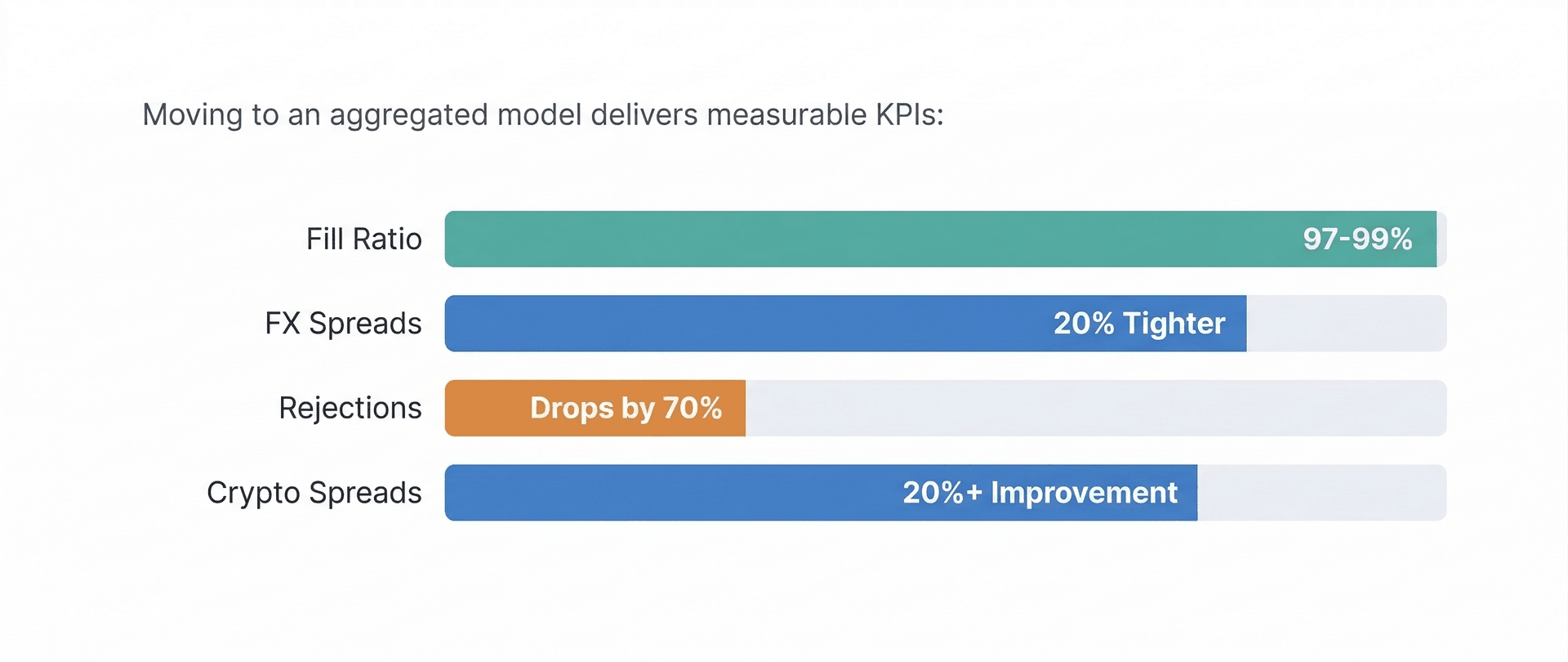
Research and live performance data confirm measurable improvements when moving to the cross-venue aggregated model:
- Effective Spreads: Brokers typically see a 5–20% reduction across major FX pairs. Less liquid assets like crypto CFDs often show improvements exceeding 20%.
- Fill Ratios: Well-configured environments boost fill rates from the low nineties to 97–99%. Partial fills decrease because the engine splits large orders intelligently across available liquidity.
- Slippage: Negative slippage frequency drops significantly during volatile sessions. The distribution becomes more symmetrical because the system distributes larger orders across multiple deep pools instead of sweeping through a single thin order book.
- Rejection Rates: Rejections often drop by 30–70%. During macro news releases, multi-venue routing reduces "off quotes" errors by finding alternative paths when one venue creates a bottleneck.
Institutional brokers treat multi-venue routing as baseline infrastructure for best execution. A clear view of the market microstructure of how LPs price and reject orders, including last look behavior, helps you set realistic routing rules.
Stop Losing Clients to Volatility
Access deep, multi-asset liquidity from top-tier venues with a single connection and zero aggregation headaches.
Key Benefits for Brokers and Trading Desks
Brokers evaluate multi-venue setups through execution KPIs and operational load. Dealing looks at tradable pricing and depth, risk tracks fill stability during volatility, and operations focuses on how quickly the stack supports new instruments.
Tighter Spreads and Deeper Order Books
A multi-venue feed builds a composite book from competing quotes. The top of the book reflects the best executable bid and offer at that moment, while additional levels add usable size for larger tickets.
Depth across additional book levels matters once ticket sizes rise. Accessing deep liquidity pools reduces adverse price impact on marketable orders, which supports cleaner fills for VIP clients, algorithms, and active trading strategies.
Brokers using multi-venue aggregation also protect their margin. Venue selection, quote filters, and per-symbol limits keep pricing competitive without giving up control over risk and execution costs.
Enhanced Fill Ratios During Volatility
During volatility, liquidity quality shifts fast. Some venues widen or reduce the displayed size, which increases partial fills and rejects when your routing logic keeps pushing flow into thinning books.
Multi-venue routing keeps execution active by switching destinations based on live depth and venue health. Dealing teams can keep client experience consistent during news-driven spikes, including common “price changed” responses.
Cross-Asset Offering Expansion
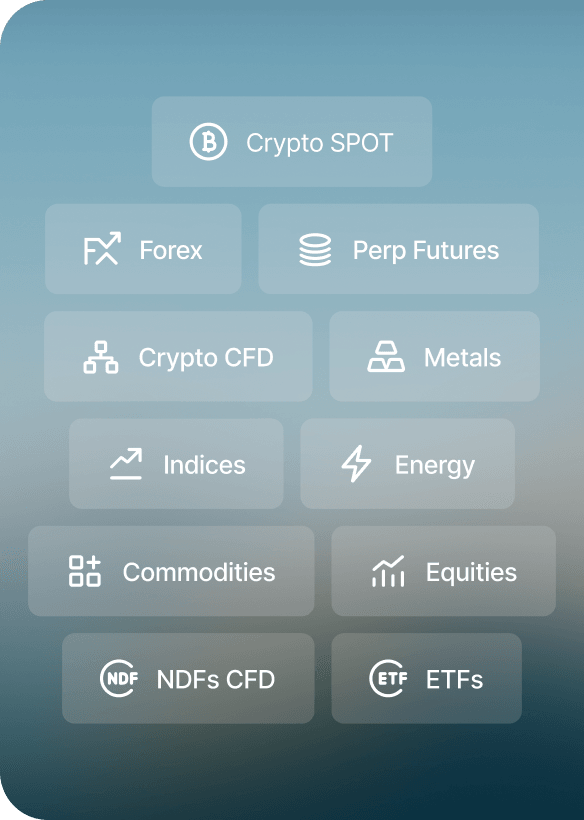
Multi-venue frameworks enable brokers to scale their product offering efficiently. Connecting to specialized venues allows firms to add asset classes like digital assets, equities, and commodities without building separate infrastructure for each.
A unified aggregation layer simplifies back-office operations as the instrument list grows. Dealing teams manage net exposure across all asset classes through a single interface, supporting sustainable business growth and attracting diverse client segments seeking comprehensive market access.
Growth stage often drives the decision:
- 0–500 active traders: single-source execution often stays workable.
- 500–3,000 active traders: multi-venue becomes a practical upgrade.
- ~$500M–$1B+ monthly trading volume: multi-venue turns into core infrastructure.
Deep, Reliable Liquidity Across 10 Major Asset Classes
FX, Crypto, Commodities, Indices & More from One Single Margin Account
Tight Spreads and Ultra-Low Latency Execution
Seamless API Integration with Your Trading Platform
Core Components of a Multi-Venue Liquidity Stack
A multi-venue setup depends on a small set of trading systems that handle pricing, routing, and controls as one workflow. These components function together to transform fragmented liquidity into a reliable execution service for the end client.
Aggregation Engine and Smart Order Routing
The aggregation engine normalizes quotes from connected venues into one price feed. It maintains a live best bid and best offer, using executable prices and available size rather than headline quotes.
Smart order routing (SOR) sits on top of that feed and chooses where each order goes. The router evaluates price and depth to prevent latency arbitrage, then adds venue reliability as decision inputs.
SOR priorities should match the broker model. Many teams formalize the logic into routing profiles, then apply them per symbol group or client segment.
- A-book (agency) flow: depth-aware pricing plus fill probability.
- B-book (market-making) hedging: exposure thresholds plus hedge triggers.
- C-book hybrid routing: toxicity signals plus venue score.
Venue connectivity usually runs through FIX, which the FIX Trading Community traces back to 1992. FIX standardizes order submission and execution reporting, so operations teams get consistent status updates across providers.
Execution reporting also has a concrete format. In FIX, the Execution Report message (MsgType 35=8) communicates fills, rejects, and order status changes, which simplifies downstream reconciliation.
Crypto venues often expose REST or WebSocket APIs, so an adapter layer becomes part of the build. Many brokers prefer an institutional partner that already maintains these connections and supports router configuration at scale
Real-Time Risk and Exposure Controls
Multi-venue execution demands continuous monitoring of net exposure because fills arrive from different venues at different times. Risk systems need a consolidated net position per symbol that updates on every fill event, then feeds the hedging and limits layer.
Pre-trade risk checks protect the brokerage from excessive exposure before an order reaches the market. These controls enforce position limits and credit thresholds automatically.
Common controls include:
- Position caps by symbol and account group
- Credit limits by venue or LP
- Margin checks tied to platform equity
Automation matters as volume grows. A rules-based layer can trigger hedges when net delta crosses a threshold, then pause routing to a venue when rejects spike or fills slow.
Multi-Jurisdictional Compliance and Reporting
Multi-venue routing touches regulatory rules in various jurisdictions where you service clients. Operations teams need a documented execution policy that maps instruments to eligible venues and ties routing behavior to the firm’s best-execution standards.
In the EU, MiFID II sets a best-execution obligation built around taking “all sufficient steps” to achieve the best possible result. That requirement pushes brokers to keep routing logic configurable by instrument and to retain evidence behind venue selection.
Teams typically formalize two outputs for governance and audits: time-stamped order lifecycle events, including venue acknowledgments and fills, and routing decision logs that capture the inputs used to select a destination
Transaction cost analysis (TCA) then uses that dataset to monitor trading activity and venue performance over time. In many EU setups, annual venue reporting under RTS 28 also becomes part of the compliance workflow.
Steps to Implement an Aggregation Framework
Deploying a multi-venue framework requires a deliberate implementation strategy. This roadmap guides through the technical and operational setup.
Map Asset Coverage and Target Venues
List the financial instruments you plan to offer, then shortlist venues that show reliable depth for those symbols. Confirm access terms and reliability before you connect, since onboarding work scales with every added destination.
Keep the first release small, usually 3–5 core venues. That scope keeps integration and monitoring practical, while still giving the router options when one venue’s depth changes.
Use hard selection criteria:
- Regulatory standing in your target regions
- Uptime record and incident handling
- Supported order types and market data scope
Configure Smart Order Routing Logic
Turn your dealing model into routing profiles and assign them per symbol group. For A-book flow, weight executable price and fill probability. For hedge routing, trigger external execution only after exposure crosses a defined limit.
Test routing in a sandbox or UAT environment that mirrors production message flow. Validate order splitting and reject handling first. Then tune timeouts and retries, since small parameter changes can shift fill quality.
Add guardrails that the router can enforce automatically. A max spread cap and a minimum depth threshold cover most venues. A volatility flag can tighten routing rules when liquidity quality drops.
Monitor and Optimize Execution KPIs
Define KPIs once and apply the same definitions across venues. Most brokers track:
- Effective spread (quote to fill)
- Fill ratio (fills to requests)
- Slippage (requested to execute)
- Rejection rate (rejects to requests)
Capture a baseline before go-live, then review results regularly. Reweight venues when performance drifts and adjust routing thresholds when market conditions change. Version every change so reviews tie outcomes to a release.
Evaluation Checklist for Liquidity Providers
A multi-venue setup depends on your provider’s connectivity and operating discipline. Use a checklist during vendor selection, then validate every claim in testing. A strong demo deck does not replace execution logs and incident history.
Focus the evaluation methodology on what your team will run every day:
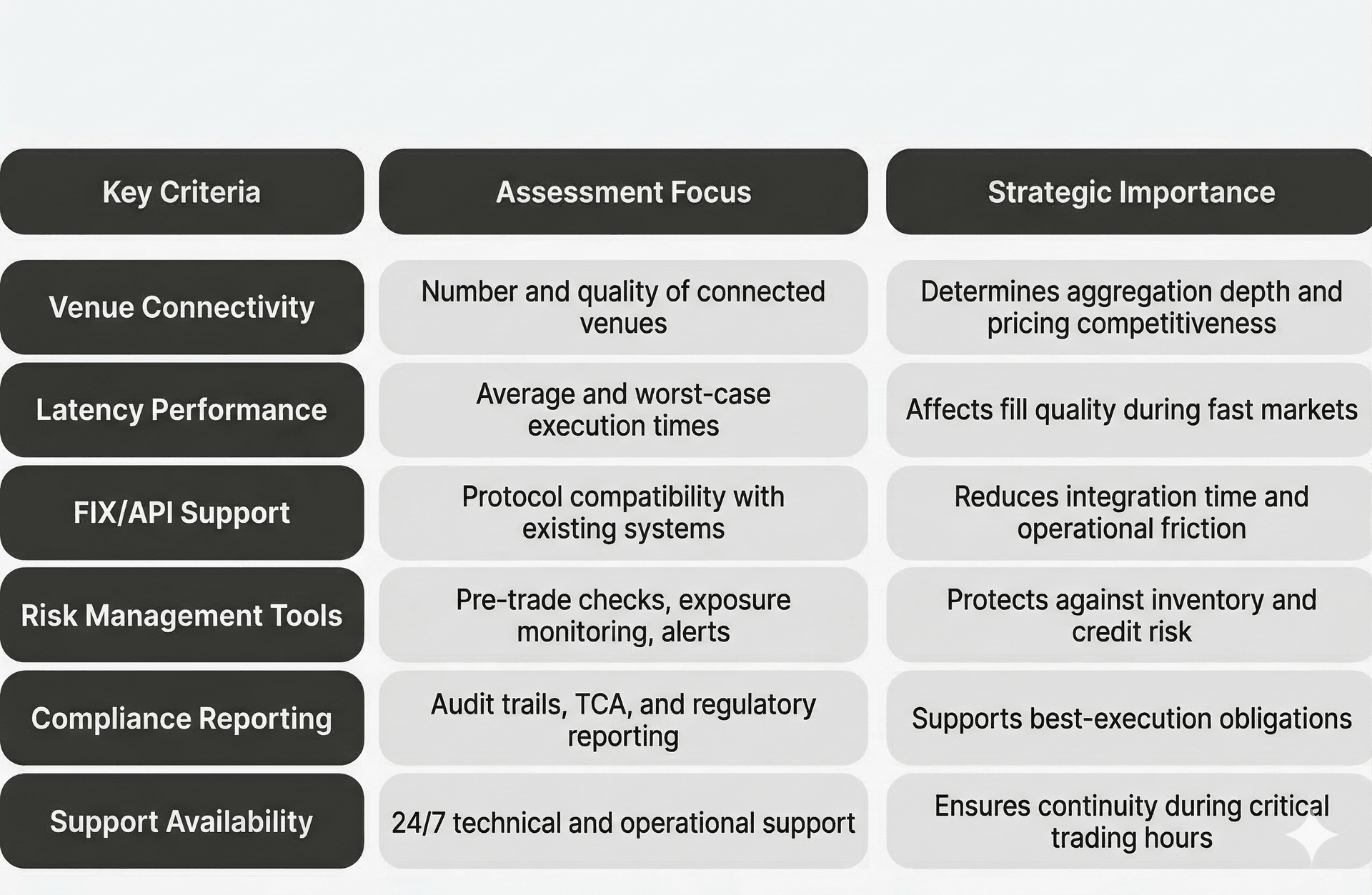
Request a proof-of-concept before you commit. Run it long enough to capture normal sessions and high-impact releases, then review fills, rejects, and router decisions with the provider’s support team.
Ask for reference clients with a similar setup and volume profile. A provider with institutional-grade liquidity should also show mature operational practices and transparent onboarding for brokers.
Improving Growth With Institutional-Grade Liquidity
Multi-venue liquidity frameworks support growth when clients demand consistent pricing and reliable execution across instruments. Aggregated depth improves trade quality, while routing logic keeps fills working during fast markets and shifting venue conditions.
Implementation requires a robust stack comprising an aggregation engine and real-time risk controls. B2BROKER provides a complete ecosystem, supporting multi-asset liquidity provision from top-tier venues, trading platforms, and an advanced back office. Serving the industry since 2014, we support over 1,000 corporate clients with infrastructure designed for scale.
Our solutions integrate trading platforms, CRM systems, and wallet management into one environment. This consolidated approach allows teams to launch faster while maintaining operational efficiency and the resilience needed to succeed in fragmented financial markets.
Next steps stay practical. Define asset coverage, then validate venue connectivity and operational support in a PoC. Keep the rollout staged and expand once KPIs improve across your live flow.
Ready to Scale Your Execution Quality?
Launch a complete brokerage ecosystem with aggregated liquidity, advanced risk controls, and turnkey trading infrastructure.
Frequently Asked Questions about Multi-Venue Liquidity
- How long does venue onboarding typically take?
Most venue onboarding takes a few days to several weeks, depending on connectivity work and compliance checks. Providers with existing venue links usually shorten the timeline.
- Can I aggregate forex and crypto markets in one pool?
Yes. Many aggregation engines support multi-asset routing, so FX and crypto can run through one execution layer with separate venue adapters and risk limits.
- Will multi-venue routing raise MT4 or MT5 bridge latency?
Properly configured bridges add minimal latency, typically single-digit milliseconds, when connected to optimized aggregation infrastructure. Brokers should test bridge performance with their specific venue configuration before live deployment.
- How do I know when I’ve outgrown a single-venue liquidity setup?
The signal shows up in execution KPIs, such as persistent spread widening in volatility and rising rejection rates. It also appears when asset expansion or volume growth starts stressing one provider’s depth and uptime.