How to Choose a Liquidity Bridge

Venues retire their APIs on their own schedule. In March 2025, MEXC gave Open API users five months' notice, then shut down its V3 WebSocket daily URL that August and moved market streams to Protocol Buffers.
Every client still on the old endpoint had to rewire and retest that connection inside the window. A desk wired directly into several exchanges gets one of those windows per connection. The bridge you choose decides whether that work lands on your engineers or on the vendor.
This guide covers how to choose a liquidity bridge once you are past definitions: the evaluation criteria, the architecture trade-offs, and where B2CONNECT fits inside the B2BROKER stack.
Key Takeaways
- The vendor that maintains your bridge also sets how fast a broken venue connection comes back up.
- A generic FIX bridge can drift out of version compatibility, and the break surfaces during a live market session.
- Institutional crypto venues split access across FIX, REST, and WebSocket, which makes native support for all three a baseline requirement.
- A purpose-built bridge removes custom API development per venue, which is where most of the integration overhead sits.
- Running spot and perpetual futures through one bridge takes margin and routing mechanics designed for those instruments.
What a Liquidity Bridge Actually Does
A liquidity bridge moves order flow between your trading platform and the venues that fill it. The connectivity work in between, from message translation to trade execution reporting, is what the bridge takes off your codebase.
One layer down sits the liquidity provision that fills those orders. Providers stream prices and your platform sends orders back; the bridge keeps the two sides speaking the same language as each one changes.
The Connectivity Problem It Solves
Without a bridge, every venue is a custom API integration your team owns for as long as it runs. One integration is manageable. A desk connected to eight venues runs eight maintenance streams that can each break independently of the others.
A bridge collapses those streams into one interface that its vendor maintains.
Why Generic Bridges Fall Short
A bridge built to connect any platform to any venue has to make assumptions about both ends that it cannot test against your stack. The gaps stay invisible in a demo and surface when a venue changes something without warning.
Both failure modes that design produces get more expensive with every venue you add.
Custom API Overhead and Maintenance Risk
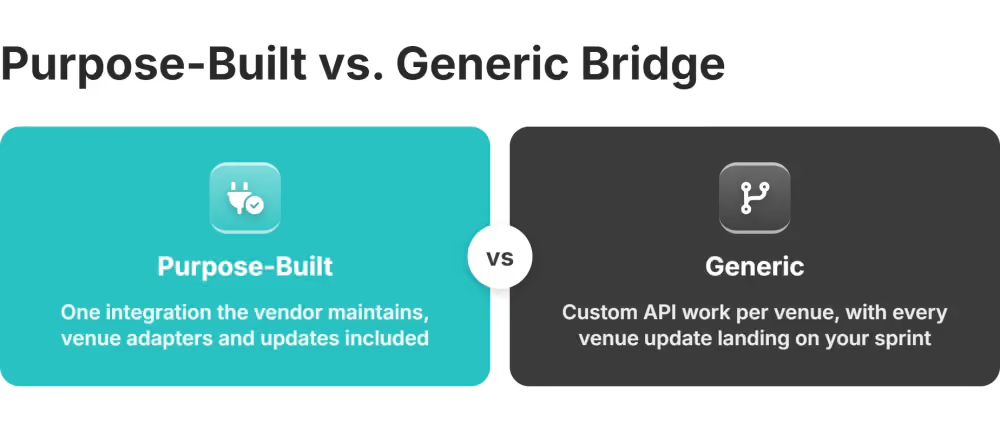
A generic bridge covers the common denominator of each venue's interface. Whatever a venue does outside that baseline returns to your team as custom API work.
That work recurs. When a venue ships an interface update, your team retests the integration and schedules a redeploy on the venue's timetable, whatever else the sprint was for. Multiply the cycle by every connected venue, and the hours come straight out of the product roadmap.
Version Drift and Platform Compatibility Breaks
Version drift is what happens when a venue or a bridge vendor updates its side independently and compatibility with your platform quietly breaks. Your own monitoring can stay green until an order fails, usually one sent when spreads are widest.
A break like that costs twice. The missed fills land while order flow is down, and more hours go into tracing a symptom on the platform screen back to a cause in the connectivity layer.
B2CONNECT
B2CONNECT is B2BROKER's crypto-native liquidity hub. The fastest way to describe it is by the work it removes from your side:
- no custom API builds per venue
- no maintenance cycle running on a schedule separate from your platform's
- no third-party support queue between you and a fix
Brokerages sourcing from prime-of-prime liquidity, crypto exchanges managing fragmented liquidity pools, and payment providers are the businesses that typically run on external liquidity at this level. All three carry the integration problem this guide describes.
Purpose-Built for the B2BROKER Ecosystem
Purpose-built here means designed for the B2BROKER stack from the start. B2CONNECT ships adapters for platforms whose behavior its vendor already knows, instead of inferring how an unfamiliar stack will respond.
Fewer inferences on either side leave fewer compatibility gaps for your team to find after go-live.
Native Integration with B2TRADER and B2CORE
B2TRADER and B2CORE connect to B2CONNECT with no custom API development on your side.
The linking code your engineers would normally write between those components does not exist here; they interoperate as shipped. Deployment effort goes into deciding which venues to enable and where each flow routes.
Crypto-Specific Execution Considerations
Institutional crypto flow is moving onto prime-broker-grade rails. In June 2026, Clear Street traded the first Bitcoin depositary receipts through a traditional prime brokerage platform , settling them through the same depository that clears US equities. Flow that arrives on those rails carries the same operational expectations into the connectivity layer.
A 2025 AIMA/PwC survey puts the same shift in numbers: 55% of traditional hedge funds now hold digital-asset exposure , up from 47% a year earlier.
Two demands decide whether a bridge fits digital-asset flow.
Fragmented Liquidity Across Centralized Venues
Crypto has no consolidated tape. Every centralized exchange runs its own order book, and the same asset can show different market depth, different trading volumes, and a different price across venues at the same moment.
A bridge that only relays orders to one venue inherits that venue's share of market liquidity, thin moments included. Fragmentation is why the criteria below include aggregation, the layer that turns many venue books into one you can trade.
Managing Spot and Perpetual Futures Order Flow
Spot and perpetual futures cannot share one set of handling rules. Margin treatment differs, which changes the capital efficiency of an open position. Perpetual derivatives add funding-rate mechanics of their own.
B2CONNECT runs direct REST and WebSocket adapters to 14 centralized exchanges for spot and perpetual futures, Binance Futures included, so both flows arrive over the same connection into your platform.
Key Criteria for Evaluating a Bridge
The practical core of how to choose a liquidity bridge is three questions: which protocols the bridge speaks natively, how it builds one tradable book from many, and what security evidence it can show. Each section below turns one question into checks you can run against what a vendor claims about execution quality.
Protocol Support: FIX, REST, and WebSocket
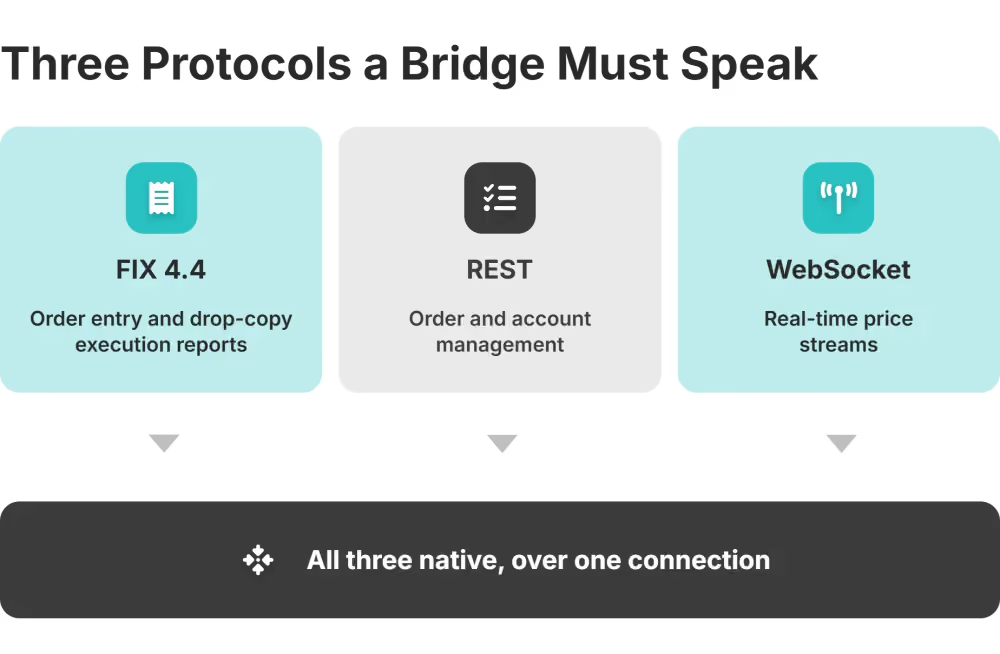
Access at institutional venues arrives over three protocols, each doing a different job. A FIX API session carries order entry and drop-copy execution reporting , REST handles order and account management, and WebSocket streams real-time prices.
If the bridge covers only part of that set, workarounds pile up at the venue edge, adding latency that costs execution speed. Confirm the support is native. Ask for latency and reject data on any protocol the vendor reaches through a later adapter.
Liquidity Aggregation and Multi-LP Access
Access to many liquidity providers pays off only if the aggregation layer above them delivers one usable book. That layer subscribes to each venue's order book, handles the symbol mapping between them, and consolidates liquidity depth into one aggregated pricing stream your platform trades against.
Evaluate it on depth first. Ask how many levels the layer reads from each venue before consolidating, because a book assembled from top-of-book prices looks tight and then thins out at the size you actually trade. Depth decides whether tighter spreads survive your order size; a shallow book turns the difference into slippage at fill time.
Then ask what happens when one source stops streaming. Configured failover priorities move the flow to the next venue on their own. Without them, reject rates climb while the desk looks for the feed that stopped.
Security Controls and Compliance Posture
Security review runs on evidence you can read. Four areas cover most of it:
- encryption standards in transit and at rest
- access controls granular enough to scope by role
- a defined penetration-testing cadence
- the audit standards the vendor submits to
Compliance belongs in the same review. Once order flow crosses venues in different jurisdictions, compliance obligations that differ by jurisdiction follow it. The bridge then has to fit your regulatory footprint as well as your technical one.
Your Bridge Vendor's Release Schedule Is Part of Your Uptime
A third-party bridge brings its update discipline and support responsiveness into your execution stack. Review a bought dependency's release process the way you would review one built in-house.
Ask each candidate what happens to your order flow the next time they ship a change.
What Happens When a Third-Party Bridge Breaks
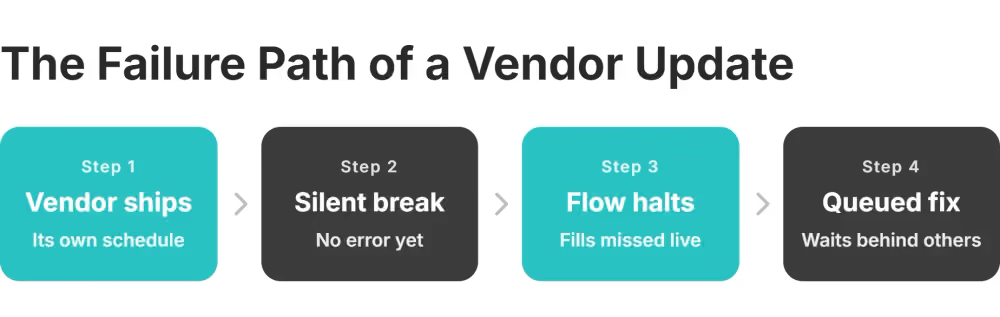
When a vendor's update breaks the connection, orders stop leaving your platform. Fixing it is not in your hands: you open a ticket and wait in line with the vendor's other clients.
Every hour in that queue is an hour your clients cannot trade. SLAs cover how fast the vendor replies, while the connection stays down until the fix ships.
With B2CONNECT there is no third party to wait on. Because B2BROKER builds both the hub and the platform it feeds, a compatibility question has one owner and no queue in front of it.
What You Can Do With B2CONNECT
For a broker weighing how to choose a liquidity bridge, this is what B2CONNECT supports today:
- native FIX 4.4, REST, and WebSocket support, plus gRPC
- direct integration with B2TRADER and B2CORE, plus FIX delivery to platforms such as cTrader
- 13 asset classes, from crypto spot and perpetual futures to FX, metals, and indices
- direct REST and WebSocket adapters to 14 centralized exchanges, futures venues among them
- order books of up to 5,000 levels consolidated into the depth tiers you configure, with your markup applied and automatic failover between sources
- A-Book, B-Book, or C-Book hybrid execution models set per symbol
The common thread is a single integration surface with one vendor accountable for it.
Track record counts here as much as the capability list. B2BROKER has operated since 2014, serves more than 1,000 corporate clients, and has helped launch over 500 brokers.
If B2CONNECT is on your shortlist, test the fit against your own venue list and execution requirements. Talk to an expert at B2BROKER and scope the integration against your setup.
Frequently Asked Questions about Liquidity Bridges
What should a broker evaluate first when choosing a liquidity bridge?
Protocol coverage. A bridge without native FIX, REST, and WebSocket support leaves venue-level gaps that only workarounds can cover, which makes it the first check, ahead of routing quality, maintenance model, and cost.
Is it better to build custom liquidity integrations or use a purpose-built bridge?
Each custom integration adds a maintenance stream that lasts as long as the connection does, and the build option keeps getting costlier as sources multiply. A purpose-built bridge concentrates that work into one integration and one vendor relationship.
How does a liquidity bridge differ from a liquidity aggregator?
An aggregator constructs a unified price feed from multiple sources. A bridge owns the wider path between platform and venues, including order routing, execution, and reporting. Institutional-grade bridges usually fold aggregation into that path as one function among several.
How can I reduce operational risk when connecting my trading platform to multiple liquidity sources?
Cut the number of separately updated vendors in the order path. Sourcing connectivity from the vendor that also supplies your trading platform and back office, as B2CONNECT does alongside B2TRADER and B2CORE, keeps compatibility questions on one escalation path.
Which protocols should an institutional liquidity bridge support?
FIX for order entry and execution reports, REST for order and account management, and WebSocket for real-time market data streams. Native support for all three matters, because institutional venues split their access across them.
Recommended articles
Subscribe to our newsletter