Liquidity Provider Volume Fees: What Triggers Better Pricing?

For a growing broker, liquidity provider volume fees have quietly turned into one of the largest controllable cost lines on the P&L. A flat per-million contract often runs roughly 25% more expensive than a properly tiered schedule on identical flow, and the gap widens with every band of new volume.
Most operators absorb that bill quietly, because the fee schedule was usually signed two growth phases ago and never revisited. If your brokerage clears $100M+ in monthly notional, this is the cost line you cannot afford to leave on autopilot.
This article walks through how LP volume fees actually work, what the math looks like at scale, the hidden costs that sit around them, and where brokers find leverage in the negotiation.
Key Takeaways
- Liquidity provider volume fees usually follow tiered structures, where a rolling-period calculation decides when the rate steps down. Volume planning around those thresholds becomes a direct operational lever for the broker.
- Headline per-million commissions capture only part of the true cost of liquidity. Infrastructure and funding charges compound separately as volume grows.
- Flat-rate contracts protect predictability at low volume. They become a margin drag once flow reaches the band where a tiered schedule would take over.
- Consolidating multi-asset flow with one institutional LP improves negotiating leverage, because aggregated notional clears tier thresholds faster than fragmented routing.
- Internalization ratio directly changes LP fee exposure. More internal matching lowers external commission spend, while also slowing tier qualification on the externalized portion.
Liquidity Provider Volume Fees: The Scaling Cost Problem
LP volume fees shape brokerage profitability based on how the schedule was designed. A single per-million rate that looks identical at $50M and $300M of monthly volume produces a P&L impact that diverges sharply with scale.
Brokers that grow volume without renegotiating the fee schedule absorb a compounding cost burden, often called the success tax of running flat rates through scale. More flow at the same per-unit rate scales the bill linearly, while all the operating leverage stays with the LP.
That range applies to a global FX market turning over more than $9 trillion in daily volume, and serves as a starting point for cost modeling with the lower bound as the negotiating target. That range serves as a starting point for cost modeling, with the lower bound as the negotiating target. Operators running $100M+ monthly should be pricing against that lower bound, and the relevant question is which tier triggers would move them there.
Why Fee Structures Matter More at Scale
The arithmetic makes the point cleanly. A flat $30 per million fee on $50M of monthly notional costs $1,500, while the same fee on $200M costs $6,000. Four times the volume creates four times the cost, with zero operating leverage on the LP line.
A tiered structure changes the result. With $30/million up to $100M and $15/million above, the $200M month costs $3,000 on the first $100M plus $1,500 on the next, for a total of $4,500, or 25% cheaper than the flat rate.
The compounding risk sits in the scaling gap. Tier thresholds are discontinuous, and a broker at $90M monthly, even with steady growth, absorbs the top per-million rate on every dollar of flow until the month the trigger is crossed. Growth is exactly when flat-rate contracts hurt most, because every dollar of new volume pays the top rate with no compression on the way up.
How LP Volume Fee Structures Work
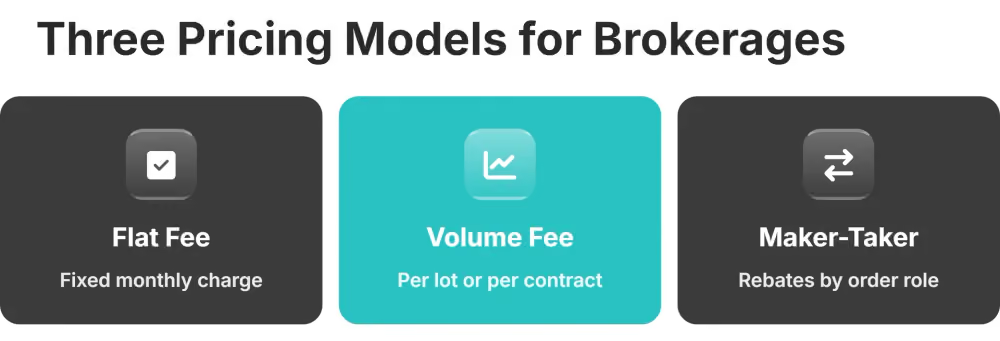
An LP quote typically combines two or three pricing layers, and each layer corresponds to one of the ways liquidity providers generate revenue as market makers. The spread markup embeds the fee directly inside the price. A per-million commission makes the fee an explicit line item. Most institutional contracts use at least these two layers, with a tiered schedule sitting on top to change the per-million rate once volume crosses a defined threshold.
How cleanly a broker can route between these layers depends on the liquidity aggregator technology underneath the order flow.
Spread Markups: Implicit Cost in the Quote
A spread markup is an implicit fee. If the LP quotes a raw bid-ask spread of 0.1 pip on EUR/USD and the broker displays 0.3 pip to clients, the 0.2 pip delta becomes broker revenue, and clients see that delta as part of their all-in trading cost.
The math compounds linearly. A 0.2 pip markup on $100M of notional is roughly $2,000 per side, and on $500M it is $10,000. Linear scaling helps the revenue line, but it also locks the pricing model.
Widening markups to offset rising LP costs is visible to clients and creates churn risk. Latency-sensitive arbitrage can pick off stale quotes across venues, which keeps the markup ceiling tight in practice.
Per-Million Commissions: The Explicit Line Item
A per-million commission is the explicit line item in the LP fee. For institutional forex notional, the typical range sits around $20–$40 per million. That benchmark sets the negotiating ceiling and floor: a broker paying $35/million on $80M of monthly volume almost always has room to renegotiate, especially with a predictable flow profile.
Crypto venues structure per-unit fees on different logic. Hyperliquid , an order book perpetuals venue, uses a rolling 14-day fee schedule that counts spot trading volume at double weight toward classification.
Centralized exchanges (CEXs) in crypto typically run similar maker-taker tiers based on trading fees against a visible limit order book. Decentralized exchanges (DEXs) in DeFi replace the order book entirely, with Uniswap and similar automated market makers (AMMs) applying a dynamic fee algorithm against the underlying liquidity pool.
A multi-asset broker routing both spot and derivatives needs to model crypto LP cost separately from FX cost, because the windows and weighting rules diverge enough that a single benchmark hides the real picture.
Tiered Pricing: Where the Real Money Moves
A tiered schedule is what turns volume growth into actual cost relief. Three things define how fee tiers behave:
- Measurement window — the period the LP uses to classify the broker (monthly, rolling 14-day, rolling 90-day).
- Threshold logic — whether the lower rate applies to all volume retroactively once the threshold is hit, or only to volume above it.
- Reclassification rules — what happens when volume drops below the threshold, and how fast downward reclassification moves relative to upward.
That last point is where the tier ratchet sits, an asymmetry that often surfaces only after the contract is signed. Some schedules move the broker up to a better tier on a fixed measurement cycle, then require a manual review to move them back down when volume slips. If the agreement reclassifies down faster than it reclassifies up, a single bad month can knock the broker into a worse rate for a full window.
Symmetric reclassification (same speed in both directions) is the clause to ask for in the contract.
Flat-Rate vs. Tiered: The Math at Scale
The choice between a flat rate and a tiered schedule is a cost-divergence problem. Across monthly volume bands, the flat $30/million rate diverges from a tiered schedule that charges $30/million up to $100M and $15/million above the threshold:
- $50M monthly: flat = $1,500; tiered = $1,500. Identical.
- $100M monthly: flat = $3,000; tiered = $3,000. Still identical.
- $150M monthly: flat = $4,500; tiered = $3,000 + $750 = $3,750. Tiered is ~17% cheaper.
- $250M monthly: flat = $7,500; tiered = $3,000 + $2,250 = $5,250. Tiered is 30% cheaper.
- $300M monthly: flat = $9,000; tiered = $3,000 + $3,000 = $6,000. Tiered is ~33% cheaper.
The savings curve is not symmetric across the threshold. Below $100M, the two contract types behave identically. Above it, the flat rate falls behind at an accelerating pace, with each $50M of additional volume widening the gap further.
The condition the comparison above does not show is duration above the threshold. A broker who holds volume cleanly above $150M for an entire measurement cycle captures the tier in full. A broker who crosses and falls back may pay the higher rate on qualifying months anyway, depending on the reclassification clause.
Flat rates protect predictable low-volume operators best. Tiered schedules pay off once the broker holds volume above the threshold with reasonable confidence.
Hidden Costs Beyond the Headline Fee
The headline commission and spread markup capture only part of the true cost of institutional liquidity provision. The rest sits in infrastructure and funding, and those costs often stay fixed as per-unit fees compress.
Once the explicit LP fee is on the table, the surrounding cost layers usually look like this:
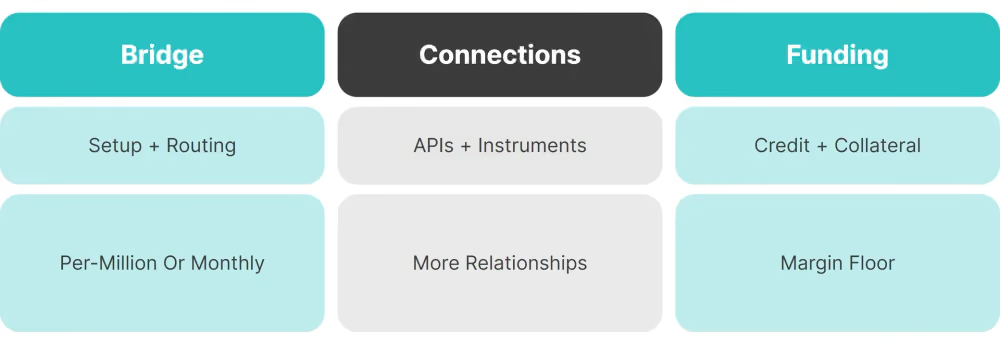
- Bridge providers typically charge a setup fee plus either a per-million volume rate or a flat monthly figure, as outlined in Takeprofit Tech's bridge cost guidance . Adding LP connections, instruments, API access, or account groups usually adds line items.
- Colocation and connectivity can add several thousand dollars per month at scale, once dedicated bandwidth and market data feeds enter the picture.
- Funding and credit charges appear when the prime broker prices counterparty risk into effective rates. The pricing comes through either wider spreads or explicit funding surcharges that scale with leverage utilization.
These fixed and semi-fixed costs sit against variable revenue, and the result is a cost floor that pressures margin hardest at lower volume bands. That is the same point where a flat or pre-threshold tier rate is already at its worst.
The Volatility Trap
During a session of acute market volatility, the LP may charge wider effective rates and issue an intraday margin call at the same time. Slippage tends to rise across the order flow, and client demand often spikes alongside that pressure, with any drop in flow from margin friction suppressing monthly volume below the next tier threshold.
The result is a feedback loop where fee compression would help most at the exact moment the tier ratchet starts working against the broker. Negotiated minimums and credit lines that anticipate stressed market conditions are the practical defense.
Fee Negotiation Leverage and Volume Thresholds
LPs price risk first and volume second. A broker delivering a steady $80M of monthly flow is a better counterparty than one running an erratic $120M, and the contract usually reflects that. Operators who lead with raw volume in negotiations tend to leave room on the table.
Four things shift the conversation in the broker's favor, and each one reduces the LP's risk in a different way. Predictable flow lets the LP size capital and operations against a known curve. Consolidated multi-asset demand grows the total relationship value while lowering the LP's per-account onboarding cost.
Disciplined counterparty operations, with clean reporting and active risk management, keep the LP's monitoring burden low. And tight execution metrics, particularly low rejection and slippage rates, make pricing for risk straightforward on the LP side.
What to Specify Before Signing
The mechanical clauses matter more than the headline rate, and they are also the ones easiest to underweight in a deal cycle. Three of them deserve explicit language in the contract.
The lookback window (monthly, rolling 14-day, rolling 90-day, or a contract-defined cycle) sets the cadence the LP uses to classify the broker. Threshold treatment specifies whether the lower rate applies retroactively to all volume once the threshold is cleared, or only to volume above it, and how each asset class counts toward classification. Reclassification symmetry matches the speed of upward and downward tier moves, with explicit language on what triggers each.
Transparency on rolling windows and published thresholds belongs in the same negotiation as the rate itself.
Evaluating LP Fee Fit for Brokers
Before comparing headline rates across providers, fit depends on what the brokerage brings to the table. Volume sets the scale of the relationship. Asset mix determines what each LP can price competitively against. The routing model decides how much flow reaches the LP at all, and the internalization ratio sits underneath it as the variable brokers can move most directly.
The right framing treats fee selection as a routing-economics problem. Agency and market-making liquidity provision models shape the cost picture differently, and hybrid models add another layer. The useful diagnostic is where flow actually reaches the market, and where the next dollar of optimization has the highest margin impact.
Volume, Asset Mix, and Routing Diagnostics
The fit usually surfaces through three diagnostic questions. The first asks for the expected monthly notional by asset class, with predictability month-to-month built in. The second covers routing (whether the broker externalizes, internalizes a portion, or runs a hybrid book) and where the current internalization ratio sits. The third tests whether volume is steady or event-driven.
Asset mix is the input that most often gets underweighted. LPs price asset classes differently, and a broker concentrated in major FX pairs has more leverage on those instruments than a broker spreading the same notional across 40 exotic pairs, even at identical aggregate volume.
Concentration is a negotiating asset.
Internalization Ratio and Its Fee Implications
Internalization ratio is the share of client flow matched internally before reaching the LP. Higher internalization lowers absolute external commission spend, while also slowing tier progression when the LP calculates the tier only on externalized flow. Both effects need to be modeled together.
A worked example, using $30B of annual external notional and a tiered schedule that prices $30/million below the threshold and $15/million above:
- Internalizing 30% removes roughly $9B from the LP line.
- At the $15/million tier, the broker saves about $135,000 in commission on the volume that no longer flows externally.
- If the remaining $21B falls below the threshold and reprices from $15/million to $30/million, the rate increase costs about $315,000 on that flow.
Net impact: internalization saves $135K and adds $315K, leaving the broker $180K worse off than if the full $30B had stayed externalized at the lower tier. The route looks cheaper at the line-item level until the tier moves against it.
Internalization has its own margin and risk benefits. The LP fee implication just needs to be priced into the decision before the routing change is made.
How B2BROKER Addresses Volume Fee Risk
Volume fee risk leaks into two places within the broker's liquidity ecosystem: raw spread quality at the source, and tier qualification across asset classes. B2BROKER's setup addresses both.
Tier-1 Sourcing Depth and Spread Efficiency
Deeper liquidity pools reduce the LP's risk exposure, which is the legitimate basis for tighter raw spreads and lower per-unit commissions at scale. B2BROKER's Tier-1 sourcing offers spreads starting from 0.01 pips, and the tighter raw spreads reduce the markup needed to keep retail pricing competitive while the LP cost base stays manageable.
Multi-Asset Aggregation and Fee Control
Consolidating flow across financial markets (FX, crypto, indices, commodities, and metals) with one institutional provider keeps notional in a single tier calculation. Fragmented routing across four LPs is the most common reason brokers miss thresholds that consolidated flow would have cleared.
B2BROKER's instrument coverage can exceed 1,500, depending on jurisdiction, with margin requirements from 0.5%. The cross-asset book runs through a single pricing base, with each instrument class feeding the same cost view.
The commercial benefit only shows up when the contract terms reflect it. The infrastructure makes the leverage available; deal-by-deal validation is what turns it into a lower bill.
Stop Overpaying as You Grow
For a brokerage , liquidity provider volume fees become a margin-control decision over time. Poor schedule design compounds against the operator quietly, and every month at the wrong rate is margin that does not come back.
The brokers who manage this well treat the LP contract as live infrastructure. They renegotiate before measurement cycles flip against them, and they bring the rolling-window math when they do.
The earlier the modeling starts, the cheaper the eventual contract.
Frequently Asked Questions about Liquidity Provider Volume Fees
How are liquidity provider volume fees usually calculated?
Most LPs charge a per-million commission on notional volume, with the forex range typically sitting between $20 and $40 per $1 million. Spread markups often apply on top, so the effective cost is the commission plus whatever is embedded in the quoted spread.
What monthly volume thresholds unlock lower LP commission tiers?
Thresholds vary by provider, and the rate usually steps down once notional volume crosses a monthly or rolling-period benchmark. Some venues use a rolling 14-day fee schedule that weights spot volume at double the rate of derivatives volume.
Is a flat per-million fee or a tiered LP fee structure better for a growing brokerage?
Flat rates offer predictability at lower volumes, and they become expensive once monthly notional scales past the band where a tiered schedule would kick in. Tiered fees compress costs at higher volume, provided the broker can sustain qualification through the measurement window.
What hidden costs sit on top of a liquidity provider's quoted volume fee?
Bridge fees, colocation, dedicated bandwidth, and market data add a fixed cost layer that the headline commission does not capture. Funding surcharges, collateral financing, and redundancy can lift the real cost of liquidity further, especially during volatile sessions.
Does consolidating volume with one liquidity provider reduce total trading costs?
Consolidation often improves fee positioning, because combined notional across FX, crypto, and commodities qualifies the broker for a better tier than fragmented routing would. Splitting flow across multiple LPs resets volume calculations at each one and adds per-relationship infrastructure overhead.
Recommended articles


Subscribe to our newsletter