Order Management System Explained: How Does it Work?

A client clicks buy on your trading platform. For a single-asset retail broker, that trade flows straight to your liquidity provider. But the moment you add new asset classes, connect multiple venues, or onboard institutional clients, that simple handoff fractures into a tangle of routing rules, margin checks, and overnight reconciliation spreadsheets.
This is the exact problem a brokerage-grade order management system solves. Unlike the retail inventory tools that dominate search results, an OMS built for brokers is the operational backbone that captures, validates, routes, and executes orders across FX, CFDs, equities, futures, and crypto, replacing fragmented workflows with a single, auditable control layer.
If you are a brokerage founder, operations director, or CTO evaluating whether an OMS is the missing piece in your stack, this guide covers what the system actually does, how multi-asset requirements change the equation, which capabilities matter most, and how to evaluate vendors.
Key Takeaways
- An order management system centralizes the entire trade lifecycle, from order capture through settlement, giving multi-asset brokers a single source of truth for all trading activity across FX, CFDs, equities, and crypto.
- Multi-asset OMS platforms must handle asset-class nuances like varying settlement cycles, instrument symbology, and cross-asset exposure management without requiring separate systems for each product.
- Core OMS capabilities include order validation, smart order routing, liquidity connectivity, and exception handling. These features directly determine execution quality and client satisfaction.
- Pre-trade risk controls, real-time exposure monitoring, and post-trade surveillance are non-negotiable for brokers operating under regulatory scrutiny and managing counterparty risk.
- Selecting an OMS vendor requires evaluating functional fit, total cost of ownership, integration capabilities, and implementation timelines against your brokerage's specific operational workflows.
What Does an Order Management System Actually Do?
At its core, an order management system is the software layer that manages the complete trade lifecycle from initial order entry through final settlement. For multi-asset brokers, it acts as the central nervous system connecting front-office trading activity with back-office operations, not a generic supply chain tool, but a specialized control layer built around the trade order lifecycle.
If you want to understand the foundational mechanics of how broker-dealer operations work underneath this infrastructure, our guide on how does a broker dealer work provides useful context.
The global OMS market reached $6.8 billion in 2025 and is projected to grow to $10 billion by 2030 at an 8% CAGR, reflecting the pace at which brokers are investing in order infrastructure to handle growing asset and venue complexity. A modern OMS manages every order across six distinct stages:
- Capture. Ingesting order entry from trading platforms via API or bridge.
- Validate. Running microsecond checks on account status, margin sufficiency, and compliance restrictions.
- Route. Determining the optimal execution path based on live pricing and predefined rules.
- Execute. Sending the order to market and receiving official fill confirmation.
- Allocate. Assigning the executed trade back to the specific client account.
- Settle. Passing finalized trade details to the back office for financial settlement.
The operational benchmark is straight-through processing (STP): the entire lifecycle runs electronically without manual intervention from your dealing desk. Research from CME Group indicates that full STP automation reduces order processing costs by approximately 30% compared to hybrid-manual workflows, a figure that becomes significant at institutional volumes.
OMS vs. EMS vs. PMS: How They Fit Together
These three system types get conflated regularly. Confusing them leads to misaligned vendor evaluations.
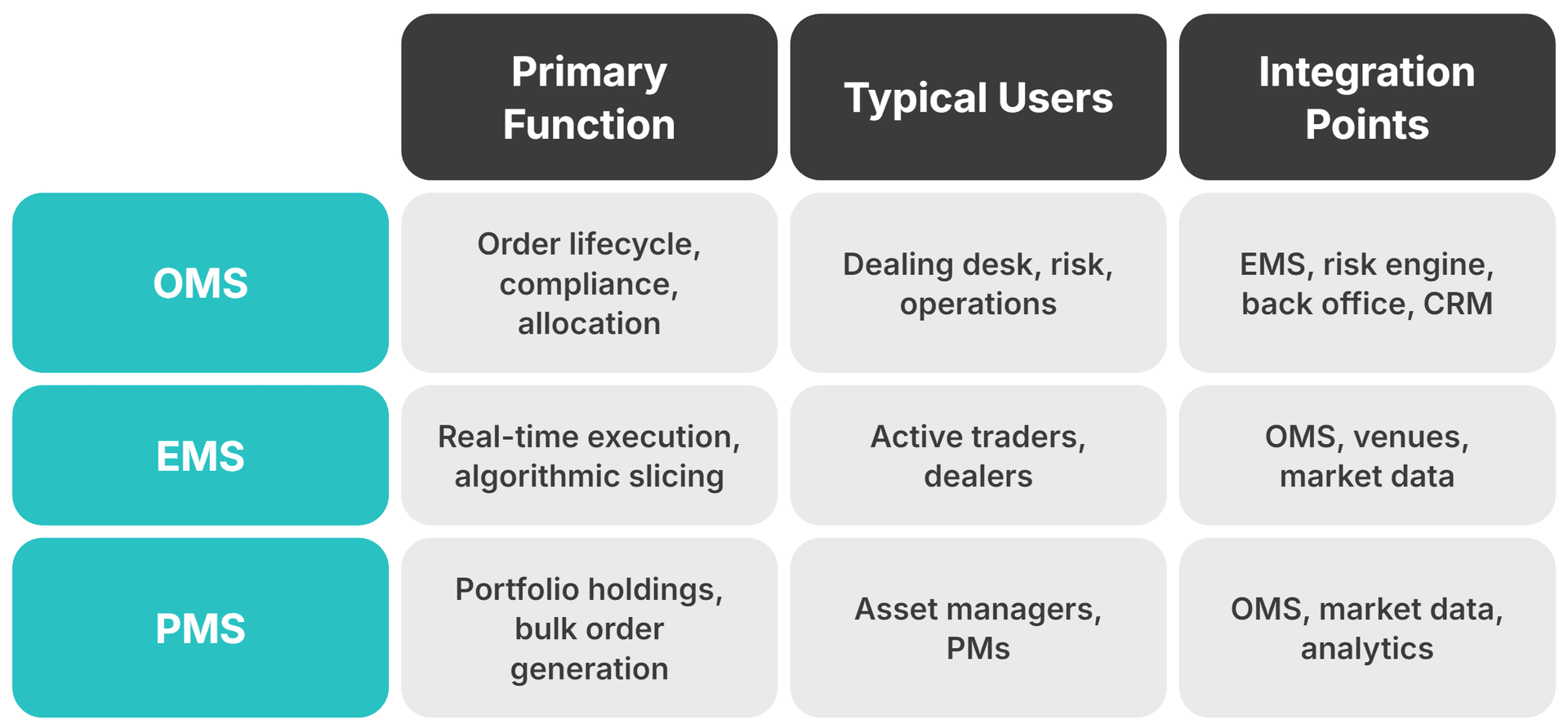
The OMS is the orchestration layer. The EMS handles speed-sensitive execution at the venue level. The PMS generates initial orders that flow downstream to the OMS. Most brokers need both an OMS and an EMS; a PMS becomes relevant only if you manage discretionary portfolios on behalf of clients.
Why Multi-Asset Brokers Can't Just Use Any OMS
The moment you add a second asset class, operational complexity multiplies. A single-asset platform cannot cleanly absorb the differences in settlement cycles, margin treatment, symbology, and regulatory reporting across product lines. A purpose-built multi-asset OMS normalizes these differences without requiring your operations team to manage parallel systems.
Each asset class has fundamentally different rules of engagement. FX and CFDs trade on margin with rolling positions and overnight swaps. Equities require handling corporate actions: splits, dividends, rights issues with varying settlement cycles. Futures have hard expiration schedules. Crypto demands support for fractional quantities, blockchain confirmation timing, and continuous weekend trading. A true multi-asset OMS handles these differences behind the scenes so your team works from one interface.
Order types and time-in-force rules compound this complexity. The OMS must translate market, limit, stop, and trailing orders with precise time-in-force modifiers (GTC, GTD, IOC, FOK) into the exact format each liquidity provider expects, requiring robust symbology mapping across every connected venue.
The most technically demanding challenge is cross-asset netting and real-time exposure management. A unified OMS lets you offset a client's long gold position against another client's short, routing only the net residual to market. That kind of real-time netting is physically impossible when FX runs through one system and crypto through another.
This design also directly shapes how you run your execution model. A-book brokers route orders directly to liquidity providers, making OMS routing accuracy and latency critical to demonstrating best execution. B-book operations internalize client orders, making position netting and real-time exposure visibility the priority. Hybrid models apply both approaches by order size, instrument, and risk appetite, requiring the OMS to execute routing logic dynamically.
Under ESMA's April 2025 RTS on MiFID II order execution policies, regulated brokers must now document venue selection decisions and conduct formal ex-ante and ex-post execution policy assessments. For these firms, automated audit-trail generation is a core OMS requirement, not an optional feature.
If you are planning multi-asset expansion, our guide on how to launch a multi-asset brokerage maps out the full operational journey.
Build the Infrastructure Behind Every Trade
Institutional-grade liquidity, FIX connectivity, and multi-asset routing — purpose-built for brokers who are serious about execution.
Core OMS Capabilities: What to Look For
When evaluating order management software, translate the broad need for an OMS into concrete operational requirements organized by function.
Order Capture
The OMS must function as a universal ingestion layer, capturing orders simultaneously from retail bridges, API connections, and institutional front ends. It normalizes these inputs into a standardized internal format regardless of source. Our breakdown of institutional trading platform infrastructure covers how purpose-built platforms connect into this layer.
Validation and Smart Routing
Before any order reaches the market, the OMS executes pre-trade checks in microseconds: account status, margin sufficiency, instrument tradability, and compliance restrictions. Any failure triggers an immediate rejection with a clear error code.
Once validated, smart order routing selects the execution venue based on real-time pricing, network latency, and historical fill probability. Because best-execution obligations require documented routing decisions, the OMS must log every routing choice with its rationale. Our guide on how smart order routing optimises your trade execution covers the mechanics in detail.
Liquidity Connectivity and Exception Handling
A multi-asset OMS connects to multiple liquidity venues simultaneously, aggregating quotes to build a consolidated view for your dealing desk. The real test is exception handling: partial fills, venue rejects, mid-flight amendments, and cancellations. The system must route around failures automatically, using idempotent message processing to prevent duplicate order submissions.
This resiliency is what protects client trust during volatile markets. Our breakdown of failover trading systems explains the architecture required to maintain accurate order state during upstream venue outages.
The Integrations That Make or Break Your OMS
An OMS delivers its full value only when integrations enable genuine STP. If your operations team reconciles manually at day-end, the integrations are incomplete.
Execution-critical: FIX and platform connectivity. The FIX protocol is the universal standard for order routing between brokers and liquidity providers. Your OMS needs native, optimized FIX support and bi-directional synchronization with MT4/MT5 or proprietary platforms, covering orders, fills, and open positions under peak volume conditions.
Risk-critical: real-time risk engine. The OMS must feed live position data to your risk engine to enforce margin calculations and trigger kill-switch actions on exposure or loss breaches. This integration must operate in sub-second timeframes.
Operations-critical: back office and CRM. The OMS must push executed trade data automatically into your back office: confirmations, clearing instructions, settlement messaging, and reconciliation files. CRM integration ensures client-specific risk profiles and pricing rules are applied at the order validation stage, not manually applied afterward.
Your OMS Needs a CRM That Keeps Up
B2CORE syncs client risk profiles, pricing tiers, and compliance status directly into your order validation layer with no manual handoffs.
Important Risk Controls You Can't Afford to Skip
Risk controls are non-negotiable infrastructure for any broker managing client funds under regulatory oversight.
Pre-Trade Limits and Real-Time Exposure Monitoring
The OMS must enforce hard pre-trade limits: notional size caps, maximum leverage, counterparty concentration limits, and fat-finger checks that block erroneous orders before they execute. Real-time exposure monitoring aggregates positions across all accounts and asset classes to show total margin utilization alongside stress-test outputs.
Kill-switch functionality must be automated: the system halts trading on defined loss or exposure thresholds without requiring dealer intervention. Risk teams must be able to adjust these limits through configuration rather than engineering releases, and every limit check, alert, and override must be captured in the audit trail.
Post-Trade Surveillance and Incident Workflows
Post-trade monitoring surfaces discrepancies between expected fills and actual confirmations, failed settlements, and reconciliation breaks. Structured incident workflows manage the escalation and resolution of each break with documented ownership at each step. Pattern detection covering unusual fill rates, repeated rejects, and latency spikes enables proactive identification of issues before they reach clients.
Build, Buy, or Hybrid: Which Path Makes Sense for You?
OMS selection shapes your operational risk profile and technology budget for years ahead. Each path carries real trade-offs.
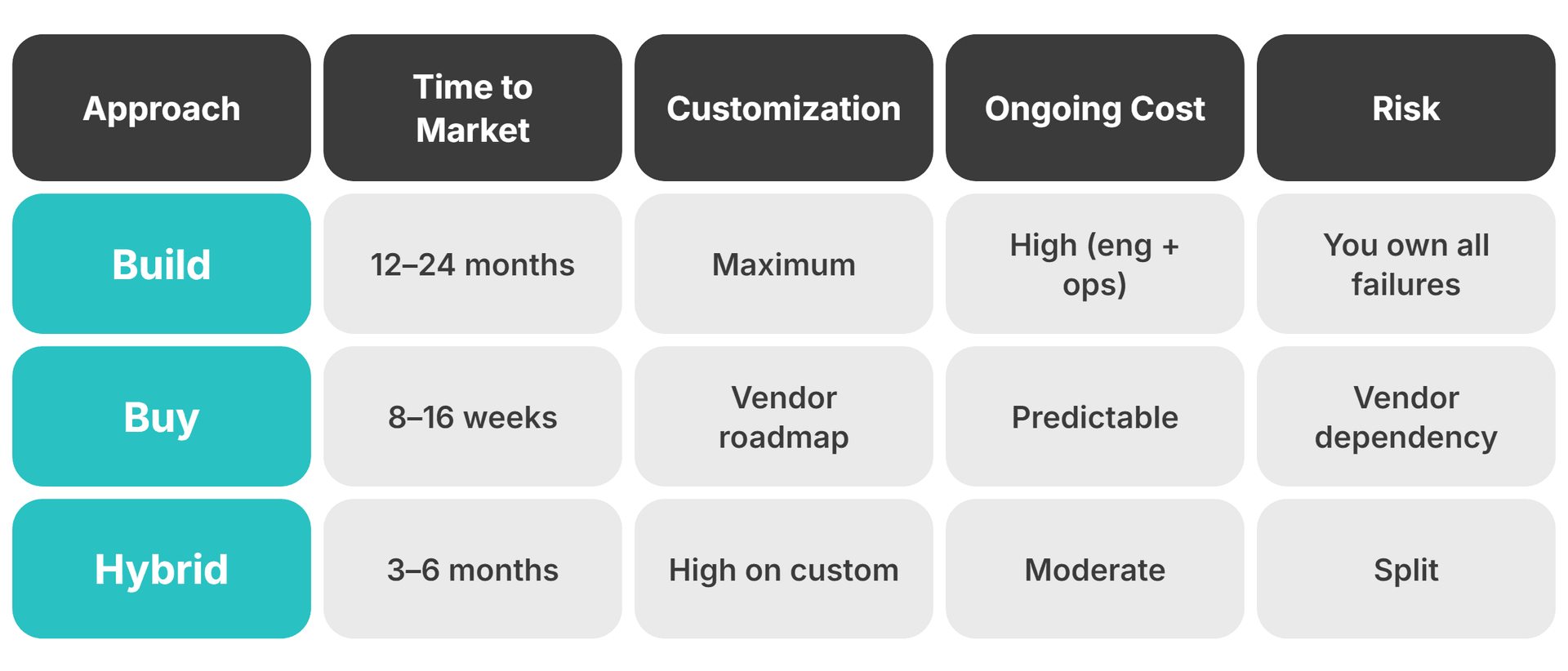
When evaluating vendors, map their capabilities against your must-have requirements first. Then assess total cost of ownership beyond the license: FIX certification fees, hosting, implementation, data migration, and ongoing support. SLAs and escalation response times are operational risk controls. When your trading desk goes down at market open, a vendor with a 4-hour response SLA is not an operational partner.
Getting Your OMS Live and Keeping It Running
OMS value depends on deployment quality and testing depth before any live client order flows through the system.
A standard implementation follows structured phases: discovery and requirements mapping, connectivity setup and venue certification, data migration, UAT and performance testing, then a phased go-live with a parallel run alongside your existing systems. Testing must cover failure scenarios explicitly: network disconnects, partial fills, duplicate messages, and total venue outages. A documented rollback plan is a requirement, not an afterthought.
Once live, track these KPIs to measure operational health:
- Fill rate: percentage of orders executed vs. submitted
- Reject rate: orders rejected pre-trade or by venue
- Latency percentiles (p95/p99): order acknowledgement and execution time
- Break count: reconciliation mismatches per trading day
- Client acknowledgement time: from order receipt to confirmation sent
Your monitoring stack must surface anomalies before clients notice them. As you add asset classes, regions, and venues, test scaling behavior in staging before changes reach production.
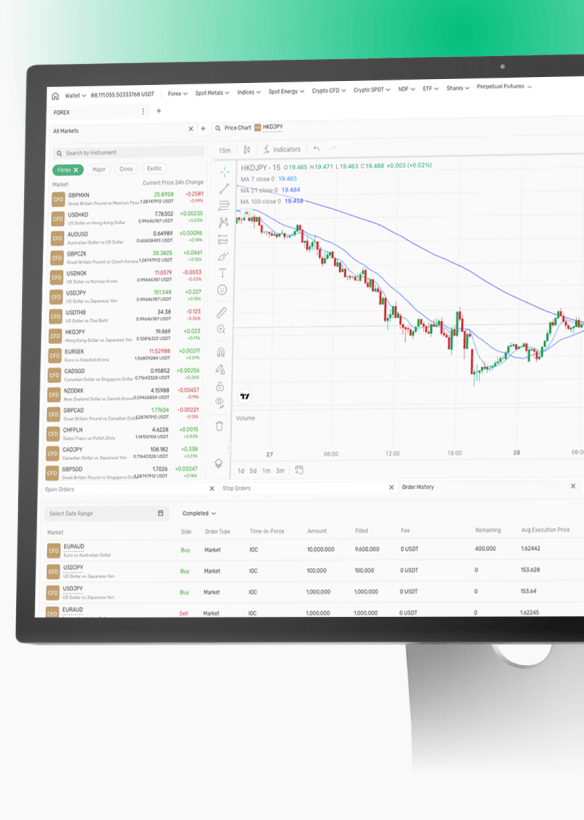
Power your Brokerage with Next-Gen Multi-Asset & Multi-Market Trading
Advanced Engine Processing 3,000 Requests Per Second
Supports FX, Crypto Spot, CFDs, Perpetual Futures, and More in One Platform
Scalable Architecture Built for High-Volume Trading
Ready to Launch? Here's How B2BROKER Can Help
A well-implemented order management system fundamentally upgrades how your brokerage operates: centralized order lifecycle management, genuine multi-asset capability, and the risk controls regulators require.
Building this infrastructure from scratch carries substantial time-to-market risk and ongoing engineering cost. B2BROKER takes an ecosystem approach designed for brokers who need to move quickly. Our solutions integrate institutional-grade OMS capabilities with deep multi-asset liquidity, B2CORE for CRM and client management, B2TRADER for trading platform infrastructure, and enterprise-grade crypto wallet systems.
A tightly integrated ecosystem eliminates the reconciliation gaps and vendor blame cycles that come with stitching together point solutions. B2BROKER provides 24/7 technical support so your trading operations stay running when they need to.
Ready to Upgrade Your Brokerage Infrastructure?
B2BROKER provides the OMS capabilities, liquidity, and CRM tools that multi-asset brokers need to scale without having to build from scratch.
Frequently Asked Questions about Order Management Systems
- What does an order management system do?
An order management system controls the entire trade lifecycle from initial entry to final execution. It connects your dealing desk directly with back-office operations so everyone works from identical real-time data.
- What is the difference between an OMS and a CRM?
An OMS strictly handles trading mechanics like order routing and final execution, while a CRM manages customer relationships and account onboarding. Integrating both allows your infrastructure to apply client-specific risk profiles automatically during the validation process.
- Do multi-asset brokers need separate OMS platforms per asset class?
No, modern platforms consolidate multiple asset classes into one unified system to provide clear exposure visibility. Running separate software for each product line multiplies integration costs and creates dangerous data inconsistencies.
- How long does OMS implementation typically take?
Standard off-the-shelf deployments take between 8 and 16 weeks to complete. Highly customized setups involving multiple venues often require six months or longer depending on your specific integration scope and testing requirements.
- Which integrations are mandatory on day one?
You must initially connect your trading platform to a primary liquidity provider and a real-time risk engine. Back-office connectivity is also required immediately to handle confirmations, while CRM tools can wait for later deployment phases.