Starting a Broker-Dealer: Requirements, Costs, and Key Decisions

Launching a broker-dealer is often perceived as a regulatory maze, but in reality, it is a structured process with dependencies and capital implications that must be carefully planned.
A broker-dealer is an entity that buys, sells, or facilitates securities transactions for clients or its own account. By the definition of the Securities Exchange Act of 1034 under section 15(b), any firm engaged in these activities must register with the US Securities and Exchange Commission (SEC), unless a specific exemption applies.
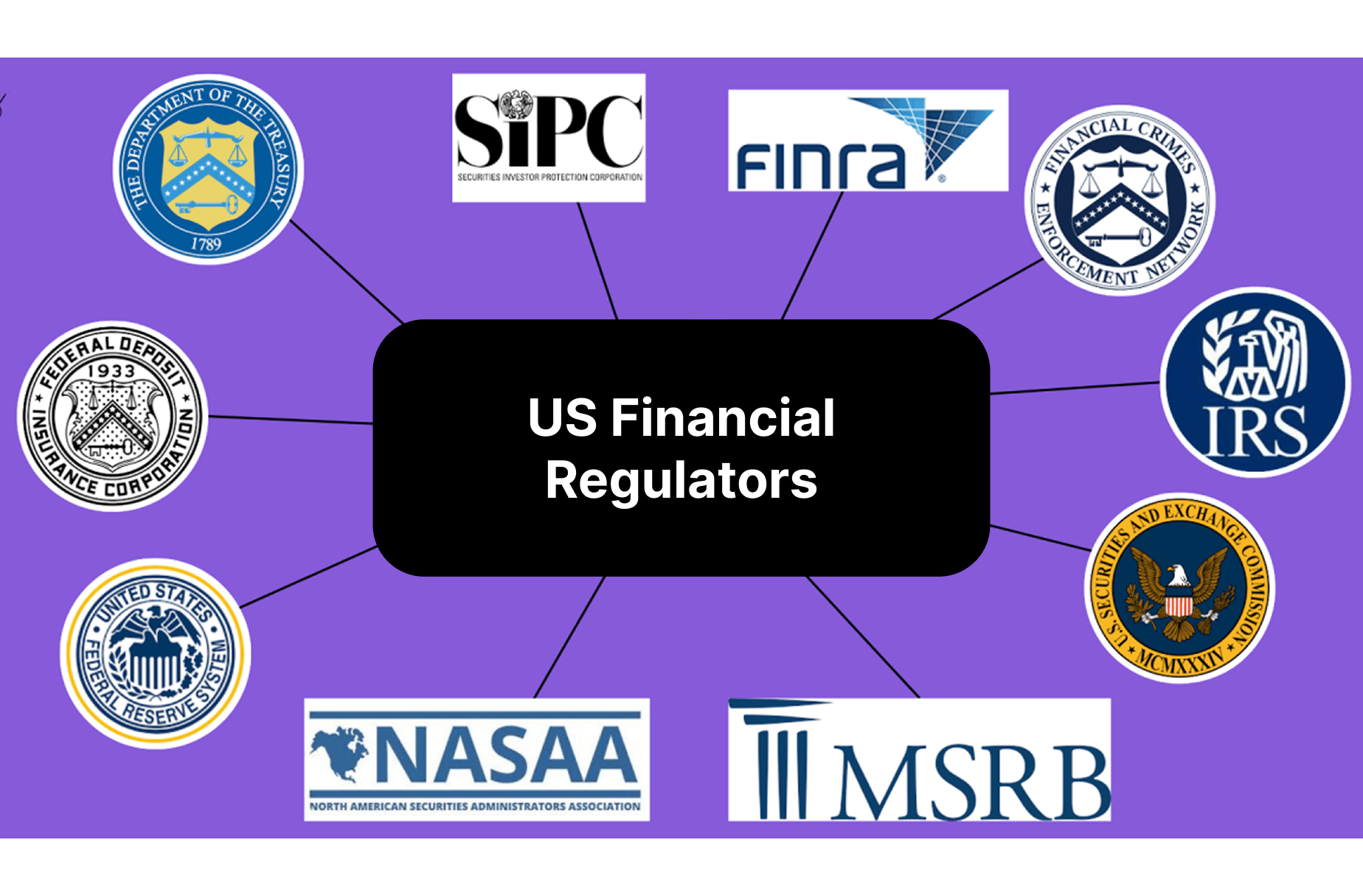
Working as a broker-dealer involves multiple operational and regulatory layers: SEC filings, FINRA membership application, compliance with net capital rules, Securities Investor Protection Corporation (SIPC) enrollment, and reporting timelines.
In this guide, we will navigate through the regulatory framework, registration process, business models, and cost analyses of establishing a broker-dealer firm.
Key Takeaways
- Starting a broker-dealer requires SEC registration, FINRA membership, SIPC enrollment, and state-level filings.
- The SEC Rule 15c3-1 represents a significant financial commitment, with amounts depending on business model and operational scope.
- Choosing between a full-service carrying model, introducing broker structure, or limited-purpose registration shapes capital requirements, compliance obligations, and technology infrastructure needs.
- Partnering with turnkey technology and liquidity providers can compress launch timelines and reduce operational complexity.
Discover the Tools That Power 500+ Brokerages
Explore our complete ecosystem — from liquidity to CRM to trading infrastructure.
Do You Need a Broker-Dealer License?
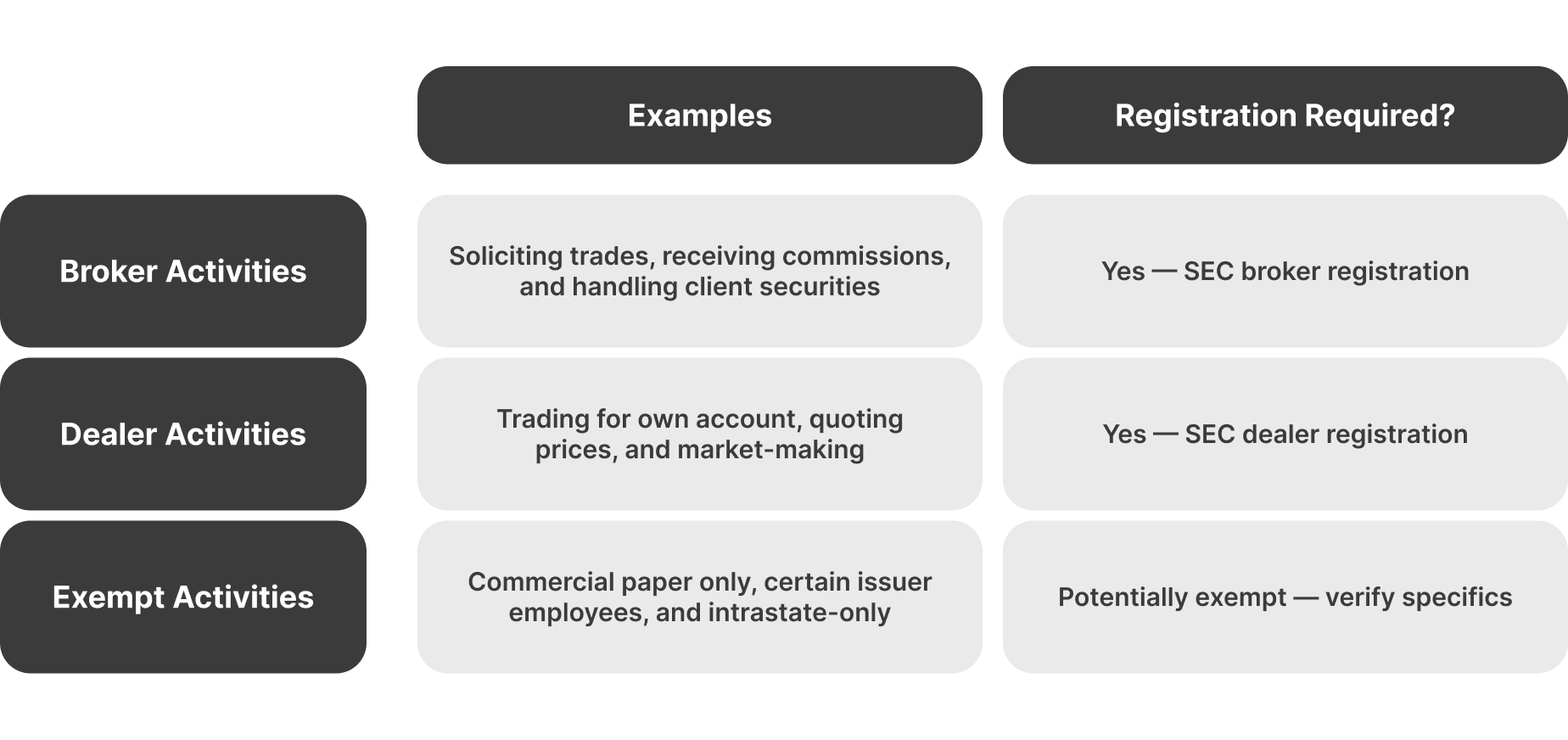
Not every securities-related business activity requires registration. Regulators have exceptions for commercial papers, certain issuer employees, or strictly intrastate transactions under specific conditions.
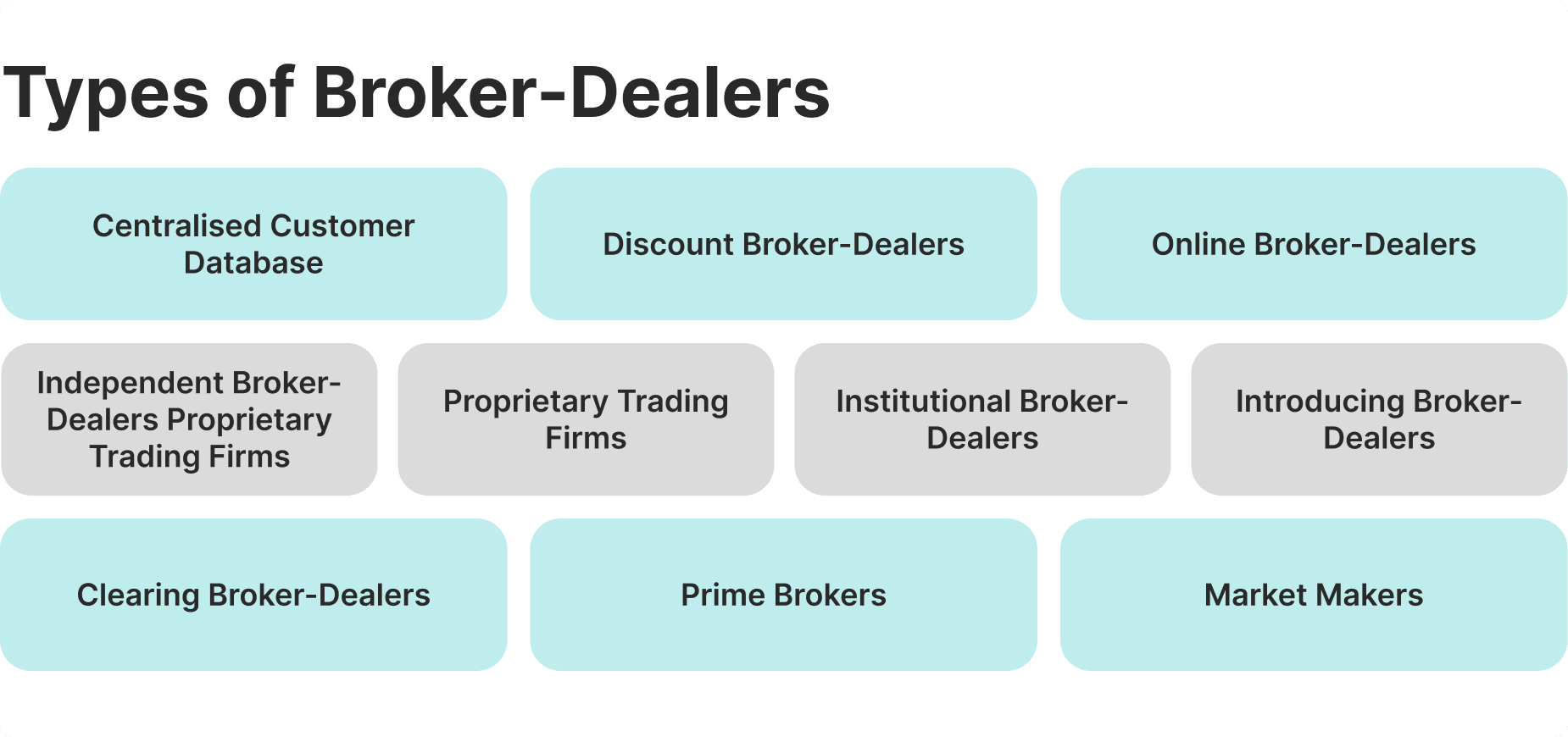
However, these cases are very narrow and specific, and misinterpreting them can lead to enforcement risk and potential penalties.
Broker registration is typically required when a firm solicits or negotiates securities transactions, receives transactional compensation (commissions or fees), or handles customer funds and securities. One of the strongest triggers that entail registration is “Transaction-based Compensation”.
Broker-dealer registration applies when a firm buys and sells securities for its own account, publicly quotes prices, underwrites offerings, or provides liquidity through market-making activities.
In 2024, the SEC expanded dealer definitions to capture certain entities engaged in systemic liquidity provision through routine buying and selling, with compliance deadlines extending into mid-2025. Ultimately, this amendment now covers proprietary trading firms and liquidity providers that operated previously outside the traditional dealer registration framework.
Let’s compare different broker activities and the required licensing.
Key Regulatory Steps to Become a Registered Broker-Dealer
Understanding the full regulatory sequence is crucial to operating legally. SEC registration may depend on membership in a self-regulatory organization (SRO), typically via the Financial Industry Regulatory Authority (FINRA). Also, state filings and SIPC enrollment must be considered alongside federal registration.
Take a look at this roadmap from decision to operational approval.
Step #1: Define Your Business Scope and Exemptions
Every regulatory obligation stems from the business scope. Asset classes, transaction types, geographic reach, and custody arrangements all influence licensing triggers and capital requirements.
Founders must document intended activities before filing: Will you underwrite securities? Offer municipal bonds? Trade government securities? Provide custody? Operate nationally or regionally? Each affects filings and examination requirements.
Limiting the scope to exempt securities, such as commercial paper, may avoid full broker registration, but does not eliminate compliance obligations entirely. Narrow scope simplifies regulatory burden but constrains growth flexibility.
Step #2: File Form BD Through the Central Registration Depository
Form BD (Broker-Dealer) is the primary SEC registration document. It is filed electronically through FINRA’s Central Registration Depository (CRD) system.
This application discloses firm ownership structure, control persons, business lines, disciplinary history, and associated individuals. It also identifies the SRO through which the firm seeks membership.
After submission, the SEC responds within 45 days, whereas approval often depends on concurrent progress with FINRA membership. Filing Form BD also initiates state registrations and SIPC enrollment workflows, making it a central regulatory checkpoint.
Step #3: Submit the FINRA New Member Application
FINRA membership is typically the most demanding phase. The New Member Application (NMA), governed by FINRA Rules 1000/1010 series, requires detailed disclosure of business plans, supervisory systems, financial statements, and compliance infrastructure.
FINRA evaluates whether the applicant can operate in compliance with securities laws and SRO rules. It strictly scrutinizes written supervisory procedures (WSPs), AML programs, organizational charts, technology descriptions, and capital adequacy.
This application process may extend beyond the SEC’s 45-day window and often serves as the pacing factor in launch planning, where review speed influences preparation quality.
Step #4: Secure SIPC Enrollment and State Registrations
Membership in the Securities Investor Protection Corporation (SIPC) is mandatory for most broker-dealers that handle customer securities. This regulatory body provides limited protection in cases of firm insolvency.
Add to that state securities regulators, which vary by jurisdiction and may require additional filings, fees, and individual registrations via Form U4. Federal registration does not replace state requirements; it operates in parallel.
Step #5: Qualify Principals and Associated Persons
Individuals must be associated with a registered firm before acquiring securities licenses. Common qualification exams include Series-7 for general securities representatives, Series-63 for state law compliance, and Series-24 for principals.
Note that additional testing may be required depending on the business scope, and Form U4 registers associated persons through the CRD system and links them to the firm’s registration.
Business Models for a New Broker-Dealer Firm
Your business model determines regulatory burden, such as capital minimums, compliance complexity, and infrastructure requirements.
Full-Service Carrying Model
A carrying broker-dealer holds customer funds and securities, clears its own trades, and maintains custody. This model provides maximum control over client assets, revenue streams, and operational flexibility.
However, it requires the highest net capital, robust custody arrangements, sophisticated back-office systems, and extensive recordkeeping infrastructure, making compliance oversight quite intensive.
This model suits well-capitalized founders pursuing institutional-scale ambitions and long-term growth strategies.
Introducing or Agency-Only Model
An introducing broker executes trades for clients but clears them through a carrying firm. This model has lower capital requirements, lower operational complexity, and a faster time-to-market.
However, the trade-off is reduced margin and limited control over clearing functions. Many founders adopt this model to validate market demand before scaling into carrying operations.
Limited-Purpose Single-Asset Model
Limited-purpose registrations focus on specific activities such as private placements, investment advisers, or Mergers and Acquisitions experts. Established firms prefer this model for its narrow scope, which reduces capital and compliance requirements.
However, expansion into additional business lines may require amended filings and increased capital commitments, making it appropriate for specialized strategies with clearly defined service boundaries.
Startup Costs and Net Capital Considerations
Startup costs vary widely by model, jurisdiction, and operations complexity.
Key cost drivers are SEC/FINRA filing fees, state registration fees, legal and compliance consulting, audit services, technology infrastructure, and ongoing net capital reserves.
Founders must also consider the net capital requirements under SEC Rule 15c3-1, which sets the minimum liquid capital a broker-dealer must maintain. The required amount depends on activity type, custody status, and exposure. This means that net capital is not a one-time deposit but an ongoing operational constraint that affects growth and risk.
When planning a broker-dealer business, you must carefully consider emergency funds and maintain cash reserves for additional requirements, as underestimating compliance and infrastructure costs is a common mistake that can delay your business launch.
Designing a Compliance and Supervision Program
Compliance is a tough challenge for broker-dealers, and it is central to FINRA approval and long-term viability. The NMA review process scrutinizes supervisory structures, WSPs, AML frameworks, and surveillance systems.
Core components include trade monitoring, customer assessments, anti-money laundering programs, and comprehensive books-and-records maintenance. Firms must designate a qualified Chief Compliance Officer early and align procedures with regulatory expectations and clear documentation.
A key tip to streamline compliance screenings is integrating RegTech to automate surveillance tools, exception reporting systems, and audit trail capabilities.
Weak compliance programs and fragmented manual procedures can lead to delayed filings, incorrect submissions, and even denied applications.
Technology Stack: From Trading Platforms to Client Onboarding
Technology is the operational backbone of a broker-dealer. It determines execution quality, scalability, reporting efficiency, and client experience.
Core components of a brokerage ecosystem include trading platforms, such as MT4, MT5, or proprietary systems; order management systems; CRM and onboarding tools; risk management systems; and back-office reporting infrastructure.
This stack and the efficient integration between them influence operational complexity, time-to-market, and cost structure. Therefore, you need to evaluate whether to build proprietary infrastructure, license third-party platforms, or partner with turnkey providers.
You can differentiate your firm by getting institutional-grade liquidity, ensuring cutting-edge API connectivity, and adopting granular risk controls within the infrastructure. This selection process should happen during the registration process so you become operationally credible during regulatory review.
Get an Institutional-Grade Infrastructure
Our experts will help you build a unique brokerage firm, totally customized to your needs
Operational Timeline and Resource Planning
The process from feasibility to launch typically spans six months to over a year. You must consider pre-filing preparation, which includes business scoping, compliance drafting, technology selection, and capital planning. Application submission triggers SEC and FINRA review cycles, which may involve additional information requests.
You must plan buffer time for regulatory questions and compliance preparation, as operational activation is only permitted after final approval is granted.
Before submission, you must assemble the core leadership board: compliance officer, operations head, and technology partners, while parallel workstreams across technology, licensing, and state filings can accelerate timelines.
In a nutshell, the NMA process demands sustained leadership engagement, thoughtful filing planning, and strategic resource allocation.
Partnering vs. Building Your Own Brokerage Infrastructure
Whether you build or get a ready brokerage infrastructure, this decision shapes capital efficiency and speed to market. What’s the difference?
Proprietary infrastructure offers maximum customization but requires significant investment and extended development timelines.
Turnkey providers compress timelines and reduce technical complexity by delivering integrated trading platforms, CRM systems, liquidity aggregation, and back-office tools in one solution.
This does not mean that any off-the-shelf infrastructure is suitable; you must evaluate technology reliability, liquidity depth, integration flexibility, regulatory support capabilities, and long-term innovation roadmap.
Power your brokerage with cutting-edge technology. From AI-driven trading to risk-proof security, discover top solutions and expert tips to start a brokerage firm.
22.05.25
Hybrid models are gaining popularity, with core infrastructure outsourced while client-facing features built internally, balancing control and efficiency.
Accelerating Your Launch With B2BROKER
Launching a broker-dealer requires coordinated decisions across regulation, capital, compliance, and infrastructure. Each choice influences approval timelines, operational risk, and scalability.
Making these financial, compliance, and operational decisions alone can be daunting because regulations are full of complex terms and challenging requirements. We are the experts—with 10+ years of experience and 500+ specialists worldwide—to ensure you launch correctly and efficiently.
B2BROKER provides a comprehensive ecosystem for new broker-dealers, including multi-asset liquidity aggregation, trading platforms such as MT4, MT5, and B2TRADER, CRM and back-office solutions through B2CORE, and integrated wallet systems via B2BINPAY.
Our institutional-grade infrastructure facilitates scalable growth, with 24/7 support, continuous platform innovation, and a focus on strategic differentiation rather than technical complexity.
Have a Question About Your Brokerage Setup?
Our team is here to guide you — whether you're starting out or expanding.
Frequently Asked Questions about Starting a Broker Dealer
- How much does it cost to start a broker-dealer?
Startup costs vary significantly based on business model and scope, but founders should budget for SEC/FINRA filing fees, legal and compliance consulting, technology infrastructure, and ongoing net capital reserves that can range from tens of thousands to several hundred thousand dollars or more. The introducing broker model typically requires lower capital than full-service carrying firms.
- How long does it take to become a broker-dealer?
The registration process typically spans six months to over a year, with the SEC’s initial registration form taking up to 45 days and FINRA’s New Member Application often representing the longest phase due to rigorous business plan and compliance infrastructure review. Parallel preparation of technology, personnel qualifications, and state filings can help compress overall timelines.
- Can I start my own brokerage firm without prior industry experience?
Yes, but FINRA’s New Member Application scrutinizes the qualifications of registered representatives and compliance officers, so founders without securities industry backgrounds typically need to hire experienced compliance professionals and may face additional scrutiny during the review process. Partnering with experienced legal counsel and technology providers can help bridge knowledge gaps.
- Do I need separate registrations for crypto assets?
Digital asset activities may trigger additional registration requirements depending on whether the assets qualify as securities under SEC guidance, and some crypto-related activities fall under state money transmitter laws or CFTC jurisdiction. Founders planning multi-asset offerings should conduct a thorough legal analysis of each asset class before finalizing their registration strategy.
- When should I engage technology vendors during the registration process?
Technology vendor selection should begin during the pre-filing preparation phase, as FINRA’s NMA review evaluates your operational infrastructure, and demonstrating a credible technology roadmap strengthens your application. Early engagement also allows time for integration testing and staff training before launch.
Recommended articles