How to Build a High-Performance Crypto Exchange App: A Guide for Brokers and Exchanges

Mobile order volume dominates the global cryptocurrency trading landscape in 2026. Your crypto exchange app's performance and service level determine whether you retain active traders or lose to competitors.
This guide outlines the strategic architecture for building a scalable exchange app. We focus on engineering decisions that drive stability and also explain how B2BROKER infrastructure can accelerate your time to market.
Key Takeaways
- Mobile interfaces now execute over 60% of total global crypto transaction volume.
- Professional traders demand sub-100ms latency to ensure accurate price execution.
- Native architecture offers superior performance for biometric security and real-time charting.
- In-app identity verification automates compliance without destroying onboarding conversion rates.
- Users with installed apps engage with trading platforms three times more frequently than web-only clients.
Download the free PDF guide covering the key decisions, common mistakes, and real costs of starting a crypto exchange.
Crypto Exchange App: What It Is and Why It Matters
A cryptocurrency exchange app is the mobile terminal where your clients execute trades and manage capital. It connects users directly to the matching engine, enabling real-time order placement from any location.
Unlike passive wallets or long-term investment tools, this interface drives active volume against live order books.
Today, mobile devices generate the majority of retail trading volume for brokerages. The FINRA Investor Education Foundation study found that 81% of U.S. adults with bank accounts use their mobile devices to access checking or savings accounts.
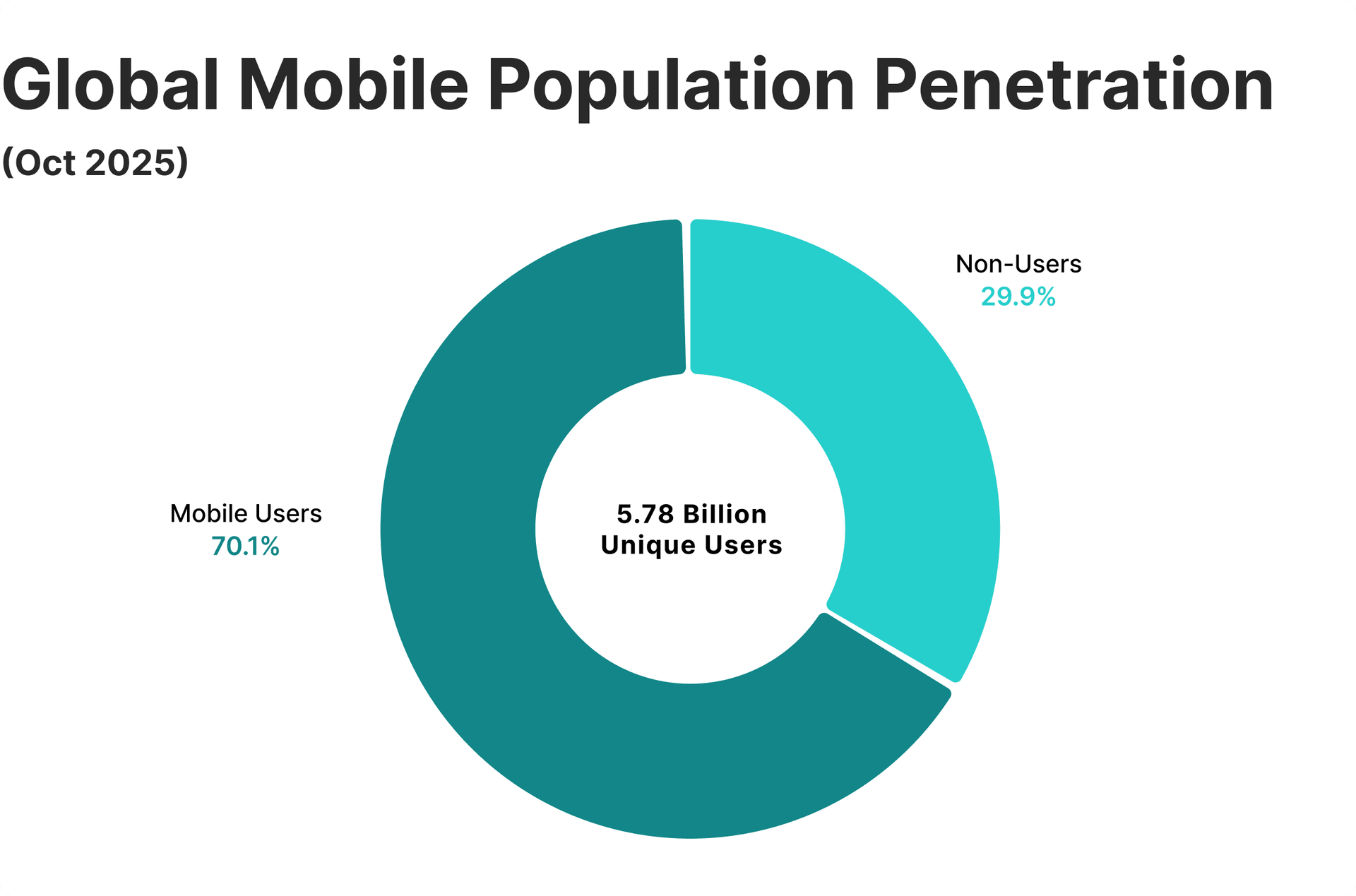
As of October 2025, unique mobile users reached 5.78 billion, covering 70.1% of the global population. In key markets such as the U.S., the UK, and South Korea, adult smartphone ownership exceeds 95%.
Traders treat the smartphone as their primary terminal rather than a secondary monitoring tool. Active clients open the app dozens of times daily to check positions and react to volatility. For many, this screen becomes the primary point of contact with market liquidity.
The Role of Mobile Apps in Modern Crypto Trading Ecosystems
Crypto exchange apps are the central revenue engine for modern trading businesses. With mobile interfaces accounting for over 60% of global web traffic, including crypto transaction volumes, traders increasingly utilize these platforms to execute complex strategies.
Impact on Liquidity Perception and Execution Trust
The mobile interface directly shapes a trader's perception of market depth. A delayed order book update or a lagging price chart creates the impression of poor liquidity, even if the backend matching engine functions correctly.
Rendering tight spreads on a small screen requires efficient data handling. If the spread flickers or widens due to app-side processing lag, the user perceives a brokerage or exchange as expensive.
Visual stability builds trust in the venue’s execution capabilities. Clients will equate your exchange app's responsiveness with the brokerage’s overall financial health.
Eliminate Slippage With Institutional-Grade Liquidity
Connect to the deepest crypto pools with B2CONNECT and deliver the tight, reliable spreads that professional traders demand.
The Role Of Apps In Retention and Engagement
High-quality mobile experiences significantly extend client lifetime value (LTV). Data suggests that users with installed apps engage with the platform three times as often as web-only clients. Push notifications regarding price levels or order fills trigger immediate sessions, keeping capital active.
Practical roles mobile apps play in growth and retention:
- Short-session conversion: Fast onboarding and a reliable first trade raise activation metrics.
- Continuous engagement: Frequent price checks raise lifetime touchpoints per user.
- Behavioral data: On-device signals enable targeted merchant and product strategies.
Modern user acquisition relies heavily on app store presence and ratings. A substandard mobile experience limits the effectiveness of marketing spend. Investing in high-performance mobile infrastructure secures the brokerage’s position in a market driven by accessibility.
Institutional Expectations for Mobile Platforms
Professional users expect functional parity between web and mobile platforms. Corporate desks utilize mobile apps to monitor exposure and intervene during automated strategy malfunctions. A simplified application lacking advanced charting or complex order types fails to meet this segment's needs.
Institutional clients require full control over portfolios and sub-accounts from handheld devices. So, neglecting the mobile layer creates a hard ceiling on exchange scalability.
Core Crypto Exchange App Models and Use Cases
The technical architecture of a mobile exchange app depends on the underlying business model. Different exchange types require specific approaches to wallet management, order matching logic, and user interface design. Selecting the right model early determines your platform's scalability and regulatory path.
1. Centralized Exchange Apps
Centralized exchanges (CEX) run against a central order book and usually hold user assets on behalf of clients. These platforms support fast matching and deep liquidity, which lets mobile interfaces show real-time volumes and advanced order types.
Such apps offer fast matching and the depth of features that active traders expect, including margin trading, derivatives, and staking. However, holding user assets also means rigorous security protocols and strict adherence to Know Your Customer (KYC) and Anti-Money Laundering (AML) regulations.
Typical mobile capabilities for centralized apps:
- In-app fiat on-ramps and custodial balance management.
- Multiple order types and margin position controls.
- Engines capable of processing 10,000+ transactions per second.
- Advanced order types rendered with live market data.
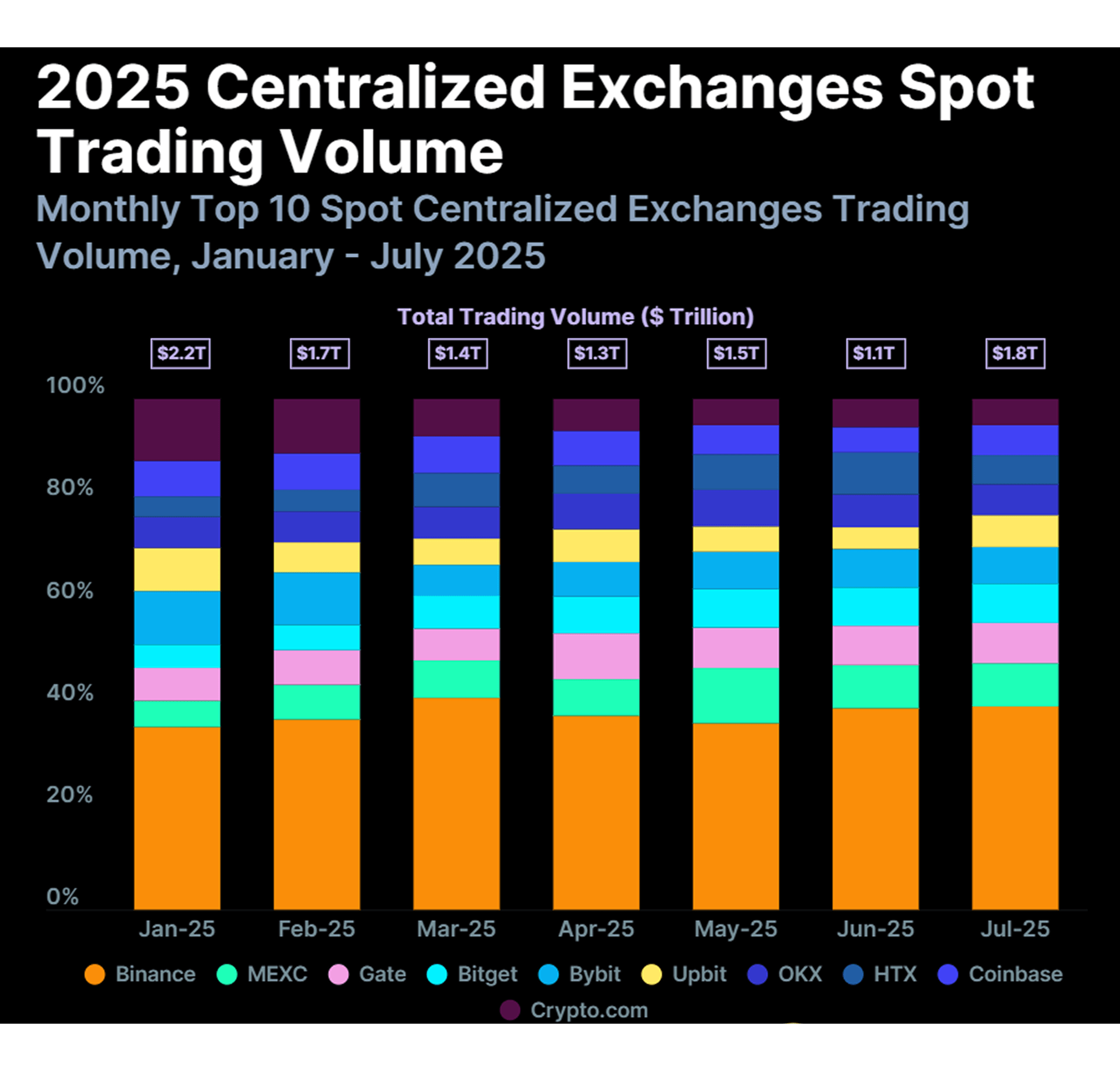
Leading centralized venues like Binance and Coinbase account for the bulk of on-chain and off-chain trading volume in the crypto market: industry trackers record trillions in annual turnover across the top CEX platforms.
2. Hybrid Exchange Apps
Hybrid apps merge the speed of centralized matching with the security of non-custodial settlement of a decentralized exchange (DEX). The app architecture separates the trading layer from the custody layer, so users retain control of their private keys while the operator facilitates order discovery off-chain.
Typical app considerations include:
- Rapid price discovery without immediate blockchain congestion.
- The operator does not hold client funds directly.
- Users sign transactions via external wallets like MetaMask.
Hybrid designs reduce the exchange's liability for user funds but alter the user experience significantly. Onboarding friction often rises as clients try to manage their own wallet connections and transaction signing processes at once.
3. P2P and Instant Exchange Features
P2P and instant exchange features focus on fast conversions and peer matching rather than deep order books. These modules suit retail users prioritizing speed and simplicity.
P2P suits regions with limited banking infrastructure or specific remittance use cases. Operational challenges of this model include managing dispute resolution workflows and fragmented liquidity.
Typical mobile capabilities for P2P and instant exchange apps:
- Quote-driven swap screens with time-bound pricing.
- Dispute management and escrow visibility.
- Lightweight identity checks aligned with local regulations.
Most modern brokerages prioritize the centralized model for its scalability and execution control. It remains the best architecture for supporting the high-frequency volume and tight spreads required by professional traders.
What Makes Crypto Exchange App Development Uniquely Complex?
Developing a crypto exchange app requires solving engineering problems that standard fintech products rarely encounter. The architecture must process high-frequency data streams while managing custodial assets in an environment where downtime equals direct financial loss. The combination of 24/7 cryptocurrency market activity and irreversible transactions creates an unforgiving technical baseline.
- Real-time Data Synchronization
Market data changes thousands of times per second. The app must render these updates via WebSockets without draining the device battery or freezing the UI thread. Stale prices lead to rejected orders and immediate user churn.
- Latency Sensitivity
Traders operate in milliseconds. The mobile client must serialize orders and transmit them to the matching engine instantly. Any delay added by the application layer results in slippage, causing the user to enter positions at worse prices than displayed.
- Volatility-Driven Traffic Spikes
Crypto markets trade continuously and experience sudden surges in activity. Bitcoin and Ethereum have recorded intraday price moves exceeding 10 percent multiple times in recent years, driving sharp increases in concurrent users. Apps must absorb these bursts without degrading responsiveness or order accuracy.
- Variable Network Conditions
Mobile devices frequently switch between Wi-Fi and cellular networks or lose signal entirely. The app requires robust reconnection logic to pause and resume data streams without forcing the user to re-authenticate or lose unsaved order details.
- App Lifecycle Management
Users constantly background the app to check alerts or answer calls. The operating system often kills the process to save memory. The code must handle socket disconnection and state restoration gracefully so the trader returns to the exact same context.
- Release Cycle Constraints
Apple and Google review processes introduce delays for updates. Developers must build feature flags and server-side configuration switches to manage incidents without waiting for store approval.
- Regulatory Compliance Integration
Onboarding flows must satisfy multi-jurisdictional KYC requirements without destroying conversion rates. The app must integrate liveness checks and document scanning natively while ensuring no sensitive user data remains cached on the local device.
Mobile-First Architecture for Scalable Exchange Apps
Your architectural choices determine the long-term viability of your trading business. Decisions made during the initial build phase impact everything from execution speed to how quickly you can deploy security patches.
Native vs Cross-Platform Development
Your first major technical decision is the development approach. Native development involves writing distinct codebases specifically for iOS (using Swift) and Android (using Kotlin). Cross-platform frameworks, such as Flutter or React Native, allow developers to write a single codebase that runs on both operating systems.
Cross-platform solutions reduce initial cryptocurrency exchange development time and costs. However, they rely on a translation layer between your code and the device hardware. This extra step often introduces micro-latency during high-load scenarios.
Native development grants direct access to the device's processor and memory. You need this level of control to optimize biometric security features and maximize frame rates on complex charting modules.
API-First and Microservices Design
An Application Programming Interface (API) is a bridge that transmits data between your user’s mobile device and your backend server. An API-first approach means defining these data contracts before building the interface. This sequence guarantees your mobile client consumes data efficiently without requesting unnecessary information.
Legacy systems often use a "monolithic" architecture, where all functions exist in one massive block of code. Microservices break your architecture into independent functional units:
- Order Matching Engine: Handles trade execution and balance updates.
- User Authentication: Manages logins and security protocols.
- Wallet Service: Controls deposits and withdrawals.
If high traffic stresses your crypto wallet service, the matching engine remains unaffected. You can scale specific components to meet demand without redeploying the entire system.
Global Availability and Latency Management
Physical distance creates an unavoidable data lag. If your matching engine sits in London but your trader operates from Tokyo, execution speed suffers. You must deploy geo-redundant clusters to place execution logic near key markets.
Content Delivery Networks (CDNs) store static assets like icons and charts on servers located at the network edge, closer to the user. The mobile app loads the interface locally while only essential price data travels to the core server. This configuration preserves bandwidth for trade execution.
Monitoring, Observability, and Crash Analytics
You cannot fix performance bottlenecks that remain invisible. Mobile environments vary wildly across thousands of device models and operating system versions. Your developers need granular visibility into application performance under real-world conditions.
Implement real-time observability tools to track error rates. Such systems monitor specific metrics like API response times and login success rates. If a specific OS update breaks a feature, automated alerts notify your engineering team immediately. You identify and resolve issues before user complaints overwhelm customer support staff.
Designing High-Performance Trading UX on Mobile
Trading UX defines the gap between profit and loss. A user-friendly interface accelerates decision-making, while clutter leads to costly input errors. Your design choices directly influence whether a trader trusts the platform enough to deploy significant capital.
Performance, Latency, and Uptime Expectations
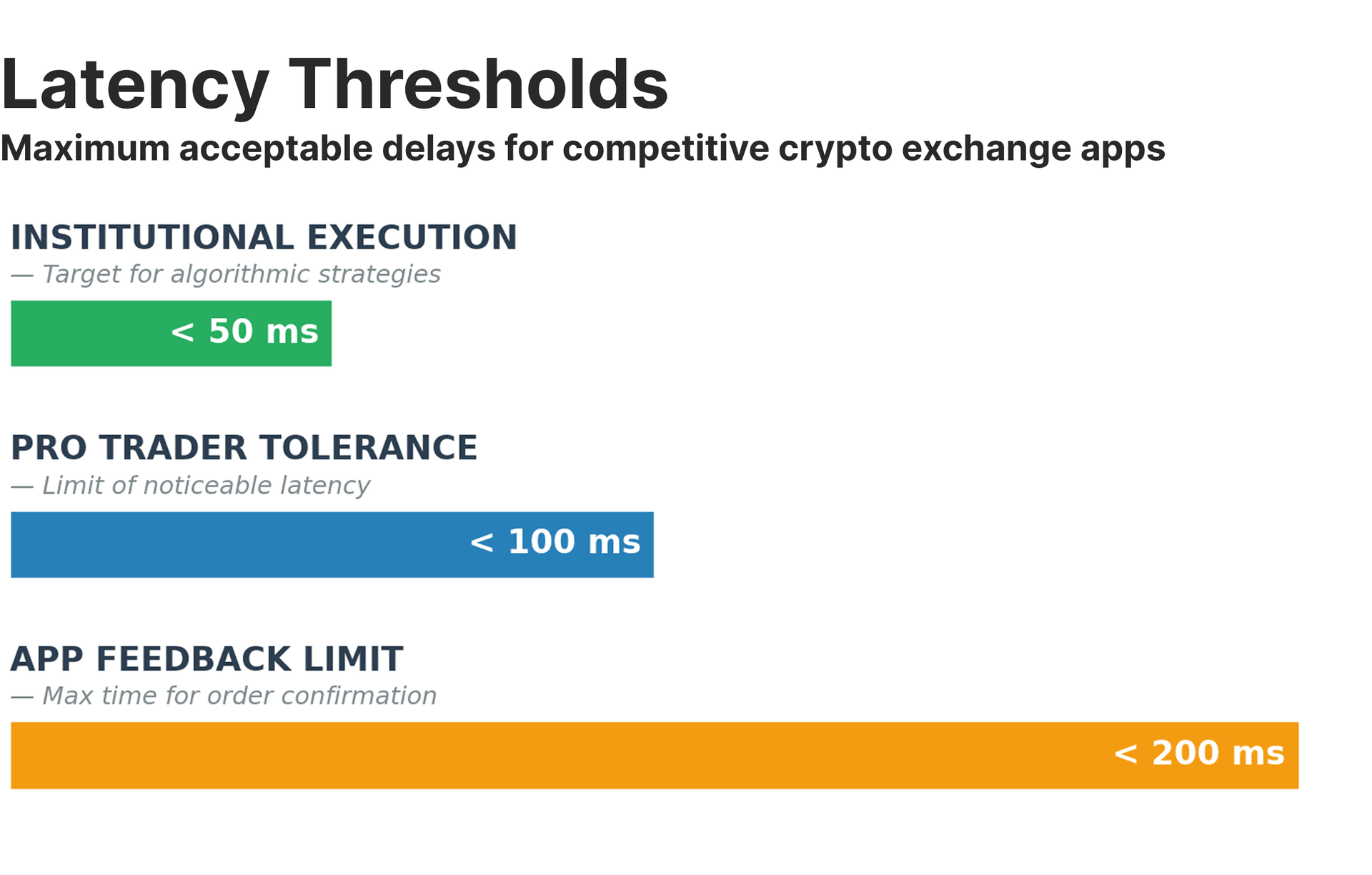
Performance sets expectations long before users evaluate features. Delays above 100 milliseconds become noticeable during active trading, especially when prices update rapidly. Your mobile app must deliver consistent refresh rates and reliable availability because even short outages interrupt order flow and reduce displayed liquidity.
- Interactions must feel instantaneous to prevent perceived arbitrage losses.
- Background systems must switch data sources automatically if a primary feed stalls.
- The UI must handle rejected orders gracefully without leaving the user in an uncertain state regarding their position.
Order Placement and Confirmation Flows
The order entry screen requires a balance between speed and safety. One-tap trading modes suit high-frequency strategies, whereas large block orders require clear confirmation summaries to prevent "fat-finger" errors.
The UI/UX design must acknowledge the interaction immediately before the network processes the order, which will prevent your users from tapping twice and accidentally doubling their exposure during network lag.
Charts, Depth, and Order Book Visibility
Displaying Level 2 market data on mobile screens presents a spatial challenge. You cannot simply shrink desktop charts. Mobile interfaces require adaptive layouts that prioritize the spread and nearest 5-10 order layers.
Depth charts should overlay price action subtly. This approach helps traders to gauge liquidity depth without losing sight of the immediate trend. Complex indicators must scale correctly to remain readable without obscuring the candlestick patterns that drive technical analysis.
Retail vs Professional Trader Experiences
Your target audience can include both casual buyers and algorithmic traders. A single rigid interface fails to serve either group effectively. Implement progressive disclosure to hide complex order types like "Fill or Kill" (FOK) or "Immediate or Cancel" (IOC) for new accounts.
Advanced users require "Pro" modes. These views expose API keys, raw data feeds, and granular charting tools. Customization options let power users strip away educational tooltips to maximize screen real estate for raw market data.
Localization and Accessibility
Asian markets often expect red to signify a price increase, while Western markets use green. Your app must adapt color logic, currency formatting, and number separators automatically based on the user's region.
Accessibility features like high-contrast modes create usability for traders with visual impairments. Meeting these standards widens your potential market reach and ensures compliance with digital accessibility regulations in strict jurisdictions like the EU and the US.
Security and Compliance in Crypto Exchange Apps
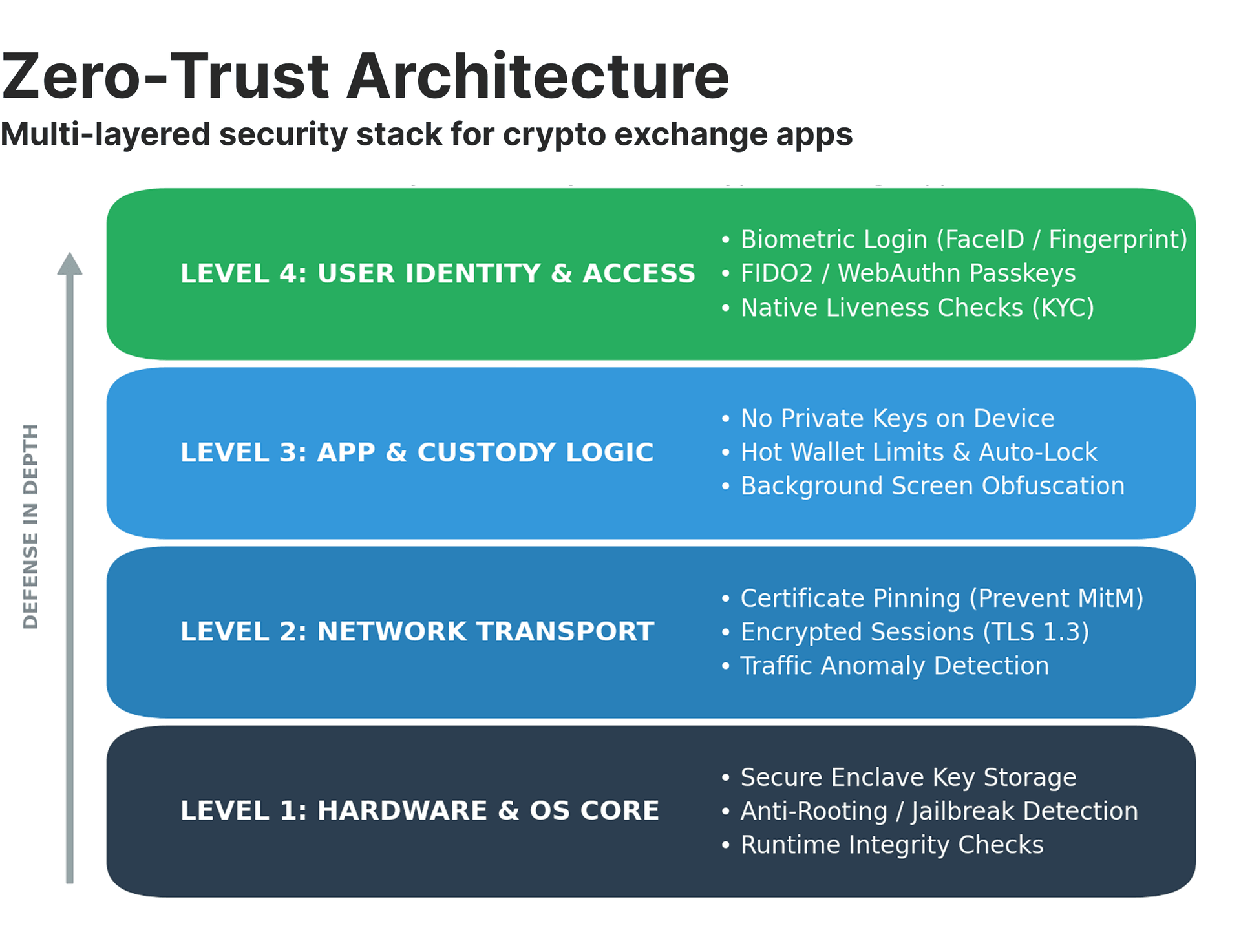
Mobile trading places your exchange terminal in an uncontrolled environment. Devices often get lost, stolen, or connected to malicious public networks. You must build a zero-trust architecture that assumes the hardware itself is compromised.
Mobile Attack Surfaces and Device Risks
Mobile operating systems introduce risks that do not exist on desktop platforms. Compromised devices, screen injection attacks, and insecure Wi-Fi connections remain common. OWASP consistently lists insecure data storage and weak runtime protection among the most frequent mobile vulnerabilities affecting financial apps.
Modern exchange apps mitigate these risks through layered controls:
- Hardware-backed key storage tied to secure device enclaves.
- Runtime checks that detect rooting, emulation, or screen capture.
- Encrypted network sessions with certificate pinning.
These measures operate silently and preserve trading usability.
Wallet Integration and Asset Custody
Wallet design defines how crypto assets move between trading and storage layers. Most exchanges route active balances through hot wallets, maintain operational buffers in warm storage, and secure the majority of funds offline.
You limit potential losses from a compromised user session by enforcing strict daily withdrawal limits on the hot wallet layer. The mobile interface should only display balances. It must never store the private keys that control the core treasury on the local device storage.
Authentication and Session Management
Static passwords provide insufficient protection for high-value financial targets. While modern standards mandate Two-Factor Authentication (2FA), FIDO2-compliant Passkeys offer the definitive defense. This technology renders credentials immune to phishing sites and remote credential harvesting by anchoring cryptographic tokens to device hardware.
Biometric login via FaceID or fingerprint sensors reduces friction while binding access to a specific physical user.
Session management protocols must also be aggressive. For example, configure the app to auto-lock after 5 to 10 minutes of inactivity. This prevents unauthorized access if the trader leaves their phone unlocked.
KYC and AML Flows Optimized for Mobile
Strict regulatory requirements often destroy onboarding conversion rates. Mobile-first Identity Verification (IDV) reverses this dynamic by automating manual entry. Your team can also leverage native Optical Character Recognition (OCR) to extract data from government IDs instantly.
Effective mobile-first compliance balances speed with accuracy:
- Real-time validation during document capture.
- Clear progress indicators during review.
- Immediate feedback on failed checks.
Crucially, you should execute this entire workflow inside the application. Redirecting users to external mobile browsers for document uploads disrupts the journey and significantly increases abandonment.
All-In-One CRM & Back Office for Brokers and Exchanges
Fully Customisable Trader’s Room with Modular Features
Built-In IB Module, KYC, Payment Integrations, and Reporting Tools
Intuitive Interface that Boosts Client Engagement
Key Features That Power Competitive Crypto Exchange Apps
Evaluate every mobile feature by its impact on capital efficiency and trade volume. A lean, high-performance feature set encourages frequent activity and maximizes client lifetime value.
Trading and Execution Layer
The core engine must support diverse strategies to retain professional volume. While market orders satisfy basic needs, advanced traders require limit, stop-loss, and take-profit functionality. You must deliver execution feedback in under 200 milliseconds. If the app confirms a trade late, the user doubts the fill price accuracy and moves capital elsewhere.
Wallet and Asset Management
The wallet module must display clear status updates for blockchain technology confirmations to prevent anxiety. Ambiguity regarding deposit delays generates support tickets. Implementing address whitelisting and QR code scanning reduces input errors, protecting your users from irreversible fund loss.
Liquidity Visibility and Pricing
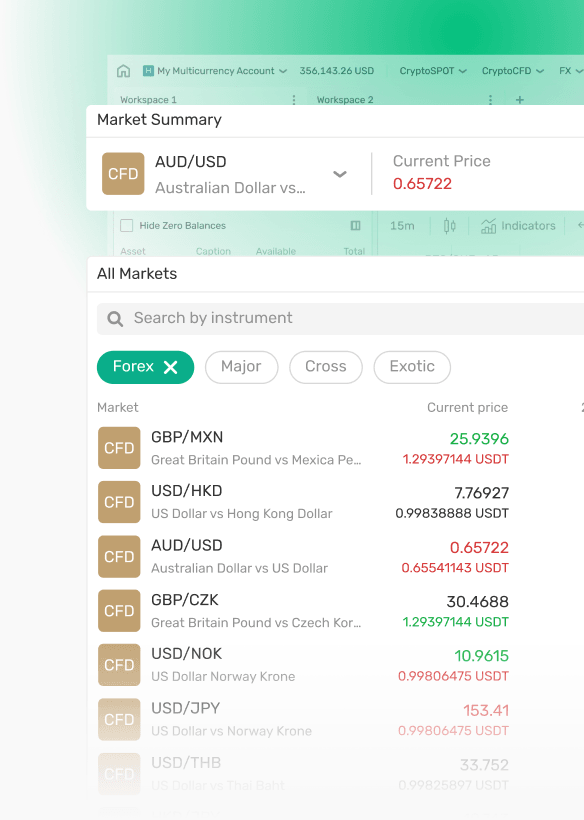
Mobile screens struggle to display deep liquidity effectively. You need dynamic aggregation to show the "Level 2" order book without clutter. Visualizing the spread (the gap between buy and sell prices) clearly helps traders gauge market health and execution costs instantly.
Notifications and Real-Time Alerts
Push notifications for price targets or margin warnings bring users back to the app immediately to manage risk. However, you must let users customize these triggers. Flooding devices with irrelevant noise causes users to disable permissions entirely.
Admin, Monitoring, and APIs
Behind the interface, operational tools keep the exchange stable. Admin dashboards and back-office functionality help to track order flow, system health, and compliance flags in real time. APIs let institutions and partners connect their systems securely without manual intervention.
Launch Your Crypto Exchange in Weeks
Get a complete turnkey ecosystem, including a matching engine, back-office solution, and wallet management, ready for immediate deployment.
How to Create a Crypto Exchange App: Step-by-Step Roadmap
Write a brief introduction explaining a lifecycle-based approach to building an app for swapping digital assets.
Step 1: Define App Scope and Performance Requirements
Establish concrete performance metrics before approving design concepts. Institutional clients demand 99.99% uptime and trade execution under 50 milliseconds. You must decide if the engine supports high-frequency algorithmic strategies or focuses on simplified retail conversion, as this dictates your entire backend infrastructure budget.
Step 2: UX Planning and User Journey Mapping
Map the exact sequence of screens a user interacts with from download to first deposit. Every additional tap in the onboarding process drops conversion rates by measurable percentages. Your design team must prototype high-risk flows, such as withdrawal confirmations, to balance security compliance with operational speed.
Step 3: Selecting Architecture and Development Approach
Evaluate whether a custom build offers enough competitive advantage to justify a 12-month development cycle. White-label solutions reduce time-to-market to weeks but limit deep customization. For most new brokerages, utilizing pre-built, tested modules for the matching engine allows engineering resources to focus on unique frontend differentiators.
Step 4: Integrating Liquidity, Wallets, and Payments
Secure connectivity with liquidity providers early to ensure your order book has depth on day one. You must integrate payment gateways for fiat currencies on-ramps simultaneously with the custodial wallet system. Delaying these third-party integrations often creates bottlenecks during the final quality assurance phase.
Step 5: Building Core App Components
Construct the backend logic to handle data serialization and user authentication first. The mobile frontend then acts as a consumer of these data streams via APIs. Your team must embed encryption standards and fraud detection layers directly into the codebase during this primary build phase.
Step 6: Compliance and Security Measures Integration
Regulators increasingly scrutinize in-app actions, not just backend processes. Embed compliance logic before writing the first line of frontend code. Integrate sanction screening and transaction monitoring tools immediately to ensure every test trade meets regulatory standards from the start.
Step 7: Testing, Deployment, and App Store Approval
Navigate strict Apple and Google finance policies. Submit your application documentation weeks in advance, as app stores frequently reject crypto platforms that lack transparent data collection disclosures or clear jurisdictional licenses.
Step 8: Launch and Early Optimization
Deploy a private beta to a small, trusted user group first. Real-world usage exposes edge cases that automated scripts miss. Analyze support tickets and crash logs during this window to fix critical friction points before opening marketing channels to the general public.
Step 9: Ongoing Monitoring and Support
Establish 24/7 observability teams to watch for latency drift and deposit failures. Automated alerts must trigger immediate engineering responses when performance metrics dip. Your support staff needs direct access to transaction history logs to resolve user disputes quickly without escalating every ticket to the software development team.
Step 10: Scaling and Feature Expansion
Growth requires expanding your asset listings and order types. Adding new blockchain networks demands upgrading your node infrastructure to handle distinct validation methods. You must assess how each new feature impacts database load to prevent performance degradation for existing users as you scale.
Step 11: Continuous Compliance and Updates
Regulatory landscapes shift constantly. You must maintain a flexible backend that adapts to new reporting rules without requiring a full app update. Schedule regular third-party security audits to identify vulnerabilities introduced by new features.
Marketing, Adoption, and Retention Through Exchange Apps
Growth depends on moving users from "registered" to "funded." Successful exchanges align acquisition spend with specific behavioral triggers inside the application to maximize Return on Ad Spend (ROAS).
Driving App Adoption Among Active Traders
Traders switch to mobile when the experience offers distinct speed advantages over the web. Promote the app as the fastest mechanism for risk management, highlighting features like one-tap position closing and biometric signing. Exclusive mobile-only charts or alert types create a tangible reason for power users to install the terminal immediately.
Onboarding and Conversion Optimization
Friction during the first session destroys marketing ROI. Reduce the "Time to First Trade" metric by automating identity checks. If a user can deposit funds via Apple Pay or Google Pay within two minutes of downloading the app, conversion rates often skyrocket compared to flows requiring manual bank transfers.
Retention and Lifetime Value Growth
Reward systems increase cryptocurrency exchange platform stickiness. Implement a tiered fee structure where holding the exchange's native token reduces trading costs. This strategy binds the user's capital to your ecosystem. Additionally, gamified milestones for consecutive login days can effectively boost Daily Active Users (DAU) metrics without aggressive marketing spend.
Additionally, an integrated referral system turns your user base into a decentralized sales force, driving organic acquisition through automated revenue-sharing. Specialized modules like B2CORE IB automate commission tracking to scale these affiliate networks efficiently.
How B2BROKER Accelerates Crypto Exchange App Development
Launching a competitive crypto app typically requires 12 to 18 months of engineering work. B2BROKER compresses this timeline into weeks. We provide the full-stack infrastructure for you to focus entirely on user acquisition and brand strategy.
Launch Faster With Turnkey Exchange Infrastructure
Developing a proprietary matching engine drains capital and delays revenue. Our B2TRADER solution delivers a tested, institutional-grade backend immediately. You receive a fully branded environment where you control the fee structures and asset listings without managing the underlying code maintenance.
Power your Brokerage with Next-Gen Multi-Asset & Multi-Market Trading
Advanced Engine Processing 3,000 Requests Per Second
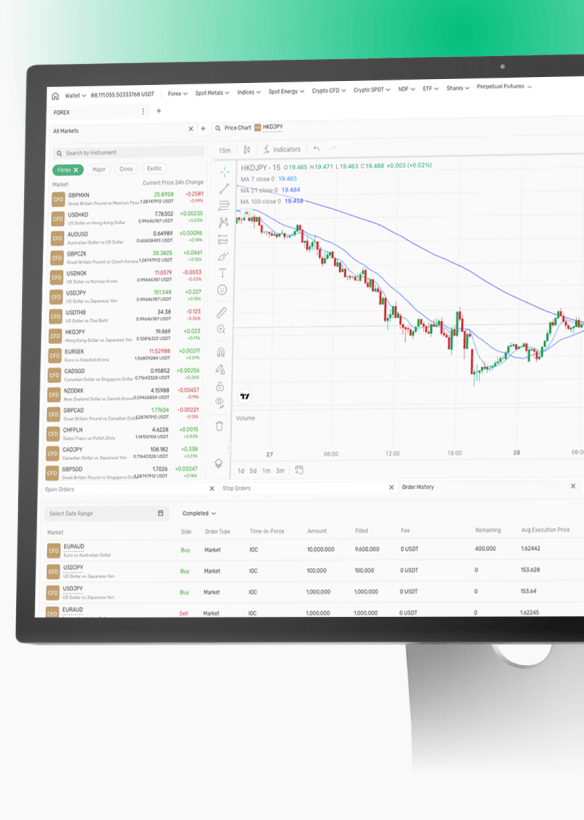
Supports FX, Crypto Spot, CFDs, Perpetual Futures, and More in One Platform
Scalable Architecture Built for High-Volume Trading
Liquidity-First Mobile Trading Experiences
Mobile traders demand institutional pricing. We connect your app directly to the deepest liquidity pools in the industry. Your users execute large orders with minimal slippage, ensuring the tight spreads displayed on their screens match the actual fill prices.
Modular Technology for Long-Term Scalability
Your platform must grow without requiring a system-wide reboot. Our modular architecture (CRM and Back-Office, liquidity, mobile terminal, desktop solutions, copy trading engine) allows you to add new assets or payment gateways as independent microservices. You can expand your offering without disrupting existing user sessions or risking downtime.
Operational and Technical Support
Technical incidents do not adhere to business hours. Our support teams operate 24/7 to monitor your infrastructure health. We resolve potential latency issues before they impact your users, serving as an extension of your own engineering department.
App-Store–Ready Backend and Compliance Alignment
Our infrastructure complies with strict data handling standards by default. This alignment simplifies the review process, helping your mobile terminal pass verification on Apple and Google platforms faster than custom-built alternatives.
Proven Mobile Stability Under Real Market Stress
Theoretical performance means nothing during a bull run. Our systems currently process billions in daily turnover across live client exchanges. Your app utilizes this same battle-tested architecture, guaranteeing stability even when market volatility drives massive concurrent traffic spikes.
Moving Forward with B2BROKER
Since 2014, B2BROKER has focused on delivering infrastructure that compresses launch timelines and scales revenue. With over 1,000 corporate clients and 10 regulatory licenses, our ecosystem supports your long-term growth. We provide the operational stability required to stay efficient across market cycles.
Your mobile execution layer determines user retention. Our team of specialists ensures your technology remains ahead of retail demand.
Book a demo to explore how B2BROKER can accelerate your crypto exchange platform development.
Future-Proof Your Exchange With Proven Infrastructure
Join hundreds of businesses using our full-stack ecosystem to scale revenue and dominate global mobile markets.
Frequently Asked Questions about Exchange App Development
- How much does it cost to start a crypto exchange?
Building a custom exchange from scratch typically costs between $150,000 and $500,000, depending on features and licensing. Using a white-label solution like B2Trader significantly reduces this initial capital expenditure.
- What is a white label crypto exchange?
A white label exchange is a pre-built software platform that you can purchase, brand, and launch immediately. It removes the need for years of development while giving you full control over fees and assets.
- How long does it take to launch a crypto exchange app?
A proprietary build usually takes over a year to reach a production-ready state. Leveraging a turnkey infrastructure provider compresses this timeline to approximately 4 to 6 weeks.
- Do I need a large developer team to run an exchange app?
Maintaining a custom app requires specialists in mobile security, matching engines, and blockchain nodes. Partnering with a full-stack technology provider eliminates the need to hire and manage this massive in-house engineering team.
Recommended articles