Trading Platform Maintenance: In-House vs Outsourcing Explained

Trading platform maintenance determines whether a brokerage delivers reliable execution or loses clients due to preventable downtime. A single missed server patch can cascade into security exposure, degraded client confidence, and regulatory scrutiny. Yet many brokerages still treat maintenance as an afterthought until something breaks.
The central question for forex and crypto brokerages is whether to handle trading platform maintenance in-house vs outsourcing it to specialized providers. Both models carry real trade-offs, from how predictably you can budget to how quickly you can scale under regulatory pressure. The right answer depends on where your organization stands today and where it needs to be in two years.
This article defines what trading platform maintenance actually covers and compares in-house and outsourced models factor by factor. It also walks through hybrid approaches, providing a decision framework with SLA benchmarks and a practical maintenance schedule for brokerage software.
Key Takeaways
- Trading platform maintenance spans everything from infrastructure monitoring and application updates to security patching and regulatory compliance logging.
- In-house maintenance offers maximum control over proprietary systems but demands significant investment in skilled personnel and hardware, with ongoing training adding further cost.
- Outsourced maintenance provides predictable costs alongside access to specialized expertise, making it particularly valuable for brokerages that struggle to hire locally or need 24/7 coverage.
- Hybrid approaches allow brokerages to retain strategic control over core systems while delegating routine tasks to external providers, balancing flexibility with cost efficiency.
- The optimal model depends on your budget and in-house technical depth, weighed against scalability requirements and regulatory obligations specific to your jurisdiction and asset classes.
Defining Trading Platform Maintenance
Trading platform maintenance covers far more than break/fix troubleshooting. It encompasses the full lifecycle of activities required to keep a brokerage's technical infrastructure secure, performant, and compliant with regulatory requirements.
At its foundation, trading servers are dedicated computing environments that process financial transactions and connect brokerages with liquidity providers and trading venues, as well as client-facing applications. Maintaining these systems involves constant server health monitoring and security patching, alongside execution optimization, backup management, and audit-ready documentation.
A few terms deserve clarification.
Uptime SLAs (service level agreements) define the minimum percentage of time a platform must remain operational, typically 99.9% or higher for production trading environments.
Compliance audits evaluate whether a brokerage's operational setup meets regulatory standards set by bodies like the FCA, CySEC, or ESMA.
Maintenance windows refer to scheduled periods when updates or changes are applied with minimal disruption to live trading.
The compounding risk of neglected maintenance is real. Delayed patches leave security vulnerabilities unnoticed when monitoring is skipped, and the resulting performance degradation erodes the client experience. Meanwhile, incomplete logging can trigger regulatory penalties or even license revocation. Each failure compounds the next, and recovery always costs more than prevention would have.
Protect Your Brokerage From Costly Downtime
Get expert MT4/MT5 or cTrader server management with 24/7 monitoring and proactive maintenance.
Why Ongoing Maintenance Is Mission-Critical for Brokers
Trading platforms operate around the clock across global markets. Any delay or disruption can translate directly into financial loss for both the brokerage and its clients. Investors and institutional counterparties are more likely to trust and remain loyal to platforms that demonstrate consistent uptime and fast execution.
The stakes are quantifiable. Execution failures during high-volatility windows cause direct trading losses, and prolonged disruptions accelerate client attrition as traders migrate to more reliable competitors. Publicized outages compound the damage further, eroding confidence well beyond the immediate incident.
Maintenance quality also affects competitive positioning. Brokerages that deliver superior uptime and tighter execution through well-maintained institutional trading platforms attract and retain sophisticated traders who generate higher volumes.
Regulators increasingly mandate documented maintenance procedures with incident response protocols and audit trails. MiFID II, for example, requires firms to maintain detailed records of every system change and trading event, including security incidents. Maintenance has become a compliance requirement with enforceable consequences.
Core Maintenance Tasks Across Infrastructure, Application, and Compliance
Every brokerage must cover three maintenance pillars regardless of whether the work is handled internally or by an external provider. These categories give leadership a clear framework for evaluating which tasks to keep in-house and which to delegate.
Infrastructure Monitoring and Patching
Infrastructure maintenance covers continuous monitoring of server health and network latency, and tracks storage and hardware performance metrics. Trading environments demand low-latency connections and high availability, which means even minor degradation can affect execution quality.
Patching cycles include OS and security updates, all deployed systematically to reduce vulnerabilities without disrupting live markets. The challenge is scheduling these updates for platforms that operate 24/5 or 24/7 with clients across multiple time zones. Hot patches that apply without downtime are preferred, but some updates require planned maintenance windows with failover to backup systems.
Application Updates and Bug Fixes
Application-layer maintenance addresses software bugs and platform updates and extends to third-party integration changes and performance tuning. Corrective maintenance targets live-trading issues such as price discrepancies and execution errors, which can escalate to full system crashes under load.
MT4/MT5 environments require specialized upkeep: plugin and bridge configuration management, including liquidity provider integration adjustments after each release. Every new version from MetaQuotes can affect existing configurations, so thorough testing must precede deployment.
Regulatory Logging and Audit Trails
Compliance maintenance involves producing and safeguarding transaction logs, client activity records, and system change documentation throughout their retention lifecycle. Regulators require tamper-proof records with accurate timestamps that remain accessible for on-demand review.
MiFID II and similar frameworks mandate comprehensive audit trails covering every trade, system modification, and security event. Penalties for falling short range from fines to license suspension or forced market exit, which is why regulatory logging remains an essential maintenance function regardless of the operating model.
Power Your Entire Brokerage From One Hub
Replace fragmented systems with our unified ecosystem featuring institutional liquidity, ultimate back-office, and fully managed trading platforms.
In-House vs. Outsourced Models: Compared Factor by Factor
The broader build vs. buy brokerage software debate applies directly to maintenance decisions. The comparison between in-house and outsourced trading platform maintenance spans multiple operational dimensions. Each model has genuine advantages and limitations whose impact varies by company size, budget reality, and long-term direction.
Control vs. Flexibility
In-house maintenance gives brokerages direct control over priorities and architecture decisions, with proprietary development staying entirely internal. Teams can respond to requests immediately without vendor coordination, and sensitive intellectual property never leaves the organization.
Outsourced maintenance trades some of that control for operational flexibility. A 2024 Northern Trust survey found that 40% of participants cited rising platform expenses as the primary driver for considering outsourcing. Scaling resources up or down happens through contract adjustments, bypassing the slow cycle of hiring and onboarding. Internal management overhead also drops because the outsourced partner covers staffing and shift scheduling on your behalf.
The trade-off is straightforward. Control demands more internal management bandwidth, while outsourcing introduces dependency on third-party responsiveness. A common middle ground keeps strategic decision-making internal while delegating execution to specialists.
Security and Data Sovereignty
Security concerns rank among the top objections to outsourcing platform maintenance. Granting outsourced teams access to production servers and client data, let alone proprietary trading logic, introduces risk that must be carefully managed.
Reputable providers mitigate these risks with enterprise-grade security controls backed by industry certifications and contractual safeguards. However, brokerages must still verify credentials and conduct due diligence on data handling, making sure jurisdictional data residency requirements are met.
In-house maintenance puts full security responsibility on the brokerage, which requires investment in qualified personnel and the right tooling to support them. Teams must build deep expertise in network security and application hardening while staying current on compliance monitoring requirements. Both models carry residual security risk. The question is which team is better equipped to manage that risk, given available resources.
Scalability and 24/7 Coverage
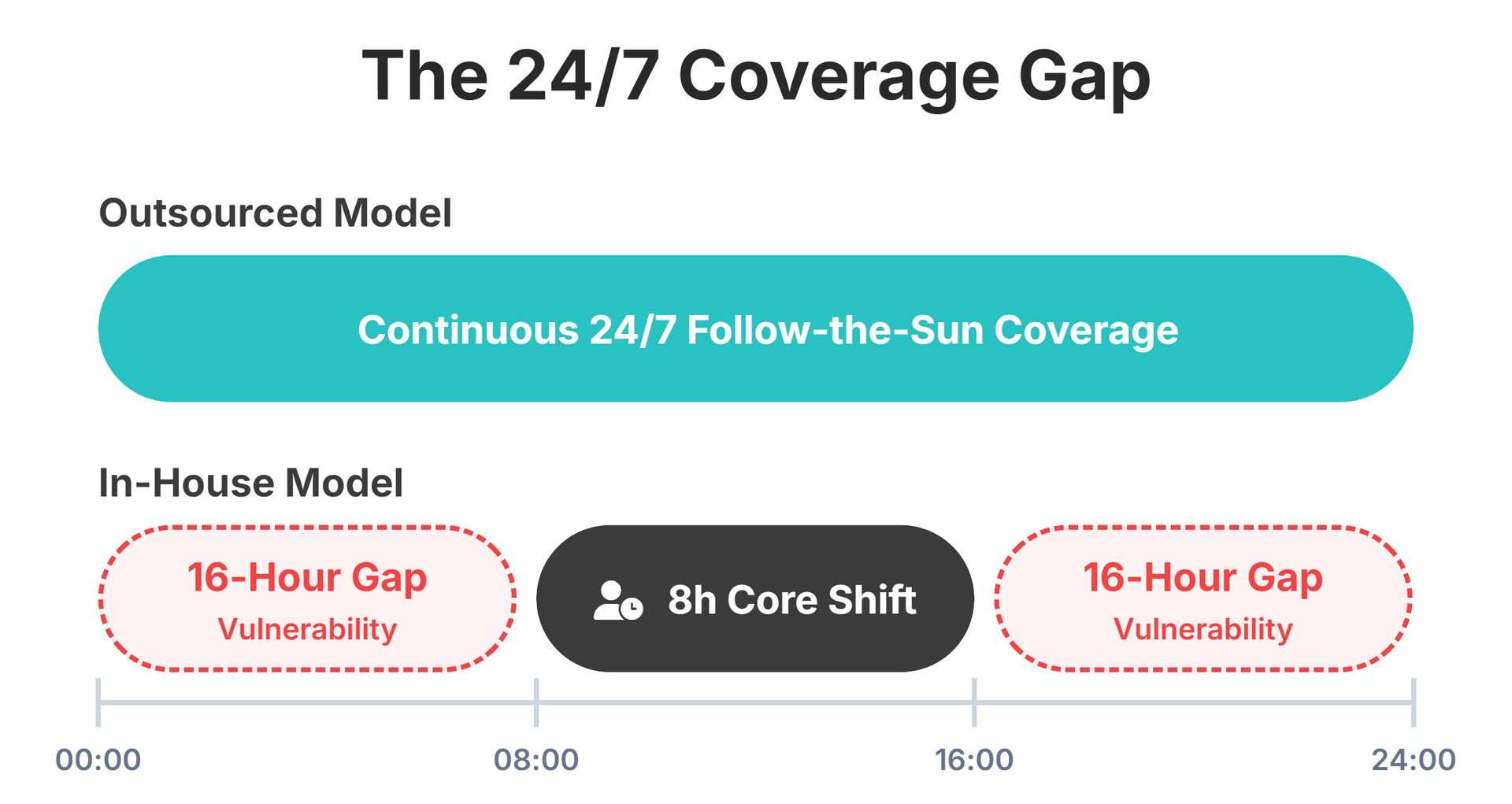
Multi-time-zone brokerages need continuous monitoring and rapid incident response. Small in-house teams with limited full-time staff struggle to provide genuine 24/7 coverage without burning out team members or maintaining expensive night and weekend shifts.
Outsourced providers commonly deliver round-the-clock coverage through distributed teams across multiple time zones, reducing the brokerage's staffing burden while maintaining consistent response times regardless of when incidents occur.
Scaling speed differs significantly between models. In-house growth is constrained by recruiting and onboarding timelines, with training adding further delay. Outsourced capacity typically expands through contract tier upgrades, often within days, where hiring would take months. For fast-growing startups and established brokers entering new markets, that speed advantage can be decisive.
Cost Structure Considerations
Cost is rarely straightforward in either model. The table below breaks down typical cost categories:
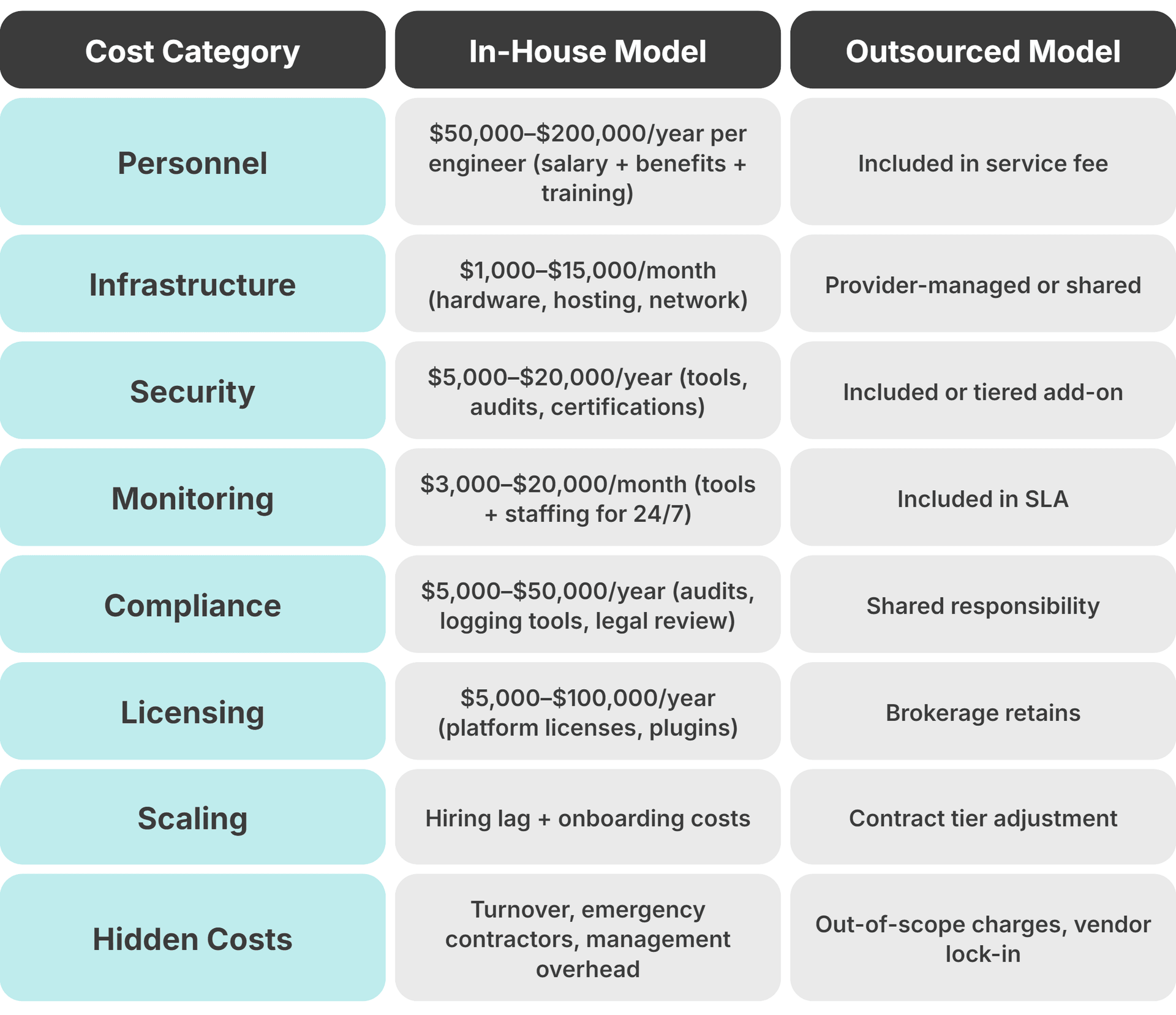
In-house operational costs extend beyond salaries to include infrastructure upgrades and security tooling, with continuous training as an ongoing line item. Outsourced pricing tends to be more predictable through fixed service agreements, delivering potential cost savings on staffing and infrastructure. However, brokerages should confirm exactly what is included versus what incurs additional charges.
With the global IT services outsourcing market projected to reach $778 billion by 2032, the trend toward external service models is accelerating across financial services. Total cost of ownership matters more than headline figures. Hidden costs exist in both models, and a thorough five-year TCO analysis prevents surprises.
When a Hybrid Approach Makes Strategic Sense
Brokerages can freely blend in-house and outsourced maintenance. Many successful operations combine both models to optimize for their specific circumstances.
Common hybrid configurations keep core functions like development and security oversight internal while outsourcing monitoring and routine patching, or delegating after-hours support entirely. Firms with proprietary systems find this particularly useful: intellectual property stays protected while commodity tasks benefit from specialized third-party expertise. Automation tools can further streamline handoffs between in-house teams and external providers.
The operational prerequisite for hybrid success is clear responsibility boundaries. Communication routines and escalation paths must be documented, and handoff procedures need the same rigor. Enforcement should be built in to prevent coverage gaps or duplicate work. Lax boundary management turns hybrid models into sources of confusion.
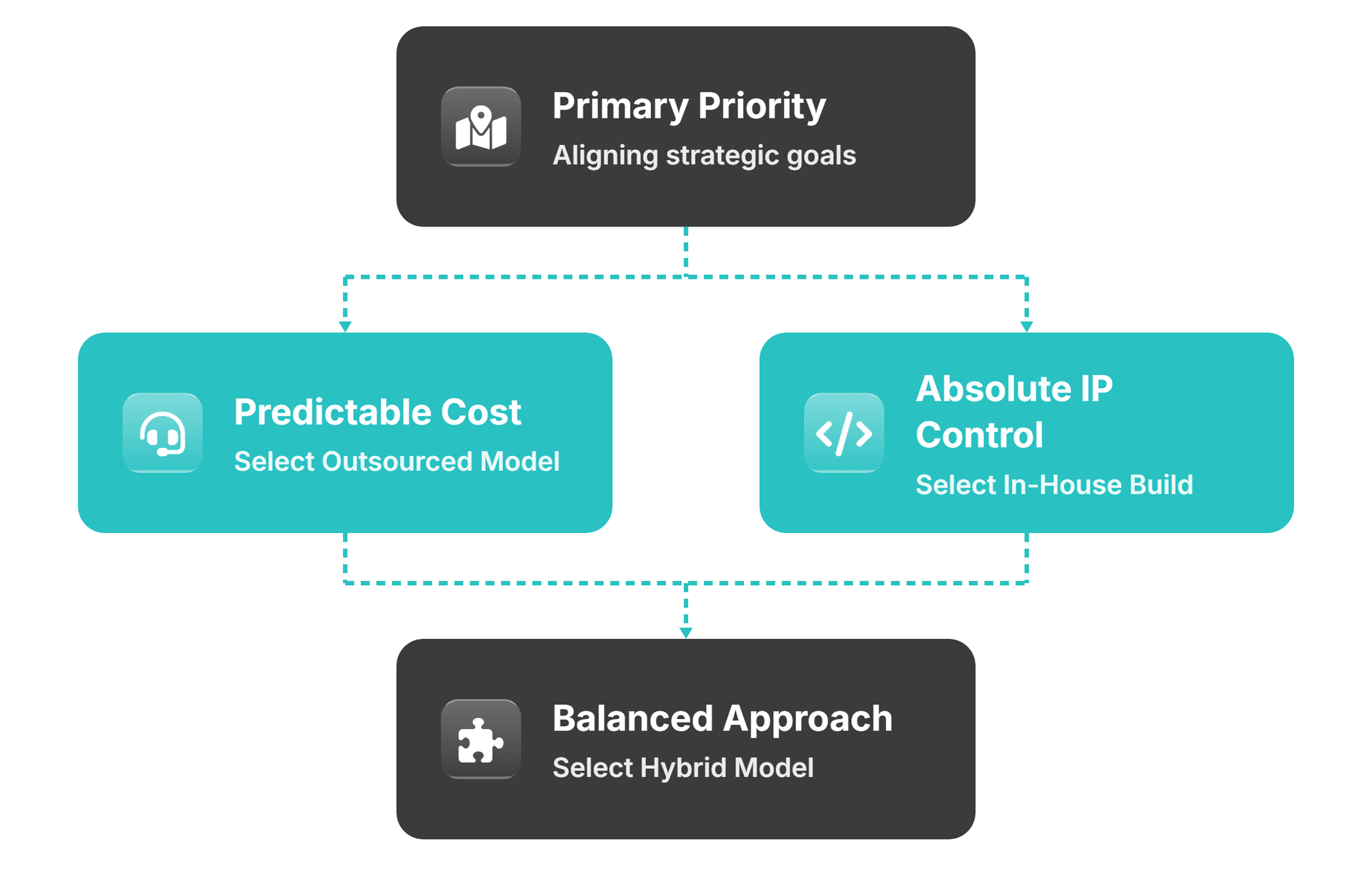
A practical decision rule applies here. Retain functions that provide competitive differentiation in-house and outsource commodity or routine tasks. If your own monitoring infrastructure offers no market advantage, delegating it frees engineering resources for higher-value work. The goal is to align each maintenance function with broader business goals instead of defaulting to one model for everything.
Decision Framework for Choosing the Right Model
Brokerages should run a structured evaluation process that matches the maintenance model to their actual operating constraints and growth plans, moving past assumptions and competitor mimicry.
Evaluate Internal Talent and Budget
Start with an honest skills assessment. Can current staff maintain trading infrastructure and applications while keeping up with compliance workflows? Identify where the gaps are, particularly in infrastructure management and security. If the answer involves recruiting multiple specialized engineers in a competitive labor market, factor in realistic timelines and costs for that process.
Calculate fully loaded in-house costs: compensation and benefits, tooling, ongoing training, and management overhead. Compare these directly against provider proposals to make informed decisions about resource allocation. Early-stage brokerages often find that outsourcing converts large upfront investments into predictable monthly operating expenses, preserving capital for growth initiatives. The same logic drives the broader trend toward brokerage technology solutions that minimize upfront infrastructure spend.
Set SLA and KPI Benchmarks
Define SLAs before evaluating any option. Uptime guarantees, incident response times, resolution windows, and escalation procedures should all be specified in writing, whether the work is internal or outsourced.
Recommended KPIs tied to measurable outcomes include mean time to resolution (MTTR) and security patch deployment cadence on the operational side. On the compliance side, track backup test success rates and audit pass rates. Client-reported incident frequency rounds out the picture as a direct quality signal. These benchmarks enable objective comparisons between in-house performance and vendor proposals. Written SLAs are valuable even for internal teams because they enforce accountability and provide clear prioritization criteria.
Maintenance Checklist and Operational Schedule
A structured maintenance schedule ensures nothing falls through the cracks, regardless of who performs the work. The table below provides a reference framework that brokerages can adapt to their specific platforms and regulatory requirements.
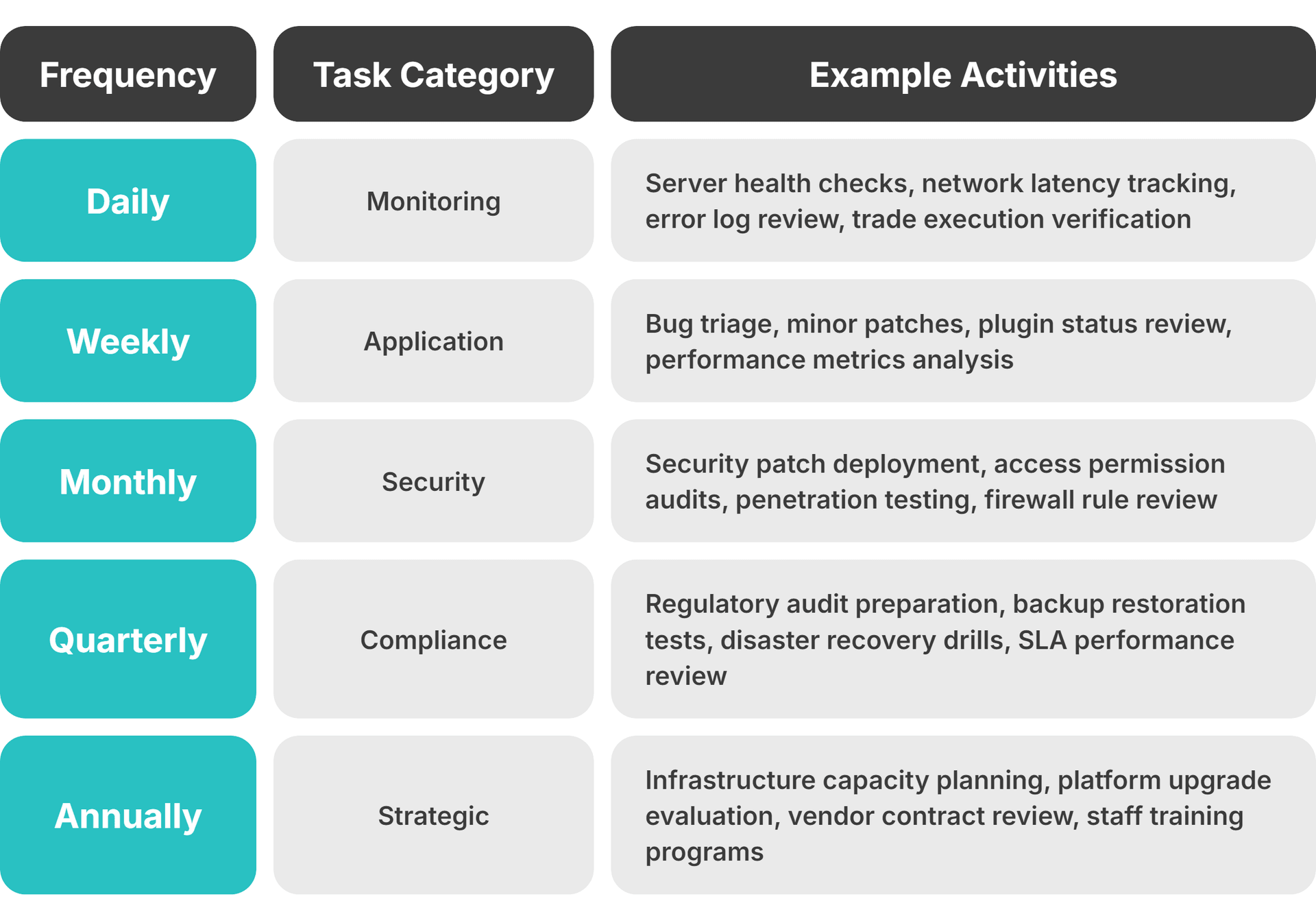
Hot backups (live-replicated copies that can take over immediately) and cold backups (offline copies restored on demand) both play roles in a complete backup strategy. Hot backups enable near-zero downtime during switchovers, while cold backups provide additional recovery options for catastrophic failures.
Regardless of who performs these tasks, the brokerage remains legally and operationally responsible for ensuring completion. Some regulators mandate specific task frequencies, so firms should validate their obligations before finalizing any schedule.
Start your Forex Brokerage in Weeks, not Months
All Technology, Liquidity & Payment Integrations Included
White-Label cTrader/B2TRADER with Full Back Office Support
Compliance-Ready Setup with Ongoing Technical Support
Boost Uptime With Managed Maintenance
The maintenance model a brokerage chooses directly affects day-to-day stability and regulatory standing, with competitive positioning closely tied to both. Whether the decision is to build internally, outsource entirely, or go hybrid, the goal stays constant — the platform must perform reliably enough to support growth, never constrain it.
B2BROKER provides managed platform outsourcing services for MT4/MT5, cTrader, and B2TRADER platforms. The offering covers everything from ongoing monitoring to security patching and backup management, all delivered with performance optimization under a single 24/7 support layer.
The broader ecosystem value extends beyond platform maintenance. B2BROKER's brokerage technology stack includes multi-asset liquidity and CRM solutions through B2CORE, complemented by wallet infrastructure and back-office tools. Consolidating these under a single provider reduces vendor fragmentation, which drives up costs and creates operational complexity.
As trading technology and regulatory requirements continue evolving, partnering with a proven infrastructure provider allows your brokerage to redirect engineering resources toward client-facing innovation, leaving infrastructure management to specialists.
Simplify Your Platform Operations
Get managed MT4/MT5 and cTrader maintenance with 24/7 support and proactive monitoring.
Frequently Asked Questions about Trading Platform Maintenance
- What is the difference between in-house maintenance and outsourced maintenance?
In-house maintenance relies on your internal team for server upkeep and compliance, offering total control but requiring heavy investment. Outsourced maintenance shifts these duties to a specialized provider, giving you predictable costs and faster scalability.
- Why do some brokerages keep maintenance in-house instead of outsourcing?
Brokerages keep maintenance in-house to retain maximum control over proprietary systems, unique customizations, and sensitive client data. This model is also required when strict local regulations demand absolute data sovereignty.
- What are the main cost differences between in-house and outsourced maintenance?
In-house costs are highly variable and include salaries, hardware upgrades, and ongoing team training. Outsourced maintenance typically converts those unpredictable expenses into predictable, fixed monthly service fees.
- How do brokerages ensure security when outsourcing platform maintenance?
Brokerages protect themselves by choosing providers with enterprise-grade security certifications and strict contractual safeguards regarding data access. You must also enforce clear service level agreements (SLAs) and conduct regular audits to verify compliance.
- Can brokerages combine in-house and outsourced maintenance?
Yes, many brokerages use a hybrid model, keeping strategic development internal while outsourcing routine tasks like 24/7 monitoring. This approach works incredibly well as long as your communication routines and escalation paths are strictly documented.
Recommended articles