How to Evaluate Crypto Prime Brokerage Connectivity


An institutional-size order in crypto rarely has one home. Liquidity sits scattered across roughly 200 to 250 active centralized exchanges , plus a long tail of decentralized exchanges. Even though the ten largest account for about 90% of trading volume, no single book reliably absorbs a large ticket without moving the price.
Crypto prime brokerage exists to solve that fragmentation. Evaluating a provider starts with the architecture underneath, because the connectivity and aggregation layer sets both your fill quality on large orders and the engineering workload for every venue you add.
This guide stays at that layer. It covers how liquidity aggregation actually operates, then turns the mechanics into evaluation criteria you can put to any provider.
Key Takeaways
- A crypto prime broker consolidates venue access, execution, and margin financing behind a single point of connection; evaluate it the way you would evaluate core infrastructure.
- Quote normalization and venue selection inside the liquidity aggregation layer decide your fill quality on large orders.
- Direct exchange integrations pile up maintenance code; a liquidity bridge replaces them with one connection.
- Judge providers on venue coverage, documented uptime SLAs, and fill rates during volatile windows before committing.
- A bridge kept in sync with your trading platform and back office carries less integration risk than a generic FIX bridge.
What Crypto Prime Brokerage Means
A crypto prime broker is a partner that stands between your firm and the exchanges. It already holds the exchange accounts, the credit, and the settlement arrangements, so your brokerage deals with one company instead of with every venue separately.
Beyond Definitions: The Infrastructure Model
A prime brokerage is a connectivity and aggregation architecture. It sits above individual venues and presents them to your platform through one interface, with one price stream and one settlement relationship behind it.
The consolidation covers three assemblies an operator otherwise builds by hand:
- Venue access: spot and derivatives markets reached through a single integration;
- Financing: margin and collateral managed across the whole book instead of locked venue by venue;
- Execution: orders executed centrally against the aggregated picture of depth.
Every other service a provider lists sits on top of those three.
How Prime Brokerage Differs from Executing Brokerage
An executing broker's job ends when an order fills. A prime broker builds the workflow around that order, adding financing and credit lines that run across the firm's whole book, plus venue access held through one relationship in place of a stack of bilateral setups.
Counterparty netting comes with that consolidation. Counterparty exposure that would otherwise sit in a dozen separate exchange accounts nets down against one relationship, which cuts both the counterparty risk and the reconciliation work behind it.
Institutional Demand Is Reshaping the Market
Institutional flow in crypto is measurable now, at a scale that is resetting what institutional investors demand from prime brokerage. Spot ETF approvals and rising custody volumes have moved institutional adoption of crypto from pilot allocations to production flow; providers keep widening their service coverage to compete for it. The buyers now span hedge funds, asset managers, and family offices, with investment banks and other financial institutions standing up digital-asset desks of their own.
The cause has not changed since the first institutional wave. Liquidity remains fragmented, while growing volumes keep raising the cost of reaching it venue by venue.
Spot ETF Inflows and Institutional Capital Flows
US spot Bitcoin (BTC) ETFs have taken in $51.8 billion in cumulative net inflows since their January 2024 launch, with about $80 billion in assets under management as of July 2026. This year brought heavy outflows in May and June, yet the products remain the standard regulated route to spot Bitcoin exposure.
Workflows are expanding along with the capital. In June 2026, Clear Street executed the first Bitcoin depositary receipt trade run through a traditional prime brokerage platform and settled through the Depository Trust Company. Digital-asset exposure is starting to travel the prime brokerage rails traditional finance has used for decades.
Why Fragmented Venue Access Drives Prime Brokerage Adoption
Fragmentation is the reason prime brokerage has a market in crypto. The same instrument trades in parallel on crypto exchanges, market-maker streams, and OTC desks, each its own pool of liquidity provision, with a separate order book and connectivity rules.
Concentration has not fixed it. The largest venues hold most of the volume, yet that volume still sits in separate books. A large ticket sent to any one of them exhausts the visible depth and finishes at a worse average price.
For an operator, fragmentation arrives as engineering work before it arrives as bad fills. Reaching enough depth means connecting to more venues. Every connection is code your team builds and then maintains for as long as it runs.

The Core Services Stack for Operators
A prime brokerage stack pairs trade execution and financing with digital asset custody coordination and risk controls. None of the four works alone. Execution depends on connectivity, and financing depends on collateral data arriving from every venue in real time. Let the collateral feed lag, and the first sign is a margin call the desk did not see coming.
Execution and financing carry most of the engineering work, because both have to stay correct across every venue at once.
Multi-Venue Order Execution
Multi-venue execution means an order can fill across several venues at once; a single-exchange setup leaves that same order sitting on one book until it fills or fails. Three mechanics decide whether that works in practice:
- Request-for-quote flows price a large block privately, without moving a public order book.
- Time-in-force controls decide how long a resting order stays live on each venue.
- Partial-fill handling fills the remainder on another venue when one absorbs only part of a ticket.
Margin Financing and Collateral Management
Financing is where a prime brokerage stack pays for itself. Cross-margining nets exposure across venues and frees the collateral that per-venue margin rules would otherwise lock up, a direct gain in capital efficiency.
Portfolio-based collateral and configurable haircuts let a risk team match margin policy to the actual risk of the book, position by position.
The payoff feeds straight back into execution, because freed collateral can back active trading. Platforms built for this workflow, such as B2TRADER , a multi-asset and multi-market trading platform, support cross-margin collateral management as part of a prime-brokerage-ready stack.
How Liquidity Aggregation Works
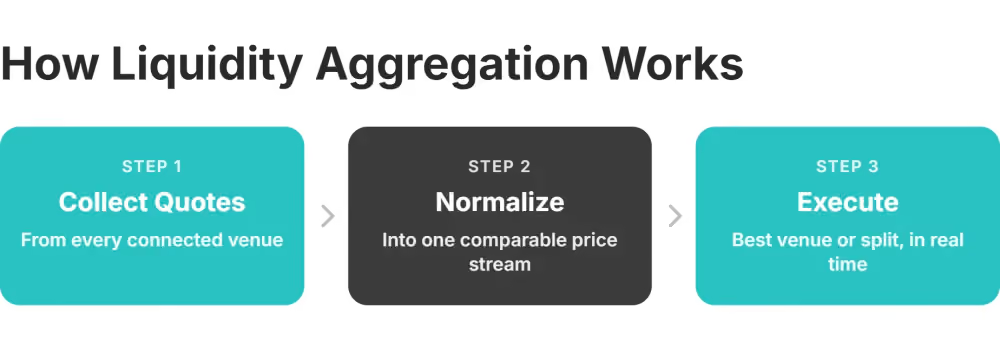
Liquidity aggregation combines executable quotes from multiple venues into one normalized price stream and execution layer. It is the part of crypto prime brokerage that decides what your largest orders actually cost.
The process breaks into three continuous jobs: collecting quotes from every connected venue, normalizing them into one comparable stream, and sending each order to wherever the best execution sits.
Quote Normalization Across Venues
No two venues publish quotes the same way. Data formats and latency profiles both differ. Normalization reconciles that variety into one comparable price stream, the raw material of every execution decision.
Where that work happens determines who pays for it. Skip the normalization layer, and your engineers parse and reconcile every venue's format themselves. The job never ends, because venues keep changing their APIs — those changes land in changelogs nobody on the desk has time to watch.
Best-Price Execution and Slippage Reduction
The aggregation layer selects the venue, or the combination of venues, for each order in real time. For a large ticket, that choice decides the slippage. One thin book moves against the order; a split across deeper books protects the average fill.
Calm markets make venue selection look easy, since the best-priced venue with adequate depth usually wins. Stress is the real test.
In the October 2025 flash crash, forced liquidations reached roughly $19 billion in a day and order books thinned unevenly across venues. That is the environment where the aggregation layer proves its value, weighing fill probability and latency alongside price.
Liquidity Bridge vs. Direct Exchange Integration
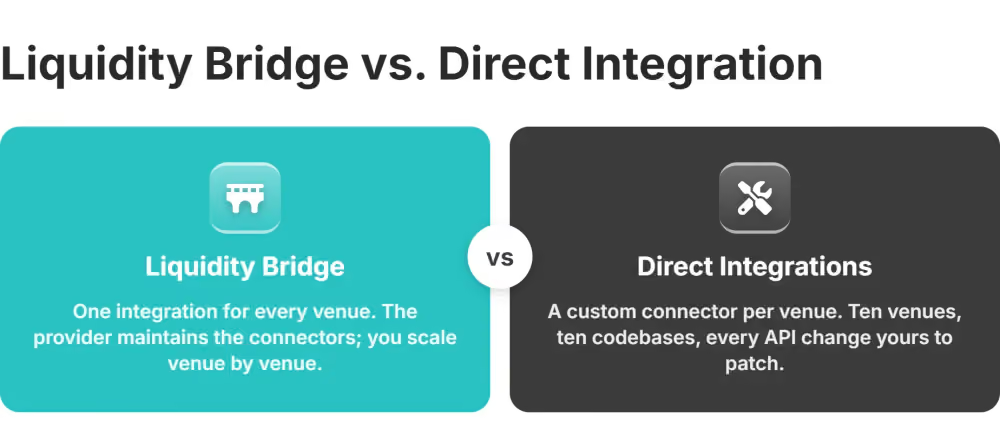
The build-or-connect question decides most of your maintenance budget. Direct market access to each venue means a custom connector per exchange, each bringing API changes and failure modes of its own. Ten venues can mean ten codebases patched indefinitely.
A liquidity bridge collapses that into one integration and moves the per-venue maintenance onto the provider. For a broker running multiple venues, it removes most of the connector code your team would otherwise own. To scope one, compare venue lists against what the leading crypto liquidity providers already cover.
Connectivity Infrastructure: The Technical Layer
The connectivity layer sits between your trading platform and your liquidity sources, translating protocols and managing sessions for every connected venue. Its design sets what each new venue and instrument costs you to add later.
The challenges at this layer are conventional engineering. Crypto connectivity stopped being an experimental blockchain exercise years ago. What remains is the integration work any institutional system demands, from protocol compatibility to failover.
FIX Protocol and API Integration Overhead
FIX 4.4 and 5.0 remain the standard for institutional order flow across foreign exchange and institutional crypto alike, with WebSocket and REST covering market data and lighter interactions. A connectivity solution that speaks FIX natively connects to existing institutional systems with far less bespoke work on your side.
The overhead hides in the exceptions. Every venue without a clean FIX endpoint pushes translation and error handling onto your engineers. That connector work gets scoped as a one-off sprint. Multiplied across venues and instruments, it becomes a permanent line in the engineering budget.
Purpose-Built Bridges vs. Generic FIX Solutions
Bridges differ in what they know about your stack. A generic FIX bridge translates protocol and stops there, so keeping it compatible with the systems on either side of it stays with your team.
A purpose-built bridge is developed and upgraded together with the platforms it connects. B2BROKER maintains B2CONNECT , its crypto-native liquidity hub, in lockstep with B2TRADER and the B2CORE back office. When the trading platform releases an upgrade, a matching connectivity update goes out with it, keeping the bridge current.
Apply the same check to any vendor on your shortlist, including the wider field of forex technology providers .
Evaluating a Liquidity Connectivity Solution
A mismatch at this layer is expensive to unwind after go-live. Provider claims are cheap to make, so the questions worth asking are the ones with answers you can verify.
Venue Coverage and Instrument Depth
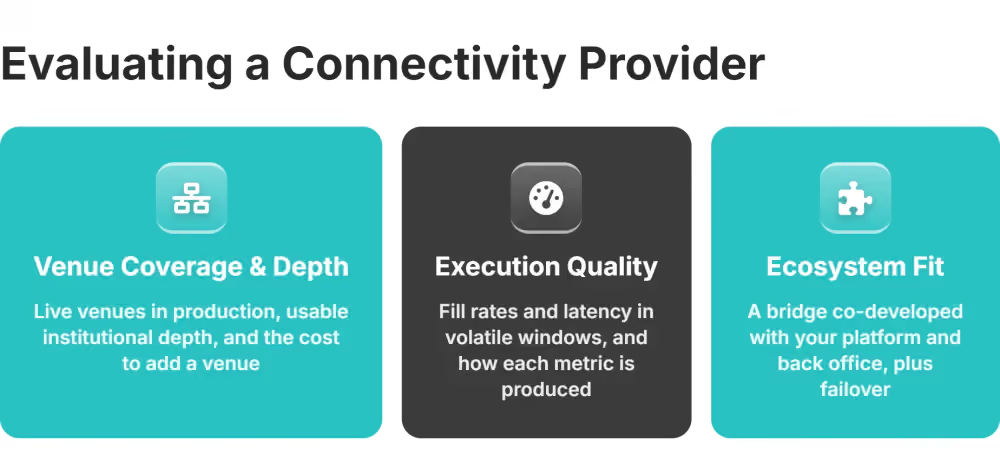
Start from your own order flow. Confirm the provider covers the specific spot and futures venues your strategies trade, and confirm the instruments you care about carry usable depth on those venues.
Three questions belong in every due diligence call:
- How many spot and derivatives venues are live in production today?
- Which instruments carry institutional depth, and on which venues?
- What does adding a new venue take, in calendar time and in your engineering hours?
Before the call, compare the provider's venue list against the top multi-asset liquidity providers and bring the gaps as your agenda.
Latency, Uptime SLAs, and Execution Quality
Average quote response time, historical fill rates, and documented uptime SLAs mean little if they only describe calm markets. Request the same metrics for the most volatile windows the provider has lived through, then ask how each number is produced. An average hides tail latency, while a fill rate looks better than it is when rejected orders drop out of the denominator.
Resilience has reached the supervisory agenda as well. The Bank for International Settlements flagged weaknesses in crypto market infrastructure in its 2026 annual report. Redundancy and failover in the provider's stack are the operator-level answer to that concern.
Execution quality claims deserve as much scrutiny as the counterparty behind them, and the traits of an institutional-grade liquidity provider show what to check in both.
Build Your Prime Brokerage Stack on Proven Infrastructure
Crypto prime brokerage is an infrastructure decision. Spend the evaluation budget on the connectivity and aggregation architecture underneath the service — that is what sets your fill quality and your engineering load.
B2BROKER approaches that layer as one co-developed ecosystem:
- B2CONNECT carries connectivity and liquidity aggregation;
- B2TRADER runs multi-asset and multi-market execution with cross-margin support;
- B2CORE runs the back office and client management.
Since the three ship and upgrade together, the seams between execution, connectivity, and the back office sit inside one vendor instead of between several.
B2BROKER has operated since 2014, helped launch more than 500 brokers, and supports over 1,000 corporate clients.
If you are scoping a prime brokerage build or replacing a fragile connectivity setup, start from components already engineered to work together.
Frequently Asked Questions about Crypto Prime Brokerage
What does a crypto prime broker actually do for institutional trading firms?
It consolidates market access, execution, margin financing, and custody coordination behind one relationship and one integration. The firm trades across many venues while managing a single counterparty and a single collateral pool.
How is a crypto prime broker different from an executing broker?
An executing broker places and fills orders. A prime broker adds financing, cross-margin collateral management, and consolidated multi-venue access on top of execution.
Why do institutions use crypto prime brokerage instead of connecting to exchanges directly?
Direct connections mean custom API work and permanent maintenance for every venue, while depth stays fragmented across them. A prime broker or liquidity bridge delivers aggregated depth through one integration; a prime broker also nets the counterparty relationships behind it.
How does liquidity aggregation work in crypto prime brokerage?
An aggregation layer pulls executable quotes from every connected venue into one comparable stream and sends each order to the venue, or combination of venues, showing the best available fill. The layer adjusts in real time as depth and volatility change.
What should brokers evaluate when choosing a crypto prime brokerage connectivity provider?
Venue coverage and instrument depth come first, followed by measured execution quality: latency, fill rates, and uptime SLAs in volatile markets. Ecosystem fit matters just as much, since a bridge developed alongside your platform and back office cuts integration risk at the source.
Recommended articles
Subscribe to our newsletter