Wallet as a Service: What Brokers Actually Need

Every crypto balance you hold for a client is a liability that a single custody failure turns into a payout. In February 2025, attackers drained about $1.5 billion from Bybit's Ethereum cold wallet through a manipulated signing interface, the biggest exchange breach on record.
A failure of that kind in your own infrastructure threatens the operating license. That is why brokerages, exchanges, and fintech firms are now deciding whether to buy wallet as a service or build it themselves.
This guide gives you an evaluation framework and shows where B2BROKER's integrated stack fits.
Key Takeaways
- WaaS moves custody, key management, and compliance tooling to a provider, so you go live without hiring for those functions.
- Embedded in a platform stack, WaaS cuts vendor count and time-to-market compared with assembling point solutions.
- Custody design is the first evaluation criterion: hot, warm, and cold segmentation plus an MPC wallet.
- MiCA and the FATF Travel Rule have turned compliance adaptability into a procurement requirement.
- Integration depth with trading, back-office, and payment systems decides the operational overhead you carry at scale.
What Is Wallet as a Service?
Wallet as a service is digital wallet infrastructure delivered through an API. The provider holds the keys and signs on your instruction; your engineers reach all of it through documented endpoints and SDKs.
Behind that API sits the daily work of running wallets. The provider issues a deposit address for each client and credits the funds only once they reach the confirmation depth you set. From there it sweeps balances into the hot wallet and signs every withdrawal that goes back out.
The edge cases are what you are really paying for. A withdrawal can stall unconfirmed in the mempool, and a reorg can drop a block that already credited a deposit.
For a regulated operator, that layer also carries the compliance work. Deposits and withdrawals clear with anti-money laundering (AML) screening applied, and every movement lands in an audit trail a regulator can follow.
The work of building a crypto wallet for business starts well below the wallet itself.
The Build-vs-Buy Decision for Financial Operators
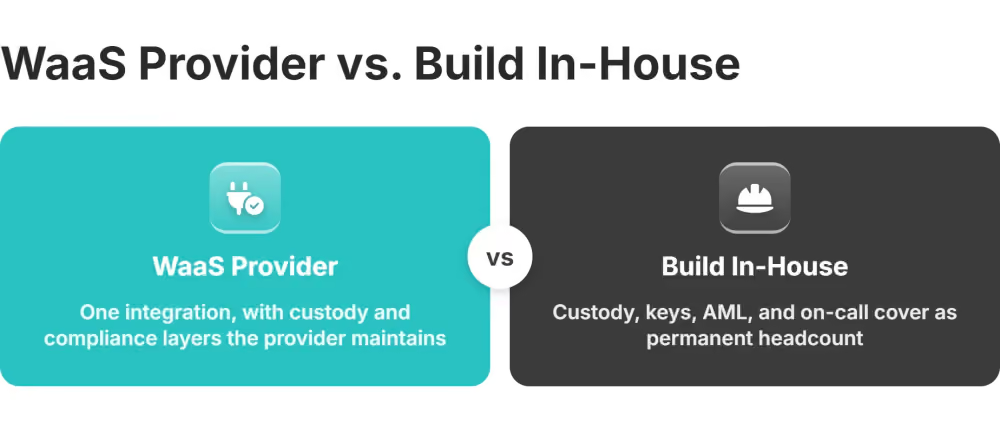
Building in-house means staffing four functions:
- custody engineering that keeps client assets segregated across storage tiers
- key management with rotation, backup, and disaster-recovery procedures that survive an audit
- AML and transaction-monitoring tooling that needs new rules as typologies shift
- availability engineering, with redundancy and an on-call rotation for a market that never closes
None of it ends at launch. For most regulated firms, those salaries cost more than a managed provider's fee within the first few years.
The buy option leaves one duty with you. A regulator still holds your firm responsible for client assets, so provider diligence and ongoing oversight become part of your team's job.
How WaaS Differs from Proprietary Wallet Infrastructure
The difference is who runs the system day to day. A proprietary wallet keeps key custody, breach exposure, and regulatory maintenance on your own balance sheet. Every rule change lands in your engineering backlog.
In practice, a self-built stack is rarely one system. It stitches a signing library to an AML vendor, a monitoring stack, and custom reconciliation code, each on its own update cycle. Any one of them can break reconciliation.
WaaS replaces those parts with one maintained interface. The provider owns every update cycle behind it, so your engineers stop tracking them one vendor at a time.
How B2BROKER Covers WaaS for Financial Operators
B2BROKER covers the custody leg through its partner B2BINPAY , whose enterprise wallets hold client assets. The design matters because a wallet that cannot talk to your payment, KYC, and execution systems only moves the integration work to your team.
Each piece arrives with the connections to the others already built:
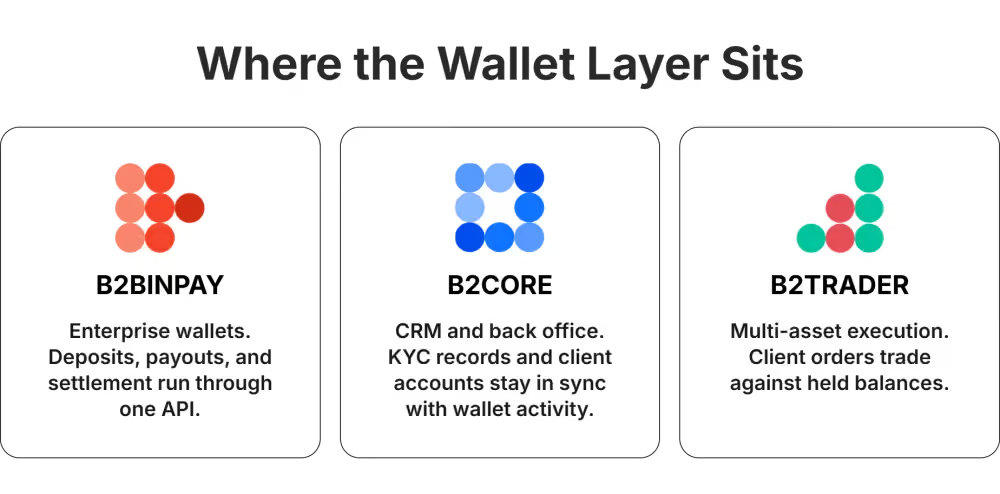
- B2BINPAY holds the wallets and handles crypto deposits, payouts, and settlement
- B2CORE runs KYC, client accounts, and back-office reporting
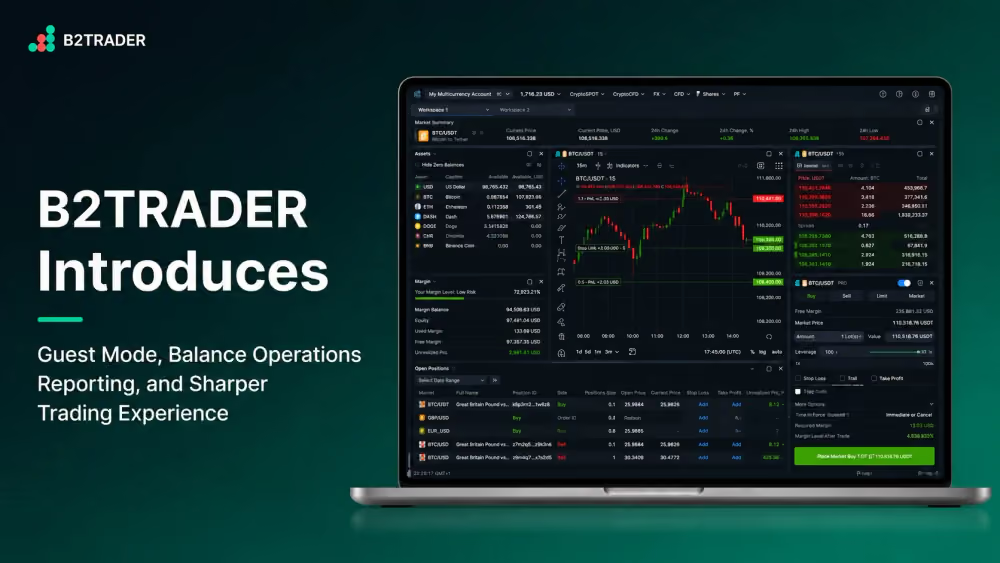
- B2TRADER is the multi-asset trading platform where client orders execute
Service has legal and jurisdictional limitations. Check T&Cs here .
Where WaaS Sits in the B2BROKER Ecosystem
Custody stops at the wallet. What happens before and after it, from onboarding to accounting, belongs to the products around it.
Those products share one platform design, and keeping them working together is the provider's job. A version change stops being something your team re-tests across three vendors.
The policy layer stays with you. You still set transfer limits and approval rules and decide who inside your firm can move client assets.
Integration with B2BINPAY, B2CORE, and B2TRADER
Deposits, payouts, and internal transfers run through the B2BINPAY API, against the wallets that hold the keys. Wallet activity and compliance data land in B2CORE, where reporting and KYC read from the same records. B2TRADER trades against those balances, which shortens the gap between a fill and the custody update.
None of the standalone leaders pairs custody with those adjacent systems. Fireblocks and Circle sell wallet APIs, and Privy targets embedded wallets for consumer apps. A broker picking any of them still shops separately for execution and back office.

Core Capabilities for Institutional Operators
Every provider on your shortlist will have a polished user interface and white-label branding. What separates them is how the provider stores keys, exposes its API, and enforces compliance under load.
Custody Architecture: Hot, Warm, and Cold Wallet Segmentation
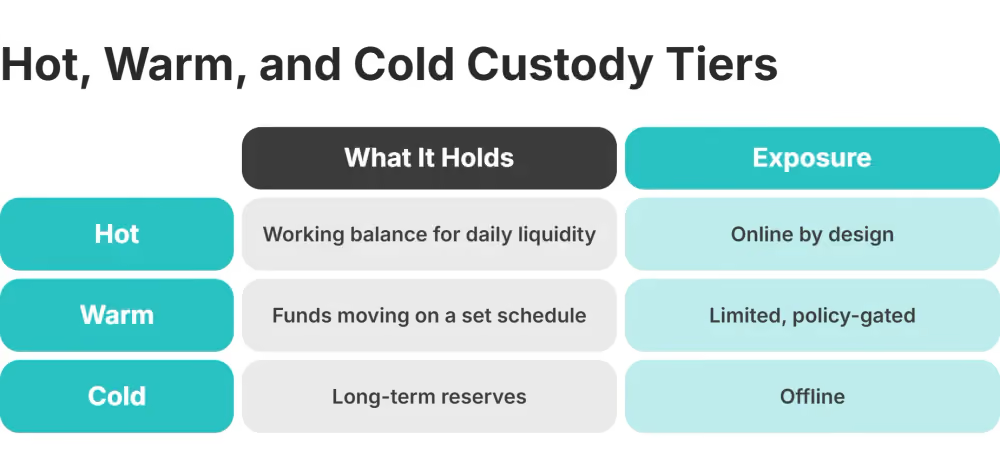
Tiered custody exists to contain a breach. A compromise of the hot, internet-facing tier must not reach the cold reserves. Hot wallets carry the working balance for daily liquidity and stay online by design. Behind them, cold storage holds long-term reserves offline, with a warm tier in between for funds that move on a schedule.
When you evaluate a provider, ask for the movement policy between tiers. Who signs a cold-to-hot transfer, whether withdrawal addresses need whitelisting, and how the provider handles exceptions show how the custody design works in practice.
MPC Key Management and HSM Security Controls
Because multi-party computation (MPC) splits signing authority across several parties, no complete private key or seed phrase exists in one place. A transaction goes through only when the required parties jointly compute the signature.
A hardware security module (HSM) is the physical counterpart. It generates and stores cryptographic material inside tamper-resistant hardware, and keys never leave that boundary in plaintext.
A provider that runs both MPC and HSMs, with multi-factor authentication in front of administrative access, can show your security team where key exposure stops.
API-First Integration and Multi-Currency Support
Custody integration runs mostly over REST APIs for wallet, deposit, and payout operations, plus callbacks that push status changes to your systems, so nothing polls for confirmations. Anything missing from that set becomes a custom adapter your team writes and then owns.
Asset coverage and multichain support decide whether the infrastructure fits your book. A forex broker needs settlement across fiat pairs; a crypto venue needs tokens and stablecoins on chains such as Ethereum and Solana. Judge a provider on the rails your own flow runs on, at your actual volume.
Compliance, Scalability, and Reliability Infrastructure
Compliance has to run inside the transaction layer, and that includes FATF Travel Rule support. AML screening at the point of transfer scales with volume, while controls added outside it become a bottleneck.
Reliability claims deserve numbers. Ask for SLA-backed uptime and throughput measured under realistic load, because a custody layer that degrades in a volatile session fails when withdrawals spike.
WaaS Use Cases by Operator Type
An exchange and a fintech both buy WaaS, but they are paying to solve different problems.
Exchanges, Brokers, and Digital Asset Platforms
When a trade fills on an exchange, three things have to happen together: settlement, a custody update, and a compliance check. Systems that do not share infrastructure turn that single motion into reconciliation work and audit exposure.
The mismatch usually surfaces at withdrawal time, when the trading ledger and the custody balance disagree and the payout waits for a manual check. When the provider keeps those systems in step, the two records reconcile automatically and the check disappears.
Fintechs, Neobanks, and Institutional Market Makers
For a fintech or neobank, the deciding factor is time-to-market. Compliant wallet infrastructure built from scratch delays a launch by months, while a managed layer deploys in weeks and frees engineers to work on the product that differentiates the business.
Institutional market makers have different priorities. They need multi-currency settlement, netting across positions, and infrastructure that stays up through continuous trading.
Institutional demand behind that flow is rising. In a January 2026 survey of 351 institutions by Coinbase and EY-Parthenon, 73% planned to increase their digital-asset allocations this year.
For a market maker, connecting the wallet to B2CORE and to B2BROKER's liquidity stack is what makes settlement reliable enough to trade against.
Deployment: From Integration to Go-Live
How fast you go live depends on how much of your stack already speaks the provider's protocols. The path is standard: technical scoping, API integration and testing in a sandbox, then a controlled production rollout.
Common interfaces shorten every step. B2BINPAY integrates over REST, while B2TRADER carries order flow over FIX 4.4 and streams market data over WebSocket.
With round-the-clock support, a blocker found in testing gets picked up on the day it appears.
Regulatory Trends Shaping WaaS Procurement
Crypto rules now change faster than most firms can finish a vendor review.
MiCA became fully applicable across the EU on 30 December 2024, and its transition period for firms operating under national regimes ended on 1 July 2026 . An EU operator now needs providers authorized as crypto-asset service providers; ESMA has told the rest to wind down their EU activity.
The FATF Travel Rule attaches a data obligation to the transfer itself. In the EU it arrives through the Transfer of Funds Regulation, which since December 2024 requires originator and beneficiary information on any transfer involving a service provider , whatever its size.
Custody expectations are consolidating on MPC, and a provider still built around single-key signing has to explain that choice in due diligence.
A 2025 Financial Stability Board review found implementation of its crypto framework uneven across jurisdictions, which creates opportunities for regulatory arbitrage . For a buyer, that turns into one forward-looking question: how fast a provider absorbs the next rule change, because your license depends on rules nobody has drafted yet.
Choosing a WaaS Provider
Evaluate a provider against the criteria your firm is judged on, so the choice holds up before a board or a regulator. Two criteria carry most of the weight.
Custody, Compliance, and Jurisdictional Adaptability
Custody fit and jurisdictional fit have to be checked together. A custody model that matches your risk tolerance, with clear tier segmentation and MPC signing, still fails you if the compliance layer cannot follow you into the markets you plan to enter.
Test against named frameworks: AML and KYC enforcement inside the transaction flow, Travel Rule data handling, MiCA authorization where you serve EU clients. Ask how the provider handled the last rule change; the answer previews the next one.
The obligations also reach past the wallet itself. Compliance requirements across a white-label trading stack follow the operator into every system it rents. Put the same questions to the rest of your vendor list.
Integration Depth and Institutional Support Standards
Treat integration as a total-cost-of-ownership question. A point solution looks cheap at signing and grows more expensive with every system it has to touch, because your team builds and then maintains every new connection.
Hold support to the same institutional standard. Coverage should mean 24/7 availability and named technical contacts who know your deployment. The difference from a generic ticket queue surfaces during your first production incident.
Build Your Wallet Infrastructure with B2BROKER
Every criterion in this framework measures one property. Wallet as a service does its job when the custody you buy is wired into the systems that trade and report on it.
B2BROKER builds for that requirement. Custody runs in B2BINPAY, and the connections to trading and back office come pre-built.
The counterparty behind the stack matters as much as its design. B2BROKER has operated since 2014, holds 10+ regulatory licenses, and runs infrastructure for more than 1,000 corporate clients.
If you are weighing build against buy for wallet infrastructure, start with a conversation about your stack and jurisdictions. Talk to a B2BROKER expert and see how your requirements fit an integrated deployment.
Frequently Asked Questions about Wallet as a Service
What is wallet as a service and how does it work?
It is an API-delivered layer where the provider holds the keys and runs compliance checks, while your systems call it through documented endpoints.
Should a fintech or exchange build its own wallet infrastructure or use a WaaS provider?
Building means carrying custody and compliance operations in-house for the life of the license, which usually costs more than a provider's fee.
What security model should you look for in a wallet as a service platform?
An institutional model combines tiered storage with a documented movement policy, MPC signing so no complete key sits in one place, and HSMs behind the cryptographic operations. In a custodial model, signing authority stays under auditable policy, while non-custodial wallets leave keys with the client.
How do wallet as a service providers handle compliance and regulatory requirements?
Know your customer and AML checks run inside the transaction layer, Travel Rule data moves with qualifying transfers, and EU-facing operators now need a provider authorized as a CASP.
How does wallet as a service fit into a broader brokerage or exchange infrastructure stack?
A standalone API leaves you to connect payments, back office, matching, and compliance yourself; in a pre-integrated stack, those connections arrive already built and maintained.
Recommended articles
Subscribe to our newsletter