How Brokers Deal With Slippage: Models, Controls, and Tradeoffs


Slippage is a fundamental execution challenge that directly affects a brokerage’s operational risk and long-term client retention. Rather than a brokerage’s system failure, it is an unavoidable structural byproduct of how modern electronic markets match competing orders across fragmented liquidity pools.
Maintaining a competitive edge requires shifting from reactive management to intentional execution models and stringent technical controls. This guide analyzes how advanced firms use dynamic aggregation and real-time analytics to maintain consistent pricing and protect business margins even during extreme market volatility.
Key Takeaways
- Slippage directly affects broker profitability, client trust, and regulatory exposure.
- Execution models determine how much control brokers have over slippage outcomes.
- Liquidity depth and routing quality matter more than headline bid-ask spreads.
- Passing through positive slippage strengthens trust and execution credibility.
- Predictive analytics allow brokers to manage slippage proactively, not reactively.
Have a Question About Your Brokerage Setup?
Our team is here to guide you — whether you're starting out or expanding.
What Is Slippage in Trading?
Slippage is the difference between the expected execution price and the actual price at which the trade is executed. This variance occurs during the milliseconds required for order routing and matching. Because displayed prices reflect historical data rather than guaranteed volume, these gaps remain an inherent feature of electronic market structures.
Slippage can result from broad market movements across all trading venues simultaneously. At the same time, it can stem from specific variables such as internal latency or insufficient liquidity at a single level, which leads orders to execute across multiple liquidity layers.
For brokers, the objective is to design systems that manage slippage consistently. Regulators and sophisticated clients increasingly view slippage metrics as a definitive signal of execution quality.
Execution results fall into two distinct categories based on price direction.
- Negative Slippage: Execution occurs at a worse price because available liquidity shifts or is consumed before the order fills. This is a standard market risk during volatility.
- Positive Slippage: Execution improves because the market moves favorably while the order processes.
Handling these outcomes with total symmetry is essential for long-term credibility. Asymmetric slippage, where firms pass on losses but retain price improvements, triggers significant regulatory fines. Demonstrating integrity requires a system that passes both favorable and unfavorable price movements directly to the client.
Eliminate Slippage With Tier-1 Liquidity
Access institutional liquidity across 10 asset classes designed to absorb heavy volume instantly without forcing price displacement or rejection.
Why Slippage Occurs During Volatile Markets and Large Orders
Slippage appears when order flow overwhelms available liquidity or when price discovery outpaces routing speed. Below are the primary causes of execution variance in modern trading.
Market Volatility and Event Risk
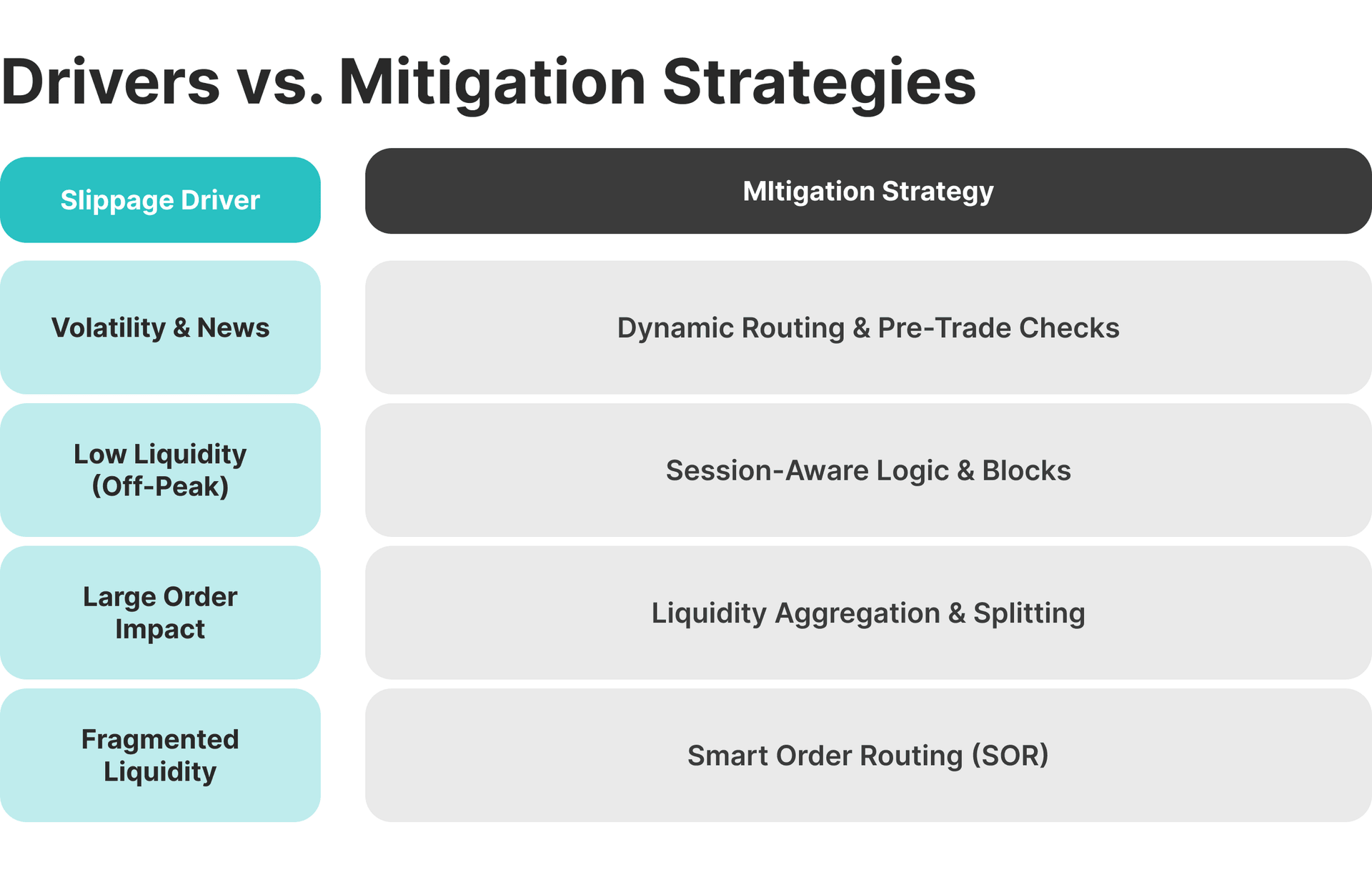
Volatility compresses the time available for execution. During macroeconomic releases and central bank decisions, market openings, or major news events, prices can move through several levels before an order reaches the matching engine. Even in highly liquid markets, routing speed cannot keep pace with rapid repricing.
Professional brokers observe slippage clustering around these predictable calendar events. This historical data informs preemptive adjustments to routing parameters and disclosure requirements.
Order Size and Market Impact
Large orders interact with the order book differently from small trades. When size exceeds available volume at the best available price, execution continues across deeper levels. This “walking the book” effect increases the average fill price as each portion trades at a progressively worse level.
At this scale, broker-side execution logic matters more than trader behavior alone. Fragmenting orders, routing across venues, or pacing execution can reduce impact. Without these controls, large tickets amplify slippage regardless of market conditions.
Liquidity Depth and Time of Day
Liquidity depth fluctuates throughout the trading day. After-hours sessions, weekends, and regional handovers reduce the number of active counterparties. During these windows, order books thin even if quoted spreads remain narrow.
Brokers manage this exposure with session-aware rules. Execution parameters change by instrument and time window, reflecting when depth reliably absorbs flow. Static pricing models often fail during low-participation periods because they ignore how quickly liquidity can disappear.
Liquidity Provider Repricing and Quote Withdrawal
Liquidity providers dynamically reprice or withdraw quotes during periods of heightened uncertainty. This defensive behavior manages risk exposure when market direction becomes unclear. Providers often proactively reduce quote sizes before volatility becomes visible on a price chart.
As providers pull liquidity, available volume at each level shrinks. Market orders hit the next available quote, increasing the likelihood of price gaps. This defensive action is a standard market response affecting all brokerage firms equally.
Positive vs. Negative Slippage and Execution Fairness
Slippage represents a neutral market reality regardless of its common negative reputation. Professional brokers treat price variance as a two-way street, ensuring that clients benefit from favorable price shifts. Fair handling results in specific operational advantages:
- Compliance with global standards, such as MiFID II.
- Improved retention among institutional clients who monitor fill quality.
- Lower volume of client disputes during high-volatility sessions.
Asymmetric slippage handling creates significant legal exposure. Firms that pass negative fills while retaining positive ones invite regulatory scrutiny. Global compliance mandates require symmetric execution to prove that external liquidity dictates the final fill price.
Passing price improvements validates the integrity of agency-style models like Straight-Through Processing (STP) and Electronic Communication Networks (ECNs). In these structures, symmetry provides the necessary evidence that the broker operates as a neutral bridge to the global market, allowing the execution logic to function without interference.
Accurate execution reporting solidifies professional trust. Providing historical data on slippage trends enables clients to adjust their trading strategies based on real market behavior, effectively replacing disputes with collaborative execution management.
Broker Execution Models That Shape Slippage Outcomes
Infrastructure choices dictate execution quality more than any other factor. Structural decisions regarding how a brokerage connects to the market determine slippage behavior long before a client places a trade.
Straight-Through Processing vs. Market Making
Straight-Through Processing (A-Book) model of operation routes orders directly to external counterparties. It reflects true market conditions, meaning the client experiences the actual slippage present in the underlying market. Transparency takes priority here, as the broker does not intervene in the pricing logic.
Conversely, Market Makers (B-Book) execute buy and sell orders internally against their own inventory, which lets a broker offer zero slippage or fixed spreads by absorbing the price slippage. However, stability transfers significant risk to the broker’s balance sheet. Managing exposure in this model requires strict risk limits to prevent toxic flow from eroding capital.
Prime-of-Prime and Aggregated Liquidity
Relying on a single liquidity source creates execution bottlenecks. Prime-of-Prime (PoP) access solves this by aggregating streams from multiple Tier-1 banks and non-bank market makers into a unified pool. Deep liquidity absorbs large tickets without forcing prices to slide.
Aggregation fosters competition at the top of the book. If one provider reprices or withdraws, the engine immediately executes against the next available stream. This protects execution quality during partial outages or liquidity crunches.
ECN Models and Smart Routing
Electronic Communication Networks expose orders to an open marketplace of participants. In this environment, the broker shifts from being a price setter to an execution optimizer through routing, order splitting, and venue selection. Success depends on the quality of the routing logic.
Smart Order Routing (SOR) algorithms scan multiple venues simultaneously. They split large orders across different pools to capture the desired price. SOR minimizes variance by finding liquidity pockets microseconds faster than manual trading ever could.
CTA:
Trading Platform for Any Model of Execution
Aggregate liquidity and manage complex STP or internal matching strategies instantly with B2TRADER’s ultra-fast architecture.
Core Broker Controls for Slippage Management
Market mechanics make zero slippage impossible. Instead of promising perfect execution, robust brokerage infrastructure focuses on containment, establishing hard limits on price variance to keep outcomes within an acceptable risk boundary.
Slippage Tolerance and Order Constraints
Slippage tolerance defines how far execution may move from an expected price before an order cancels or reroutes. Brokers tune these limits by instrument, volatility regime, and trading session. Tighter limits protect prices but raise rejection rates during fast-moving markets, while looser limits improve fill probability but increase order execution costs.
Pre-Trade Risk and Slippage Controls
Modern execution engines calculate expected variance milliseconds before an order hits the market. Algorithms perform a "synthetic sweep" of the current order book depth against the requested size. If the projected Weighted Average Price (VWAP) exceeds defined loss thresholds, the system triggers alerts or blocks the trade entirely.
This proactive logic shifts the dynamic from blaming the broker to managing market reality before the commitment is made. By flagging low-liquidity scenarios instantly, brokers protect clients from entering positions that the current market structure cannot support.
Timing, Session Logic, and Liquidity Windows
Smart Order Routers adjust their logic based on the time of day. Routing engines prioritize different venues during the Asian session compared to the liquid London-New York overlap. For 24/7 assets like crypto, session-aware logic stops orders from hitting empty order books during maintenance windows.
Administrators often implement hard blocks on specific instruments during the daily rollover (typically 5:00 PM EST). Disabling "Market Execution" on illiquid exotics during this window prevents clients from unknowingly trading into spreads that have widened by 500% due to a lack of institutional participants.
How Analytics and Aggregation Reduce Slippage at Scale
As order volumes grow, brokers move from reacting to slippage after execution to managing it before orders reach the market.
Advanced analytics provide the foresight required to maintain consistent pricing. Forecasting execution outcomes transforms slippage from a random penalty into a calculated variable.
Predictive Slippage Models
Algorithms analyze historical execution data alongside real-time volatility metrics to forecast likely price deviations. By monitoring Order Book Imbalance (OBI) and volatility spikes, the system estimates "expected slippage" before routing. These metrics dynamically adjust tolerance thresholds for specific client tiers.
Execution Speed and Real-Time Feeds
Latency reduction serves as a direct risk-control mechanism for brokers. Reducing the routing round-trip time (RTT) from 100ms to sub-millisecond speeds drastically shrinks the window for adverse price discovery. Stale quotes frequently cause rejections in financial markets, creating artificial slippage.
Faster processing creates tighter price continuity. Consequently, high-speed infrastructure lowers the statistical variance of fill prices, directly stabilizing execution quality for end clients.
Slippage Across Crypto, Forex, and Multi-Asset Environments
Execution logic cannot remain static across different instrument types. A single policy for both Bitcoin and EUR/USD invites operational risk because their liquidity structures differ fundamentally.
Crypto Market Slippage
Cryptocurrency trading occurs continuously across a highly fragmented landscape of exchanges. This dispersion means liquidity for the same token varies wildly between venues. Solutions like B2CONNECT address this by unifying order books from the biggest exchanges into a single executable stream. Consolidating depth safeguards execution quality during low-volume weekend sessions when retail flow dominates and institutional makers withdraw.
Forex Liquidity and Pair Concentration
In forex trading, major currency pairs like EUR/USD typically benefit from deep institutional support, resulting in minimal variance during standard hours. Exotic pairs function on significantly thinner order books. Consequently, brokers apply stricter slippage tolerances to these volatile groups. This differentiation protects the house from absorbing toxic flow during the transitional windows between major market sessions.
Multi-Asset Execution Challenges
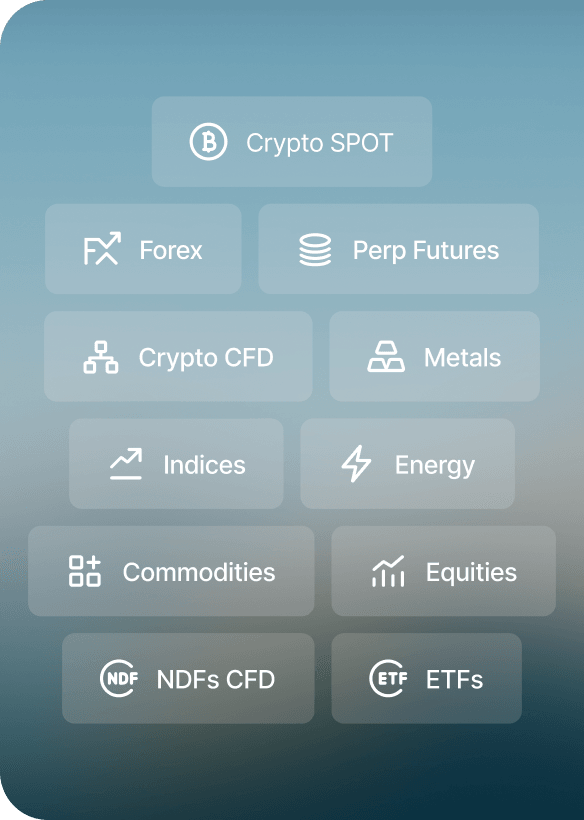
Managing equities, commodities, ETFs, CFD instruments and crypto simultaneously requires normalizing execution logic across vastly different settlement speeds. Executing equities during the New York open requires different latency parameters than trading perpetual swaps on a Saturday. Effective governance involves establishing specific routing rules for each asset class while maintaining a unified risk management framework for the entire brokerage.
Deep, Reliable Liquidity Across 10 Major Asset Classes
FX, Crypto, Commodities, Indices & More from One Single Margin Account
Tight Spreads and Ultra-Low Latency Execution
Seamless API Integration with Your Trading Platform
Building a Brokerage That Manages Slippage Well
Disciplined slippage management directly correlates with reduced client disputes and higher retention rates. Instead of making unrealistic promises about zero variance, successful brokerages focus on delivering fair, transparent execution outcomes.
Delivering this reliability requires a robust infrastructure capable of handling liquidity fragmentation. Since 2014, B2BROKER has empowered brokerages through Tier-1 PoP liquidity, advanced execution tooling supporting A-, B- and hybrid C-Book models, and analytics that help businesses manage slippage consistently across assets and market conditions.
We support over 1,000 corporate clients with a regulatory framework spanning 10 global licenses. Partnering with B2BROKER equips your firm with the tools to transform execution from a liability into a competitive advantage.
Master Execution With Complete Infrastructure
Combine Tier-1 liquidity aggregation with ultra-fast connectivity to deliver the fair, consistent pricing your clients demand.
Frequently Asked Questions about How Brokers Manage Slippage
- How do brokers manage slippage outside normal trading hours?
Brokers mitigate off-hour risks by dynamically widening spreads, tightening position limits, or restricting specific order types (limit orders, stop-loss orders) when liquidity thins. Session-aware logic automatically reroutes flow to venues that remain active during these low-volume windows.
- Are brokers required to disclose slippage data to clients?
Regulations like MiFID II and FINRA mandate that brokers track execution quality to prove compliance with "Best Execution" standards. Many firms voluntarily publish these statistics to demonstrate transparency and build client confidence.
- Can brokers eliminate slippage entirely?
No, price changes and latency are unavoidable structural elements of electronic trading. Instead of elimination, brokers focus on reducing variance through low-latency infrastructure and deep liquidity pools.
- What role does liquidity aggregation play in reducing slippage?
Aggregation pools liquidity from multiple sources to create a deeper order book at every price level. This depth absorbs large trade volumes without forcing prices to move, significantly reducing impact costs.
- How do brokers ensure slippage is handled fairly for clients?
Firms ensure integrity by enforcing symmetric execution, meaning clients receive positive price improvements just as they incur negative ones. This consistent policy proves that fill prices reflect neutral market conditions rather than dealer intervention.
Recommended articles